
MI / Genetics of Disease · September 23, 2026 · 80 minutes
Wet ELISA data table record
Route P: paper route. This is the same six-task record, filled from the supplied Strip 1.
One record with six tasks, T1 to T6: two control predictions, a six-well data table, the step order with one wash sentence, a control check, a flagged-strip check and one limit sentence
You read supplied illustrative records. Nothing in your record claims you ran a kit, observed a plate or measured anything. The color words are supplied observations. No sample well is called positive or negative today.
Today's six wells carry no concentration label and no unit. A clean control pair lets you read the other wells. It does not make any sample well positive or negative, and it does not guarantee that every well behaved. Calling a sample well positive or negative needs the test's decision rule, the stated cutoff for what counts, and that rule is not supplied today. A classroom kit is also not a test of a person: in a clinic a screening ELISA is not a diagnosis by itself, and a confirmatory test follows it.
Hand the paper record to Mr. Mendoza before leaving, or submit one PDF. Do not submit twice.
This page has three parts, in the order you use them. Part 1 is what you need to know: the reference and the reading. Part 2 says what to do, in plain English. Part 3 is your own record and its six tasks. Everything you write goes in one record.
Part 1 of 3 · Background and definitions
Required reference
Workflow for the six-well record. This is a teaching diagram, not a kit procedure, a reagent list or a picture of a plate. On Route W your kit's printed procedure supplies the actual steps and times; on Route P the supplied step order in R3 is what you record.
BUILD THE CHAIN, ONE LAYER AT A TIME
Step 1  antigen or sample goes into the well
        wash: unbound material leaves
Step 2  primary antibody binds antigen, if antigen is there
        wash
Step 3  enzyme-linked antibody binds the layer below it
        wash
Step 4  substrate: color is meant to appear where the chain is complete, unless the run has an error
        (stop step only if the kit prints one)
                       |
                       v
READ EACH WELL ON ITS OWN
Nearly clear / Light / Medium / Dark
then compare with NC: more color / about the same / less
                       |
                       v
CHECK THE TWO CONTROLS FIRST
PC developed color?      NC stayed nearly clear?
Both yes: read the sample wells.
NC colored: the strip is flagged; repeat or review, do not subtract.
                       |
                       v
STATE THE LIMIT
More color than NC is a comparison you wrote down.
Positive or negative needs a decision rule, which is not supplied.
A classroom kit is not a test of a person.
Full text equivalent
The chain is built one layer at a time, and between layers the wells are washed so that anything that did not bind is carried away. Antigen or sample attaches to the well. Primary antibody binds antigen if it is there. Enzyme-linked antibody binds the antibody layer below it. Substrate is added last, and the enzyme is meant to make color where the full chain is present, unless the run has an error; some kits print a stop step after that. Read every well on its own, using the four color words, then compare each well with the negative control. Before reading any sample well, check the two controls: the positive control should have developed color and the negative control should have stayed nearly clear. If both did, the sample wells can be read. If the negative control developed color, the strip is flagged, and the group repeats the run or asks for review rather than subtracting the color. Whatever the colors show, the record stops at a comparison. A positive or negative call for a sample well needs the test's decision rule, which this record does not supply, and a classroom kit does not test a person.
Optional restart cue
Find the next unfinished task ID. T1 uses R2 and R4. T2 uses your own wells on Route W or Strip 1 on Route P, with R5. T3 uses the kit's printed order on Route W or R3's order on Route P. T4 uses your PC and NC rows with R4. T5 uses Strip 2 with R4. T6 uses R5. Stay in the same record; do not start a second product.
The complete reading, which the tasks quote
Open the sections in order for the chain, the wash rule, the two controls and where reading stops.
Genetics of Disease / Medical Interventions | Wednesday, September 23, 2026 | Required briefing
R1. Your one record
Complete one Wet ELISA data table record with six tasks, T1 to T6: your two control predictions, a six-well data table, the step order with one wash sentence, a control check, a check of a flagged strip, and one limit sentence. Keep the six tasks together; they are one submission, on paper or as one PDF.
Your route line tells you where your well colors come from. On Route W you run a classroom kit with your group and read your own wells. On Route P you read a supplied illustrative record called Strip 1. The six tasks, the table and the limit are the same on both routes. Nothing on Route P claims you ran a kit, and nothing on either route calls a sample well positive or negative.
The September 17 paper dilution plan and the September 18 four labeled model wells were separate records. Today's six wells carry no concentration label and no unit. You will record color words, compare each well with the negative control, and check the two controls. Tuesday's debate weighed the harm of false results. Today you see what a run has to show before anyone can trust a color at all.
R2. The binding chain
An antigen is a substance an antibody can bind. An antibody has a binding site that contacts a particular part of the antigen. Binding is selective, but an antibody can sometimes bind another target; that is cross-reaction, and it is one reason a specific test is still not an error-free test. Janeway, Immunologists' Toolbox, introductory Immunization paragraphs and A-8.
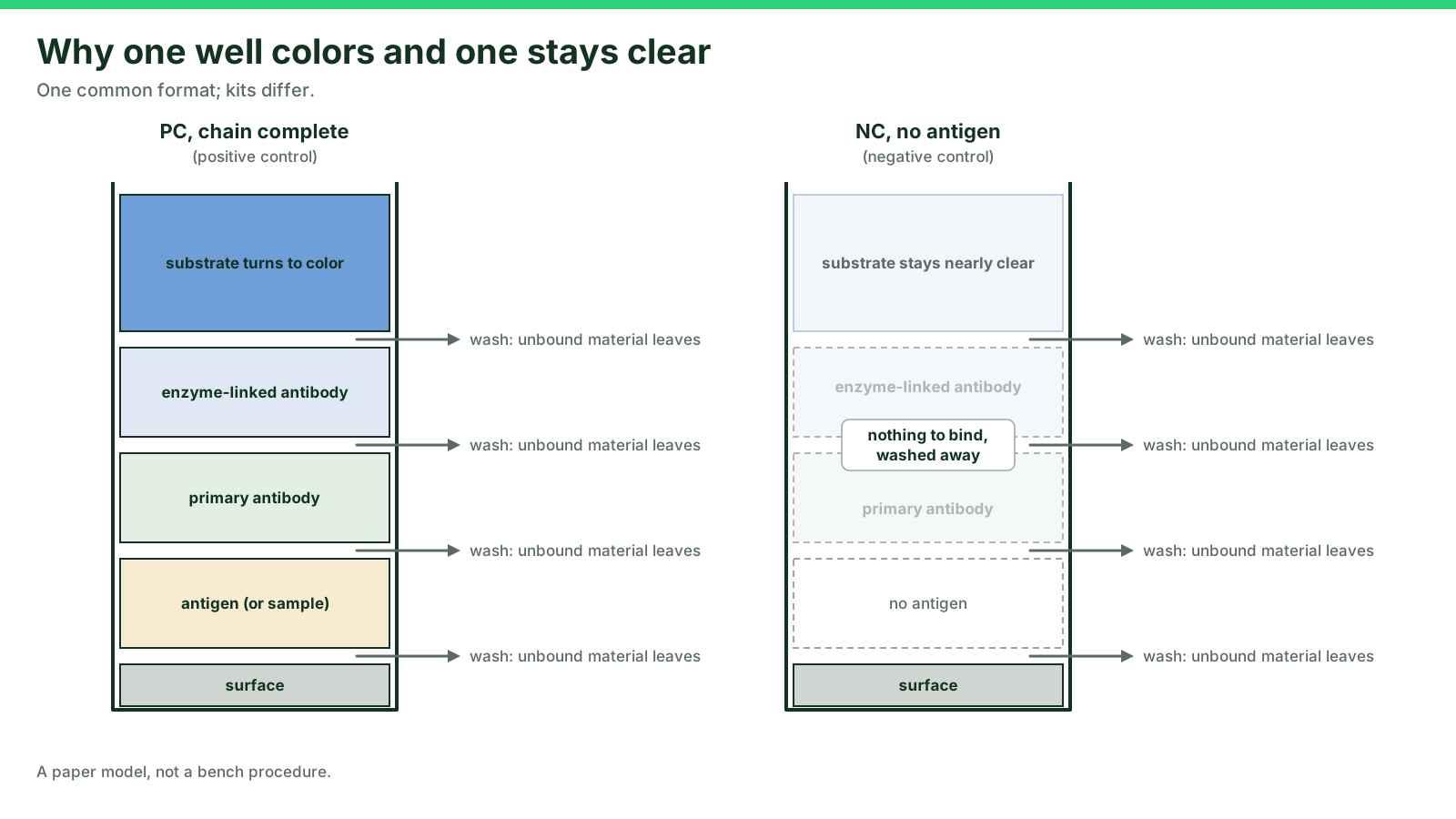
In a color-based ELISA the layers stack in a set order. Antigen, or a sample that may hold it, goes into the well and attaches to the surface. A primary antibody is added and binds antigen if antigen is there. An enzyme-linked antibody is added and binds the antibody layer below it. Last, a substrate is added; the enzyme turns it into a colored product, so color appears where the whole chain is present. Color is the signal, the detectable response of the test. ELISA background, Specimen Requirements and Procedure; Assay Guidance Manual, Sandwich Immunoassay (ELISA).
Kits differ. Some attach an antibody to the well first and add the sample second; some name the steps differently. On Route W, your kit's printed procedure is the order you follow and record. On Route P, the supplied step order in R3 is the one you record.
R3. Order and washing
Each reagent can only bind the layer added before it. Add a reagent out of order and it has nothing to hold onto; it washes away, or it stays behind as loose material that has nothing to do with binding. Either way the final color stops meaning what it should.
Between the main steps the wells are washed: liquid is added and emptied to carry away everything that did not bind. That is what makes the color specific. Skip a wash, or shorten it, and enzyme-linked antibody that never bound anything can stay in the well and make color where there is no antigen. ELISA background, Specimen Requirements and Procedure (between each of the four primary steps, a wash step removes unbound material); Assay Guidance Manual, Basic Steps for Developing and Running an Immunoassay.
The classroom model order, used for T3 on Route P and for comparison on Route W:
| Step | What is added | What it binds | Then |
|---|---|---|---|
| 1 | Antigen or sample | The well surface | Wash |
| 2 | Primary antibody | Antigen, if present | Wash |
| 3 | Enzyme-linked antibody | The antibody layer below | Wash |
| 4 | Substrate | The enzyme turns it into color | Read; stop step only if your kit prints one |
Incubation means the waiting time that lets a layer bind before the next step. On Route W, use the times printed in your kit's procedure and record when each one started. This reading does not give you a time; the kit does.
R4. Two controls decide whether to read the rest
A control is a well with an expected result, run the same way as every other well. The positive control holds material that should complete the chain, so it should develop color. The negative control holds no antigen, so it should stay nearly clear. Both are recommended for tests that give a yes-or-no style result, and both are treated exactly like the samples. ELISA background, Quality Control and Lab Safety; Assay Guidance Manual, Control Samples.
Read the two controls before you read anything else. If the positive control developed color and the negative control stayed nearly clear, the run passed its own check and you can read the sample wells. If the negative control developed color, the run made color without antigen; contamination, a skipped wash, a reused tip or a timing slip can all do that. The sample wells on that strip cannot be read, because the same problem could be adding color everywhere. The run is flagged, and a careful group repeats it or asks the teacher to review it. Do not subtract the negative control's color and keep going. If the positive control stayed nearly clear, the other half of the check failed: the chain never completed. A missing or expired reagent, a skipped layer, a wash that took the wrong thing away or too little incubation time will all do it. A clear sample well on that strip means nothing, because the run could not have made color anywhere. Flag it the same way and repeat or ask for review.
A clean control pair lets you read the other wells. It does not make any sample well positive or negative, and it does not guarantee that every well behaved.
R5. Read color, then stop
Use four words for every well: Nearly clear, Light, Medium, Dark. They are an observation scale, in order, not amounts. Write the hue (for example, blue) once on the hue line above your table, because kits differ. Read each well on its own against a white background, then write whether it shows more color than the negative control, about the same, or less. Light is still more color than Nearly clear.
Today's wells have no concentration label. The darker-means-more relationship you used on September 18 was that model's stated relationship, not a rule for every format, and some formats run the other way. Assay Guidance Manual, Sandwich Immunoassay and Competitive Binding Assay. You are not estimating an amount, and there is no curve to read one from.
"More color than the negative control" is a comparison you wrote down. It is not a positive result. Calling a sample well positive or negative needs the test's decision rule, the stated cutoff for what counts, and that rule is not supplied today. A classroom kit is also not a test of a person: in a clinic a screening ELISA is not a diagnosis by itself, and a confirmatory test follows it. ELISA background, Clinical Significance. Your T6 sentence names one thing the record cannot establish. Naming it is enough; do not invent the missing rule.
R6. Your route
Only your route's section is on your page. If you were absent, or the class ran Route W and you did not, use R6-P.
R6-P. Route P: reading a supplied record
Strip 1 is a supplied illustrative record: six wells, a hue, and a color word for each well. It is what a careful group might have written down; it is not a plate you looked at and not a measurement. You copy its colors into T2, compare each with NC, list the supplied step order in T3, and check its controls in T4 exactly as a bench student would. Strip 2, the flagged strip in T5, is supplied to everyone on both routes.
Nothing on this route claims you ran a kit, opened a reagent, or observed a plate. Write "Supplied Strip 1" on your record's route line. If a well word seems odd, record it as supplied and use your T6 limit; do not change a supplied word.
PLTW connection and optional help
This local record practices the run order, the wash rule and the control check that PLTW Medical Interventions Activity 1.1.5, ELISA, builds on. Route W runs a classroom kit; Route P reads a supplied record. Neither route certifies completion of the official activity, and the required explanation is here, so a sign-in issue does not stop you. Activity 1.1.5, ELISA is the official reference; use myPLTW for authorized access.
F1 shows the workflow. The separate Strip M in the worked model shows filled rows and a control check on wells that are not yours. Guided notes and a partner check are optional and are not another submission.
Check and submit once
Check T1 to T6: two control predictions with a reason, six table rows with the hue line, the step order with the wash sentence, the control check, the Strip 2 sentences, and one limit. Submit one record on paper before you leave, or one PDF to Wk5 Data table: Wet ELISA lab by the due time on the assignment. Do not submit twice. Keep notebook pages in your notebook.
All required materials are on today's portal lesson. Absent? Use R6-P and Strip 1, and complete the same six tasks.
All vocabulary definitions
- Antigen
- An antigen is a substance an antibody can bind.
- Antibody
- An antibody has a binding site that contacts a particular part of the antigen.
- Cross-reaction
- Binding is selective, but an antibody can sometimes bind another target; that is cross-reaction, and it is one reason a specific test is still not an error-free test.
- Signal
- Color is the signal, the detectable response of the test.
- Wash
- Between the main steps the wells are washed: liquid is added and emptied to carry away everything that did not bind.
- Control
- A control is a well with an expected result, run the same way as every other well.
- Positive control
- The positive control holds material that should complete the chain, so it should develop color.
- Negative control
- The negative control holds no antigen, so it should stay nearly clear.
- Incubation
- Incubation means the waiting time that lets a layer bind before the next step.
- Decision rule
- Calling a sample well positive or negative needs the test's decision rule, the stated cutoff for what counts, and that rule is not supplied today.
Part 2 of 3 · Directions in plain English
What you will do today, in order
Complete one Wet ELISA data table record, tasks T1 to T6. Your route line says where your colors come from: Route W, your group's own wells from a classroom kit, or Route P, the supplied Strip 1. The six tasks are the same on both routes. No sample well is called positive or negative today, and nothing on Route P claims you ran a kit.
- Set up the record. Add your period and code and your route line. Before any color is read, write T1: what the positive control and the negative control should look like at the end, and why a run needs both.
- Build or read the chain. Route P: read R2 and R3 and the Strip 1 layout. You are reading a record, not running a kit.
- Fill the table and the order. T2 gets one row per well, the color word and the comparison with NC, with the hue on the line above. T3 lists the main steps in order and adds one wash sentence. Route P: copy Strip 1's supplied colors, one well at a time.
- Check the controls, then the flagged strip, then the limit. T4 uses your PC and NC rows. T5 uses Strip 2, supplied to everyone. T6 names one thing the record cannot establish.
- Submit once. Hand the paper record to Mr. Mendoza before leaving, or submit one PDF to Wk5 Data table: Wet ELISA lab by the due time on the assignment.
Show the 80-minute plan
- 0 to 10 minutes: Teacher launch. Hear the product and the route. Find Strip 1 in your record and label it a supplied illustrative record. Begin T1 from R2 and R4.
- 10 to 25 minutes: Set up. Read R2, R3 and the supplied step order. Finish T1. Start T3's step list from R3's order.
- 25 to 50 minutes: Build the chain. Fill T2 from Strip 1: each well's color as supplied and its comparison with NC. Finish T3's wash sentence.
- 50 to 65 minutes: Read and record. Reread Strip 1's PC and NC rows and complete T4. Complete T5 from Strip 2.
- 65 to 75 minutes: Check and limit. Complete T6. Reread all six tasks against the check list.
- 75 to 80 minutes: Clean up and submit. Hand in paper or submit one PDF, once.
Materials. The six-task record, on paper or in a document; Period and code; R1 to R5 reading and F1; Strip 2, printed in the record for T5; Separate Strip M worked model, optional; Strip 1, printed in the record; R6-P.
Route W runs only after the kit and reagents are confirmed in the room and any existing pre-lab requirement for this activity is met. Route P needs no preparation and does not certify bench work.
Slides, worked model and optional notes
Guided notes and a partner check are optional and are not another submission.
This worked model uses a four-well practice strip, Strip M. It is not Strip 1, not Strip 2 and not your group's wells. Use its structure, not its words, in your record. It is not another submission.
Part 3 of 3 · Your work
3.1 Required record
Route line: Route P: supplied Strip 1
- Record source: Supplied Strip 1 (illustrative)
- Hue supplied: blue
One line above the table: the color's hue, written once (Route W as observed; Route P supplied as blue). Color words, in order: Nearly clear, Light, Medium, Dark. Compare each well with the negative control: More color than NC, About the same as NC, Less color than NC.
No sample well is called positive or negative today, and nothing on Route P claims you ran a kit.
Supplied Strip 1 (illustrative). Hue: blue. Supplied illustrative observation words, not measurements; no concentration, no decision rule, no positive or negative call for any sample well; nothing claims a student ran a kit
| Well | Contents as labeled | Color (supplied) |
|---|---|---|
| PC | Positive control | Dark |
| NC | Negative control | Nearly clear |
| S1 | Sample 1 | Dark |
| S2 | Sample 2 | Nearly clear |
| S3 | Sample 3 | Light |
| S4 | Sample 4 | Medium |
Read the whole printable record here
Genetics of Disease / Medical Interventions | Wednesday, September 23, 2026 | Route P: paper route
Route P: paper route. You read supplied illustrative records. Nothing in your record claims you ran a kit, observed a plate or measured anything. The color words are supplied observations. No sample well is called positive or negative today.
Today's six wells carry no concentration label and no unit. A clean control pair lets you read the other wells. It does not make any sample well positive or negative, and it does not guarantee that every well behaved. Calling a sample well positive or negative needs the test's decision rule, the stated cutoff for what counts, and that rule is not supplied today. A classroom kit is also not a test of a person: in a clinic a screening ELISA is not a diagnosis by itself, and a confirmatory test follows it.
Cover block
- Period and code, not your name: ____________________
- Date: ____________________
- Tasks included: [ ] T1 [ ] T2 [ ] T3 [ ] T4 [ ] T5 [ ] T6
- Route: [ ] paper handed to Mr. Mendoza [ ] one PDF to Wk5 Data table: Wet ELISA lab
Required briefing, the same text as the reading above
R1. Your one record
Complete one Wet ELISA data table record with six tasks, T1 to T6: your two control predictions, a six-well data table, the step order with one wash sentence, a control check, a check of a flagged strip, and one limit sentence. Keep the six tasks together; they are one submission, on paper or as one PDF.
Your route line tells you where your well colors come from. On Route W you run a classroom kit with your group and read your own wells. On Route P you read a supplied illustrative record called Strip 1. The six tasks, the table and the limit are the same on both routes. Nothing on Route P claims you ran a kit, and nothing on either route calls a sample well positive or negative.
The September 17 paper dilution plan and the September 18 four labeled model wells were separate records. Today's six wells carry no concentration label and no unit. You will record color words, compare each well with the negative control, and check the two controls. Tuesday's debate weighed the harm of false results. Today you see what a run has to show before anyone can trust a color at all.
R2. The binding chain
An antigen is a substance an antibody can bind. An antibody has a binding site that contacts a particular part of the antigen. Binding is selective, but an antibody can sometimes bind another target; that is cross-reaction, and it is one reason a specific test is still not an error-free test. Janeway, Immunologists' Toolbox, introductory Immunization paragraphs and A-8.
In a color-based ELISA the layers stack in a set order. Antigen, or a sample that may hold it, goes into the well and attaches to the surface. A primary antibody is added and binds antigen if antigen is there. An enzyme-linked antibody is added and binds the antibody layer below it. Last, a substrate is added; the enzyme turns it into a colored product, so color appears where the whole chain is present. Color is the signal, the detectable response of the test. ELISA background, Specimen Requirements and Procedure; Assay Guidance Manual, Sandwich Immunoassay (ELISA).
Kits differ. Some attach an antibody to the well first and add the sample second; some name the steps differently. On Route W, your kit's printed procedure is the order you follow and record. On Route P, the supplied step order in R3 is the one you record.
R3. Order and washing
Each reagent can only bind the layer added before it. Add a reagent out of order and it has nothing to hold onto; it washes away, or it stays behind as loose material that has nothing to do with binding. Either way the final color stops meaning what it should.
Between the main steps the wells are washed: liquid is added and emptied to carry away everything that did not bind. That is what makes the color specific. Skip a wash, or shorten it, and enzyme-linked antibody that never bound anything can stay in the well and make color where there is no antigen. ELISA background, Specimen Requirements and Procedure (between each of the four primary steps, a wash step removes unbound material); Assay Guidance Manual, Basic Steps for Developing and Running an Immunoassay.
The classroom model order, used for T3 on Route P and for comparison on Route W:
| Step | What is added | What it binds | Then |
|---|---|---|---|
| 1 | Antigen or sample | The well surface | Wash |
| 2 | Primary antibody | Antigen, if present | Wash |
| 3 | Enzyme-linked antibody | The antibody layer below | Wash |
| 4 | Substrate | The enzyme turns it into color | Read; stop step only if your kit prints one |
Incubation means the waiting time that lets a layer bind before the next step. On Route W, use the times printed in your kit's procedure and record when each one started. This reading does not give you a time; the kit does.
R4. Two controls decide whether to read the rest
A control is a well with an expected result, run the same way as every other well. The positive control holds material that should complete the chain, so it should develop color. The negative control holds no antigen, so it should stay nearly clear. Both are recommended for tests that give a yes-or-no style result, and both are treated exactly like the samples. ELISA background, Quality Control and Lab Safety; Assay Guidance Manual, Control Samples.
Read the two controls before you read anything else. If the positive control developed color and the negative control stayed nearly clear, the run passed its own check and you can read the sample wells. If the negative control developed color, the run made color without antigen; contamination, a skipped wash, a reused tip or a timing slip can all do that. The sample wells on that strip cannot be read, because the same problem could be adding color everywhere. The run is flagged, and a careful group repeats it or asks the teacher to review it. Do not subtract the negative control's color and keep going. If the positive control stayed nearly clear, the other half of the check failed: the chain never completed. A missing or expired reagent, a skipped layer, a wash that took the wrong thing away or too little incubation time will all do it. A clear sample well on that strip means nothing, because the run could not have made color anywhere. Flag it the same way and repeat or ask for review.
A clean control pair lets you read the other wells. It does not make any sample well positive or negative, and it does not guarantee that every well behaved.
R5. Read color, then stop
Use four words for every well: Nearly clear, Light, Medium, Dark. They are an observation scale, in order, not amounts. Write the hue (for example, blue) once on the hue line above your table, because kits differ. Read each well on its own against a white background, then write whether it shows more color than the negative control, about the same, or less. Light is still more color than Nearly clear.
Today's wells have no concentration label. The darker-means-more relationship you used on September 18 was that model's stated relationship, not a rule for every format, and some formats run the other way. Assay Guidance Manual, Sandwich Immunoassay and Competitive Binding Assay. You are not estimating an amount, and there is no curve to read one from.
"More color than the negative control" is a comparison you wrote down. It is not a positive result. Calling a sample well positive or negative needs the test's decision rule, the stated cutoff for what counts, and that rule is not supplied today. A classroom kit is also not a test of a person: in a clinic a screening ELISA is not a diagnosis by itself, and a confirmatory test follows it. ELISA background, Clinical Significance. Your T6 sentence names one thing the record cannot establish. Naming it is enough; do not invent the missing rule.
R6. Your route
Only your route's section is on your page. If you were absent, or the class ran Route W and you did not, use R6-P.
#### R6-P. Route P: reading a supplied record
Strip 1 is a supplied illustrative record: six wells, a hue, and a color word for each well. It is what a careful group might have written down; it is not a plate you looked at and not a measurement. You copy its colors into T2, compare each with NC, list the supplied step order in T3, and check its controls in T4 exactly as a bench student would. Strip 2, the flagged strip in T5, is supplied to everyone on both routes.
Nothing on this route claims you ran a kit, opened a reagent, or observed a plate. Write "Supplied Strip 1" on your record's route line. If a well word seems odd, record it as supplied and use your T6 limit; do not change a supplied word.
F1. Build, wash, read, check
Workflow for the six-well record. This is a teaching diagram, not a kit procedure, a reagent list or a picture of a plate. On Route W your kit's printed procedure supplies the actual steps and times; on Route P the supplied step order in R3 is what you record.
BUILD THE CHAIN, ONE LAYER AT A TIME
Step 1  antigen or sample goes into the well
        wash: unbound material leaves
Step 2  primary antibody binds antigen, if antigen is there
        wash
Step 3  enzyme-linked antibody binds the layer below it
        wash
Step 4  substrate: color is meant to appear where the chain is complete, unless the run has an error
        (stop step only if the kit prints one)
                       |
                       v
READ EACH WELL ON ITS OWN
Nearly clear / Light / Medium / Dark
then compare with NC: more color / about the same / less
                       |
                       v
CHECK THE TWO CONTROLS FIRST
PC developed color?      NC stayed nearly clear?
Both yes: read the sample wells.
NC colored: the strip is flagged; repeat or review, do not subtract.
                       |
                       v
STATE THE LIMIT
More color than NC is a comparison you wrote down.
Positive or negative needs a decision rule, which is not supplied.
A classroom kit is not a test of a person.
Full text equivalent. The chain is built one layer at a time, and between layers the wells are washed so that anything that did not bind is carried away. Antigen or sample attaches to the well. Primary antibody binds antigen if it is there. Enzyme-linked antibody binds the antibody layer below it. Substrate is added last, and the enzyme is meant to make color where the full chain is present, unless the run has an error; some kits print a stop step after that. Read every well on its own, using the four color words, then compare each well with the negative control. Before reading any sample well, check the two controls: the positive control should have developed color and the negative control should have stayed nearly clear. If both did, the sample wells can be read. If the negative control developed color, the strip is flagged, and the group repeats the run or asks for review rather than subtracting the color. Whatever the colors show, the record stops at a comparison. A positive or negative call for a sample well needs the test's decision rule, which this record does not supply, and a classroom kit does not test a person.
T1 to T6, one record
T1. Predict the two controls. Before any color is read, write what the positive control well should look like at the end of the run and what the negative control well should look like. Then write one sentence saying why a run needs both.
*Space: 3 writing lines. Help: Expected is not observed. Do not fill this from the data table.*
Positive control expected:
________________________________________________________________________________
Negative control expected:
________________________________________________________________________________
Why a run needs both:
________________________________________________________________________________
T2. Six-well data table
Fill one row for each of the six wells: the color you record using the four color words, and whether the well shows more color than the negative control, about the same, or less. Write the hue once on the hue line. Do not assign a concentration or a positive or negative call to any well.
*Space: Six printed rows with blank Color and Compared-with-NC cells at least 3 cm wide and an optional Note column; one route line and one hue line above the table, and on Route W two more lines above the table for the kit name and the incubation start times. Help: Read each well on its own before comparing. Light is still more color than Nearly clear. The four words are an observation scale, not amounts.*
- Route line: Route P: supplied Strip 1
- Record source: Supplied Strip 1 (illustrative)
- Hue supplied: blue
Blank fields on every row.
- Hue line: ____________________
- Color (Nearly clear / Light / Medium / Dark): one per row, left blank for you
- Compared with NC (More color / About the same / Less color): one per row, left blank for you
- Note (optional): one per row, left blank for you
Supplied Strip 1 (illustrative). Hue: blue. Supplied illustrative observation words, not measurements; no concentration, no decision rule, no positive or negative call for any sample well; nothing claims a student ran a kit
Copy these supplied colors into your T2 rows; the Compared-with-NC column is yours to fill.
| Well | Contents as labeled | Color (supplied) |
|---|---|---|
| PC | Positive control | Dark |
| NC | Negative control | Nearly clear |
| S1 | Sample 1 | Dark |
| S2 | Sample 2 | Nearly clear |
| S3 | Sample 3 | Light |
| S4 | Sample 4 | Medium |
| Well ID | Contents as labeled | Color | Compared with NC | Note |
|---|---|---|---|---|
| PC | Positive control | |||
| NC | Negative control | |||
| S1 | Sample 1 | |||
| S2 | Sample 2 | |||
| S3 | Sample 3 | |||
| S4 | Sample 4 |
T3. Order and wash. List the main steps of the run in the order they happened, with a wash between each (four in the model; use your kit's count if it prints more). Then write one sentence: what does the wash remove, and what would a skipped wash do to the color?
*Space: 4 short lines plus 2 writing lines. Help: Your kit may name a step differently. Keep the order it printed. The wash sentence is about what the color would mean, not about being neat.*
*Template: The wash removes ______, so a skipped wash would ______.*
Steps in order:
________________________________________________________________________________
Wash sentence:
________________________________________________________________________________
T4. Control check. Answer two questions from your table: Did the positive control develop color? Did the negative control stay nearly clear? Then write one sentence saying whether the other four wells can be read from this run, and why.
*Space: 2 short lines plus 2 writing lines. Help: A clean pair lets you read the other wells. It does not make them positive or negative.*
*Template: The positive control ______ and the negative control ______, so the other wells ______ because ______.*
PC developed color: yes or no:
________________________________________________________________________________
NC stayed nearly clear: yes or no:
________________________________________________________________________________
Can the sample wells be read, and why:
________________________________________________________________________________
Supplied Strip 2 (for T5), printed for both routes
Supplied Strip 2 (illustrative, flagged). Hue: blue. Supplied illustrative observation words; the negative control developed color, so the strip is flagged; no positive or negative call for any sample well
| Well | Contents as labeled | Color (supplied) |
|---|---|---|
| PC | Positive control | Dark |
| NC | Negative control | Medium |
| S1 | Sample 1 | Dark |
| S2 | Sample 2 | Medium |
| S3 | Sample 3 | Light |
| S4 | Sample 4 | Medium |
T5. Flagged strip, Strip 2. Strip 2 is a supplied illustrative record for every student. Its negative control is Medium. In two sentences, say what that means for reading the sample wells S1 to S4 on that strip, and what should happen next with the run.
*Space: 4 writing lines. Help: Do not subtract the negative control's color and keep going. Say what the run shows and what a careful group does with it.*
*Template: Because Strip 2's negative control is Medium, ______. Next, ______.*
What the Medium negative control means for the sample wells:
________________________________________________________________________________
________________________________________________________________________________
What happens next:
________________________________________________________________________________
________________________________________________________________________________
T6. One limit. Write one sentence naming something this record cannot establish about a sample well, or one kind of information that would be needed to establish it. Do not invent that information.
*Space: 2 writing lines. Help: More color than the negative control is a comparison you wrote down. A positive or negative call needs the test's decision rule, and a classroom kit is not a test of a person.*
*Template: This record cannot establish ______ because it does not supply ______.*
Limit sentence:
________________________________________________________________________________
Before you submit
- [ ] I predict what both controls should show before I read any color.
- [ ] I record each of six wells with the four color words and compare each with the negative control.
- [ ] I list the steps in the order they ran and explain what the wash removes.
- [ ] I read the two controls first and say whether the other wells can be read.
- [ ] I explain what a colored negative control does to a strip.
- [ ] I name one thing my record cannot establish, without inventing the missing rule.
Submit once
Hand the paper record to Mr. Mendoza before leaving, or submit one PDF to Wk5 Data table: Wet ELISA lab by the due time on the assignment. Use your period and code. Do not submit twice.
3.2 The six tasks in one record
- T1. Predict the two controls. Before any color is read, write what the positive control well should look like at the end of the run and what the negative control well should look like. Then write one sentence saying why a run needs both. Expected is not observed. Do not fill this from the data table.
Space: 3 writing lines. Where it comes from: R2 and R4. - T2. Six-well data table. Fill one row for each of the six wells: the color you record using the four color words, and whether the well shows more color than the negative control, about the same, or less. Write the hue once on the hue line. Do not assign a concentration or a positive or negative call to any well. Read each well on its own before comparing. Light is still more color than Nearly clear. The four words are an observation scale, not amounts.
Space: Six printed rows with blank Color and Compared-with-NC cells at least 3 cm wide and an optional Note column; one route line and one hue line above the table, and on Route W two more lines above the table for the kit name and the incubation start times. Where it comes from: Strip 1, the supplied illustrative record printed in the table area; you are copying supplied observations, not observing a plate. - T3. Order and wash. List the main steps of the run in the order they happened, with a wash between each (four in the model; use your kit's count if it prints more). Then write one sentence: what does the wash remove, and what would a skipped wash do to the color? Your kit may name a step differently. Keep the order it printed. The wash sentence is about what the color would mean, not about being neat.
Space: 4 short lines plus 2 writing lines. Where it comes from: R3's supplied classroom model order.
Template: The wash removes ______, so a skipped wash would ______. - T4. Control check. Answer two questions from your table: Did the positive control develop color? Did the negative control stay nearly clear? Then write one sentence saying whether the other four wells can be read from this run, and why. A clean pair lets you read the other wells. It does not make them positive or negative.
Space: 2 short lines plus 2 writing lines. Where it comes from: Strip 1's PC and NC rows as you copied them into T2.
Template: The positive control ______ and the negative control ______, so the other wells ______ because ______. - T5. Flagged strip, Strip 2. Strip 2 is a supplied illustrative record for every student. Its negative control is Medium. In two sentences, say what that means for reading the sample wells S1 to S4 on that strip, and what should happen next with the run. Do not subtract the negative control's color and keep going. Say what the run shows and what a careful group does with it.
Space: 4 writing lines. Where it comes from: Strip 2, supplied to everyone.
Template: Because Strip 2's negative control is Medium, ______. Next, ______. - T6. One limit. Write one sentence naming something this record cannot establish about a sample well, or one kind of information that would be needed to establish it. Do not invent that information. More color than the negative control is a comparison you wrote down. A positive or negative call needs the test's decision rule, and a classroom kit is not a test of a person.
Space: 2 writing lines. Where it comes from: Your own record and R5.
Template: This record cannot establish ______ because it does not supply ______.
Supplied Strip 2, for T5
Supplied Strip 2 (illustrative, flagged). Hue: blue. Supplied illustrative observation words; the negative control developed color, so the strip is flagged; no positive or negative call for any sample well
| Well | Contents as labeled | Color (supplied) |
|---|---|---|
| PC | Positive control | Dark |
| NC | Negative control | Medium |
| S1 | Sample 1 | Dark |
| S2 | Sample 2 | Medium |
| S3 | Sample 3 | Light |
| S4 | Sample 4 | Medium |
The run is flagged, and a careful group repeats it or asks the teacher to review it. Do not subtract the negative control's color and keep going.
Connection to PLTW
This local record practices the run order, the wash rule and the control check that PLTW Medical Interventions Activity 1.1.5, ELISA, builds on. Route W runs a classroom kit; Route P reads a supplied record. Neither route certifies completion of the official activity, and the required explanation is here, so a sign-in issue does not stop you. Activity 1.1.5, ELISA is the official reference; use myPLTW for authorized access.
- Activity 1.1.5 ELISA
- myPLTW: authorized access
- ELISA background: Reference opened for this lesson, background and not an extra assignment
- Assay Guidance Manual: Reference opened for this lesson, background and not an extra assignment
- Janeway, Immunologists' Toolbox: Reference opened for this lesson, background and not an extra assignment
Submit the one record once
Complete one Wet ELISA data table record, T1 to T6. Hand in paper before leaving or submit one PDF to the assignment. Keep the record; Friday's specificity and sensitivity lesson works with ELISA records, and no sample well is called positive or negative until a decision rule is supplied.
Wk5 Data table: Wet ELISA labHand the paper record to Mr. Mendoza before leaving, or submit one PDF to Wk5 Data table: Wet ELISA lab by the due time on the assignment. Use your period and code. Do not submit twice.
Today's six wells carry no concentration label and no unit. A clean control pair lets you read the other wells. It does not make any sample well positive or negative, and it does not guarantee that every well behaved. Calling a sample well positive or negative needs the test's decision rule, the stated cutoff for what counts, and that rule is not supplied today. A classroom kit is also not a test of a person: in a clinic a screening ELISA is not a diagnosis by itself, and a confirmatory test follows it.
Help when you need it
Need help? Choose a starting point
Restart where you left off
If you lose your place, find the next unfinished task ID. T1 uses R2 and R4; T2 uses your own wells or Strip 1 with R5; T3 uses the printed order or R3; T4 uses your PC and NC rows with R4; T5 uses Strip 2; T6 uses R5. Stay in the same record.
If you were absent
Use Route P: R6-P and the supplied Strip 1 on today's portal page, and complete the same six tasks. Nothing in your record claims you ran a kit. No virtual lab, plate photo or separate absence response is required.
If your teacher is absent
Run Route P for everyone: the supplied Strip 1 and the same six tasks. Do not open a kit without Mr. Mendoza present.
Check your one record
- I predict what both controls should show before I read any color.
- I record each of six wells with the four color words and compare each with the negative control.
- I list the steps in the order they ran and explain what the wash removes.
- I read the two controls first and say whether the other wells can be read.
- I explain what a colored negative control does to a strip.
- I name one thing my record cannot establish, without inventing the missing rule.
A common trap
If the right reagents all end up in the well, the order and the washes are just suggestions.
Each reagent binds only the layer added before it, and each wash removes what did not bind. A reagent added early, or a skipped wash, leaves color that measures error instead of binding.
Take home: Order and washing build the chain, and the two controls are the only wells that can tell you whether to believe the rest.
Keep this record. Thursday is the JCU bioethics session on mandatory testing. Friday's specificity and sensitivity lesson works with ELISA records; do not call any sample well positive or negative until a decision rule is supplied.