
Lab Safety
Use this page to review before the Schoology safety test. Already passed? Do not retake it. Before hands-on work, you need your signed contract on file, a passing test result, and my approval after any required room or equipment check.
Quick start: the 6 non-negotiables
- Goggles on before any bottle is opened, and on for the whole activity.
- Use the gloves and other protection specified for this activity. Ask before handling materials.
- No food, drink, or gum, ever.
- Know your eyewash, shower, extinguisher, and spill kit before you start.
- Label samples with a code, never a name; put biohazard and sharps in the right bin.
- Report every spill, cut, or accident right away, no matter how small.
PPE: what to wear, and when
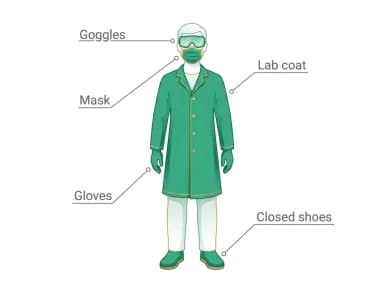
Personal protective equipment (PPE) protects you from specific hazards. Use the type named in the procedure and Safety Data Sheet. Ask me to check your setup before you begin.
| Hazard | Wear |
|---|---|
| Chemical | Splash goggles; chemical-compatible gloves and protective clothing as directed |
| Biological / cultures | Gloves, goggles, lab coat |
| Sharps / dissection | Teacher-specified eye and hand protection; stable dissection tray. Gloves do not make a blade safe. |
| Heat / flame | Goggles, tied hair, no loose sleeves |
Take gloves off inside-out so the outside never touches your skin, then wash your hands.
How to read a Safety Data Sheet (SDS)
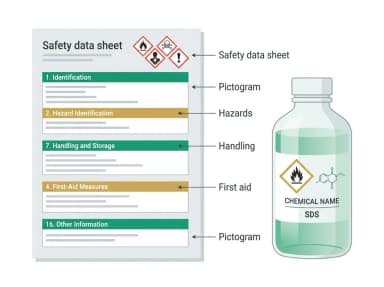
Every chemical has an SDS. Before you open a bottle, read three sections:
- Section 2 (Hazards): what this chemical can do to you. Read this first.
- Section 8 (PPE): exactly what to wear to handle it.
- Section 4 (First aid): what to do if it gets on your skin, in your eyes, or is swallowed.
The SDS binder lives in the room. If you cannot find a chemical's SDS, do not open it. Ask.
Before you begin a lab: the checklist
- State the question in your own words.
- Read every step and know step one.
- List each hazard and the PPE for it.
- Write a prediction with a because-clause.
- Set up and date your data table.
- Name your control and what it rules out.
- Locate the eyewash, shower, extinguisher, and spill kit.
- Confirm your signed contract is on file.
Emergencies: what to do
- Chemical in eyes: get to the eyewash immediately and hold your eyes open under the water. Shout for Mr. Mendoza as you go, or send the person next to you. Keep flushing for 15 minutes. Do not rub, and do not wait to call for help.
- Chemical on skin: rinse the area with water straight away and call Mr. Mendoza at the same time. Remove contaminated clothing while the water runs.
- Small spill: tell the teacher and use the spill kit as directed. Never clean a spill alone.
- Large spill or fire: move away, alert the teacher, follow the evacuation route.
- Cut or needlestick: wash with soap and water and alert Mr. Mendoza immediately. For possible blood or body-fluid exposure, get prompt medical evaluation through the teacher and school nurse.
- When in doubt: stop, hands off, and ask. Always.
Sharps-response reference: CDC/NIOSH guidance. The teacher provides the procedure and safety instructions for each activity.
Equipment quick-cards
All 21 safety rules
- 1. Act responsibly at all times. No horseplay, no practical jokes, no pranks. A lab is not the place for it.
- 2. Follow every written and spoken instruction carefully. If you do not understand a step, ask before you do it.
- 3. Do not touch equipment, supplies, specimens, or materials without permission from your teacher.
- 4. Do only approved experiments. Never run an experiment when the teacher is out of the room.
- 5. Never eat, drink, chew gum, or taste anything in the lab. Keep food and drinks out of the room.
- 6. Keep your hands away from your face, eyes, and mouth while you work. Wash your hands with soap and water before you leave.
- 7. Wear your goggles or safety glasses whenever you are told to, and keep them on for the whole activity. There are no exceptions to this rule.
- 8. Wear the gloves and protective clothing specified by your teacher and the procedure. For chemicals, check the Safety Data Sheet; not every glove protects against every chemical.
- 9. Tie back long hair, remove dangling jewelry, and avoid loose or baggy clothing. Closed-toe shoes only.
- 10. Keep your hands, and everyone's, out of the biohazard and sharps containers. Those are one-way.
- 11. Treat every chemical as dangerous. Do not touch or smell a chemical unless the procedure tells you to, and read its Safety Data Sheet (SDS) first: Section 2 (hazards), Section 8 (PPE), Section 4 (first aid).
- 12. Handle all glassware with care. Never pick up hot or broken glass with your bare hands, and check every piece for chips and cracks before you use it.
- 13. Use burners, hot plates, and flames only when told to. Do not put anything into a flame unless instructed, and never leave a lit burner unattended. When heating a test tube, point the open end away from every person.
- 14. Cut away from your body, never toward it. Use scalpels, blades, and dissecting tools only as instructed, and put them in the sharps container, never the trash.
- 15. Follow your teacher's directions for waste collection and decontamination. Put used cultures in the designated biological-waste container, not regular trash. Do not open used cultures or mix disinfectants on your own.
- 16. Carry a microscope with both hands: one on the arm, one under the base.
- 17. Treat all specimens and cultures with care and respect. Do not remove any specimen, culture, chemical, or equipment from the lab.
- 18. Never open a storage cabinet or enter the prep room without permission.
- 19. Keep your work area and the whole room neat. Bring only your lab instructions, worksheets, and something to write with to the bench.
- 20. Clean your area and equipment at the end of the lab and return everything clean and working to its place.
- 21. Learn where the safety equipment is (eyewash, shower, extinguisher, spill kit, exits) and how to use it before you start. Report every accident, injury, spill, breakage, or hazard to your teacher right away, no matter how small.
Printable contract based on the Flinn Scientific Student Safety Contract (© Flinn Scientific, Inc.), used for classroom safety instruction.