
PCR, restriction enzymes, electrophoresis, microarrays, and the limits of each method.
Your PLTW coursework: Medical Interventions ▸ Unit 2: How to Screen What is In Your Genes ▸ Lesson 2.1 Genetic Testing and Screening / Lesson 3.1 Detecting Cancer ▸ "Activity 2.1.2 Copying Our Genes", "Activity 3.1.4 DNA Microarray"
What to do if absent- CER:
- Claim, Evidence, Reasoning: make a claim, back it with evidence, explain your reasoning.
- SOP:
- Standard Operating Procedure, the exact steps to follow (especially in a lab).
- Tracker:
- Your PLTW progress log where you record completed evidence.
- myPLTW:
- The PLTW course site where you do the online activities. Find it in Clever with your Microsoft sign-in, right next to Schoology.
Compare , , and microarrays, then read a gel to decide which sample carries a disease marker.
- 1Watch the Khan Academy and gel clip in the PLTW course shell and jot the goal of each method in your own words.
- 2Put on goggles and gloves, then load your provided dye samples into the gel wells using a .
- 3Run the gel at the set voltage and watch which direction the colored fronts move from the wells.
- 4While it runs, sketch a table comparing , restriction enzymes, and microarrays with one strength and one limit each.
- 5After staining, measure how far each band traveled and rank the fragments from largest to smallest.
- 6Decide which lane matches the disease marker and write one sentence of evidence using the word banding.
- • You'll be able to load and run an gel safely.
- • You'll be able to explain why smaller fragments travel farther on a gel.
- • You'll be able to choose the right method for a given testing question.
Open any day for its full lesson, the work due that day, and guided notes.
Three-row method comparison table (, gel, ) plus one sentence on a microarray limit not shared by the other two methods.
Fold-change table for four genes with / labels and one sentence on the biological meaning of an upregulated gene.
Shaded of four genes and a CER claim (claim, two fold-change values as evidence, reasoning) that distinguishes risk from diagnosis.
Your worksheet: the side you argued, your three strongest arguments, the opposing point you had to answer, and where you actually stand now.
Complete analysis report: fold-change , shaded , and CER claim distinguishing disease risk from diagnosis.
- Today matters because every clinic test you have heard of starts with copying or sorting , and you will do both.
- Goal for today: run a real gel and read the banding pattern like a lab technician would.
- From Monday's debate, keep asking who gets access to test results once a method makes them easy to produce.
- Upload your gel sketch and method-comparison table to the class site, where the grade is recorded.
Do this: Advance the Unit 2 testing-methods benchmark by submitting your gel banding interpretation on the class site.
- • uses primers to copy a target stretch of many times.
- • sorts by size, with smaller fragments traveling farther.
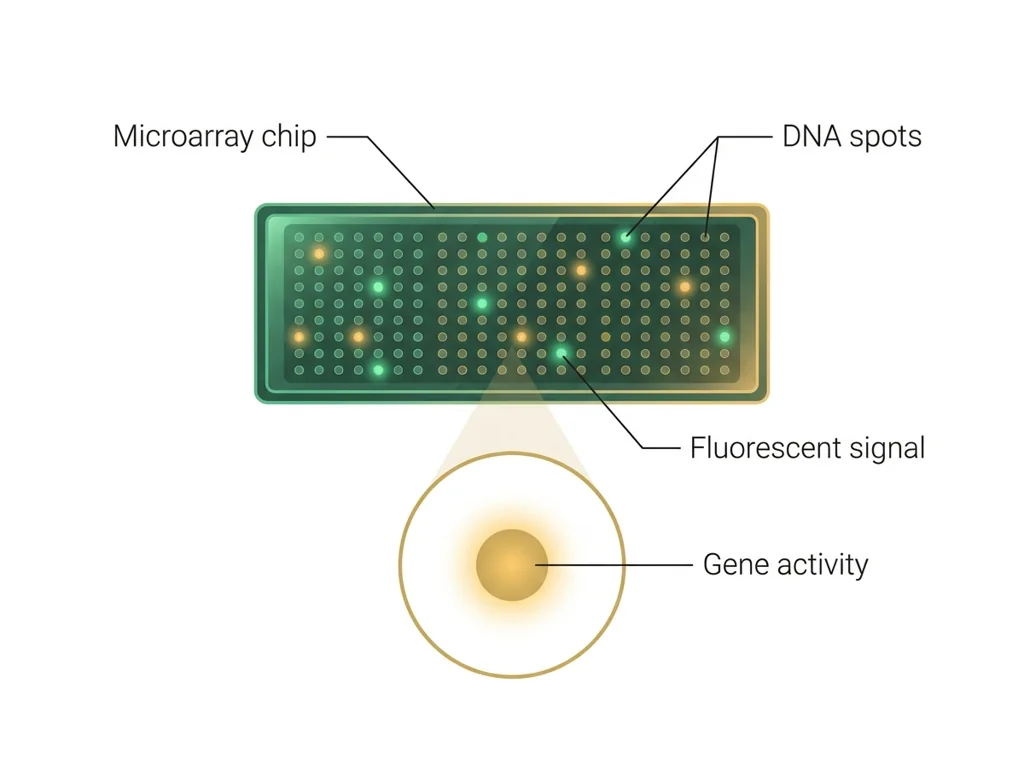
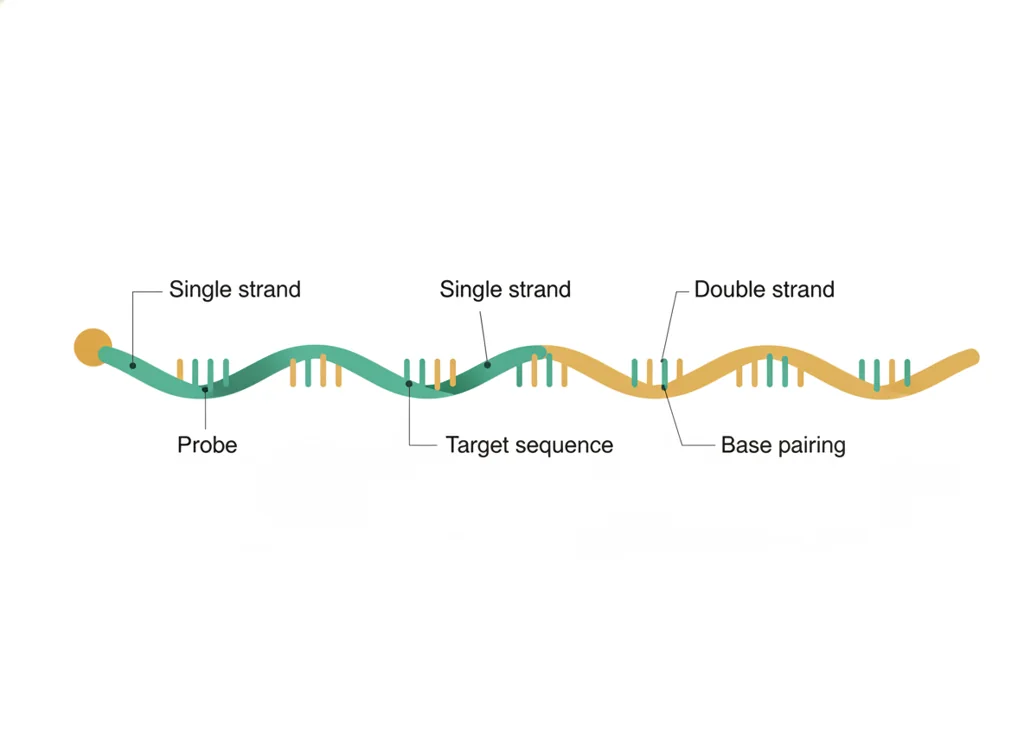
- • Microarrays use to detect many markers at once.
- • Read a gel banding pattern to compare fragment sizes.
- • Match a testing method to the question it best answers.
📋 Tracker evidence due this week: your gel banding interpretation and method-comparison table posted in the PLTW course shell.
All PLTW activities are completed inside the PLTW course environment: this page only gives direction.
Use this chart to keep your place. Nothing on it is turned in through the portal.
| Day | Work | Turn in |
|---|---|---|
| Monday · Mon, Oct 26 | Microarray introduction | Three-row method comparison table (PCR, gel, microarray) plus one sentence on a microarray limit not shared by the other two methods. |
| Tuesday · Tue, Oct 27 | Expression data lab | Fold-change table for four genes with upregulated/downregulated labels and one sentence on the biological meaning of an upregulated gene. |
| Wednesday · Wed, Oct 28 | Heat-map claim | Shaded heat map of four genes and a CER claim (claim, two fold-change values as evidence, reasoning) that distinguishes risk from diagnosis. |
| Thursday · Thu, Oct 29 | JCU bioethics 6: Cochlear implants before the age of consent | Your worksheet: the side you argued, your three strongest arguments, the opposing point you had to answer, and where you actually stand now. |
| Friday · Fri, Oct 30 | Microarray report submit | Complete microarray analysis report: fold-change data table, shaded heat map, and CER claim distinguishing disease risk from diagnosis. |
- M: access-to-results debate
- T: diagram
- W: gel practice
- Th: intro
- F: methods quiz
Turn in: PCR, restriction enzymes, electrophoresis, microarrays, and the limits of each method. weekly work due Genetic testing methods quiz.
Go to Schoology to turn this in.
Submit one PDF. Schoology attaches your name to your upload; on the page itself, write your period and code. Name the file: FirstName LastName - Assignment Title - YYYY-MM-DD.pdf.
Open Schoology PDF upload helpIf you cannot get in, see Mr. Mendoza. Do not skip the work.
4 panels from the illustrated semester.
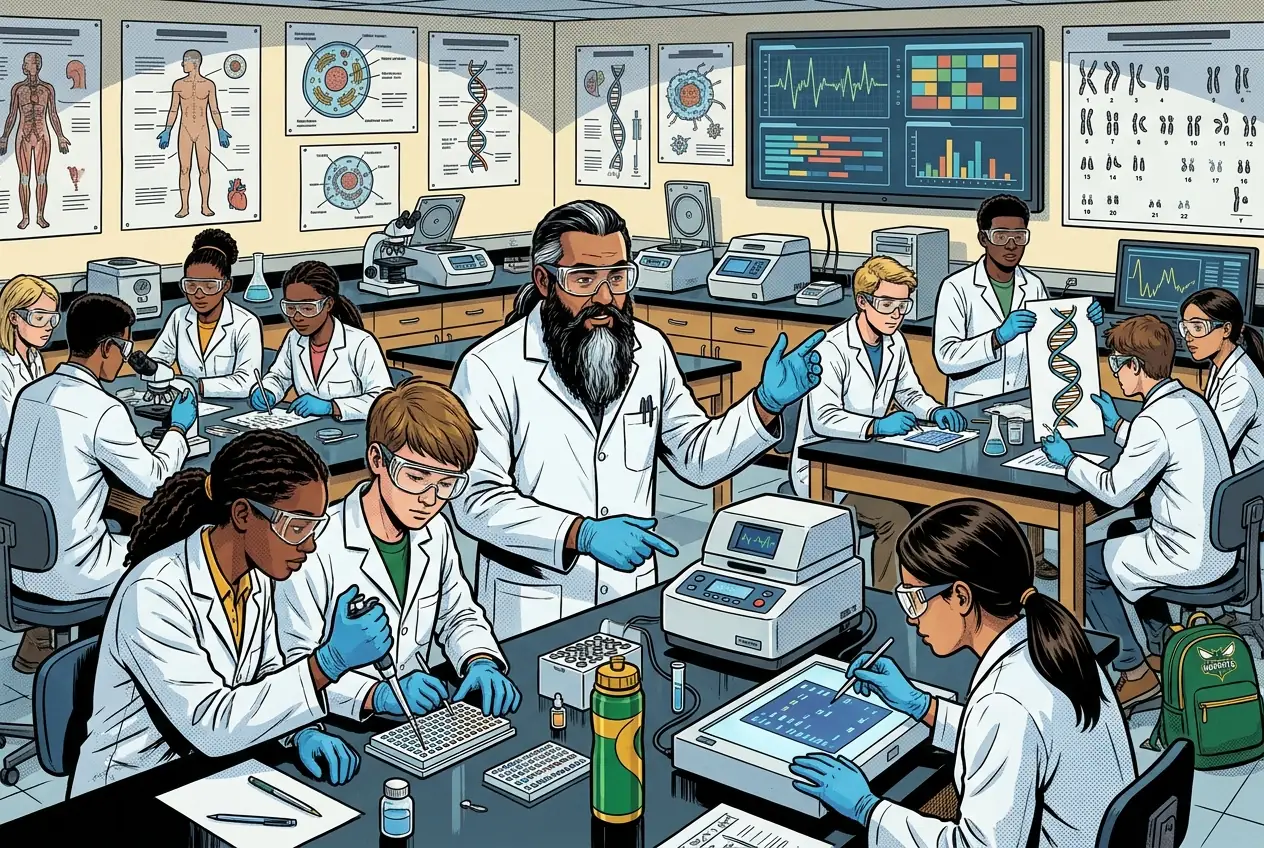
Fiction. There is no such student. The lessons, labs and dates are the real planned course; the student, the classmates and the conversations are invented.
This explainer accompanies the PLTW lab protocol: watch it before lab.
Most days, this class is your PLTW coursework: and PLTW is online and individual. So being out usually just means doing exactly what we did in class, from home.
Open Clever, then myPLTWSign in to Clever with your district Microsoft account to open Schoology or myPLTW. Follow today's posted steps. If myPLTW will not open, use the posted alternative and tell Mr. Mendoza. Turn in your completed work through the Schoology assignment.
You can't do those from home: do this instead: Khan / gel plus banding interpretation.
Class still runs. A substitute will post today's plan: complete the online activity above; it's built to be self-guided. Need the concept taught without a teacher? Use this authoritative explainer:
Genetic Science Learning Center: Gel Electrophoresis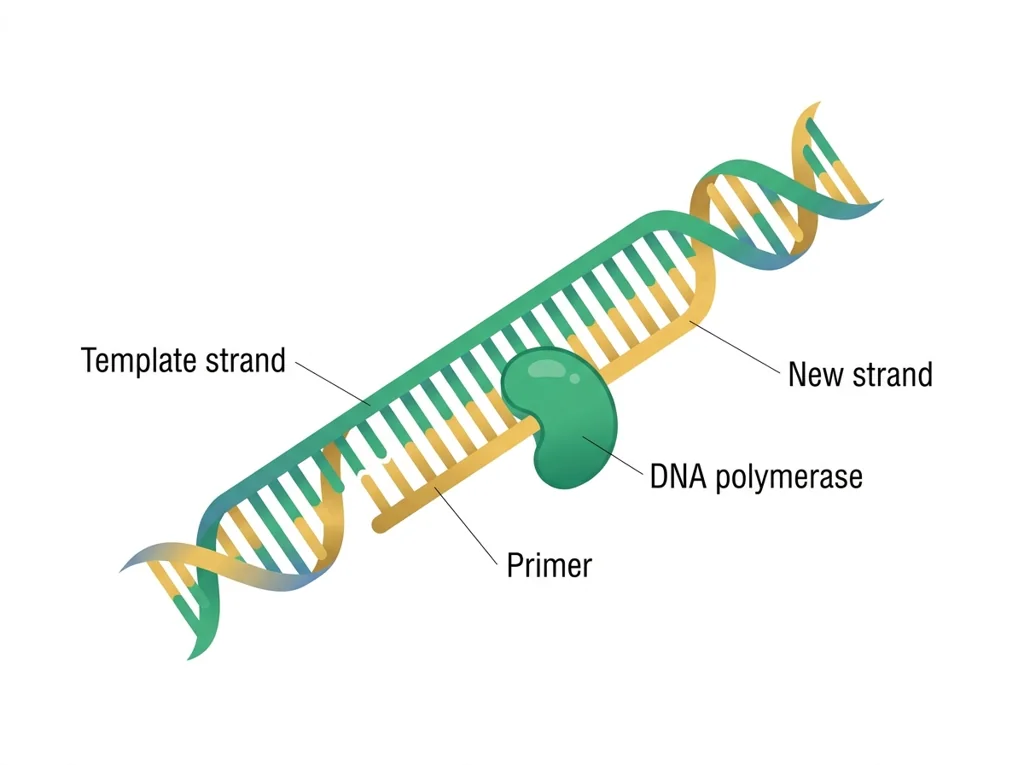


Classroom documents for this lesson are posted in Schoology. Open Clever, then Schoology, and find each one by the name shown on its card.
Open this when the class reaches this activity and use it to complete the required lesson artifact.
Use this if you were absent, got stuck, or need another pass before you submit the lesson artifact.
Use this after the required lesson work when you are ready for a harder application or a deeper connection.
Sign in to Clever with your district Microsoft account to open Schoology or myPLTW. Follow today's posted steps. If myPLTW will not open, use the posted alternative and tell Mr. Mendoza. Turn in your completed work through the Schoology assignment.