
Your Weeks Work packet
The packet tells this week's story day by day, explains every term on labeled reference pages, and lists each task with its deadline. Open it before you start today's work. The mind map shows how the whole unit fits together, with the tested ideas in red. Your Unit 1 Take-Home Exam is handed out Friday, October 2 and due Monday, October 5 at the start of class. It replaces the in-class Unit 1 Test printed in the packet, so ignore the packet's 40-minute and pencil instructions for the test.
ELISA lab report submission
This page has four parts, in the order you use them. Part 1 is what you need to know. Part 2 says what to do, in plain English. Part 3 shows the work done once on a case that is not yours. Part 4 is your own work and where to turn it in.
Open your materials, follow the steps, then turn in your work.
Submit a full ELISA lab report interpreting your controls, results, and the test's reliability.
Optional: listen or watch a unit review▸
Part 1 of 4 · Background and definitions▸
💡 Big idea: A lab report turns raw colour into a defensible conclusion only when it carries the controls and the error rates alongside the result.
- • A complete lab report integrates visual evidence (photo), quantitative data (table), and analytical interpretation into one coherent argument.
- • Discussing sensitivity and specificity in the report shows you can evaluate the quality of your own results, not just report them.
- • Naming a specific limitation shows scientific integrity: all methods have constraints, and acknowledging them is required for credibility.
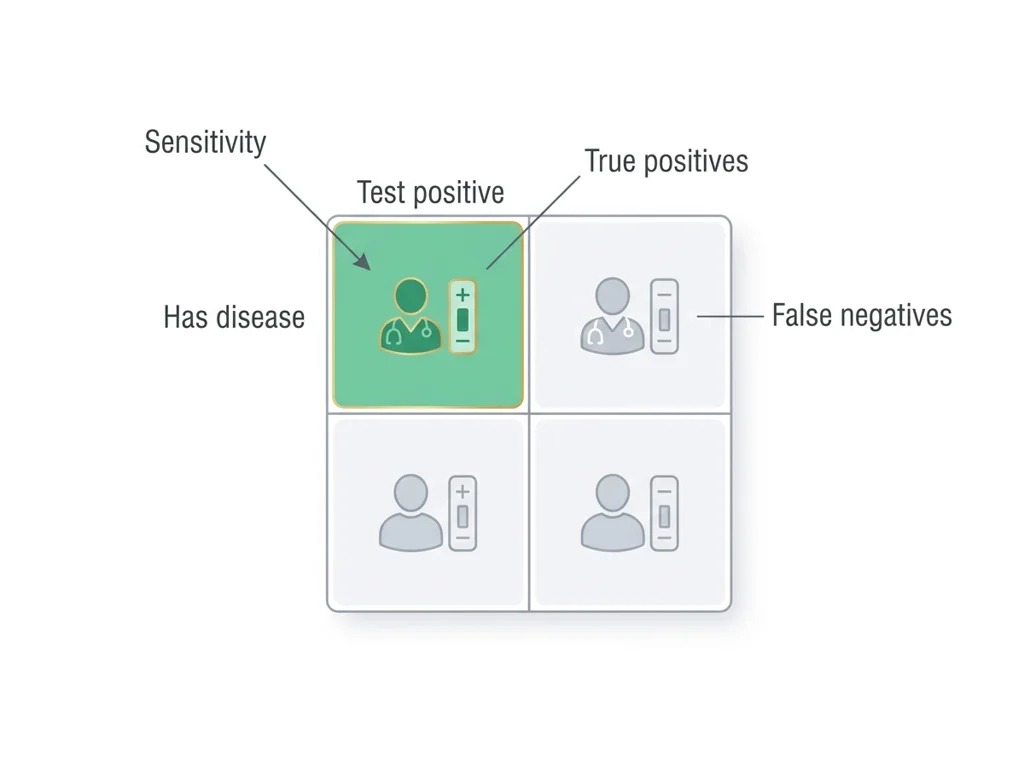
Sensitivity counts the people with the condition who were caught; specificity counts the people without it who were cleared. Each needs a reference standard to be counted at all.
A lab report turns raw colour into a defensible conclusion only when it carries the controls and the error rates alongside the result.
Driving question: Your plate has colour in some wells and not others. Which of those wells would you be willing to tell a patient about?
What you already know: Sensitivity counts the people with the condition who were caught; specificity counts the people without it who were cleared. Each needs a reference standard to be counted at all.
New idea: A lab report turns raw colour into a defensible conclusion only when it carries the controls and the error rates alongside the result.
- Observe or measure the relevant feature in lab report submission.
- Organize the observation with a stable evidence ID.
- Apply this rule: Define variables, controls, sampling, units, and the analysis plan before interpreting a result; analysis cannot repair biased or inconsistent measurement.
- Choose the option the evidence supports and state the limit of the conclusion.
Real biomedical example: Your plate has colour in some wells and not others. Which of those wells would you be willing to tell a patient about?
What the evidence supports: E1 to E3 and the figure support the daily take-home when the response meets the stated success criteria.
What it cannot prove: The package does not support claims beyond this lesson's or any real patient diagnosis.
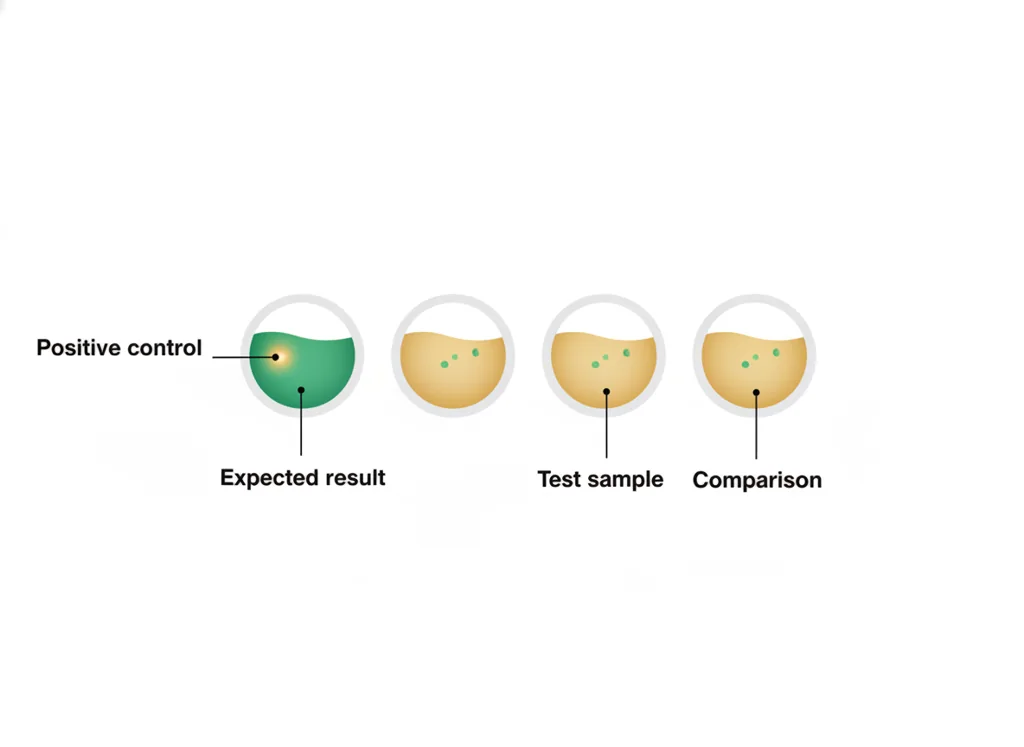
- • : A sample known to produce a result, included in an experiment to confirm that the test is working correctly.
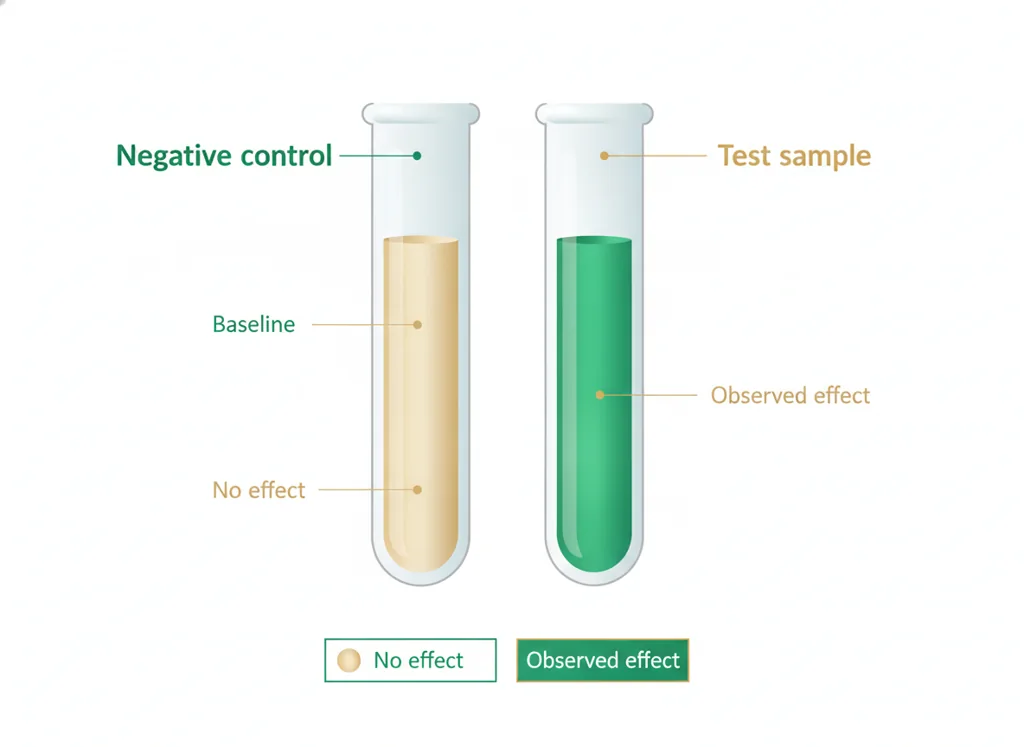
- • : A sample in an experiment expected to show no effect, used as a baseline to confirm that any result in the test sample is real.
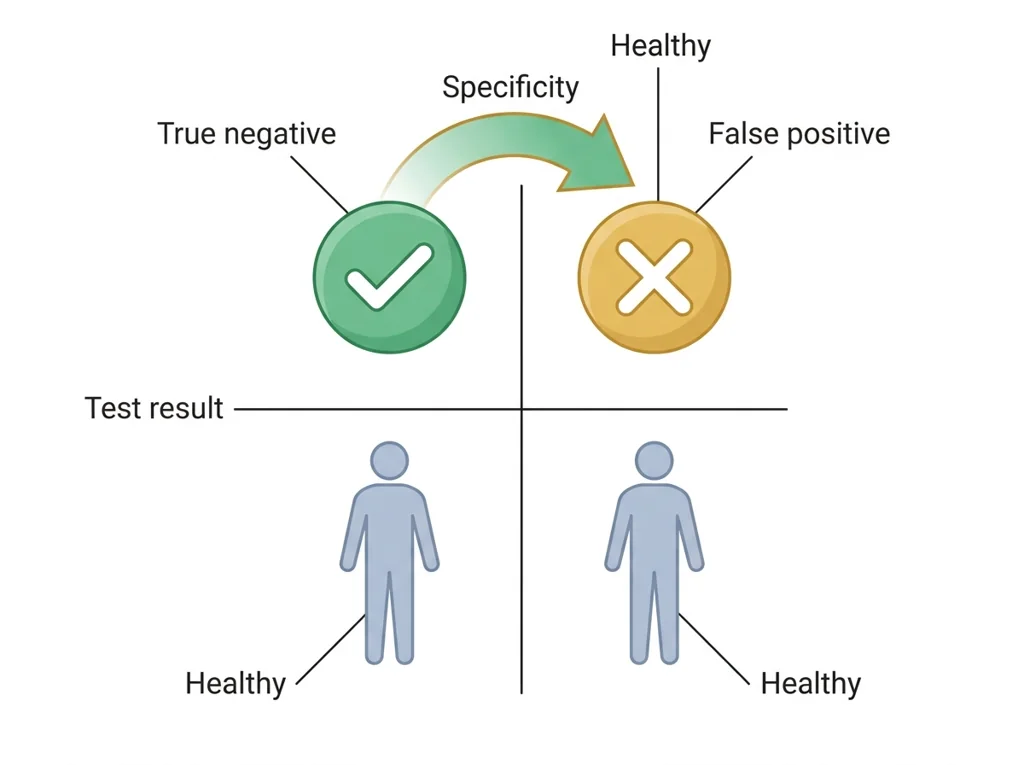
- • specificity: A test's ability to correctly identify people who do not have a condition, giving few false positives.
- • sensitivity: A test's ability to correctly identify people who truly have a disease, measured as the share of real cases that the test flags as positive.
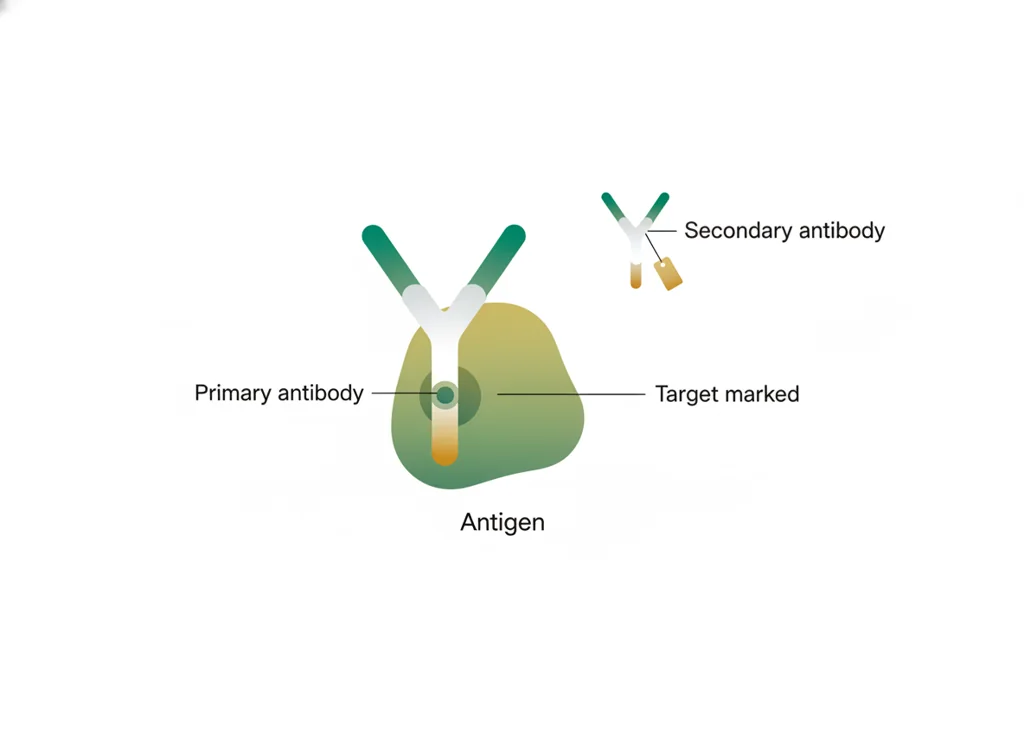
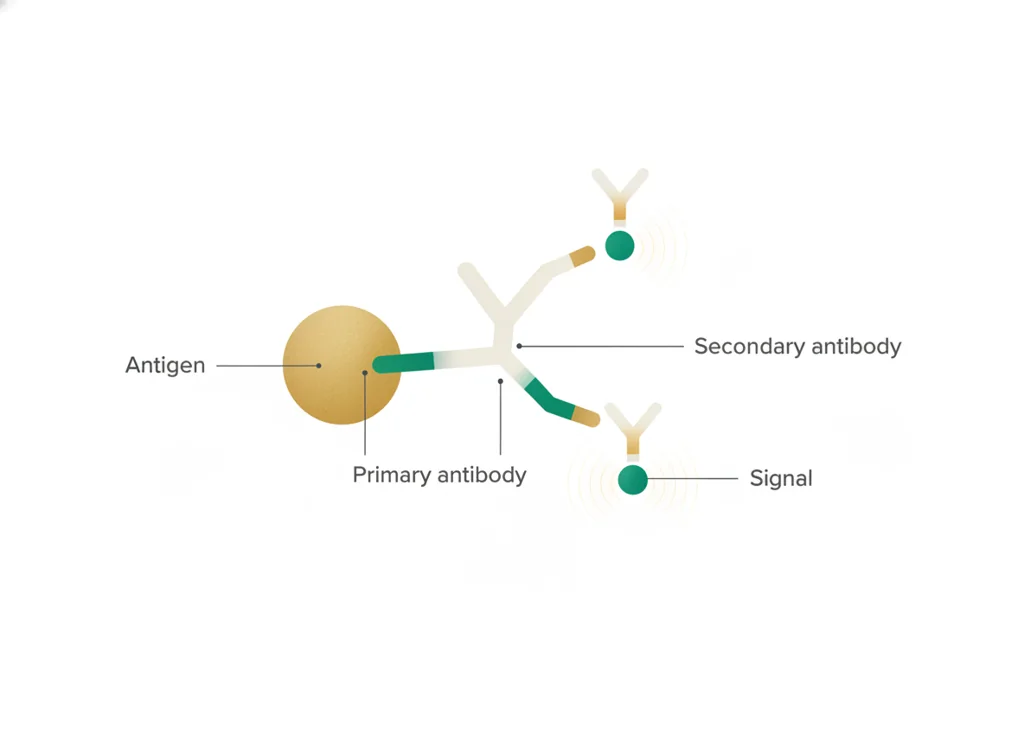
- • : The first added in a test that binds directly to the target molecule, marking it so it can be detected later.
- • : An that binds to a and carries a tag, such as a dye or , to make the target visible in a test.
Use it now: Choose one decision option. Cite E1 and E3, then explain how the rule connects the evidence to your choice. This is thinking practice for the one turn-in named under Turn in, not a second submission.
Go further, optional: The source links below are optional enrichment. Every fact required for today's local evidence decision appears in this lesson package.
An uses selective binding and controls to produce a measurable signal, but performance, cross-reactivity, sampling, and the decision threshold limit what a result can establish.
Limit: A classroom result does not establish a clinical diagnosis or an exact target concentration unless the validated and support that use.
Define variables, controls, sampling, units, and the analysis plan before interpreting a result; analysis cannot repair biased or inconsistent measurement.
Limit: A well-organized classroom study can still be limited by , measurement quality, confounding, and the population represented.
You can submit a complete lab report.
Limit: E3 defines the classroom product or success criterion. It is not independent scientific evidence and cannot justify a clinical or causal claim.
Today's decision · Simulated classroom evidence scenario
Your role: medical interventions team member
Decision: Your team must decide what the evidence from lab report submission supports before submitting the lab report named on today's page.
- • State the cutoff you used beside every call, because the report hides its biggest decision without it.
- • Report every coloured well as a positive and every clear well as a negative, since colour is the result.
- • Hold the reliability claim until the control results are read, because a result alone cannot show how likely it is wrong.
Response: State one choice, cite at least two evidence IDs, explain the rule that connects them, and add one limitation. Use it inside the one turn-in named under Turn in; it is not a separate submission.
Claim ceiling: Today's evidence supports a classroom claim about lab report submission. It cannot prove causation, diagnose a real patient, or justify action outside this room.
Reason for review: Your team must decide what the evidence from lab report submission supports before submitting the lab report named on today's page.
Context: A result only becomes evidence once you can say how likely it is to be wrong, so reporting a number without its reliability is reporting half a finding.
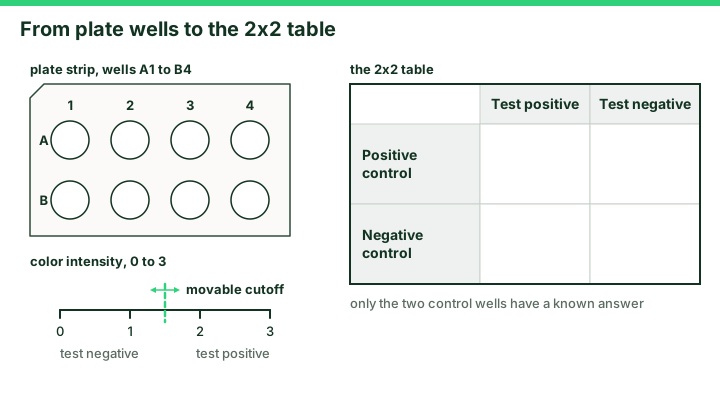
- • T1: Assemble your plate photo, color , and control results.
- • T2: Write a Claim about which samples were positive and a Reasoning paragraph using your data.
- • T3: Explain why your class run cannot give a sensitivity or specificity, and what your positive and negative controls do show.
- • T4: Add one sentence on a limitation or error in your procedure.
- • T5: Submit the report on the class site.
- • T6: Confirm it is turned in and note one improvement for next time.
- • E1: An uses selective binding and controls to produce a measurable signal, but performance, cross-reactivity, sampling, and the decision threshold limit what a result can establish.
- • E2: Define variables, controls, sampling, units, and the analysis plan before interpreting a result; analysis cannot repair biased or inconsistent measurement.
- • E3: You can submit a complete lab report.
Measurements: No patient measurement is supplied unless it appears explicitly in E1-E3 or F1. Do not invent a value.
Figure finding: An empty eight-well plate strip labeled with columns 1 to 4 and rows A and B, a color intensity scale from 0 to 3 with a dashed movable cutoff line, and an empty two by two table with rows and and columns Test positive and Test negative.
Uncertainty: This is a composite classroom scenario. Missing history, measurements, or confirmation tests remain unknown and limit the conclusion.
Students often think a coloured well as a yes and a clear well as a no. The trap: Colour is continuous, not binary. Someone has to pick the cutoff that turns a shade into a call, and moving that cutoff moves your sensitivity and specificity in opposite directions. A report that does not state its cutoff has hidden the most important decision in the whole .
- CER:
- Claim, Evidence, Reasoning: make a claim, back it with evidence, explain your reasoning.
- SOP:
- Standard Operating Procedure, the exact steps to follow (especially in a lab).
- Tracker:
- Your PLTW progress log where you record completed evidence.
- myPLTW:
- The PLTW course site where you do the online activities. Find it in Clever with your Microsoft sign-in, right next to Schoology.
Tap the speaker to hear a term. Add two of these to your notebook glossary with a definition and an example in your own words.
Pick just 2 or 3 words from today and make them yours: write what each one means in your own words, name the context clue or evidence that helped, then give one example from what you actually did in ELISA lab report submission. Try your own words first; the glossary is there if you get stuck. This is voluntary and counts as extra credit, so keep it short.
Saved on this device. Show Mr. Mendoza or add these to your notebook glossary to claim the extra credit.
Part 2 of 4 · Directions in plain English▸
2.1 Open your materials
Use the materials named in the first step below. Open lesson resources.
2.2 Start the work
Assemble your plate photo, color data table, and control results.
Show all 6 required steps
- Assemble your plate photo, color data table, and control results.
- Write a Claim about which samples were positive and a Reasoning paragraph using your data.
- Explain why your class run cannot give a sensitivity or specificity, and what your positive and negative controls do show.
- Add one sentence on a limitation or error in your procedure.
- Submit the report on the class site.
- Confirm it is turned in and note one improvement for next time.
Lost your place? Find your plate photo and your colour data table. If you have both, go straight to the Claim sentence: which samples were positive, and how confident are you.
- 0-12 minAssemble materials: plate photo, color , control results, and 2x2 classification table from the sensitivity and specificity lesson
- 12-27 minDraft the Claim: one sentence naming which samples were positive, supported by control validation
- 27-47 minWrite the Reasoning paragraph: cite well colors and control results
- 47-60 minExplain why your class run cannot give a sensitivity or specificity, and what your positive and negative controls do show
- 60-70 minWrite the limitation sentence: one specific procedural error or source of uncertainty
- 70-80 minSubmit on the class site; confirm all items show as turned in
- • This report represents the full arc of the unit: the testing debate, the wet ELISA record, and the sensitivity and specificity analysis.
- • A lab report that only says 'the test worked' is not science; it must say how well it worked, how you know, and where it could fail.
- • You have every piece you need; today is about assembly, precision, and submission.
- • Exit goal: report submitted and confirmed as turned in before you leave.
PLTW connection and today's work
Open Activity 1.1.6 Final Diagnosis in myPLTW and use your ELISA results to complete the diagnosis.
Today's stopping point: Final diagnosis report submitted and confirmed today.
PLTW activity titles identify the course connection. If your account will not open, use the posted materials for today and tell Mr. Mendoza. Do not mark an online activity complete unless you completed it.
Use the turn-in directions in Part 4 of this page. Do not create a second submission unless your teacher asks for one.
Show another explanation or a smaller first step
Need help? Choose a starting point
Part 3 of 4 · Worked example▸
This is a parallel case, not your own. Read it for the order of the work, then do your own in Part 4.
ELISA lab report (sample run on a practice plate, not your plate; your wells and scores will differ)
Plate photo: attached, read 30 minutes after the stop solution went in.
Color data table (scored 0 to 3 by eye against the standard strip):
Well | Sample | Color | Call
A1 | Positive control | 3 | Positive
A2 | Negative control | 0 | Negative
B1 | Patient 1 | 3 | Positive
B2 | Patient 2 | 0 | Negative
B3 | Patient 3 | 1 | Borderline
B4 | Patient 4 | 3 | Positive
Control check, done before reading any patient well: the positive control developed strong color and the negative control stayed clear, so this plate can tell signal from background and the patient wells are readable. If the negative control had developed color I would have discarded the run, because unbound antibody that was never washed away produces the same color as a real positive.
Claim: Patients 1 and 4 are positive for the antigen, Patient 2 is negative, and Patient 3 is borderline and needs a repeat.
Reasoning: Color in this assay comes from enzyme-linked antibody that stayed bound because its antigen was present. Patients 1 and 4 matched the positive control at 3, and they sat on a plate whose negative control was clean, so the color is attributable to antigen rather than to leftover reagent. Patient 2 matched the negative control at 0. Patient 3 sat between them at 1, which is the region my method cannot resolve.
Sensitivity and specificity from this run: sensitivity is the share of true positives the test catches, and specificity is the share of true negatives it leaves alone. My run cannot put numbers on either, because I do not know the true status of the patient samples independently. What I can say is that a clean negative control is evidence against a specificity problem on this plate, and that a borderline read like Patient 3 is where a sensitivity failure would hide.
Limitation: I scored color by eye instead of on a plate reader, so a 1 and a 2 are not reliably distinguishable. Patient 3 landed exactly there, which makes that call the least trustworthy line in the table and the reason I am asking for a repeat rather than reporting a result.
| Well | Sample | Color (0 to 3) | Call |
|---|---|---|---|
| A1 | Positive control | 3 | Positive |
| A2 | Negative control | 0 | Negative |
| B1 | Patient 1 | 3 | Positive |
| B2 | Patient 2 | 0 | Negative |
| B3 | Patient 3 | 1 | Borderline |
| B4 | Patient 4 | 3 | Positive |
This model shows the level of evidence and organization needed to complete: Completes the ELISA report task: plate photo, color data table, a claim checked against the controls, a reasoning paragraph, a sensitivity and specificity discussion, and one named limitation.
- State the question and method.
- Present the observations and data with units.
- Explain the result, limitations, and next investigation.
Keep the structure. Replace the question, facts, measurements, and evidence. Then recheck units, vocabulary, and whether the conclusion goes beyond the evidence.
Also due today: Submit the full ELISA lab report in Schoology by end of block.
A research team lays out its question, variables, controls, sampling plan, measurement record, and analysis before deciding what the data support.
- Which variable is changed or compared?
- Which conditions and measurements must stay consistent?
- Which conclusion is inside the study's evidence boundary?
Define variables, controls, sampling, units, and the analysis plan before interpreting a result; analysis cannot repair biased or inconsistent measurement.
A well-organized classroom study can still be limited by , measurement quality, confounding, and the population represented.
- • Question and variable cards map to the study design.
- • Control and measurement cards map to fair, reproducible data collection.
- • The conclusion card maps to a bounded claim supported by the analysis.
Part 4 of 4 · Your work▸
Check your work before submitting
- You will be able to submit a complete ELISA lab report.
- You will be able to interpret results using controls.
- You will be able to discuss sensitivity, specificity, and limitations.
4.1 Turn in your work
DueCheck the Schoology assignment for this day- Hand in
- Full ELISA lab report: plate photo, data table, claim with control validation, reasoning paragraph, sensitivity/specificity discussion, and limitation sentence.
How to submit and name your file
Use the submission route shown on today's page.
In Schoology, open your course and the assignment for this lesson. Attach your file, select Submit, and check that it appears in the submission.
PDF upload helpYou get two school days for every day you were absent, so this deadline moves with you.
Find this lesson's Schoology assignments
These are existing assignments for your section. Follow the directions in the assignment you are working on; this list does not add new work. A PLTW Work row repeats on every day of its lesson; submit it once. Check Schoology for each deadline.
- Wk6 Lab report: ELISA lab report submission(today's turn-in)
Link will not open? Open Schoology, choose your course and section, and find the title shown above.
- CompleteEvery required part of the artifact is present, nothing left blank.
- AccurateThe science and the data are correct and match the evidence.
- Scientific reasoningYou explain your claim with evidence and reasoning (CER), not just an answer.
- Professional communicationClear, organized, labeled, and written the way a clinician or scientist would.
- SubmittedGo to Schoology to turn this in. Submit one PDF. Schoology attaches your name to your upload; on the page itself, write your period and code. Name the file: FirstName LastName - Assignment Title - YYYY-MM-DD.pdf. If you cannot get in, see Mr. Mendoza. Do not skip the work.
How this lesson connects
Keep using what you learned last class: Sensitivity counts the people with the condition who were caught; specificity counts the people without it who were cleared. Each needs a reference standard to be counted at all. Today: A lab report turns raw colour into a defensible conclusion only when it carries the controls and the error rates alongside the result.
Practice: try a question, then check your answer▸
Claim ceiling for this check: Today's evidence supports a classroom claim about lab report submission. It cannot prove causation, diagnose a real patient, or justify action outside this room.
Your negative control developed faint colour. What does that do to every positive call on the plate?
Write an answer and pick a confidence to unlock the key.
Fast retrieval with instant answers, not the commit-then-reveal check above. Try each from memory first: write what you remember about the earlier units, then check yourself here.
Missed class or ready for more?▸
Optional practice for this unit's lab skills. Nothing in it is due today.
What today's skills lead to. These are real health-science careers this course builds toward. Tap one to see, on the US Department of Labor's O*NET site, what the job actually involves, what it pays, and how fast it is growing.
The bench work needs equipment you do not have at home. Do the thinking half now: read the procedure, write your prediction, and set up your data table so it is ready.
Back in class. Ask Mr. Mendoza for the class data set, or for a bench slot to run it yourself. Do not submit a Lab report with invented numbers.
Class still runs. Complete today's work as this page describes (it is self-guided). Need the concept taught without a teacher? Use this authoritative explainer:
HHMI BioInteractive (preview; use fallback if blocked)Sources: slides, readings, and resources▸
Your Unit 1 Take-Home Exam is handed out Friday, October 2. It is due Monday, October 5 at the start of class. Read the study guide first, then take the practice test and check your answers with the key at the end.
The preparation page has the ten-skill checklist, a table of every test we used, the glossary, flashcards, two self-checking practice quizzes and study conversations you can read.
The deck carries the prior idea forward, lets you inspect an analogy, maps the rule to biology, and ends with the same evidence decision and exit ticket used on this page.
Classroom documents for this lesson are posted in Schoology. Open Clever, then Schoology, and find each one by the name shown on its card.
Open this when the class reaches this activity and use it to complete the required lesson artifact.
Use this if you were absent, got stuck, or need another pass before you submit the lesson artifact.
Open this when the class reaches this activity and use it to complete the required lesson artifact.
Sign in to Clever with your district Microsoft account to open Schoology or myPLTW. Follow today's posted steps. If myPLTW will not open, use the posted alternative and tell Mr. Mendoza. Turn in your completed work through the Schoology assignment.
This week
My Progress dashboard