
MI / Genetics of Disease · September 25, 2026 · 80 minutes
Sensitivity and specificity: two rates, two errors
Parts A to E in one data table: definitions and layout, ten sorted practice rows with counts, two computed rates, the 1,000-person practice rates and positive column, and two limit sentences
This page has three parts, in the order you use them. Part 1 is what you need to know. Part 2 says what to do, in plain English. Part 3 is your own record and the tasks. Everything you write goes in one product.
Every row and count is practice for the made-up Infection Q from Tuesday. No real disease, test or person. No classroom ELISA well, plate photo or lab result is used. Sensitivity counts the people with the condition who were caught; specificity counts the people without it who were cleared. Each needs a reference standard to be counted at all. A screening result is never a confirmation; in the scenario, only the confirmatory test settles the question. None of that supplies a reference standard for unknown samples, so a classroom run, by itself, cannot place its wells in the rows of this table or produce a sensitivity or specificity. This is your position about a practice scenario, not a rule and not medical advice.
Hand the paper table to Mr. Mendoza before leaving, or submit one PDF. Do not submit twice.
Part 1 of 3 · Background and definitions
Required reference
Practice layout, printed blank for A2. This is a teaching diagram, not data from any real test, run or person.
                              SCREEN POSITIVE        SCREEN NEGATIVE
                          +----------------------+----------------------+
HAS THE CONDITION         |                      |                      |
(by the reference std.)   |                      |                      |
                          +----------------------+----------------------+
DOES NOT HAVE IT          |                      |                      |
(by the reference std.)   |                      |                      |
                          +----------------------+----------------------+

This is the blank A2 layout. R2 and R4 name the four cells and the four letters; you write them in.

SORT A ROW:  read the supplied STATUS first  ->  then the supplied RESULT  ->  write TP, FN, FP or TN

YOUR WORK:  A1 define + formulas  ->  A2 label layout  ->  B1 sort ten rows  ->  B2 count (sum 10)
            ->  C1, C2 rates from your counts  ->  D1, D2 the 1,000-person table and its positive column
            ->  E1 which error to avoid (your position)  ->  E2 why a classroom run cannot fill this table
            ->  submit once
Full text equivalent
The layout is printed blank and has two rows and two columns. The rows are what is true for a person, decided by a reference standard: the person has the condition, or does not. The columns are what the screen reported: positive or negative. Cell a is a true positive, a person with the condition who screened positive; cell c is a false negative, a person with the condition who screened negative; cell b is a false positive, a person without the condition who screened positive; cell d is a true negative, a person without the condition who screened negative. Sensitivity is a divided by the sum of a and c, and uses only the row of people who have the condition. Specificity is d divided by the sum of b and d, and uses only the row of people who do not. Reading the positive column, a divided by the sum of a and b is the share of positive screens that are true; its optional name is positive predictive value. To sort a row, read the supplied status first, then the supplied result, then write TP, FN, FP or TN. Your work runs A1 to E2 in order and ends with one submission.
Optional restart cue
Check A1 and A2. Sort the ten rows in B1 and count in B2; the counts must add to 10. Then C1 and C2 from your counts, D1 and D2 from the 1,000-person table, and E1 and E2 last. One table, submitted once.
The complete reading, which the tasks quote
Open the sections in order for the two rates, the reference standard, the sorting rule and the limits.
Genetics of Disease / Medical Interventions · Friday, September 25, 2026 · Required briefing
R1. Your one data table
Today you complete one Sensitivity and specificity data table with five parts. Part A defines the two rates and labels the layout. Part B sorts ten supplied practice rows and counts the cells. Part C computes the two rates from your counts. Part D computes them for Tuesday's 1,000-person practice table and reads its positive column. Part E states two limits. One table, submitted once.
Every row and count is practice for the made-up Infection Q from Tuesday. No real disease, real test or real person appears here. No classroom ELISA well, plate photo or lab result is used, and you will see in R6 why it could not be.
R2. Two rates, two names
Tuesday you argued about a false alarm and a missed case. Today each error gets a rate.
Sensitivity is the proportion of people who have the condition whose test comes back positive. In the StatPearls chapter on diagnostic testing accuracy (NCBI Bookshelf, Issues of Concern), it is "the proportion of true positive tests out of all patients with a condition." Formula: sensitivity = true positives ÷ (true positives + false negatives), written a ÷ (a + c).
Specificity is the proportion of people who do not have the condition whose test comes back negative. The same chapter calls it "the percentage of true negatives out of all subjects who do not have a disease or condition." Formula: specificity = true negatives ÷ (true negatives + false positives), written d ÷ (b + d).
The letters come from the layout in F1: a is a true positive, b a false positive, c a false negative, d a true negative. Sensitivity uses only the row of people who have the condition (a and c). Specificity uses only the row of people who do not (b and d). A plain way to hold them: sensitivity counts the people with the condition who were caught; specificity counts the people without it who were cleared.
Write A1 in your own words and copy both formulas, naming the letters. Label A2.
R3. The table needs a reference standard
A 2x2 table has rows for what is actually true and columns for what the screen said. To place anyone in a row, someone has to know whether that person really has the condition. That knowledge comes from a reference standard: a screening test is assessed by its agreement with a recognised gold standard method of establishing the diagnosis (NCBI Bookshelf, Methods of assessing diagnostic test accuracy). In Tuesday's scenario, the reference standard was the confirmatory laboratory test.
Your ten practice rows each carry a supplied status, decided by that scenario's reference standard, and a supplied screen result. You can sort them only because the status is given. Keep that fact for E2.
R4. How to sort a row
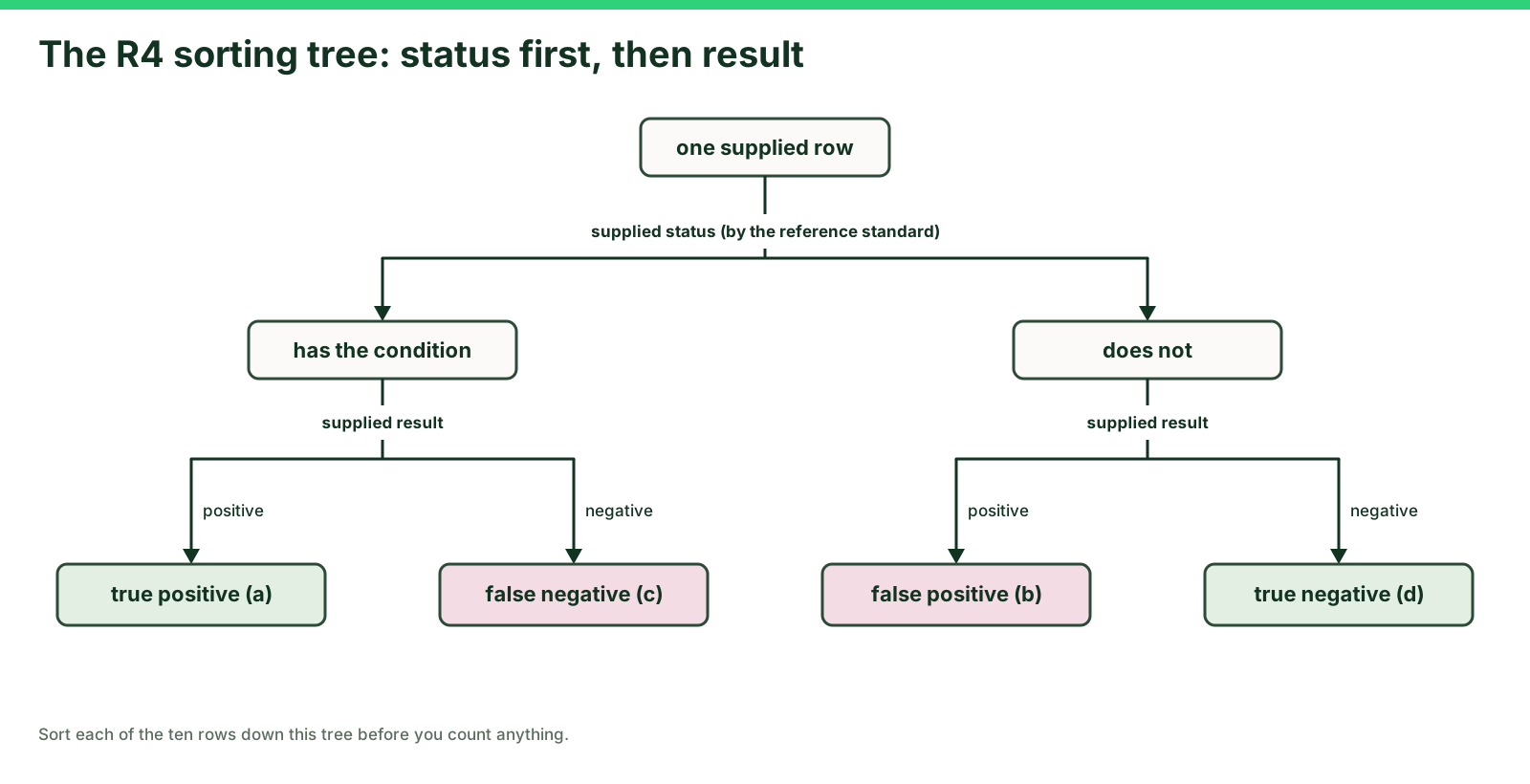
Read the supplied status first, then the supplied result.
- Has Infection Q and screen positive: true positive (TP, cell a).
- Has Infection Q and screen negative: false negative (FN, cell c).
- Does not have Infection Q and screen positive: false positive (FP, cell b).
- Does not have Infection Q and screen negative: true negative (TN, cell d).
The name of a cell is the result (positive or negative) plus whether the result was right (true or false). Sort all ten rows in B1, then count in B2. Your four counts must add to 10, and TP + FN must equal the number of rows that have Infection Q. If they do not, one row is missing or doubled; find it before computing anything.
For C1 and C2, use your own counts. Write each rate as a fraction, then a decimal, then a percent rounded to the nearest whole percent. If a decimal repeats, write about before the percent. Rounding is not a measurement claim; it is a way to report a fraction.
R5. Read the 1,000-person table, then read one column
First, the thing that confuses people here. The ten rows you just sorted and this 1,000-person table are two different groups from the same scenario. The ten are not ten of the 1,000. That is why the rates you compute in C1 and C2 will not match the ones you compute in D1, and it is not a mistake in either. A small batch gives a rough estimate of the same two underlying rates; a bigger one gives a steadier estimate. Sensitivity is a property of the TEST, not of whichever pile of people you happen to be holding.
Tuesday's practice table is reprinted on your handout: 100 people with Infection Q, of whom 95 screened positive and 5 negative; 900 without it, of whom 90 screened positive and 810 negative; 185 positive screens and 815 negative screens in all. Compute both rates in D1 using the row totals 100 and 900 as denominators.
Then read only the positive column for D2. Count the positive screens and count how many of them are true positives. Write one sentence on why a positive screen result is not a confirmation, using those two numbers. A screening result is never a confirmation; in the scenario, only the confirmatory test settles the question. If you want a name for the share of positive screens that are true, the StatPearls chapter calls it the positive predictive value, a ÷ (a + b). It is optional vocabulary today, not a required calculation.
Why does a clinic have to choose? The StatPearls chapter states the general pattern: "Sensitivity and specificity are inversely related: as sensitivity increases, specificity tends to decrease, and vice versa." The word *tends* matters; it is a common pattern, not a law for every test. For E1, take a position: which error should the scenario's clinic most avoid, a false negative or a false positive, and why? Use Tuesday's stipulations, reprinted here: after a positive screen, a confirmatory test and about three days at home; after a negative screen, nothing further unless symptoms appear; Infection Q can be passed to others while a person has it and is treatable once confirmed. Name the error, name what happens next to that person, and connect it to the rate that error lowers. This is your position about a practice scenario, not a rule and not medical advice.
R6. What a classroom run cannot tell you, and how to submit
You may run an ELISA in this course. A run like that has positive and negative controls: references with an expected result, used to check that the test worked (September 18 reading). A control tells you about the run. It does not tell you the true status of any other sample on the plate. A sample's positive or negative interpretation also needs the test's decision rule and the known control results. None of that supplies a reference standard for unknown samples, so a classroom run, by itself, cannot place its wells in the rows of this table or produce a sensitivity or specificity. Your practice rows could be sorted only because each row's status was supplied. Write E2 from this paragraph, in one sentence.
Hand the paper table to Mr. Mendoza before leaving, or submit one PDF to Wk5 Data table: Specificity vs sensitivity by the due time shown in Schoology. Use your period and code. Do not submit twice. Keep the table with Tuesday's CER record.
This is local John Hay practice connected by title to PLTW Medical Interventions Activity 1.1.6, Final Diagnosis. It does not complete that official activity, it plots no standard curve and it estimates no unknown; those need measured data this lesson does not supply.
If you were absent, or lose your place: the ten rows and the 1,000-person table are on the handout and the portal page. Complete A1 and A2, sort and count, compute, read the column, write the two limits, and submit once. No lab, photo or separate absence response.
References opened for this lesson: StatPearls, Diagnostic Testing Accuracy: Sensitivity, Specificity, Predictive Values and Likelihood Ratios, section Issues of Concern; Methods of assessing diagnostic test accuracy, NCBI Bookshelf. Background, not extra assignments.
All vocabulary definitions
- Sensitivity
- Sensitivity is the proportion of people who have the condition whose test comes back positive.
- Specificity
- Specificity is the proportion of people who do not have the condition whose test comes back negative.
- True positive
- Has Infection Q and screen positive: true positive (TP, cell a).
- False negative
- Has Infection Q and screen negative: false negative (FN, cell c).
- False positive
- Does not have Infection Q and screen positive: false positive (FP, cell b).
- True negative
- Does not have Infection Q and screen negative: true negative (TN, cell d).
- Reference standard
- a screening test is assessed by its agreement with a recognised gold standard method of establishing the diagnosis
- Positive predictive value
- If you want a name for the share of positive screens that are true, the StatPearls chapter calls it the positive predictive value, a ÷ (a + b).
- Control
- A run like that has positive and negative controls: references with an expected result, used to check that the test worked (September 18 reading).
- Practice rows
- Practice rows. The infection (Infection Q), the screen and every status and result are made up for this lesson. The status column is supplied by the scenario's reference standard so the rows can be sorted.
Part 2 of 3 · Directions in plain English
What you will do today, in order
Tuesday's CER used a practice scenario with 1,000 people and four supplied counts to argue which error a clinic can better afford. Thursday's JCU lesson has its own page; today's numbers come from Tuesday.
Make one Sensitivity and specificity data table: Parts A to E. Every row and count is practice for the made-up Infection Q from Tuesday. No real disease, test or person. No classroom ELISA well, plate photo or lab result is used. A calculator is allowed.
- Define and label. Read R2 and R3. Add your period and code. Write A1: sensitivity and specificity in your own words, plus the two formulas with the letters named. Label A2's layout with TP, FP, FN, TN and a, b, c, d; circle the two cells sensitivity uses and box the two specificity uses.
- Sort and count. For each of the ten supplied rows S01 to S10, read the supplied status first, then the supplied result, and write TP, FN, FP or TN in B1. Count the four cells in B2; the counts must add to 10.
- Compute from your counts. C1: sensitivity = TP ÷ (TP + FN). C2: specificity = TN ÷ (TN + FP). Write each as a fraction, a decimal and a percent to the nearest whole; if a decimal repeats, write the word about before the percent.
- The 1,000-person table. D1: both rates from Tuesday's supplied counts (95, 5, 90, 810), denominators 100 and 900. D2: count the positive screens and the true positives among them, then write one sentence on why a positive screen is not a confirmation.
- Limits, then submit once. E1: which error the scenario's clinic should most avoid and why, using Tuesday's stipulations. E2: why a classroom ELISA run, by itself, cannot fill this table. Hand the paper table to Mr. Mendoza before leaving, or submit one PDF to Wk5 Data table: Specificity vs sensitivity by the due time shown in Schoology. Do not submit twice.
Show the 80-minute plan
- 0 to 10 minutes: Teacher launch. Identify the one data table and the practice-only boundary. Do the do-now. Read the two definitions aloud from R2. Launch, definitions read aloud and the do-now.
- 10 to 25 minutes: Definitions and layout. Write A1 in your own words and copy the two formulas. Label A2's layout with the four cell names and the letters a to d, and mark which cells each formula uses. Tasks A1, A2.
- 25 to 40 minutes: Sort and count. Classify each of the ten supplied rows in B1 using R4's rule: status first, then result. Count the four cells in B2 and check the sum is 10. Tasks B1, B2.
- 40 to 55 minutes: Compute from your counts. Compute C1 sensitivity and C2 specificity from B2. Show the fraction, the decimal and the percent to the nearest whole; keep about where the decimal repeats. Tasks C1, C2.
- 55 to 68 minutes: The 1,000-person table. Compute D1's two rates from Tuesday's supplied counts. Read the positive column for D2 and write the confirmation sentence using R5. Tasks D1, D2.
- 68 to 80 minutes: Limits, check and submit. Write E1 and E2 from R5 and R6. Read the table once as a stranger would. Hand in paper or submit one PDF. Tasks E1, E2, handoff.
Slides and optional notes
A partner check of B1 and B2 is optional; guided notes are optional; neither is a submission.
Part 3 of 3 · Your work
3.1 Required record
Use your period and code.
Genetics of Disease / Medical Interventions | Friday, September 25, 2026
Every row and count is practice for the made-up Infection Q from Tuesday. No real disease, test or person. No classroom ELISA well, plate photo or lab result is used. Sensitivity counts the people with the condition who were caught; specificity counts the people without it who were cleared. Each needs a reference standard to be counted at all. A screening result is never a confirmation; in the scenario, only the confirmatory test settles the question. None of that supplies a reference standard for unknown samples, so a classroom run, by itself, cannot place its wells in the rows of this table or produce a sensitivity or specificity. This is your position about a practice scenario, not a rule and not medical advice.
Cover block
- Period and code, not your name: ____________________
- Date: ____________________
- Parts included: [ ] A [ ] B [ ] C [ ] D [ ] E
- Route: [ ] paper handed to Mr. Mendoza [ ] one PDF to the Wk5 data table item
Required briefing, the same text as the reading above
R1. Your one data table
Today you complete one Sensitivity and specificity data table with five parts. Part A defines the two rates and labels the layout. Part B sorts ten supplied practice rows and counts the cells. Part C computes the two rates from your counts. Part D computes them for Tuesday's 1,000-person practice table and reads its positive column. Part E states two limits. One table, submitted once.
Every row and count is practice for the made-up Infection Q from Tuesday. No real disease, real test or real person appears here. No classroom ELISA well, plate photo or lab result is used, and you will see in R6 why it could not be.
R2. Two rates, two names
Tuesday you argued about a false alarm and a missed case. Today each error gets a rate.
Sensitivity is the proportion of people who have the condition whose test comes back positive. In the StatPearls chapter on diagnostic testing accuracy (NCBI Bookshelf, Issues of Concern), it is "the proportion of true positive tests out of all patients with a condition." Formula: sensitivity = true positives ÷ (true positives + false negatives), written a ÷ (a + c).
Specificity is the proportion of people who do not have the condition whose test comes back negative. The same chapter calls it "the percentage of true negatives out of all subjects who do not have a disease or condition." Formula: specificity = true negatives ÷ (true negatives + false positives), written d ÷ (b + d).
The letters come from the layout in F1: a is a true positive, b a false positive, c a false negative, d a true negative. Sensitivity uses only the row of people who have the condition (a and c). Specificity uses only the row of people who do not (b and d). A plain way to hold them: sensitivity counts the people with the condition who were caught; specificity counts the people without it who were cleared.
Write A1 in your own words and copy both formulas, naming the letters. Label A2.
R3. The table needs a reference standard
A 2x2 table has rows for what is actually true and columns for what the screen said. To place anyone in a row, someone has to know whether that person really has the condition. That knowledge comes from a reference standard: a screening test is assessed by its agreement with a recognised gold standard method of establishing the diagnosis (NCBI Bookshelf, Methods of assessing diagnostic test accuracy). In Tuesday's scenario, the reference standard was the confirmatory laboratory test.
Your ten practice rows each carry a supplied status, decided by that scenario's reference standard, and a supplied screen result. You can sort them only because the status is given. Keep that fact for E2.
R4. How to sort a row
Read the supplied status first, then the supplied result.
- Has Infection Q and screen positive: true positive (TP, cell a).
- Has Infection Q and screen negative: false negative (FN, cell c).
- Does not have Infection Q and screen positive: false positive (FP, cell b).
- Does not have Infection Q and screen negative: true negative (TN, cell d).
The name of a cell is the result (positive or negative) plus whether the result was right (true or false). Sort all ten rows in B1, then count in B2. Your four counts must add to 10, and TP + FN must equal the number of rows that have Infection Q. If they do not, one row is missing or doubled; find it before computing anything.
For C1 and C2, use your own counts. Write each rate as a fraction, then a decimal, then a percent rounded to the nearest whole percent. If a decimal repeats, write about before the percent. Rounding is not a measurement claim; it is a way to report a fraction.
R5. Read the 1,000-person table, then read one column
First, the thing that confuses people here. The ten rows you just sorted and this 1,000-person table are two different groups from the same scenario. The ten are not ten of the 1,000. That is why the rates you compute in C1 and C2 will not match the ones you compute in D1, and it is not a mistake in either. A small batch gives a rough estimate of the same two underlying rates; a bigger one gives a steadier estimate. Sensitivity is a property of the TEST, not of whichever pile of people you happen to be holding.
Tuesday's practice table is reprinted on your handout: 100 people with Infection Q, of whom 95 screened positive and 5 negative; 900 without it, of whom 90 screened positive and 810 negative; 185 positive screens and 815 negative screens in all. Compute both rates in D1 using the row totals 100 and 900 as denominators.
Then read only the positive column for D2. Count the positive screens and count how many of them are true positives. Write one sentence on why a positive screen result is not a confirmation, using those two numbers. A screening result is never a confirmation; in the scenario, only the confirmatory test settles the question. If you want a name for the share of positive screens that are true, the StatPearls chapter calls it the positive predictive value, a ÷ (a + b). It is optional vocabulary today, not a required calculation.
Why does a clinic have to choose? The StatPearls chapter states the general pattern: "Sensitivity and specificity are inversely related: as sensitivity increases, specificity tends to decrease, and vice versa." The word *tends* matters; it is a common pattern, not a law for every test. For E1, take a position: which error should the scenario's clinic most avoid, a false negative or a false positive, and why? Use Tuesday's stipulations, reprinted here: after a positive screen, a confirmatory test and about three days at home; after a negative screen, nothing further unless symptoms appear; Infection Q can be passed to others while a person has it and is treatable once confirmed. Name the error, name what happens next to that person, and connect it to the rate that error lowers. This is your position about a practice scenario, not a rule and not medical advice.
R6. What a classroom run cannot tell you, and how to submit
You may run an ELISA in this course. A run like that has positive and negative controls: references with an expected result, used to check that the test worked (September 18 reading). A control tells you about the run. It does not tell you the true status of any other sample on the plate. A sample's positive or negative interpretation also needs the test's decision rule and the known control results. None of that supplies a reference standard for unknown samples, so a classroom run, by itself, cannot place its wells in the rows of this table or produce a sensitivity or specificity. Your practice rows could be sorted only because each row's status was supplied. Write E2 from this paragraph, in one sentence.
Hand the paper table to Mr. Mendoza before leaving, or submit one PDF to Wk5 Data table: Specificity vs sensitivity by the due time shown in Schoology. Use your period and code. Do not submit twice. Keep the table with Tuesday's CER record.
This is local John Hay practice connected by title to PLTW Medical Interventions Activity 1.1.6, Final Diagnosis. It does not complete that official activity, it plots no standard curve and it estimates no unknown; those need measured data this lesson does not supply.
If you were absent, or lose your place: the ten rows and the 1,000-person table are on the handout and the portal page. Complete A1 and A2, sort and count, compute, read the column, write the two limits, and submit once. No lab, photo or separate absence response.
References opened for this lesson: StatPearls, Diagnostic Testing Accuracy: Sensitivity, Specificity, Predictive Values and Likelihood Ratios, section Issues of Concern; Methods of assessing diagnostic test accuracy, NCBI Bookshelf. Background, not extra assignments.
F1. The 2x2 layout and the two rates
Practice layout, printed blank for A2. This is a teaching diagram, not data from any real test, run or person.
                              SCREEN POSITIVE        SCREEN NEGATIVE
                          +----------------------+----------------------+
HAS THE CONDITION         |                      |                      |
(by the reference std.)   |                      |                      |
                          +----------------------+----------------------+
DOES NOT HAVE IT          |                      |                      |
(by the reference std.)   |                      |                      |
                          +----------------------+----------------------+

This is the blank A2 layout. R2 and R4 name the four cells and the four letters; you write them in.

SORT A ROW:  read the supplied STATUS first  ->  then the supplied RESULT  ->  write TP, FN, FP or TN

YOUR WORK:  A1 define + formulas  ->  A2 label layout  ->  B1 sort ten rows  ->  B2 count (sum 10)
            ->  C1, C2 rates from your counts  ->  D1, D2 the 1,000-person table and its positive column
            ->  E1 which error to avoid (your position)  ->  E2 why a classroom run cannot fill this table
            ->  submit once
Full text equivalent. The layout is printed blank and has two rows and two columns. The rows are what is true for a person, decided by a reference standard: the person has the condition, or does not. The columns are what the screen reported: positive or negative. Cell a is a true positive, a person with the condition who screened positive; cell c is a false negative, a person with the condition who screened negative; cell b is a false positive, a person without the condition who screened positive; cell d is a true negative, a person without the condition who screened negative. Sensitivity is a divided by the sum of a and c, and uses only the row of people who have the condition. Specificity is d divided by the sum of b and d, and uses only the row of people who do not. Reading the positive column, a divided by the sum of a and b is the share of positive screens that are true; its optional name is positive predictive value. To sort a row, read the supplied status first, then the supplied result, then write TP, FN, FP or TN. Your work runs A1 to E2 in order and ends with one submission.
Part A. The two rates and the 2x2 layout
A1. In your own words, define sensitivity and specificity. Then copy the two formulas from R2: sensitivity = a ÷ (a + c) and specificity = d ÷ (b + d), naming what a, b, c and d stand for.
*Space: Four labeled lines. Help: Sensitivity uses only the row of people who have the condition. Specificity uses only the row of people who do not.*
Sensitivity definition:
________________________________________________________________________________
Specificity definition:
________________________________________________________________________________
Sensitivity formula with letters named:
________________________________________________________________________________
Specificity formula with letters named:
________________________________________________________________________________
A2. Label the 2x2 layout: write TP, FP, FN, TN in the correct cells and the letters a, b, c, d beside them. Circle the two cells sensitivity uses and box the two cells specificity uses.
*Space: The printed 2x2 layout. Help: Rows are what is true (has the condition or does not). Columns are what the screen said. A false positive sits in the row of people who do not have the condition, in the positive column.*
                              SCREEN POSITIVE        SCREEN NEGATIVE
                          +----------------------+----------------------+
HAS THE CONDITION         |                      |                      |
(by the reference std.)   |                      |                      |
                          +----------------------+----------------------+
DOES NOT HAVE IT          |                      |                      |
(by the reference std.)   |                      |                      |
                          +----------------------+----------------------+
Four cell labels:
Four letters:
Circled and boxed cells:
Use the blank 2x2 layout printed above. Write the four cell names and the four letters, then circle the two cells sensitivity uses and box the two cells specificity uses.
Part B. Sort the ten rows and count
Practice rows. The infection (Infection Q), the screen and every status and result are made up for this lesson. The status column is supplied by the scenario's reference standard so the rows can be sorted.
| Row | Status by reference standard (supplied) | Screen result (supplied) | Your classification (TP, FN, FP or TN) |
|---|---|---|---|
| S01 | has Infection Q | positive | |
| S02 | does not have Infection Q | negative | |
| S03 | has Infection Q | negative | |
| S04 | does not have Infection Q | positive | |
| S05 | does not have Infection Q | negative | |
| S06 | has Infection Q | positive | |
| S07 | does not have Infection Q | negative | |
| S08 | has Infection Q | positive | |
| S09 | does not have Infection Q | negative | |
| S10 | does not have Infection Q | negative |
B1. For each of the ten supplied practice rows S01 to S10, read the supplied reference-standard status, then the supplied screen result, and write TP, FN, FP or TN in the classification column.
*Space: One cell per row. Help: Status first: has Infection Q means the answer is TP or FN; does not have it means FP or TN. Then the result decides which.*
Ten classification cells:
B2. Count your B1 classifications: how many TP, FN, FP and TN. Check that the four counts add to 10 and that TP + FN equals the number of rows with Infection Q.
*Space: Four count boxes and one check line. Help: If the counts do not add to 10, one row is classified twice or not at all. Go back to that row.*
TP count:
________________________________________________________________________________
FN count:
________________________________________________________________________________
FP count:
________________________________________________________________________________
TN count:
________________________________________________________________________________
Sum check:
________________________________________________________________________________
Part C. Both rates from your own counts
C1. Sensitivity from your counts: TP ÷ (TP + FN). Write the fraction, the decimal and the percent to the nearest whole percent.
*Space: Three short lines. Help: The denominator is the number of rows with Infection Q, not 10.*
Fraction:
________________________________________________________________________________
Decimal:
________________________________________________________________________________
Percent:
________________________________________________________________________________
C2. Specificity from your counts: TN ÷ (TN + FP). Write the fraction, the decimal and the percent to the nearest whole percent. If the decimal repeats, write about before the percent.
*Space: Three short lines. Help: The denominator is the number of rows without Infection Q, not 10.*
Fraction:
________________________________________________________________________________
Decimal:
________________________________________________________________________________
Percent:
________________________________________________________________________________
Part D. The 1,000-person table and its positive column
Practice numbers from Tuesday's scenario
| Screen positive | Screen negative | Row total | |
|---|---|---|---|
| Has Infection Q (100 people) | 95 true positives | 5 false negatives | 100 |
| Does not have Infection Q (900 people) | 90 false positives | 810 true negatives | 900 |
| Column total | 185 | 815 | 1,000 |
What happens next in the scenario
- After a positive screen, the person is asked to take the confirmatory laboratory test and to stay home until its result returns, about three days later.
- After a negative screen, nothing further happens unless symptoms appear.
- In this scenario, Infection Q can be passed to others while a person has it, and it is treatable once confirmed.
- A screening result is never a confirmation; in the scenario, only the confirmatory test settles the question.
D1. For the 1,000-person practice table (95 TP, 5 FN, 90 FP, 810 TN), compute sensitivity and specificity as fractions and percents.
*Space: Two lines. Help: Use the row totals 100 and 900 as the denominators.*
Sensitivity fraction and percent:
________________________________________________________________________________
Specificity fraction and percent:
________________________________________________________________________________
D2. Read the positive column of the 1,000-person table: how many positive screens are there, and how many of them are true positives? Then write one sentence on why a positive screen result is not a confirmation, using those two numbers.
*Space: Two short lines and two writing lines. Help: Optional vocabulary: the share of positive screens that are true is called the positive predictive value, a ÷ (a + b). You do not have to compute it.*
Positive screens:
________________________________________________________________________________
True positives among them:
________________________________________________________________________________
Confirmation sentence:
________________________________________________________________________________
Part E. Two limits
E1. One sentence: which error should the scenario's clinic most avoid, a false negative or a false positive, and why? Use the scenario's stated next steps from Tuesday. This is your position, not a rule.
*Space: Two writing lines. Help: Name the error, name what happens next to that person in the scenario, and connect it to the rate that error lowers.*
Position sentence:
________________________________________________________________________________
________________________________________________________________________________
E2. One sentence: why can a classroom ELISA run, by itself, not fill this table? Use the idea that a reference standard supplies the true status of each sample, and that a control checks the run rather than telling you the status of other samples.
*Space: Two writing lines. Help: Your practice rows could be sorted only because each row's true status was supplied. A run with unknown samples supplies no such status.*
Limit sentence:
________________________________________________________________________________
________________________________________________________________________________
Before you submit
- [ ] I define sensitivity and specificity as two separate rates, copy their formulas, and label the blank 2x2 layout in A2.
- [ ] I sort the ten supplied rows by reading the supplied status first, then the result, and my four counts add to ten.
- [ ] I compute both rates from my own counts, showing the fraction, the decimal and the rounded percent.
- [ ] I compute both rates for the 1,000-person table in D1 and read its positive column to explain why a positive screen is not a confirmation.
- [ ] I name in E1 which error the scenario's clinic should most avoid and why, I state why a classroom ELISA run cannot fill this table, and I submit one table once.
Submit once
Complete one Sensitivity and specificity data table, Parts A to E. Hand the paper table to Mr. Mendoza before leaving, or submit one PDF to Wk5 Data table: Specificity vs sensitivity by the due time shown in Schoology. Use your period and code. Do not submit twice. Keep the table with Tuesday's CER record.
The ten supplied practice rows
Practice rows. The infection (Infection Q), the screen and every status and result are made up for this lesson. The status column is supplied by the scenario's reference standard so the rows can be sorted.
| Row | Status by reference standard (supplied) | Screen result (supplied) | Your classification (TP, FN, FP or TN) |
|---|---|---|---|
| S01 | has Infection Q | positive | |
| S02 | does not have Infection Q | negative | |
| S03 | has Infection Q | negative | |
| S04 | does not have Infection Q | positive | |
| S05 | does not have Infection Q | negative | |
| S06 | has Infection Q | positive | |
| S07 | does not have Infection Q | negative | |
| S08 | has Infection Q | positive | |
| S09 | does not have Infection Q | negative | |
| S10 | does not have Infection Q | negative |
You can sort them only because the status is given.
Your four counts (B2)
| TP | FN | FP | TN |
|---|---|---|---|
The name of a cell is the result (positive or negative) plus whether the result was right (true or false). Sort all ten rows in B1, then count in B2. Your four counts must add to 10, and TP + FN must equal the number of rows that have Infection Q. If they do not, one row is missing or doubled; find it before computing anything.
3.2 The ten responses in one table
- A1. In your own words, define sensitivity and specificity. Then copy the two formulas from R2: sensitivity = a ÷ (a + c) and specificity = d ÷ (b + d), naming what a, b, c and d stand for. Sensitivity uses only the row of people who have the condition. Specificity uses only the row of people who do not.
- A2. Label the 2x2 layout. Write the four cell names in the correct cells FIRST: TP where the condition is present and the screen is positive, FN where it is present and the screen is negative, FP where it is absent and the screen is positive, TN where it is absent and the screen is negative. THEN copy each letter from R4 beside its own cell name. The letters do not run left to right on this grid: a and c sit in the top row, b and d in the bottom. Letter them by reading order and sensitivity turns into a different rate without ever looking wrong. Circle the two cells sensitivity uses and box the two cells specificity uses. Rows are what is true (has the condition or does not). Columns are what the screen said. A false positive sits in the row of people who do not have the condition, in the positive column.
- B1. For each of the ten supplied practice rows S01 to S10, read the supplied reference-standard status, then the supplied screen result, and write TP, FN, FP or TN in the classification column. Status first: has Infection Q means the answer is TP or FN; does not have it means FP or TN. Then the result decides which.
- B2. Count your B1 classifications: how many TP, FN, FP and TN. Check that the four counts add to 10 and that TP + FN equals the number of rows with Infection Q. If the counts do not add to 10, one row is classified twice or not at all. Go back to that row.
- C1. Sensitivity from your counts: TP ÷ (TP + FN). Write the fraction, the decimal and the percent to the nearest whole percent. The denominator is the number of rows with Infection Q, not 10.
- C2. Specificity from your counts: TN ÷ (TN + FP). Write the fraction, the decimal and the percent to the nearest whole percent. If the decimal repeats, write about before the percent. The denominator is the number of rows without Infection Q, not 10.
- D1. For the 1,000-person practice table (95 TP, 5 FN, 90 FP, 810 TN), compute sensitivity and specificity as fractions and percents. Use the row totals 100 and 900 as the denominators.
- D2. Read the positive column of the 1,000-person table: how many positive screens are there, and how many of them are true positives? Then write one sentence on why a positive screen result is not a confirmation, using those two numbers. Optional vocabulary: the share of positive screens that are true is called the positive predictive value, a ÷ (a + b). You do not have to compute it.
- E1. One sentence: which error should the scenario's clinic most avoid, a false negative or a false positive, and why? Use the scenario's stated next steps from Tuesday. This is your position, not a rule. Name the error, name what happens next to that person in the scenario, and connect it to the rate that error lowers.
- E2. One sentence: why can a classroom ELISA run, by itself, not fill this table? Use the idea that a reference standard supplies the true status of each sample, and that a control checks the run rather than telling you the status of other samples. Your practice rows could be sorted only because each row's true status was supplied. A run with unknown samples supplies no such status.
Connection to PLTW
This is local John Hay practice connected by title to PLTW Medical Interventions Activity 1.1.6, Final Diagnosis. It does not complete that official activity, it plots no standard curve and it estimates no unknown; those need measured data this lesson does not supply.
This data table is paper work on supplied practice rows. It does not use, grade or certify any laboratory run, and it clears no bench work.
- myPLTW: existing authorized access route; no action required for this product
- Diagnostic Testing Accuracy: Reference opened for this lesson, background and not an extra assignment
- Methods of assessing diagnostic test accuracy: Reference opened for this lesson, background and not an extra assignment
Submit the one table once
Complete one Sensitivity and specificity data table, Parts A to E. Hand the paper table to Mr. Mendoza before leaving, or submit one PDF to Wk5 Data table: Specificity vs sensitivity by the due time shown in Schoology. Use your period and code. Do not submit twice. Keep the table with Tuesday's CER record.
Wk5 Data table: Specificity vs sensitivityEvery row and count is practice for the made-up Infection Q from Tuesday. No real disease, test or person. No classroom ELISA well, plate photo or lab result is used. Sensitivity counts the people with the condition who were caught; specificity counts the people without it who were cleared. Each needs a reference standard to be counted at all. A screening result is never a confirmation; in the scenario, only the confirmatory test settles the question. None of that supplies a reference standard for unknown samples, so a classroom run, by itself, cannot place its wells in the rows of this table or produce a sensitivity or specificity. This is your position about a practice scenario, not a rule and not medical advice.
Help when you need it
Need help? Choose a starting point
Restart where you left off
If you lose your place, check that A1 and A2 are done. Then sort the ten rows in B1 and count in B2. Then C1, C2 from your counts; D1, D2 from the 1,000-person table; E1 and E2 last.
If you were absent
Use the same ten supplied practice rows and the reprinted 1,000-person table on the handout or the portal page. No lab, plate, photo or Wednesday result is needed. Complete the same Parts A to E and submit once. Do not sort any classroom well into the table.
If your teacher is absent
Complete the same one table from the handout. Calculators allowed. Submit paper or one PDF as directed.
Check your one table
- I define sensitivity and specificity as two separate rates, copy their formulas, and label the blank 2x2 layout in A2.
- I sort the ten supplied rows by reading the supplied status first, then the result, and my four counts add to ten.
- I compute both rates from my own counts, showing the fraction, the decimal and the rounded percent.
- I compute both rates for the 1,000-person table in D1 and read its positive column to explain why a positive screen is not a confirmation.
- I name in E1 which error the scenario's clinic should most avoid and why, I state why a classroom ELISA run cannot fill this table, and I submit one table once.
Take home: Sensitivity counts the people with the condition who were caught; specificity counts the people without it who were cleared. Each needs a reference standard to be counted at all.
Keep this table with Tuesday's CER. Your next assigned lesson is set by your teacher. Do not assume any classroom ELISA result has been sorted into these cells; that would need a reference standard the run does not supply.