
Culturing and colony data lab
This page has four parts, in the order you use them. Part 1 is what you need to know. Part 2 says what to do, in plain English. Part 3 shows the work done once on a case that is not yours. Part 4 is your own work and where to turn it in.
Open your materials, follow the steps, then turn in your work.
Streak and incubate a culture, then count and describe colonies to gather data on bacterial growth.
Optional: listen or watch a unit review▸
Part 1 of 4 · Background and definitions▸
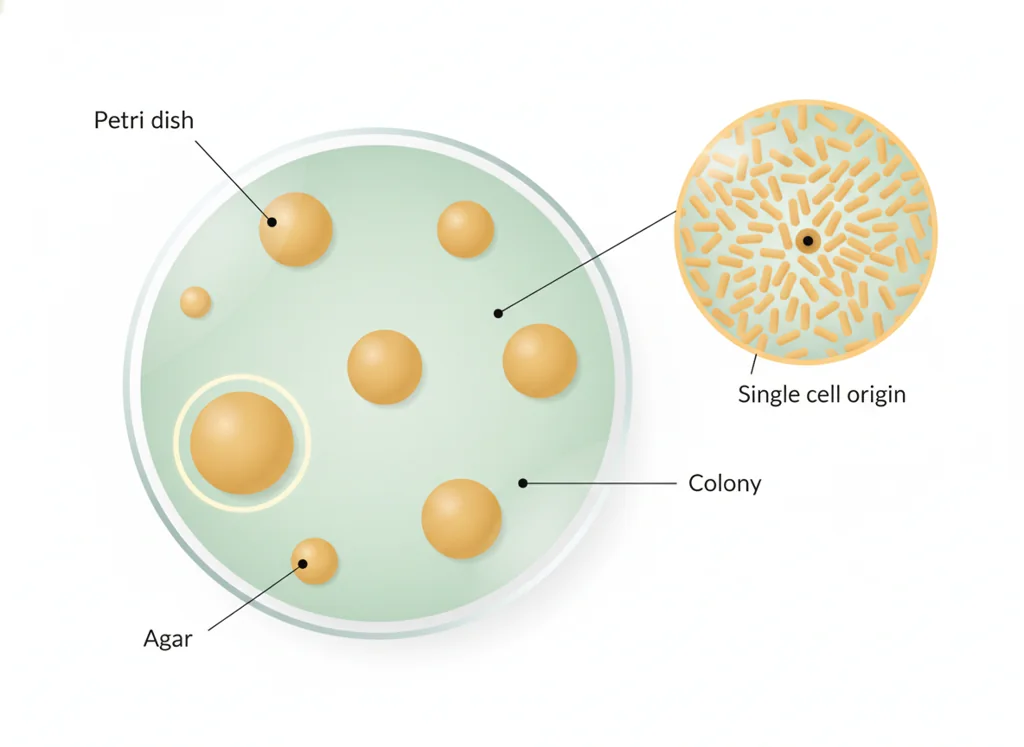
💡 Big idea: A isolates single cells so that each descends from one bacterium, which is why counting distinct colonies and describing consistent morphology gives you reliable data about a single strain.
- • A isolates individual bacteria so each that grows represents one clone descended from a single cell.
- • morphology (size, color, shape, edge type) is a first-level identifier; consistent morphology across the plate is a sign of a .
- • colonies are identified by distinct morphology different from the target; their count is recorded separately but they are not included in target- analysis.
Skin, breath, air, and unflamed tools all carry stray microbes, so limits their access to the plate in order to keep the pure and the results valid.
A isolates single cells so that each descends from one bacterium, which is why counting distinct colonies and describing consistent morphology gives you reliable data about a single strain.
Driving question: You streak your plate today and incubate it. Once colonies grow, how do you turn the dots into a count and a set of descriptions that another scientist could check?
What you already know: Skin, breath, air, and unflamed tools all carry stray microbes, so limits their access to the plate in order to keep the pure and the results valid.
New idea: A isolates single cells so that each descends from one bacterium, which is why counting distinct colonies and describing consistent morphology gives you reliable data about a single strain.
Visual or model: No figure is attached to this lesson. The readings, the worked example and E1 to E3 carry the evidence.
- Observe or measure the relevant feature in today's lesson.
- Organize the observation with a stable evidence ID.
- Apply this rule: A decision is stronger when the test fits the question and its limits are known.
- Choose the option the evidence supports and state the limit of the conclusion.
Real biomedical example: You streak your plate today and incubate it. Once colonies grow, how do you turn the dots into a count and a set of descriptions that another scientist could check?
What the evidence supports: E1 to E3 support the daily take-home when the response meets the stated success criteria.
What it cannot prove: The package does not support claims beyond this lesson's or any real patient diagnosis.
- • : A set of careful practices used to keep microbes out of a sterile area, protecting samples, cultures, and patients from .
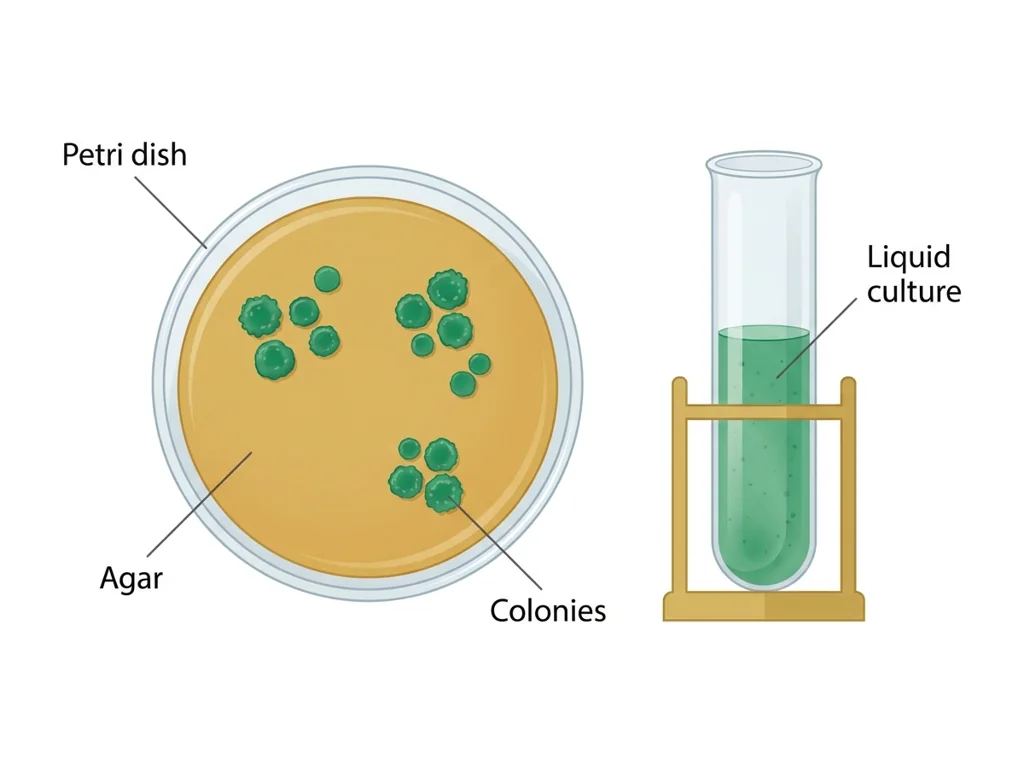
- • : A population of microbes or cells grown on purpose in a nutrient medium so they can be studied, identified, or tested.
- • : A visible cluster of identical microorganisms growing on a plate, all descended from a single original cell.
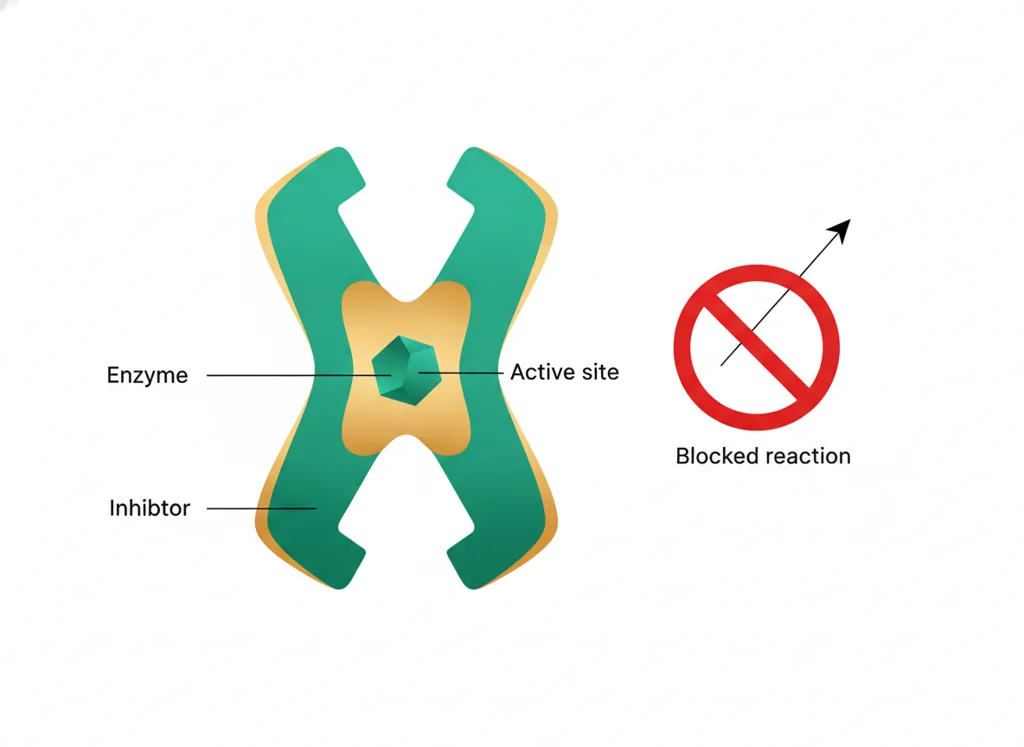
- • : The slowing or blocking of a process, such as an stopping bacteria from growing or a molecule shutting down an .
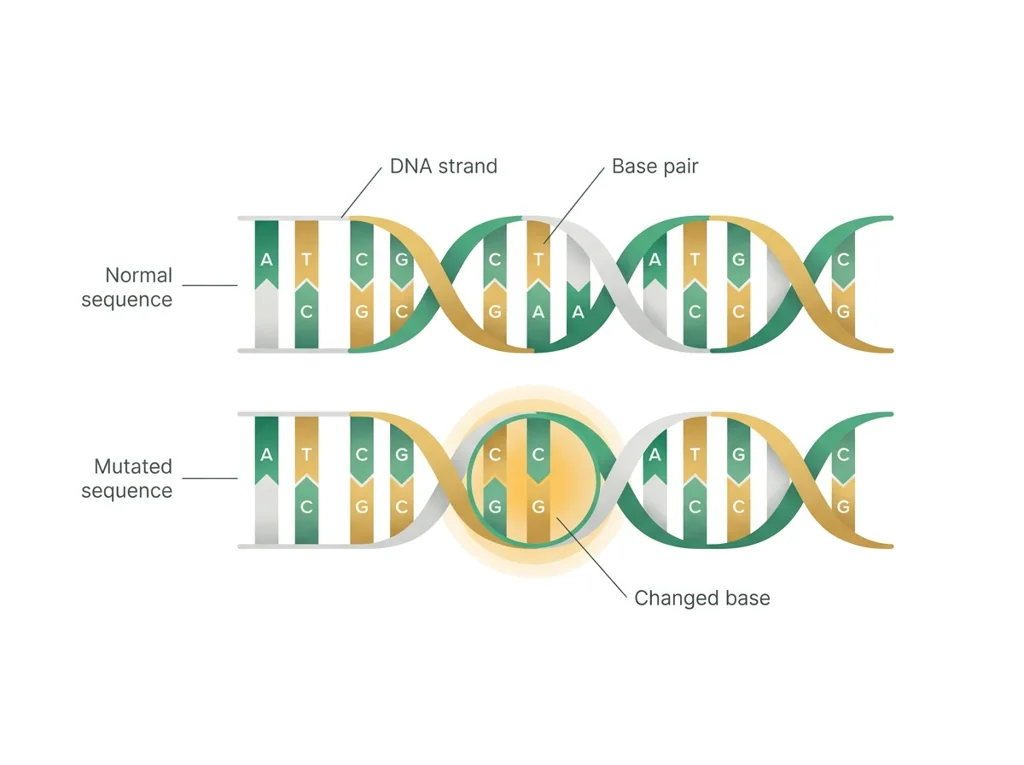
- • : A change in the ; some change a enough to cause disease, many do not.
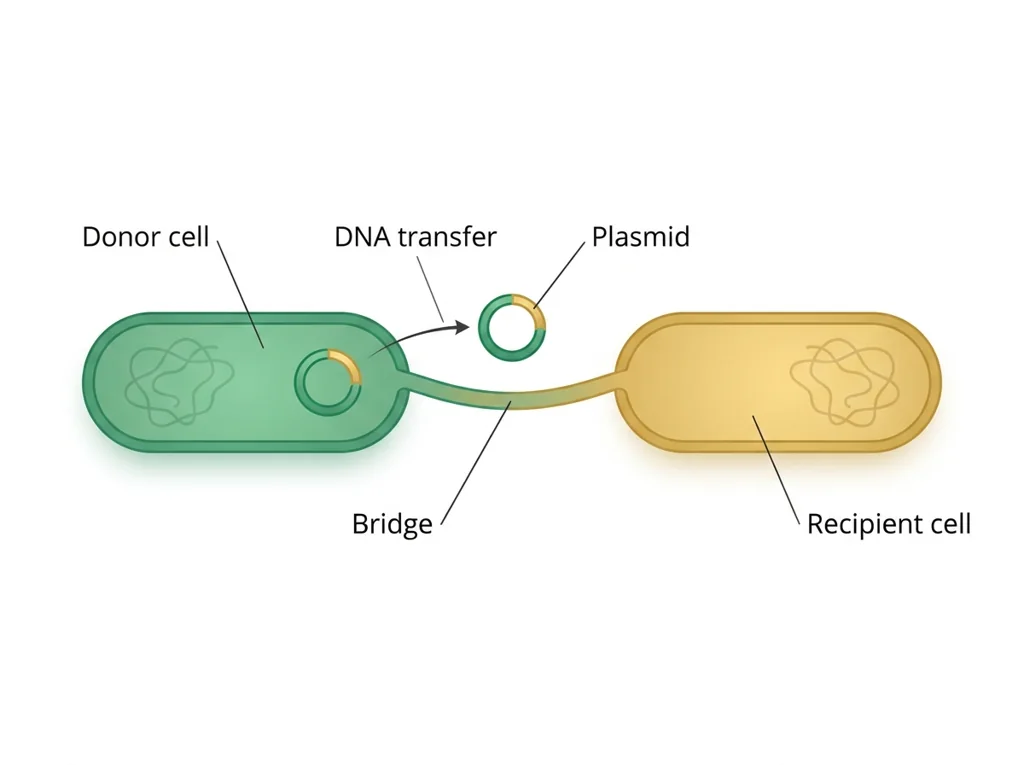
- • : The passing of genes between organisms, often bacteria, without reproduction, a major way spreads.
Use it now: Choose one decision option. Cite E1 and E3, then explain how the rule connects the evidence to your choice. This is thinking practice for the one turn-in named under Turn in, not a second submission.
Go further, optional: The source links below are optional enrichment. Every fact required for today's local evidence decision appears in this lesson package.
Laboratory depends on matching each identified hazard to an appropriate containment practice, protective measure, and stop-work condition before the procedure begins.
Limit: The lesson check does not replace the site-specific SDS, approved procedure, teacher supervision, or emergency plan.
A decision is stronger when the test fits the question and its limits are known.
Limit: Medical decisions also depend on biology, patient context, ethics, and professional judgment.
You can streak and incubate a aseptically.
Limit: E3 defines the classroom product or success criterion. It is not independent scientific evidence and cannot justify a clinical or causal claim.
Today's decision · Simulated classroom evidence scenario
Your role: medical interventions team member
Decision: Your team must decide what the evidence from today's lesson supports before submitting the labeled and result claim named on today's page.
- • Restreak the plate before counting, because never spread the cells apart enough to give countable colonies.
- • Record only the separated dots that each grew from one cell, and log any off color as .
- • Count the biggest, densest patch as your strongest growth, since every colored spot on the plate is a .
Response: State one choice, cite at least two evidence IDs, explain the rule that connects them, and add one limitation. Use it inside the one turn-in named under Turn in; it is not a separate submission.
Claim ceiling: Today's evidence supports a classroom claim about today's lesson. It cannot prove causation, diagnose a real patient, or justify action outside this room.
Students often think a bigger, denser-looking smudge on the plate means more or better colonies, and that any colored patch counts as a . The trap: a smear where bacteria never got spread apart is , not countable colonies; you can only count where individual cells were isolated enough to grow into separate dots, and colonies that look different from your target (different color, shape, or edge) are and get recorded separately, not lumped into your count.
- CER:
- Claim, Evidence, Reasoning: make a claim, back it with evidence, explain your reasoning.
- SOP:
- Standard Operating Procedure, the exact steps to follow (especially in a lab).
- Tracker:
- Your PLTW progress log where you record completed evidence.
- myPLTW:
- The PLTW course site where you do the online activities. Find it in Clever with your Microsoft sign-in, right next to Schoology.
Tap the speaker to hear a term. Add two of these to your notebook glossary with a definition and an example in your own words.
Pick just 2 or 3 words from today and make them yours: write what each one means in your own words, name the context clue or evidence that helped, then give one example from what you actually did in Culturing and colony data lab. Try your own words first; the glossary is there if you get stuck. This is voluntary and counts as extra credit, so keep it short.
Saved on this device. Show Mr. Mendoza or add these to your notebook glossary to claim the extra credit.
Part 2 of 4 · Directions in plain English▸
2.1 Open your materials
Use the materials named in the first step below. Open lesson resources.
2.2 Start the work
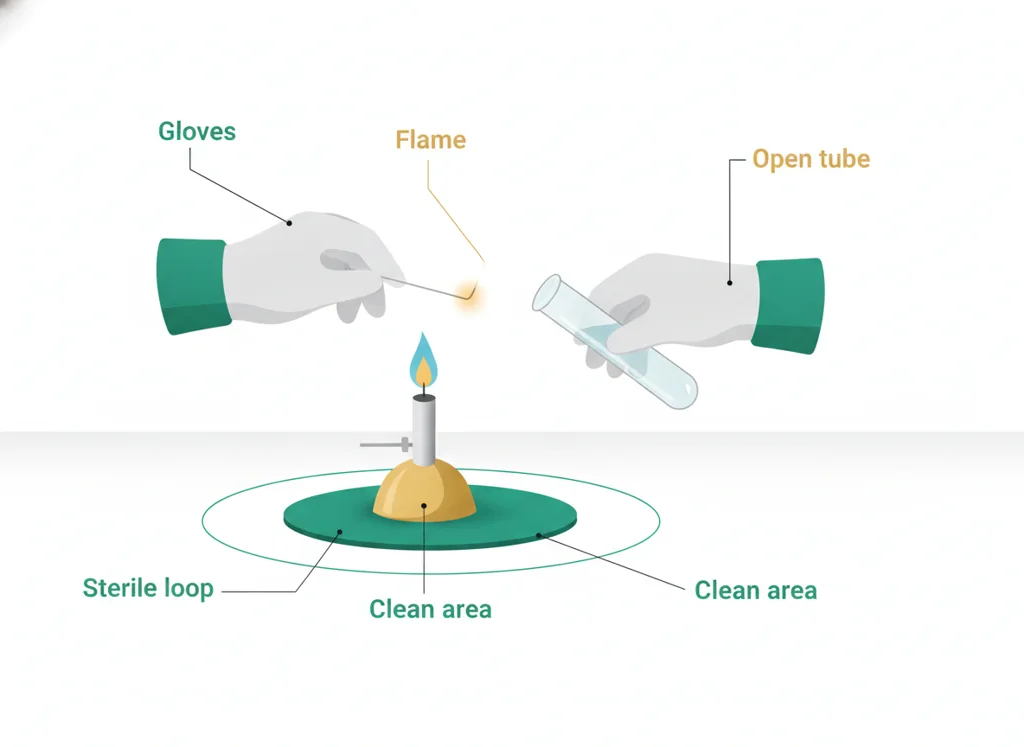
Put on gloves and use aseptic technique to streak your plate.
Show all 6 required steps
- Put on gloves and use aseptic technique to streak your plate.
- Label the bottom of the plate with your period and code, the date, and the sample, tape the lid shut, then set it to incubate lid down.
- Make your setup record: a sketch of your streak pattern, your plate label, and a prediction of how many separate colonies will grow and what contamination would look like. Submit it as one PDF to Wk7 Data table: Culturing and colony data lab in Schoology by the end of class today.
- On Tuesday, October 6, in the first 10 minutes of class, read your plate through the taped lid: count the distinct colonies and describe size, color, shape, and edges.
- Note any signs of contamination and separate them from your target colonies.
- Record your colony count and descriptions in the data table. On Tuesday, October 6, your finished colony data table goes inside that day's one notebook PDF (Wk7 Lab notebook: Mutation, HGT, and superbugs); it does not come back to this assignment.
Lost your place? Find your step: if your plate is not streaked, labeled with your period and code, the date, and the sample, taped shut and in the incubator, finish that, then make your setup record; on Tuesday, October 6, count the distinct target colonies, then describe each one's size, color, shape, and edge, and record any different-looking colonies as possible contamination.
- 0-8 minDon gloves and goggles; review the checklist you wrote last class before opening any materials
- 8-25 minStreak the plate using the four-quadrant method (or as directed); use throughout
- 25-30 minLabel plate with period and code, date, and sample source; tape the lid shut; set to incubate inverted
- 30-52 minMake the setup record: sketch your streak pattern, copy your label, and predict the count and what would look like; submit it as one PDF in Schoology
- 52-67 minSet up the empty for Tuesday, October 6: count, size (mm estimated), color, shape (round/irregular), edge (smooth/rough/wavy), and a separate tally
- 67-80 minClean up: bleach used materials for at least 20 minutes, the bench, wash hands
- • Every your doctor might prescribe was first tested against colonies grown exactly this way on agar plates.
- • The count and morphology you record at the start of next class feed directly into that day's HGT lesson on how resistance spreads.
- • Your practice from last class has one job today: make sure what grows on your plate is what you intended to grow.
- • Exit goal: a labeled, taped plate in the incubator and a setup record submitted in Schoology. Colonies need about a day to grow, so you count them in the first 10 minutes of class on Tuesday, October 6, and the goes inside that day's one notebook PDF.
PLTW connection and today's work
Open Project 1.2.3 Attack of the Superbugs in myPLTW and follow the culturing protocol to set up your plates today.
Today's stopping point: Pre-lab plan should be done (last class); plates inoculated and documented today.
PLTW activity titles identify the course connection. If your account will not open, use the posted materials for today and tell Mr. Mendoza. Do not mark an online activity complete unless you completed it.
Course connection
- Project 1.2.3 Attack of the Superbugs
Use the turn-in directions in Part 4 of this page. Do not create a second submission unless your teacher asks for one.
Show another explanation or a smaller first step
Need help? Choose a starting point
Finish the assigned lab safely before starting extra practice.
Part 3 of 4 · Worked example▸
This is a parallel case, not your own. Read it for the order of the work, then do your own in Part 4.
Practice plate, not yours (your counts and colors will differ): I streaked my plate using aseptic technique, labeled it with my period and code, the date, and 'Sample 1,' and incubated it. After growth, I counted and described the colonies.
Target colonies: I counted 14 colonies that all looked the same, which suggests a pure culture descended from one strain. Each was small (about 1 mm), cream colored, round, and had a smooth edge.
Contamination: I found 2 colonies that looked different (larger, yellow, fuzzy edges). I did not count these as target colonies because they are a different organism. I recorded them separately so my analysis stays clean.
Conclusion note: Because almost all my colonies share one morphology, I am confident most of the plate is my target strain.
| Group | Count | Size | Color | Shape | Edge |
|---|---|---|---|---|---|
| Target | 14 | ~1 mm | cream | round | smooth |
| Contamination | 2 | ~3 mm | yellow | irregular | fuzzy |
This model shows the level of evidence and organization needed to complete: Completes the culturing lab data collection: a colony count with morphology descriptions for target colonies and a separate tally for any contamination colonies.
- Name the variables and include units.
- Enter observations without changing the raw values.
- Check labels, calculations, and patterns before interpreting the data.
Keep the structure. Replace the question, facts, measurements, and evidence. Then recheck units, vocabulary, and whether the conclusion goes beyond the evidence.
Also due today: Today you submit only the setup record (streak sketch, label, predictions). A finished table like this one goes inside your one notebook PDF on Tuesday, October 6, after you count your colonies in the first 10 minutes of that class.
An airport checkpoint uses an ID check, a metal detector, and an X-ray scanner.
- What can the ID check detect?
- What might set off the metal detector by mistake?
- Why do we need the X-ray if we already checked their ID?
A decision is stronger when the test fits the question and its limits are known.
Medical decisions also depend on biology, patient context, ethics, and professional judgment.
- • The ID check maps to confirming patient identity.
- • The metal detector maps to a rapid, non-specific screening test.
- • The X-ray scanner maps to a detailed, specific diagnostic test.
Part 4 of 4 · Your work▸
Check your work before submitting
- You will be able to streak and incubate a culture aseptically.
- You will be able to count and describe bacterial colonies.
- You will be able to distinguish target colonies from contamination.
Before lab work: read the safety rules
- Disinfect your bench before you start and again after cleanup.
- No food or drink in the lab.
- Tie back long hair and keep loose sleeves away from the open flame.
- Goggles and gloves on before opening any culture tube; keep on until all materials are decontaminated.
- Treat all bacterial cultures as biohazardous even if the strain is labeled safe; apply standard biosafety level 1 (BSL-1) precautions, the lowest of the four containment levels.
- Open a culture tube only for the moment of transfer and away from air vents; keep lids on except during inoculation.
- Flame inoculating loops until red-hot and allow to cool for five seconds before touching culture; do not wave hot loops through the air.
- Tape the lid shut before incubating. Incubated plates stay taped shut and are read through the lid. Never open an incubated plate.
- Set plates to incubate inverted; do not stack more than three plates to prevent slipping.
- Before disposal: flood plates with 10% bleach and leave it in contact for at least 20 minutes (or autoclave), then seal in a biohazard bag and dispose per school protocol.
- Wash hands with soap and water immediately after removing gloves.
4.1 Turn in your work
DueCheck the Schoology assignment for this day- Hand in
- Today, the setup record: streak-pattern sketch, plate label with your period and code, and your predictions. On Tuesday, October 6, the finished colony data table (colony count, size estimate, color, shape, edge type for target colonies; separate tally for contamination colonies) goes inside that day's notebook PDF.
How to submit and name your file
Submit the setup record as one PDF to Wk7 Data table: Culturing and colony data lab in Schoology by the end of class today. On Tuesday, October 6, your finished colony data table goes inside that day's one notebook PDF (Wk7 Lab notebook: Mutation, HGT, and superbugs); it does not come back to this assignment.
In Schoology, open your course and the assignment for this lesson. Attach your file, select Submit, and check that it appears in the submission.
PDF upload helpYou get two school days for every day you were absent, so this deadline moves with you.
Find this lesson's Schoology assignments
These are existing assignments for your section. Follow the directions in the assignment you are working on; this list does not add new work. A PLTW Work row repeats on every day of its lesson; submit it once. Check Schoology for each deadline.
- Wk7 Data table: Culturing and colony data lab(today's turn-in)
Link will not open? Open Schoology, choose your course and section, and find the title shown above.
- CompleteEvery required part of the artifact is present, nothing left blank.
- AccurateThe science and the data are correct and match the evidence.
- Scientific reasoningYou explain your claim with evidence and reasoning (CER), not just an answer.
- Professional communicationClear, organized, labeled, and written the way a clinician or scientist would.
- SubmittedGo to Schoology to turn this in. Submit one PDF. Schoology attaches your name to your upload; on the page itself, write your period and code. Name the file: FirstName LastName - Assignment Title - YYYY-MM-DD.pdf. If you cannot get in, see Mr. Mendoza. Do not skip the work.
- Error analysis and method · counts doubleName a specific limit of the method and how it moved your result, and compare what you predicted to what happened. "Human error" does not count; say what about the procedure or instrument caused it.
How this lesson connects
Keep using what you learned last class: Skin, breath, air, and unflamed tools all carry stray microbes, so aseptic technique limits their access to the plate in order to keep the culture pure and the results valid. Today: A streak plate isolates single cells so that each colony descends from one bacterium, which is why counting distinct colonies and describing consistent morphology gives you reliable data about a single strain.
Practice: try a question, then check your answer▸
Claim ceiling for this check: Today's evidence supports a classroom claim about today's lesson. It cannot prove causation, diagnose a real patient, or justify action outside this room.
On your plate you count 24 round cream-colored colonies with smooth edges and 2 fuzzy green colonies. What is your target colony count, and what do you do with the green ones?
Write an answer and pick a confidence to unlock the key.
Fast retrieval with instant answers, not the commit-then-reveal check above. Try each from memory first: write what you remember about the earlier units, then check yourself here.
Missed class or ready for more?▸
Run this before you touch the bench. It is built from the real lab procedure, so the decisions you make here are the ones you will make with the equipment in your hands.
I can name the procedure's purpose and the evidence I will record. I can name today's hazards and the control for each: Tie back long hair and keep loose sleeves away from the open flame. My data table is ready before materials are handled.
Finish the checklist before you handle any material.
- • Disinfect your bench before you start and again after cleanup.
- • No food or drink in the lab.
- • Tie back long hair and keep loose sleeves away from the open flame.
- • Goggles and gloves on before opening any culture tube; keep on until all materials are decontaminated.
- • Treat all bacterial cultures as biohazardous even if the strain is labeled safe; apply standard biosafety level 1 (BSL-1) precautions, the lowest of the four containment levels.
- • Open a culture tube only for the moment of transfer and away from air vents; keep lids on except during inoculation.
- • Flame inoculating loops until red-hot and allow to cool for five seconds before touching culture; do not wave hot loops through the air.
- • Tape the lid shut before incubating. Incubated plates stay taped shut and are read through the lid. Never open an incubated plate.
- • Set plates to incubate inverted; do not stack more than three plates to prevent slipping.
- • Before disposal: flood plates with 10% bleach and leave it in contact for at least 20 minutes (or autoclave), then seal in a biohazard bag and dispose per school protocol.
- • Wash hands with soap and water immediately after removing gloves.
- 1Before materials are handled, identify the purpose, variables or comparison, controls, measurement units, and stop-work condition.
- 2Put on gloves and use aseptic technique to streak your plate.
- 3Label the bottom of the plate with your period and code, the date, and the sample, tape the lid shut, then set it to incubate lid down.
- 4Make your setup record: a sketch of your streak pattern, your plate label, and a prediction of how many separate colonies will grow and what contamination would look like. Submit it as one PDF to Wk7 Data table: Culturing and colony data lab in Schoology by the end of class today.
- 5On Tuesday, October 6, in the first 10 minutes of class, read your plate through the taped lid: count the distinct colonies and describe size, color, shape, and edges.
- 6Note any signs of contamination and separate them from your target colonies.
- 7Record your colony count and descriptions in the data table. On Tuesday, October 6, your finished colony data table goes inside that day's one notebook PDF (Wk7 Lab notebook: Mutation, HGT, and superbugs); it does not come back to this assignment.
- 8Record each result in the prepared table before interpreting it. Mark missing, repeated, or invalid results truthfully.
- 9Complete the named cleanup and waste route, remove PPE safely, wash hands when required, and confirm the station is ready for the next group.
| Which trial or sample this row is | What you changed on purpose | What you measured, with units | What you saw, before you explain it | Anything that could make this reading wrong |
|---|---|---|---|---|
Before the procedure, predict the result and cite the rule behind the prediction.
After the procedure, compare the result with the prediction and name one limitation or source of uncertainty.
What today's skills lead to. These are real health-science careers this course builds toward. Tap one to see, on the US Department of Labor's O*NET site, what the job actually involves, what it pays, and how fast it is growing.
If you miss the lab, work the virtual resistance dataset and teacher images: count colonies, describe their features, and submit your as one PDF to Wk7 Data table: Culturing and colony data lab in Schoology.
learn.genetics (Utah) virtual labsSubmit the setup record as one PDF to Wk7 Data table: Culturing and colony data lab in Schoology by the end of class today. On Tuesday, October 6, your finished colony data table goes inside that day's one notebook PDF (Wk7 Lab notebook: Mutation, HGT, and superbugs); it does not come back to this assignment.
Class still runs. Complete today's work as this page describes (it is self-guided). Need the concept taught without a teacher? Use this authoritative explainer:
CDC Antibiotic ResistanceSources: slides, readings, and resources▸
The deck carries the prior idea forward, lets you inspect an analogy, maps the rule to biology, and ends with the same evidence decision and exit ticket used on this page.
Classroom documents for this lesson are posted in Schoology. Open Clever, then Schoology, and find each one by the name shown on its card.
Use this if you were absent, got stuck, or need another pass before you submit the lesson artifact.
Open this when the class reaches this activity and use it to complete the required lesson artifact.
Sign in to Clever with your district Microsoft account to open Schoology or myPLTW. Follow today's posted steps. If myPLTW will not open, use the posted alternative and tell Mr. Mendoza. Turn in your completed work through the Schoology assignment.
This week
My Progress dashboard