
Your Weeks Work packet
The packet tells this week's story day by day, explains every term on labeled reference pages, and lists each task with its deadline. Open it before you start today's work. The mind map shows how the whole unit fits together, with the tested ideas in red. Your Unit 1 Take-Home Exam is handed out Friday, October 2 and due Monday, October 5 at the start of class. It replaces the in-class Unit 1 Test printed in the packet, so ignore the packet's 40-minute and pencil instructions for the test.
Disk diffusion and MIC lab
This page has four parts, in the order you use them. Part 1 is what you need to know. Part 2 says what to do, in plain English. Part 3 shows the work done once on a case that is not yours. Part 4 is your own work and where to turn it in.
Open your materials, follow the steps, then turn in your work.
Run a disk-diffusion test and connect zone of inhibition to minimum inhibitory concentration.
Optional: listen or watch a unit review▸
Part 1 of 4 · Background and definitions▸
💡 Big idea: A wider clear zone means this organism is inhibited at a lower concentration of that same drug, but zone width cannot rank one drug against another, because each diffuses through agar at its own rate and each has its own breakpoint.
- • The test measures effectiveness by placing antibiotic-impregnated disks on a bacterial lawn and measuring the clear zone that forms.
- • The is the area around the disk where bacteria could not grow. For one drug, a larger zone means it stopped growth even where it had diffused to a lower concentration; two different drugs cannot be ranked against each other by zone size, because disk loads and diffusion differ.
- • The minimum inhibitory concentration () is the lowest concentration of an that prevents visible bacterial growth. For the same drug, a larger zone points to a lower MIC; each drug is read against its own cutoff.
Because every use of an kills the susceptible bacteria and leaves the resistant ones to multiply, appropriate use is a shared responsibility so that the drug still works when someone truly needs it. The drug itself does not weaken; the bacterial population changes.
A wider clear zone means this organism is inhibited at a lower concentration of that same drug, but zone width cannot rank one drug against another, because each diffuses through agar at its own rate and each has its own breakpoint.
Driving question: You place three disks on one bacterial lawn and get clear rings of different sizes. How do you turn those millimeter measurements into a reading for each drug, without ranking the drugs against each other?
What you already know: Because every use of an kills the susceptible bacteria and leaves the resistant ones to multiply, appropriate use is a shared responsibility so that the drug still works when someone truly needs it. The drug itself does not weaken; the bacterial population changes.
New idea: A wider clear zone means this organism is inhibited at a lower concentration of that same drug, but zone width cannot rank one drug against another, because each diffuses through agar at its own rate and each has its own breakpoint.
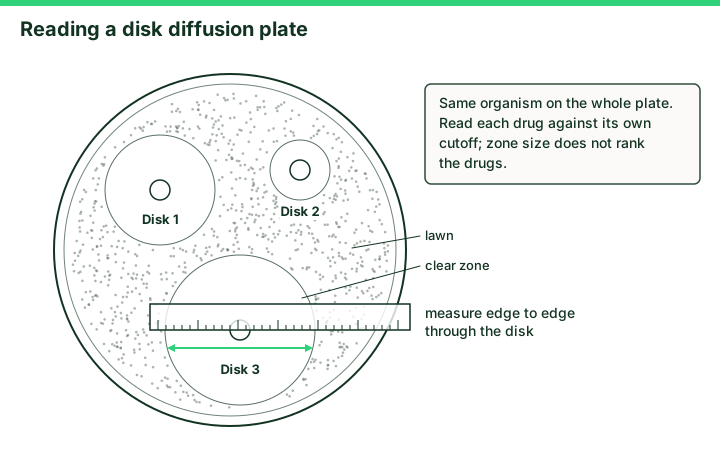
- Observe or measure the relevant feature in today's lesson.
- Organize the observation with a stable evidence ID.
- Apply this rule: A threshold applies to the dose actually received, not just the concentration in the environment.
- Choose the option the evidence supports and state the limit of the conclusion.
Real biomedical example: You place three disks on one bacterial lawn and get clear rings of different sizes. How do you turn those millimeter measurements into a reading for each drug, without ranking the drugs against each other?
What the evidence supports: E1 to E3 and the figure support the daily take-home when the response meets the stated success criteria.
What it cannot prove: The package does not support claims beyond this lesson's or any real patient diagnosis.
- • : A drug that kills bacteria by attacking structures like the bacterial cell wall, which makes it useless against viruses because viruses are not cells and lack those targets.
- • : Describes an agent that kills bacteria outright, rather than only stopping them from multiplying.
- • : The mesh-like molecule of sugar chains linked by short peptides that forms the strong cell wall of bacteria and gives it shape.
- • : A lab test where small paper disks soaked with antibiotics are placed on a bacteria-coated plate, and clear rings show which drugs stop growth.
- • : A clear ring on a bacterial lawn around an disk where the drug has killed off or stopped the growth of the bacteria.
- • : When bacteria survive a drug that used to kill them, because a or a gene picked up from other bacteria protects them, and the survivors pass that protection to the next generation. The bacterial population changes, not the patient.
Use it now: Choose one decision option. Cite E1 and E3, then explain how the rule connects the evidence to your choice. This is thinking practice for the one turn-in named under Turn in, not a second submission.
Go further, optional: The source links below are optional enrichment. Every fact required for today's local evidence decision appears in this lesson package.
Antimicrobial resistance can arise and spread through selection and genetic change, so susceptibility results must be interpreted with method-specific standards and clinical context.
Limit: A zone size or classroom result alone does not determine a patient's treatment or prove a specific resistance mechanism.
A threshold applies to the dose actually received, not just the concentration in the environment.
Limit: A single dose calculation assumes a one-time exposure and does not account for over time.
You can set up a disk-diffusion test safely.
Limit: E3 defines the classroom product or success criterion. It is not independent scientific evidence and cannot justify a clinical or causal claim.
Today's decision · Simulated classroom evidence scenario
Your role: medical interventions team member
Decision: Your team must decide what the evidence from today's lesson supports before submitting the labeled and result claim named on today's page.
- • Compare each zone against the method's own standards before ranking, since millimeters alone do not say susceptible or resistant.
- • Rank the widest clear zone as the strongest drug, because it stopped growth where the had spread thin.
- • Call the drug with the widest ring the one needing the highest dose, since it is doing the most work.
Response: State one choice, cite at least two evidence IDs, explain the rule that connects them, and add one limitation. Use it inside the one turn-in named under Turn in; it is not a separate submission.
Claim ceiling: Today's evidence supports a classroom claim about today's lesson. It cannot prove causation, diagnose a real patient, or justify action outside this room.
Reason for review: Your team must decide what the evidence from today's lesson supports before submitting the labeled and result claim named on today's page.
Context: The clear zone around an disk is a readout for that one drug on that one organism: a wider zone means the same drug stops growth at a lower concentration, and each zone is read against its own drug's cutoff, never against another drug's zone.
- • T1: Put on goggles and gloves and label the bottom of your plate with your period and code, the date, and where each disk goes.
- • T2: Place disks on the bacterial lawn using .
- • T3: Tape the lid shut, set the plate to incubate lid down, and make your setup record: a plate map showing which disk sits where, your labels, and a prediction of which zone will be widest and what a clear zone will mean. Submit the setup record as one PDF to Wk6 : and lab in Schoology by the end of class today.
- • T4: On Thursday, October 1, right after the John Carroll debate, read your plate through the taped lid and measure each in millimeters.
- • T5: Use the zone-size chart that comes with the PLTW activity (your teacher hands it out with the plates). Where it has a row for the organism on your plate label and that drug, turn the millimeters into susceptible, intermediate or resistant. Where it has no row, write 'no cutoff for this organism' and rank by zone size instead: that is a spectrum demonstration, not a resistance result.
- • T6: Define , and explain why a larger zone hints at a lower MIC for the SAME drug but says nothing when you compare two different drugs.
- • E1: Antimicrobial resistance can arise and spread through selection and genetic change, so susceptibility results must be interpreted with method-specific standards and clinical context.
- • E2: A threshold applies to the dose actually received, not just the concentration in the environment.
- • E3: You can set up a disk-diffusion test safely.
Measurements: Use only the measurements, units, graph, or counts supplied in today's task. No additional patient measurement is implied.
Figure finding: A petri dish seen from above with a stippled lawn, three disks labeled Disk 1, Disk 2 and Disk 3 with clear zones of different sizes, a ruler with unlabeled ticks laid across one zone through the disk center, and a boxed note that the same organism is on the whole plate and that zone size does not rank the drugs.
Uncertainty: This is a composite classroom scenario. Missing history, measurements, or confirmation tests remain unknown and limit the conclusion.
= the full diameter of the clear circle, edge to edge through the disk, disk included, in whole millimeters. 24 mm across means 24 mm in the table, not 9 mm of clearing on each side. Growth up to the disk edge means no zone; record it as 6 mm, the disk's own diameter.
A clear zone measures 24 mm across, through the center of a 6 mm disk. What number goes in your table, and what does a disk with growth right up to its edge get?
Every zone is at least 6 mm (the disk itself) and is a whole number of millimeters. A value under 6 mm, or one with decimals, means the ruler was read wrong.
Measure each of your zones through the disk center, record whole millimeters, and write 6 mm for any disk with growth to its edge. Then rank the zones by size; the rank is of zones, not of drugs.
Students often think a bigger clear zone means the drug needs a higher dose, since it seems to be doing more work. The trap: it reverses the relationship. A bigger zone means the drug stopped growth even where it had diffused thin, so it works at a lower concentration, which means a lower minimum inhibitory concentration, not a higher one.
- CER:
- Claim, Evidence, Reasoning: make a claim, back it with evidence, explain your reasoning.
- SOP:
- Standard Operating Procedure, the exact steps to follow (especially in a lab).
- Tracker:
- Your PLTW progress log where you record completed evidence.
- myPLTW:
- The PLTW course site where you do the online activities. Find it in Clever with your Microsoft sign-in, right next to Schoology.
Tap the speaker to hear a term. Add two of these to your notebook glossary with a definition and an example in your own words.
Pick just 2 or 3 words from today and make them yours: write what each one means in your own words, name the context clue or evidence that helped, then give one example from what you actually did in Disk diffusion and MIC lab. Try your own words first; the glossary is there if you get stuck. This is voluntary and counts as extra credit, so keep it short.
Saved on this device. Show Mr. Mendoza or add these to your notebook glossary to claim the extra credit.
Part 2 of 4 · Directions in plain English▸
2.1 Open your materials
Use the materials named in the first step below. Open lesson resources.
2.2 Start the work
Put on goggles and gloves and label the bottom of your plate with your period and code, the date, and where each antibiotic disk goes.
Show all 6 required steps
- Put on goggles and gloves and label the bottom of your plate with your period and code, the date, and where each antibiotic disk goes.
- Place antibiotic disks on the bacterial lawn using aseptic technique.
- Tape the lid shut, set the plate to incubate lid down, and make your setup record: a plate map showing which disk sits where, your labels, and a prediction of which zone will be widest and what a clear zone will mean. Submit the setup record as one PDF to Wk6 Data table: Disk diffusion and MIC lab in Schoology by the end of class today.
- On Thursday, October 1, right after the John Carroll debate, read your plate through the taped lid and measure each zone of inhibition in millimeters.
- Use the zone-size chart that comes with the PLTW activity (your teacher hands it out with the plates). Where it has a row for the organism on your plate label and that drug, turn the millimeters into susceptible, intermediate or resistant. Where it has no row, write 'no cutoff for this organism' and rank by zone size instead: that is a spectrum demonstration, not a resistance result.
- Define MIC, and explain why a larger zone hints at a lower MIC for the SAME drug but says nothing when you compare two different drugs.
Lost your place? If you stepped away, check your plate: are the disks placed and is it incubating? If zones have formed, pick up at measuring each zone of inhibition in millimeters, then rank the zones by size and read each drug against its own cutoff.
- 0-8 minDon goggles and gloves; confirm plate is labeled with the abbreviation for each disk location
- 8-22 minUsing , place disks on the bacterial lawn at the labeled positions
- 22-30 minTape the lid shut and set plate to incubate (inverted); write what a clear zone will indicate
- 30-50 minMake the setup record: plate map, labels, and a prediction for each disk; submit it as one PDF in Schoology
- 50-65 minSet up the empty for Thursday, October 1: a row per disk for zone (mm) and zone rank; the ranking will be of zones, not of drugs
- 65-80 minDefine in notebook; write one sentence on what a larger zone means for the same drug and one on why two different drugs cannot be ranked by zone size
- • The test has been the clinical standard for sensitivity testing since 1966 and is still used in hospitals today.
- • The data you collect today will drive the resistance and stewardship analysis and the report later in this unit.
- • is critical: will produce zones that mean nothing.
- • Zones need 16 to 24 hours of to form, so no zone can be measured today. You read and measure your plate on Thursday, October 1, right after the John Carroll debate.
- • Exit goal: a setup record (plate map, labels with your period and code, and a prediction for each disk) submitted as one PDF in Schoology. The finished goes inside your one debate PDF at the end of class on Thursday, October 1.
PLTW connection and today's work
Open Activity 1.2.1 Antibiotic Therapy in myPLTW and apply what you know about how antibiotics act to the case patient.
Today's stopping point: Your stewardship CER PDF should be submitted (last class); antibiotic selection and justification due today.
PLTW activity titles identify the course connection. If your account will not open, use the posted materials for today and tell Mr. Mendoza. Do not mark an online activity complete unless you completed it.
Use the turn-in directions in Part 4 of this page. Do not create a second submission unless your teacher asks for one.
Show another explanation or a smaller first step
Need help? Choose a starting point
Finish the assigned lab safely before starting extra practice.
Part 3 of 4 · Worked example▸
This is a parallel case, not your own. Read it for the order of the work, then do your own in Part 4.
Connection to MIC: a larger zone of inhibition means the antibiotic stopped bacterial growth even where it had spread thin and dilute, which points to a lower minimum inhibitory concentration (less drug needed to work).
Comparison, with its limit: C produced the widest zone (22 mm), then A (18 mm), then B (9 mm). Zone width cannot rank different antibiotics against each other, because each drug diffuses through agar at its own rate and each has its own clinical breakpoint, so this ranks the zones, not the drugs.
| Antibiotic | Zone of inhibition (mm) | Zone rank (not a drug ranking) |
|---|---|---|
| Antibiotic C | 22 | 1 (widest zone) |
| Antibiotic A | 18 | 2 |
| Antibiotic B | 9 | 3 (narrowest zone) |
This model shows the level of evidence and organization needed to complete: A data table listing each antibiotic, its measured zone of inhibition in millimeters, and a zone-size rank that is not a drug ranking, with a sentence on what zone size means for the same drug and its MIC.
- Name the variables and include units.
- Enter observations without changing the raw values.
- Check labels, calculations, and patterns before interpreting the data.
Keep the structure. Replace the question, facts, measurements, and evidence. Then recheck units, vocabulary, and whether the conclusion goes beyond the evidence.
Also due today: Today you submit only the setup record (plate map, labels, predictions). A finished table like this one goes on the last page of your one debate PDF on Thursday, October 1, after you read your plate right after the John Carroll debate.
A pharmacist converts a medication concentration in a bottle into a patient-specific dose before comparing it to the safe limit.
- What is the concentration?
- What is the intake volume?
- What is the final dose?
A threshold applies to the dose actually received, not just the concentration in the environment.
A single dose calculation assumes a one-time exposure and does not account for over time.
- • The bottle concentration maps to the environmental measurement.
- • The patient dose maps to the exposure actually taken in.
- • The pharmacy check maps to comparing against the regulatory threshold.
Part 4 of 4 · Your work▸
Check your work before submitting
- You will be able to set up a disk-diffusion test safely.
- You will be able to measure a zone of inhibition.
- You will be able to read a zone against its breakpoint table, and say why zone sizes from different drugs cannot be ranked against each other.
Before lab work: read the safety rules
- Disinfect your bench before you start and again after cleanup.
- No food or drink in the lab.
- Goggles and gloves on before opening any bacterial culture material; keep on until cleanup is complete.
- Treat all bacterial materials as biohazardous: no contact with skin, eyes, or mouth.
- Open plate lids only briefly and only near the workspace; do not talk, sneeze, or cough over an open plate.
- If a flame is used to sterilize forceps, tie back long hair and keep it away from the flame.
- Tape the lid shut before incubating. Incubated plates stay taped shut and are read through the lid. Never open an incubated plate.
- Incubate plates inverted (lid down) to prevent condensation dripping onto the lawn.
- Before disposal: flood plates with 10% bleach and leave it in contact for at least 20 minutes (or autoclave), then seal in a biohazard bag.
- Wash hands thoroughly with soap and water after removing gloves.
4.1 Turn in your work
DueCheck the Schoology assignment for this day- Hand in
- Today, the setup record: plate map, plate labels with your period and code, and a prediction for each disk. On Thursday, October 1, the finished data table: antibiotic name, zone of inhibition (mm), and the zones ranked by size (not a drug ranking); plus one sentence on what a larger zone means for the same drug and its MIC.
How to submit and name your file
Submit the setup record as one PDF to Wk6 Data table: Disk diffusion and MIC lab in Schoology by the end of class today. On Thursday, October 1, read your plate right after the John Carroll debate and put the finished data table on the last page of that day's one debate PDF; it does not come back to this assignment.
In Schoology, open your course and the assignment for this lesson. Attach your file, select Submit, and check that it appears in the submission.
PDF upload helpYou get two school days for every day you were absent, so this deadline moves with you.
Find this lesson's Schoology assignments
These are existing assignments for your section. Follow the directions in the assignment you are working on; this list does not add new work. A PLTW Work row repeats on every day of its lesson; submit it once. Check Schoology for each deadline.
- Wk6 Data table: Disk diffusion and MIC lab(today's turn-in)
Link will not open? Open Schoology, choose your course and section, and find the title shown above.
- CompleteEvery required part of the artifact is present, nothing left blank.
- AccurateThe science and the data are correct and match the evidence.
- Scientific reasoningYou explain your claim with evidence and reasoning (CER), not just an answer.
- Professional communicationClear, organized, labeled, and written the way a clinician or scientist would.
- SubmittedGo to Schoology to turn this in. Submit one PDF. Schoology attaches your name to your upload; on the page itself, write your period and code. Name the file: FirstName LastName - Assignment Title - YYYY-MM-DD.pdf. If you cannot get in, see Mr. Mendoza. Do not skip the work.
- Error analysis and method · counts doubleName a specific limit of the method and how it moved your result, and compare what you predicted to what happened. "Human error" does not count; say what about the procedure or instrument caused it.
How this lesson connects
Keep using what you learned last class: Because every use of an antibiotic kills the susceptible bacteria and leaves the resistant ones to multiply, appropriate use is a shared responsibility so that the drug still works when someone truly needs it. The drug itself does not weaken; the bacterial population changes. Today: A wider clear zone means this organism is inhibited at a lower concentration of that same drug, but zone width cannot rank one drug against another, because each antibiotic diffuses through agar at its own rate and each has its own breakpoint.
Practice: try a question, then check your answer▸
Claim ceiling for this check: Today's evidence supports a classroom claim about today's lesson. It cannot prove causation, diagnose a real patient, or justify action outside this room.
Drug A leaves a 22 mm clear zone and Drug B leaves a 10 mm zone on the same bacterial lawn. A classmate says Drug A is the stronger drug. What can the two zones actually support?
Write an answer and pick a confidence to unlock the key.
Missed class or ready for more?▸
Run this before you touch the bench. It is built from the real lab procedure, so the decisions you make here are the ones you will make with the equipment in your hands.
I can name the procedure's purpose and the evidence I will record. I can name today's hazards and the control for each: Goggles and gloves on before opening any bacterial culture material; keep on until cleanup is complete. My data table is ready before materials are handled.
Finish the checklist before you handle any material.
- • Disinfect your bench before you start and again after cleanup.
- • No food or drink in the lab.
- • Goggles and gloves on before opening any bacterial culture material; keep on until cleanup is complete.
- • Treat all bacterial materials as biohazardous: no contact with skin, eyes, or mouth.
- • Open plate lids only briefly and only near the workspace; do not talk, sneeze, or cough over an open plate.
- • If a flame is used to sterilize forceps, tie back long hair and keep it away from the flame.
- • Tape the lid shut before incubating. Incubated plates stay taped shut and are read through the lid. Never open an incubated plate.
- • Incubate plates inverted (lid down) to prevent condensation dripping onto the lawn.
- • Before disposal: flood plates with 10% bleach and leave it in contact for at least 20 minutes (or autoclave), then seal in a biohazard bag.
- • Wash hands thoroughly with soap and water after removing gloves.
- 1Before materials are handled, identify the purpose, variables or comparison, controls, measurement units, and stop-work condition.
- 2Put on goggles and gloves and label the bottom of your plate with your period and code, the date, and where each antibiotic disk goes.
- 3Place antibiotic disks on the bacterial lawn using aseptic technique.
- 4Tape the lid shut, set the plate to incubate lid down, and make your setup record: a plate map showing which disk sits where, your labels, and a prediction of which zone will be widest and what a clear zone will mean. Submit the setup record as one PDF to Wk6 Data table: Disk diffusion and MIC lab in Schoology by the end of class today.
- 5On Thursday, October 1, right after the John Carroll debate, read your plate through the taped lid and measure each zone of inhibition in millimeters.
- 6Use the zone-size chart that comes with the PLTW activity (your teacher hands it out with the plates). Where it has a row for the organism on your plate label and that drug, turn the millimeters into susceptible, intermediate or resistant. Where it has no row, write 'no cutoff for this organism' and rank by zone size instead: that is a spectrum demonstration, not a resistance result.
- 7Define MIC, and explain why a larger zone hints at a lower MIC for the SAME drug but says nothing when you compare two different drugs.
- 8Record each result in the prepared table before interpreting it. Mark missing, repeated, or invalid results truthfully.
- 9Complete the named cleanup and waste route, remove PPE safely, wash hands when required, and confirm the station is ready for the next group.
| Which trial or sample this row is | What you changed on purpose | What you measured, with units | What you saw, before you explain it | Anything that could make this reading wrong |
|---|---|---|---|---|
Before the procedure, predict the result and cite the rule behind the prediction.
After the procedure, compare the result with the prediction and name one limitation or source of uncertainty.
What today's skills lead to. These are real health-science careers this course builds toward. Tap one to see, on the US Department of Labor's O*NET site, what the job actually involves, what it pays, and how fast it is growing.
If you miss the lab, you will not have a plate of your own. Make the setup record on paper: a plate map with four disks labeled Drug W, Drug X, Drug Y and Drug Z, your period and code on it, and a prediction for each disk. Submit it as one PDF to Wk6 : and lab in Schoology. On Thursday, October 1, use the practice zone record in Part 2 of that day's page (mendozabiomed.org/learn/pltw-gend/day/2026-10-01) for your table page and write "practice data" at its top.
CDC Antimicrobial Resistance resourcesSubmit the setup record as one PDF to Wk6 Data table: Disk diffusion and MIC lab in Schoology by the end of class today. On Thursday, October 1, read your plate right after the John Carroll debate and put the finished data table on the last page of that day's one debate PDF; it does not come back to this assignment.
Class still runs. Complete today's work as this page describes (it is self-guided). Need the concept taught without a teacher? Use this authoritative explainer:
CDC Antibiotic ResistanceSources: slides, readings, and resources▸
Your Unit 1 Take-Home Exam is handed out Friday, October 2. It is due Monday, October 5 at the start of class. Read the study guide first, then take the practice test and check your answers with the key at the end.
The preparation page has the ten-skill checklist, a table of every test we used, the glossary, flashcards, two self-checking practice quizzes and study conversations you can read.
The deck carries the prior idea forward, lets you inspect an analogy, maps the rule to biology, and ends with the same evidence decision and exit ticket used on this page.
Classroom documents for this lesson are posted in Schoology. Open Clever, then Schoology, and find each one by the name shown on its card.
Open this when the class reaches this activity and use it to complete the required lesson artifact.
Open this when the class reaches this activity and use it to complete the required lesson artifact.
Use this if you were absent, got stuck, or need another pass before you submit the lesson artifact.
Sign in to Clever with your district Microsoft account to open Schoology or myPLTW. Follow today's posted steps. If myPLTW will not open, use the posted alternative and tell Mr. Mendoza. Turn in your completed work through the Schoology assignment.
This week
My Progress dashboard