
PBS/PBT · Sep 25 · Investigation Day 12 of 18 · Case A STATIC · Period 1-2
The Clock in the Body
One product: Time-of-death worksheet, Parts A to E plus your case's door-log timeline check, in one worksheet.
This page has four parts, in the order you use them. Part 1 is what you need to know. Part 2 says what to do, in plain English. Part 3 shows the work done once on a separate example. Part 4 is your own record and the tasks. Everything you write goes in one product.
Start: Open your own case, label the supplied-record route, and find the two thermometer numbers: the body's and the room's.
Claim ceiling: The window is an estimate with stated assumptions, not a fact. It constrains the timeline; it does not convict anyone inside it.
Part 1 of 4 · Background and definitions
What you need to know before you write
The last case lesson taught you that an autopsy is the last physical exam, performed for the living as much as the dead: it answers the questions the body can still answer. It did not supply a time of death.
R1. Your one worksheet
Complete the time-of-death worksheet, Parts A to E and your case's door-log timeline check. Use the supplied illustrative records for your class's case. You are reading records that were printed for you: a body temperature, a room temperature, one stiffness observation, one blood-settling observation, and a door access log. You did not measure a body, a scene model or a room, and this worksheet never says you did. All values are simulated.
Keep each observation beside the window you make from it and the assumption that could throw it off. A record may give less than you would like. A window that says "at least" with no upper limit is an honest answer when that is all the clock allows.
R2. Read the three body clocks
After death, the body changes on schedules, and a schedule can be read backward. Your case uses three clocks.
Algor mortis is body cooling after death, roughly on a schedule. Analogy to hold onto: the coffee cup; touch it and you know roughly when it was poured. In this course's working rule, the body cools from its normal living temperature, about 37 °C (98.6 °F), toward room temperature at roughly 1 to 1.5 °C per hour early on. Real examiners use tables that adjust for body size, clothing and the room. Limit: the room writes the schedule too. A warm room, clothing or body size bends the curve, so every algor estimate carries its assumptions, starting with that 37 °C normal.
Rigor mortis is temporary muscle stiffening after death; it comes and goes on a schedule. Analogy to hold onto: a timer you read backward. Muscles stiffen as their chemistry runs down, beginning in small muscles within a few hours, peaking around 12 hours, releasing over the next day. You read it backward from where the stiffness is. Limit: temperature and exertion before death shift it.
Livor mortis is blood settling to the lowest points after death, fixed after hours. Analogy to hold onto: sediment settling in a bottle. Blood settles to the lowest surfaces and shows as fixed purple discoloration after several hours. Livor tells time and position: if the settled pattern does not match the found position, the body was moved, and that is a case-changing fact. Limit: dark skin tones and pressure points complicate the read.
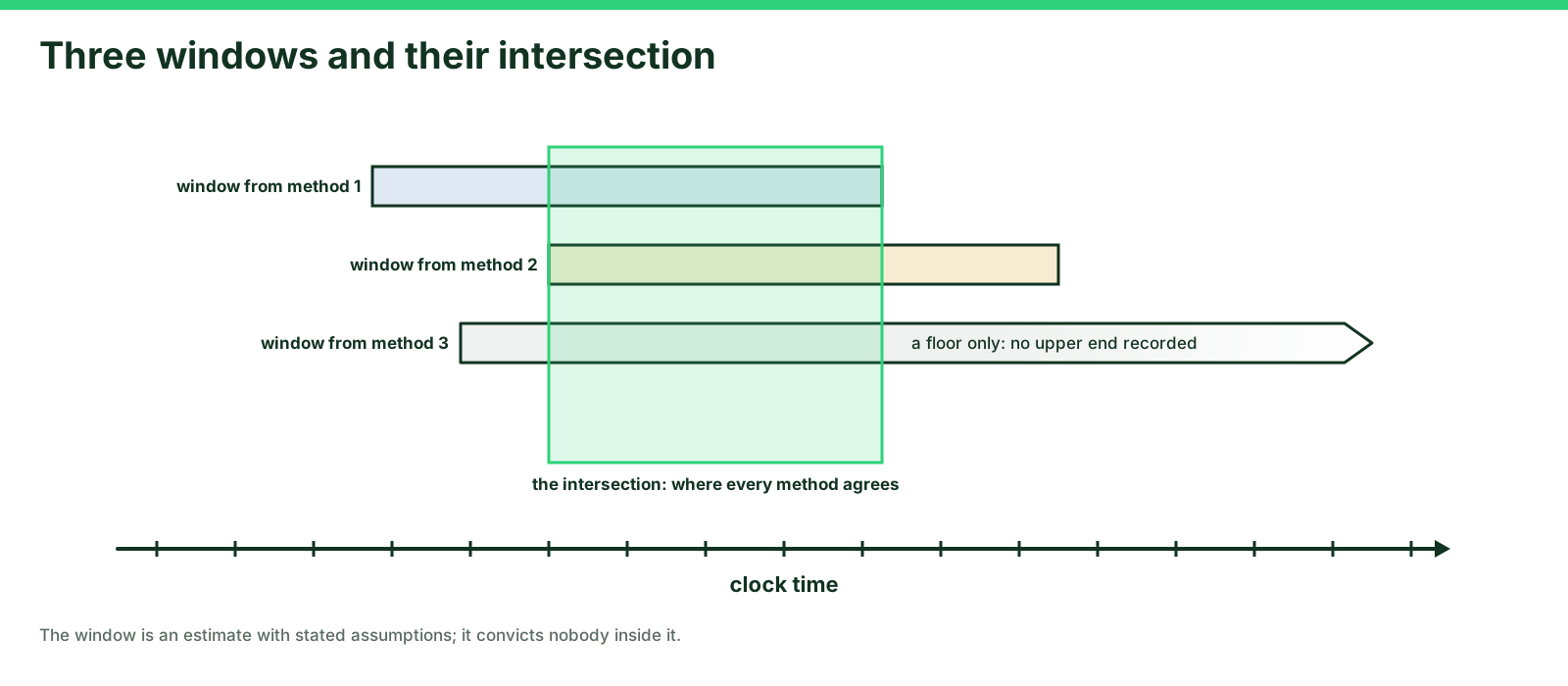
The method: estimate a window from each clock separately, then intersect the windows. One clock persuades; three clocks corroborate.
R3. Turn each observation into a window
A window is the earliest and latest time a clock allows. A single number pretends to a precision no clock has. Write units every time.
Algor. Subtract the measured body temperature from 37 °C to get the drop. Divide the drop by 1 °C per hour and by 1.5 °C per hour; the two answers are the two ends of the window, in hours before the reading. Write the assumption: a 37 °C start and a steady room. If the body has reached room temperature (within about 1 °C of the room), the cooling clock has run out: write "at least" the hours from both rates, and no upper limit from this clock. Anything covering the body slows cooling, so the true time is longer than the bare-body estimate, not shorter.
Rigor. Stiffness in the small muscles only (jaw, fingers) means the clock is in its first few hours: window under about 4 hours. Stiffness fully passed, none anywhere, means roughly 24 to 36 hours or more, but only once rigor has had time to come and go. No stiffness also reads as the first hour or two, before rigor has started, so no stiffness on its own does not pick an end. Let algor decide which end you are at before you write the window. Write the assumption: normal body temperature and no heavy exertion before death, both of which shift the schedule.
Livor. Settled blood that fades when pressed is not fixed: under several hours, call it under about 8. Settled blood that does not fade when pressed is fixed: at least about 8 to 12 hours on most schedules. A fixed reading gives a floor, not a ceiling. Then check position: if the settled surfaces are the lowest surfaces in the found position, nothing in this clock says the body was moved. That is not proof it was never moved.
R4. Intersect the windows and state the ceiling
The intersection is the overlap of all the windows. Time inside every window is possible; time outside any one window is ruled out by that clock. A window that gives only a floor still counts: it rules out times that are too recent. When every clock gives only a floor, the honest intersection is a floor, and saying that no clock can pin an hour is the correct finding.
Claim ceiling: the window is an estimate with stated assumptions, not a fact. It constrains the timeline; it does not convict anyone inside it. Name the clock you trust least in your case and the record condition that weakens it.
R5. Keep practice arithmetic separate
To convert °C to °F, multiply by 1.8 and add 32. The B3 practice numbers (30.5 °C, normal 37 °C, a normal room) are not from your case. Show the drop with units, the hours at each rate, the window, and the conversion. Do not use your case temperatures in B3, and do not use the B3 numbers in your case rows. The practice case's 33.0 °C example models the steps; its numbers are not yours either.
R6. Read the door log without concluding
Your case's door access log is a supplied simulated record. Each row is a credential or alarm event as the system printed it: a fob IN or OUT, a key code, an alarm, a call. A row records that a credential or alarm fired. It does not by itself establish that a named person was present, absent, alone or elsewhere. Copy each row exactly. Mark any row the case flags as an open question and leave it a question. The log's names and codes are printed as supplied; this handout does not give their roles, and you do not add one.
Use the log in the final part of the period, after your windows are done. Follow only the matching case note below.
Your case's support note is with the door log, in the final part of the period.
Plain-English terms
- Algor mortis
- Body cooling after death, roughly on a schedule. Analogy to hold onto: the coffee cup cooling.
- Rigor mortis
- Temporary muscle stiffening after death, comes and goes on a schedule. Analogy to hold onto: a timer you read backward.
- Livor mortis
- Blood settling to the lowest points after death, fixed after hours. Analogy to hold onto: sediment settling in a bottle.
- Window
- The earliest and latest time a clock allows. A single number pretends to a precision no clock has.
- Intersection
- The overlap of all the windows. Time inside every window is possible; time outside any one window is ruled out by that clock.
Part 2 of 4 · Directions in plain English
What you will do today, in order
Use your case's supplied body-clock records to make one window per clock with its assumption, intersect the windows, state the claim ceiling, and log your case's door access record without concluding.
Hook: Three clocks can each be wrong on their own. Why does the window become more believable when three independent clocks agree, and what does it still not tell you?
Driving question: What can three supplied body clocks and one door log say about when this person died, and what can they not say?
- Open your case's handout, add your period and code, label the supplied-record route, read R1 and R2, and complete A1 and A2.
- Complete B1: one window per clock from your case's supplied rows, with units and the assumption, then the intersection row. Answer B2.
- Complete B3 with the 30.5 °C practice values, then D1 and E1 to E3. Keep the practice numbers separate from your case.
- At minute 60, read your case's door log. Copy every row exactly into the timeline log and flag the open-question rows.
- Write C1 and submit the one worksheet on paper or as one PDF in your section assignment.
Record route: Supplied illustrative case record, available to all students; no student measures a body, a scene model or a room, examines anything, or inspects a specimen or slide. Keep each observation beside the window you make from it and the assumption that could throw it off. A record may give less than you would like. A window that says "at least" with no upper limit is an honest answer when that is all the clock allows.
Check and hand in
Your worksheet needs four B1 rows with units and assumptions, B2's clock and record condition, B3's calculations, C1's paragraph, D1 and E1 to E3, plus the timeline log with every row copied and the open questions flagged. No invented measurement, room number, role, motive or conclusion should be added.
Hand the paper worksheet to Mr. Mendoza before leaving, or submit one PDF in Wk5 D12 · The Clock in the Body (PLTW 1.2.2) by 11:59 PM on your class day. Use your period and investigator code. Do not submit the same worksheet twice. Keep notebook pages in your notebook.
The 80-minute plan
- 0–10 min (from 0:00), Teacher launch: Identify the one worksheet, your case and the paper-record boundary. If your record prints a supplied authorization line, read it. Begin R1 and R2 and start A1 and A2. Tasks A1, A2.
- 10–25 min (from 0:10), One guided example: Walk the practice case (33.0 °C, 20 °C room, 10:00 PM) through its six steps. Finish A1 and A2. Tasks A1, A2.
- 25–45 min (from 0:25), Individual work with teacher support: Complete B1's four rows from your case's supplied observations: measurement used, window with units, assumption, then the intersection. Answer B2. Tasks B1, B2.
- 45–60 min (from 0:45), Continue the same worksheet: Complete B3, D1 and E1 to E3. Check every task ID except C1 and prepare the timeline-log area. Tasks B3, D1, E1, E2, E3.
- 60–77 min (from 1:00), Door log, then C1: Use only your case's released door log and support note. Copy each row exactly, flag the open questions, mark each row against your intersection, then write C1. Tasks timeline-log, C1.
- 77–80 min (from 1:17), Check and submit: Check the timeline log and all Parts A to E. Hand in paper or one PDF; keep notebook support in your notebook. Tasks handoff.
Optional guided notes
Guided notes can support your work but are not another submission. Guided notes and the practice case are support, not extra submissions.
Optional support: Optional Guided Notes; Separate practice case model; Existing voluntary vocabulary extra credit, kept separate from required D1.
Part 3 of 4 · Worked example
Practice case: three clocks, one intersection (not your case)
This worked model uses the practice values printed on both evidence sheets (pages 2 to 3, "a practice case, not ours"). It is not evidence for Case A or Case B. Use its steps, not its numbers, in your worksheet.
The supplied practice record
A body measured at 10:00 PM reads 33.0 °C in a 20 °C room. Stiffness is present only in the jaw and fingers. The settled blood fades when pressed.
What to notice: the two thermometers. Every cooling estimate needs both numbers, the body's and the room's, and the room's is the one people forget to write down.
Six steps
- Algor, the drop: 37 minus 33.0 = 4.0 °C dropped. Write the unit every time.
- Algor, the two rates: at 1 °C per hour, 4.0 ÷ 1 = 4.0 hours. At 1.5 °C per hour, 4.0 ÷ 1.5 = about 2.7 hours. Window: 2.7 to 4.0 hours before 10:00 PM, which is about 6:00 PM to 7:20 PM. Assumption: the person started at 37 °C and the room stayed at 20 °C.
- Rigor: stiffness in small muscles only means the clock is in its first few hours. Window: under about 4 hours, so after about 6:00 PM. Assumption: normal temperature and no hard exertion before death.
- Livor: blood settled but fades when pressed means not fixed, so under several hours, call it under 8. Window: after about 2:00 PM. Assumption: a light skin tone and no pressure points hiding the pattern. Position check: the settled blood is on the surfaces that were lowest in the found position, so nothing says moved.
- Intersect: time inside every window. Algor says 6:00 to 7:20 PM, rigor says after 6:00 PM, livor says after 2:00 PM. Overlap: about 6:00 to 7:20 PM. Algor set both ends; the other two agreed and did not narrow it.
- Least-trusted clock and why: livor, because "fades when pressed" is a soft yes-or-no read with a wide schedule. Then the conversion: 33.0 × 1.8 = 59.4, plus 32 = 91.4 °F.
Finished practice product
Practice window: death about 6:00 to 7:20 PM (2.7 to 4.0 hours before the 10:00 PM reading), with the 37 °C start as the load-bearing assumption; rigor and livor agree without narrowing it, and 33.0 °C is 91.4 °F.
What may differ in your case
Your case's clocks may not all give two ends. A body that has reached room temperature gives "at least" and no upper limit. A fixed livor gives a floor. A fully passed rigor gives a floor with a wide schedule behind it. Write the assumption anyway, and let the intersection be a floor if that is all the clocks allow. The practice case had no door log; yours does, in the final part of the period.
The model and these checks do not require another upload. Complete Parts A to E and your door-log timeline check in the one time-of-death worksheet.
Body temperature + room temperature + time of the reading
Stiffness observation + settling observation + the position note your record gives
Algor: (37 minus body) divided by 1 and by 1.5, hours before the reading
Rigor: where the stiffness is, read backward on the schedule
Livor: fixed or not fixed, then the position check
Write the assumption beside each window. Units every time.
Time inside every window is possible.
Time outside any one window is ruled out by that clock.
A floor with no ceiling still counts.
An estimate with stated assumptions, not a fact.
It constrains the timeline; it does not convict anyone inside it.
Name the least-trusted clock and the record condition that weakens it.
Copy each row as printed. Flag the open questions. A credential event is not a person's presence.
Exhibit 014; the Sunday 3:00 AM DOOR HELD row stays an open question.
Read the workflow as text
Find your own-case body temperature, room temperature and the time of the reading, then the stiffness observation, the settling observation and the position note your record gives. Use R3 to make one window per clock: for algor, subtract the body temperature from 37 °C and divide by 1 and by 1.5 to get hours before the reading; for rigor, read where the stiffness is against the schedule; for livor, decide fixed or not fixed and check the settled surfaces against the position note your record gives. Write the assumption beside each window with units. Use R4 to intersect: time inside every window is possible, time outside any one window is ruled out, and a floor with no ceiling still counts. State the ceiling: an estimate with stated assumptions that constrains the timeline and convicts no one inside it, and name the least-trusted clock. In the final part of the period, copy your own case's door log exactly, flag the open questions and leave them questions, and note that a credential event is not proof of a person's presence. The finished worksheet does not claim a measurement, an examination, a role for any name, or a cause of death.
Optional restart cue
Find the next unanswered task ID. Use R2 for the clocks, R3 for each window, R4 for the intersection and ceiling, R5 for the practice numbers and R6 for the door log. Do not switch to the other case or create a second product.
Part 4 of 4 · Your work
4.1 Your supplied time-of-death record
Supplied illustrative case record, available to all students; no student measures a body, a scene model or a room, examines anything, or inspects a specimen or slide. Keep each observation beside the window you make from it and the assumption that could throw it off. A record may give less than you would like. A window that says "at least" with no upper limit is an honest answer when that is all the clock allows.
Your case: STATIC, case number JH-26-0831-A. Setting: Statik Sound, a neighborhood recording studio.
External exam and the three body clocks. And the records pull arrives: the door access log, which has one strange row in it.
| Row | What the record says |
|---|---|
| When and where the temperature was taken | Body temperature taken at discovery, Monday 7:55 AM, in the studio. |
| Ambient (room) temperature | 21 degrees C, steady all weekend, HVAC (the building's heating and cooling system) on. |
| Body temperature | 21.8 degrees C. |
| Scene cover | The acoustic blanket over the lower body. |
| Rigor observation | Fully passed: no stiffness anywhere. |
| Livor observation | Fixed (does not fade when pressed), on the anterior (front) surfaces, which matches the prone (face-down) found position. |
| Found position | Prone (face-down). |
These rows are the whole supplied record. If a value is not printed here, it is not supplied: write that, and do not fill the gap.
What B1 asks you to build from them
- Algor window with units and assumption
- Rigor window with units and assumption
- Livor window with units, position check and assumption
- Intersection
- Least-trusted clock and record condition
4.2 Ten tasks in the same worksheet
Window: the earliest and latest time a clock allows. A single number pretends to a precision no clock has. Intersection: the overlap of all the windows. Time inside every window is possible; time outside any one window is ruled out by that clock.
Open the current task here or use its writing space in the worksheet. Extra help supports that same response.
PBS-U1-D12-A1
State the course's working cooling rate and the starting temperature it assumes. Copy the first three words of the R2 sentence you used, in quotation marks. Label the rate as this course's working rule.
- Rate with units, labeled as this course's working rule
- Assumed start temperature with units
- Supporting sentence starts
Space: 3 writing lines
Need a hint?
The rate is a rule for this worksheet, not how real cases are decided. R2 says what real examiners use instead.
PBS-U1-D12-A2
Livor tells time and position. In one or two sentences, what would a mismatch between the settled blood pattern and the found position mean, and what limit does R2 put on reading livor?
- Meaning of a mismatch
- Limit on the read
Space: 3 writing lines
Need a hint?
A matching pattern is not the same as proof the body was never moved; see R3.
PBS-U1-D12-B1
Fill one row per clock from your case's supplied record: the measurement or observation you used, the window as earliest to latest hours since death with units, and the assumption that could throw it off. Then fill the intersection row. If a clock gives only a floor, write 'at least' and no upper limit. Do not use the practice case's numbers.
- Algor row: measurement, window with units, assumption
- Rigor row: observation, window with units, assumption
- Livor row: observation and position check, window with units, assumption
- Intersection row: the overlap, and what it can and cannot pin
Space: Four-row table with three response columns; at least 2 writing lines per cell.
Need a hint?
Both thermometer numbers matter: the body's and the room's. Write units every time. A single number is not a window.
PBS-U1-D12-B2
Which clock do you trust least in your case, and why? Name the specific condition in your record that weakens it.
- Clock
- Record condition and reason
Space: 3 writing lines
Need a hint?
Look at the notes in your record: what is covering the body, how close the body is to room temperature, how soft the observation is.
PBS-U1-D12-B3
Practice numbers, not from the case. A body measures 30.5 °C in a normal room. Normal living temperature is 37 °C. How many degrees has it dropped? At 1 °C per hour, how many hours? At 1.5 °C per hour? Write the window those two rates give. Then convert 30.5 °C to Fahrenheit: multiply by 1.8 and add 32. Show every step with units.
- Drop with units
- Hours at 1 °C per hour
- Hours at 1.5 °C per hour
- Window
- Fahrenheit conversion
Space: 6 calculation/writing lines
Need a hint?
Use 37 °C as the start. Do not use your case temperatures here.
PBS-U1-D12-C1
Write the time-of-death paragraph for the timeline. Include: each of the three windows in one sentence with its assumption; the intersection; the clock you trust least and why; and what your window does and does not do to any name or code in your case's supplied door log whose events sit inside or outside it. Stay inside the ceiling: the window constrains, it does not convict.
- Paragraph of five to seven sentences
Space: 10 writing lines
Need a hint?
Use names and codes only as the log prints them. Do not add a role, a motive or a conclusion about the open-question rows.
PBS-U1-D12-D1
Use algor mortis, rigor mortis and livor mortis correctly in one or two sentences about today's work. A definition alone does not count; use the words about something in your case record.
- One or two applied sentences
Space: 3 writing lines
Need a hint?
Say what each clock did in your case: gave a floor, gave a window, matched the found position.
PBS-U1-D12-E1
Practice check: a body's temperature is 8 °C below normal in a normal room. Rough time estimate and its biggest assumption?
- Rough window
- Assumption
Space: 2 writing lines
Need a hint?
Two rates, two ends. This is a rule check, not your case.
PBS-U1-D12-E2
Practice check: a livor pattern is fixed on the back, and the body is found face down. Meaning?
- Meaning
Space: 2 writing lines
Need a hint?
Compare the settled surfaces with the lowest surfaces in the found position.
PBS-U1-D12-E3
Why intersect three windows instead of trusting the tightest one?
- Reason
Space: 2 writing lines
Need a hint?
One clock persuades; three corroborate. Say what a wide window still rules out.
B1's four rows and three response columns
| CLOCK | MEASUREMENT YOU USED | WINDOW (EARLIEST TO LATEST HOURS SINCE DEATH) | THE ASSUMPTION THAT COULD THROW IT OFF |
|---|---|---|---|
| Algor mortis (cooling) | Your writing | Your writing | Your writing |
| Rigor mortis (stiffening) | Your writing | Your writing | Your writing |
| Livor mortis (settling) | Your writing | Your writing | Your writing |
| Intersection of all three | Your writing | Your writing | Your writing |
Optional single check, not alternate work plans
One of your clocks gives only a floor: 'at least 8 hours' with no upper limit. What does the intersection do with it?
- Ignore it, because it has no upper limit.
- Keep it: it rules out times that are too recent, and the other clocks may set the other end.
- Treat the floor as the exact time of death.
Check your choice
Time outside any one window is ruled out by that clock. A floor rules out recent times even when it cannot set a ceiling.
- This throws away a clock that still rules something out.
- This keeps every clock's contribution and lets the intersection be honest, even if it stays a floor.
- This turns an estimate with an assumption into a fact the record does not support.
Short check
Rigor: stiffness in the jaw and fingers only. Livor: fades when pressed. Which of these two clocks sets a floor and which sets a ceiling?
Check your answer
Neither sets a floor. Small-muscle-only rigor means within about the first 4 hours (a ceiling). Livor that fades when pressed means under about 8 hours (a ceiling). The floor has to come from algor.
If you wrote a floor for either one, reread R3: an early reading on a clock says how recent death could be, not how long ago it must have been.
Door log: use after B1 and B2
Use only your case's released door log and support note. Copy each row exactly, flag the open questions, mark each row against your intersection, then write C1.
Case A support: the weekend access log
Exhibit 014, also labeled DOC-6 in the records set. Five rows and a closing line: no other entries all weekend. Two things the case flags. First, the log shows Bell fob IN on Saturday at 2:15 PM and no fob entry after it; that is an observation about the log, not a statement about a person. Second, the Sunday 3:00 AM DOOR HELD alarm has no fob; it is logged as an OPEN QUESTION, not a conclusion. In C1, say what your window does and does not do to any name whose events sit inside or outside it.
Exhibit 014 (DOC-6): Door access log, weekend (SIMULATED)
| Row as printed | Inside, outside or cannot tell |
|---|---|
| Friday 9:02 PM: Cole fob OUT. | Your writing |
| Saturday 2:15 PM: Bell fob IN. | Your writing |
| Sunday 3:00 AM: DOOR HELD alarm, no fob. OPEN QUESTION. | Your writing |
| Monday 7:38 AM: Cole fob IN. | Your writing |
| Monday 7:40 AM: 911 call placed. | Your writing |
| No other entries all weekend. | Your writing |
Open questions, logged and not answered: The 3:00 AM row is logged as an OPEN QUESTION, not a conclusion. One open question logged, not answered
Copy Exhibit 014 (DOC-6) exactly as supplied: one row per printed event with its day, time, event and credential as printed, then the closing line. Mark the Sunday 3:00 AM DOOR HELD row OPEN QUESTION. Beside each row, write inside, outside or cannot tell against your intersection. Do not add a role or a conclusion.
- Exhibit label
- Day and time as printed
- Event and credential as printed
- Inside / outside / cannot tell against your intersection
- Open-question flag
- What the row does not establish
Space: Five event rows, one closing-line row, plus two limit lines
Write the time-of-death paragraph for the timeline. Include: each of the three windows in one sentence with its assumption; the intersection; the clock you trust least and why; and what your window does and does not do to any name or code in your case's supplied door log whose events sit inside or outside it. Stay inside the ceiling: the window constrains, it does not convict.
Help when you need it
Need help? Choose a starting point
Guided notes and the practice case are support, not extra submissions. Guided notes can support your work but are not another submission.
Restart where you stopped
Lost your place? Find the next unanswered task ID. Use R2 for the clocks, R3 for each window, R4 for the intersection and ceiling, R5 for the practice numbers and R6 for the door log. Stay in the same worksheet.
If you were absent or need help
Use the same supplied-record handout and complete the same product. The door-log page is included; use it after B1 and B2. You do not need to measure anything or invent a missing value. If your teacher separately assigns a physical activity, follow the Vital Signs simulation preparation gate and the approved instructions. This paper worksheet does not complete that requirement.
Lost your place? Find the next unanswered task ID and use F1's restart cue. Guided notes and the practice case are support, not extra submissions.
Use the same own-case supplied records and complete the same worksheet. The door-log page is included; use it after B1 and B2. Do not invent a measurement, a room number, a role for a name or code in the log, or a conclusion about an open-question row.
If your teacher is absent: Complete the supplied paper-record worksheet using the required briefing and the practice case model. Do not begin any physical activity. Use the door-log section after B1 and B2.
Notebook support, not another submission
Keep the Time-of-death worksheet organizer, the Manner-of-death logic tree (opens today, all branches live), the Day 12 Cornell page in your notebook. The practice case, the optional check and the short check do not require another upload. Complete Parts A to E and the door-log timeline check in the one worksheet.
Optional support
- Optional Guided Notes
- Separate practice case model
- Existing voluntary vocabulary extra credit, kept separate from required D1
No laboratory preparation applies today
Before any separate teacher-directed physical activity, complete the existing Vital Signs simulation preparation and use the approved instructions. The paper worksheet does not certify that practical work.
Connection to PLTW
Related PLTW reference:
- Activity 1.2.1 Anatomy of an Autopsy
- Activity 1.2.2 Time of Death
This John Hay original worksheet practices reading a rate, stating an assumption and intersecting independent estimates. It connects by title to PLTW Activities 1.2.1 Anatomy of an Autopsy and 1.2.2 Time of Death; it does not certify official activity completion. The complete required explanation is here; background links are support, not extra assignments.
referenced by title only; all materials in this file are John Hay original work. myPLTW student access is down for technical reasons. When it is restored, this day's PLTW anchor is completed online; until then the portal simulation and these printed materials carry the day.
Official PLTW section hub link: not supplied.
Turn in one worksheet
Complete one time-of-death worksheet, Parts A to E plus your case's door-log timeline check. Hand the paper worksheet to Mr. Mendoza before leaving, or submit one PDF to this section's assignment by September 25 at 11:59 PM. Use your period and investigator code. Do not submit twice; keep notebook pages in your notebook.
The practice case, the optional check and the short check do not require another upload. Complete Parts A to E and the door-log timeline check in the one worksheet.
Case A: submit to Wk5 D12 · The Clock in the Body (PLTW 1.2.2)Keep today's worksheet for the next assigned case lesson, the full examination. Its records must be supplied before you use them; do not assume a cause or manner of death already exists.
What this worksheet cannot claim
The window is an estimate with stated assumptions, not a fact. It constrains the timeline; it does not convict anyone inside it. Nothing today claims that you measured a body, a scene model or a room, examined anything, or established a role, a motive or a cause of death.
The model and these checks do not require another upload. Complete Parts A to E and your door-log timeline check in the one time-of-death worksheet.
No public background reference is printed for this day; the briefing carries the whole required explanation.