
PBS/PBT · September 21 · D10 · Case A STATIC · Period 1-2
Barcodes and Panels
One product: Match matrix and panel sheet, Parts A to E in one sheet: the STR match matrix (B1), the panel grid and pattern sentence (B2), and your case's twist note (C1).
This page has four parts, in the order you use them. Part 1 is what you need to know. Part 2 says what to do, in plain English. Part 3 shows the work done once on a separate example. Part 4 is your own record and the tasks. Everything you write goes in one product.
Start: Open your own case, label the supplied-record route, find the six lanes and the migration-scale rule, and write the three allowed calls in your own words. Digital deadline: September 21, 11:59 PM.
Part 1 of 4 · Background and definitions
What you need to know before you write
D09 taught you to compare one classroom feature and keep its source and limits visible. It supplied no DNA profile. Today's strip record is the first DNA record in your case, and it is still a supplied record, not a gel you ran.
R1. Your one sheet
Complete the match matrix and panel sheet, Parts A to E, including your case's twist note. Use the supplied illustrative records for your class's case: a six-lane STR strip record given as band positions, a panel record with its reference ranges, and one twist record released during class. You are reading these records, not reporting a gel you ran or a test you performed. The previous case lesson (D09) supplied no DNA profile. Today's strip record is the first DNA record in your case, and it is still a supplied record.
Keep each lane number beside its band positions, each panel value beside its range and unit, and each record beside its evidence or exhibit number. A record may say less than you would like. Keep that limit instead of filling the gap.
R2. Read the classroom STR rule
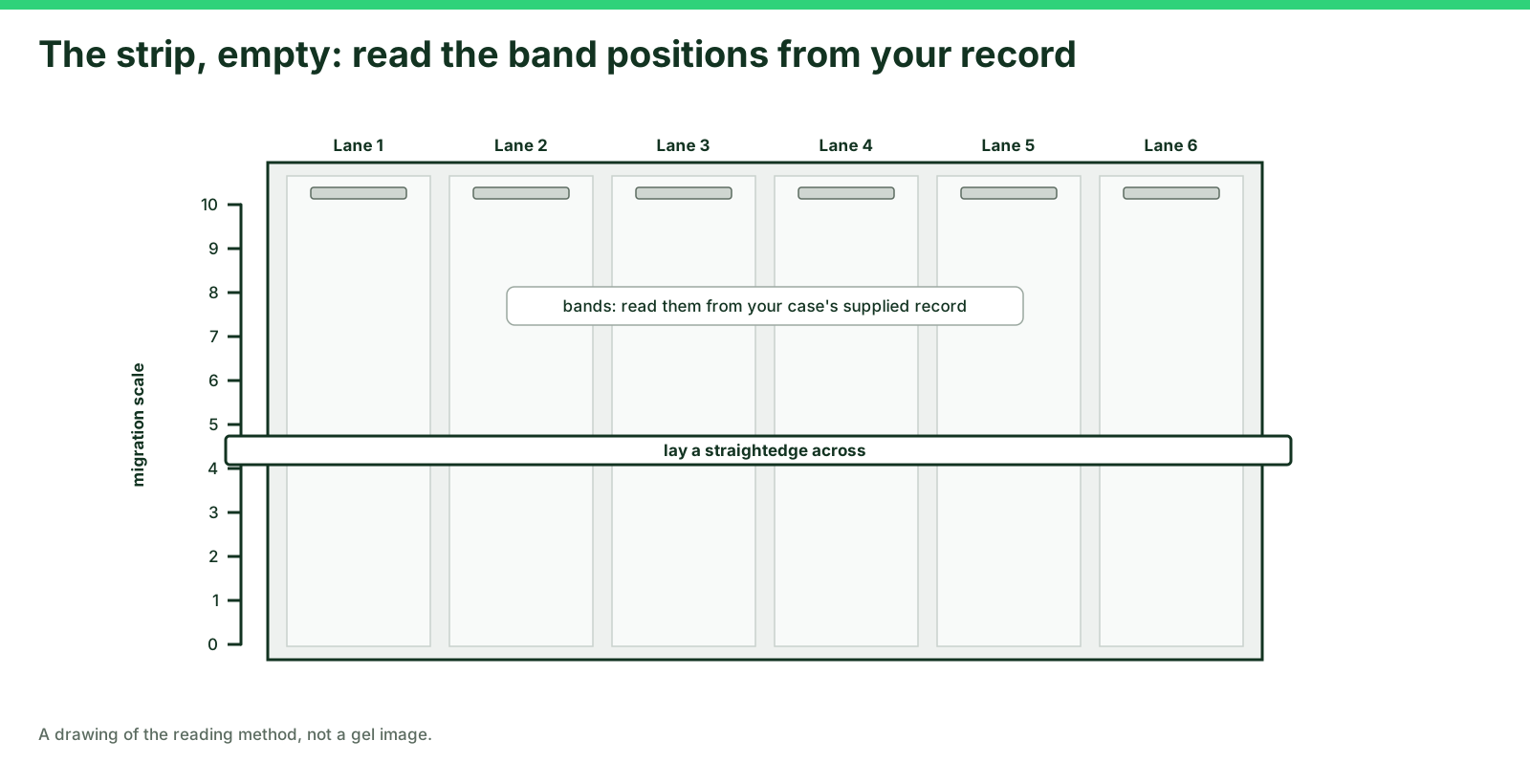
STR stands for short tandem repeat: a stretch of DNA where a short pattern repeats, and the number of repeats varies from person to person. Measure the repeat count at several sites and you get a DNA profile, a set of numbers so unlikely to repeat by chance that it works like a barcode. On the supplied gel record, longer repeats sit higher. A lane is one column of bands; questioned lanes come from scene samples and reference lanes come from named people. A band is one dark stripe, and its number on the migration scale is its position, standing in for the repeat count at one STR site. A real profile shows two bands per site, one from each parent; this strip prints one to keep it readable. The migration scale is the ruler printed beside the gel, from 10 at the top to 0 at the bottom; two bands at the same number are aligned.
Three calls are allowed in this classroom model:
| What the supplied positions show | Classroom call |
|---|---|
| Every band in the questioned lane aligns with the reference lane | MATCH |
| Every readable band aligns, and at least one band is unreadable | CANNOT EXCLUDE |
| At least one band clearly differs | EXCLUDED |
Write the limit in every row: a match names the source of the DNA, whose cells, not when they got there or what that person did. DNA on an item shows that someone's cells reached it. Mixtures put two barcodes in one lane, and partial profiles fade stripes, so a partial read is inconclusive under this rule rather than an identification. This three-band classroom rule stands in for the real laboratory process, which reads many sites and reports results with statistical weight. The three calls line up with the three result types a real report can give: inclusion, exclusion, or inconclusive. NIJ, possible results from DNA testing [S1].
Two references in your case appear only on request cards, with no band positions supplied. For those, copy the record's reported summary and label it Reported. Do not write a band-by-band call you could not make.
R3. Match strength as a decimal
A lab can state how often a full match would happen by chance among unrelated people, as 1 in some number. Write it as a decimal by dividing 1 by that number. The smaller decimal is the rarer match, so it is the stronger identification. The numbers in the worked model and in B3 are practice numbers. No rarity number is supplied for your case, so do not attach one to your lanes.
R4. Read a panel value beside its range
A toxicology screen checks for classes of drugs and poisons, usually by immunoassay: a fast screening test that uses antibodies to detect one target class of chemical. A chemistry panel measures the body's own numbers. Read each value the same way: value beside its supplied range, with the unit attached; flag it ABOVE or BELOW, or mark it inside; then look for a pattern across values. One flag is a question; a pattern of flags is a lead. Write the pattern as a direction only: no cause word, no diagnosis, no person.
A reported negative screen means the screen found none of its listed classes at its own limits. It is a screening result, not proof that nothing was present, and an antibody screen can sometimes be tripped by a related target. "No specific poison indicated" is a reported result of the targeted testing named in the record; the record does not list what was targeted. The reference ranges are the exhibit's own. Some ranges have only one limit, such as the practice range below 10 mg/L. Ordered classes, such as a practice class 2 of 4, are categories, not a measuring scale, so do not subtract them. Both are practice examples; flag the ranges and classes your own case's panel supplies.
Case A panel key
Vitreous means the clear fluid inside the eye; the record uses it because blood sugar is unreliable after death. Beta-hydroxybutyrate is, in the exhibit's own key, a ketone body: an acid the body makes when it burns fat for fuel instead of sugar. Potassium is a mineral the blood keeps in a narrow band. Bicarbonate is, in the exhibit's key, the blood's acid buffer, the chemical that soaks up acid; when acid floods in, it drops. Flag each value against its supplied range. The pattern sentence names a direction, not a cause.
R5. Weigh a twist record
New evidence does not restart the case. It joins the matrix and the timeline and gets weighed like every other record. Write it in three labeled parts. OBSERVATION: what the record states, copied exactly with its evidence or exhibit number. INFERENCE: what it changes about an earlier assumption, labeled as inference. NOT SETTLED: what the record does not establish. A record that shows where an item was, or when a message was sent, does not show who did something, why, or what happened. An absence in one record, such as no messages from one account, is not proof of absence everywhere.
Your case's twist card is released at minute 60. Follow only the matching case card below.
Your Case A twist card is released at minute 60. It is printed on the last page of your handout, under Twist record: use at minute 60.
R6. Keep source, state and event apart
The matrix says whose DNA is on what. The panel says what state the body was in. What happened is still a Day 16 question. Use the vocabulary about real rows on your sheet: STR and DNA profile belong to the lanes and calls; immunoassay belongs to the drug-screen row. A definition alone does not count.
Plain-English terms
- STR
- Short tandem repeat: a stretch of DNA whose repeat count varies person to person. Think of a barcode stripe width.
- DNA profile
- The set of STR lengths that identifies one person. Think of the whole barcode.
- immunoassay
- A fast screening test that uses antibodies to detect one target class of chemical. Think of a lock that only one key trips.
- lane
- one column of bands on the strip sheet. Questioned lanes come from scene samples; reference lanes come from named people.
- band
- one dark stripe in a lane. Its position is the repeat count at one STR site.
- flag
- a panel value outside its reference range. One flag is a question; a pattern of flags is a lead.
- migration scale
- The ruler printed beside the gel. A band's number on it is its position; two bands at the same number are aligned. Longer repeats sit higher on this gel.
- Immunoassay limit
- A screen is not a confirmation, and an antibody screen can sometimes be tripped by a related target.
- Supplied illustrative case record
- You are reading these records, not reporting a gel you ran or a test you performed.
- Reported
- Copy the record's reported summary and label it Reported. Do not write a band-by-band call you could not make.
- Reference range
- The reference ranges are the exhibit's own. Some ranges have only one limit, such as the practice range below 10 mg/L.
- Ordered class
- Ordered classes, such as a practice class 2 of 4, are categories, not a measuring scale, so do not subtract them.
- Twist record
- New evidence does not restart the case. It joins the matrix and the timeline and gets weighed like every other record.
Part 2 of 4 · Directions in plain English
What you will do today, in order
Use supplied band positions to make the three allowed STR calls with their limits, log every panel value beside its supplied range and read the pattern without naming a cause, and log your case's twist record in three labeled parts.
Hook: A panel number means nothing without its reference range, and a gel band means nothing by itself. What must your sheet show so another reader can see every band you compared and every range you used?
Driving question: What can the supplied lanes and panel values support, and what stays open after today?
Take home: A DNA profile names a source. A panel names a body state. Neither one, alone, names what happened.
- Open your own-case handout. Add your period and investigator code. Label it "Supplied illustrative case record." Read R1 and R2, answer A1 and A2, and keep the practice gel model beside you.
- Complete B1's match matrix. Compare each questioned lane with each reference lane band by band from the supplied band positions. Write one of the three allowed calls and its limit in every row. Copy the two request-card summaries and label them Reported.
- Complete B2 and B3. Log every panel value beside its supplied range and unit, flag ABOVE or BELOW or mark it inside, keep the screen rows as reported categories, and write one pattern sentence with no cause word. Then do B3 with the practice numbers only.
- At minute 60, use only your case's twist card. Write C1 in three labeled parts (OBSERVATION, INFERENCE, NOT SETTLED) and end with the ceiling sentence. Complete D1.
- Complete E1 to E3, check and submit. Check all ten task IDs. Hand in the one sheet on paper or as one PDF in your section assignment.
Record route: Supplied illustrative case record (paper-record route), available to all students including absent students. Keep each lane number beside its band positions, each panel value beside its range and unit, and each record beside its evidence or exhibit number. A record may say less than you would like. Keep that limit instead of filling the gap.
Check and hand in
Your sheet needs nine own-call matrix rows with a call and a limit each, two Reported rows, the panel grid with every row flagged or copied, one pattern sentence, B3's two decimals with the division shown, C1's three labeled parts and ceiling sentence, D1, and E1 to E3. No invented band position, rarity number, range, exhibit number, cause or person's action should be added.
Hand the paper sheet to Mr. Mendoza before leaving, or submit one PDF in Wk4 D10 · Barcodes and Panels (PLTW 1.1.6) by September 21 at 11:59 PM. Use your period and investigator code. Do not submit the same sheet twice. Keep notebook pages in your notebook.
The 80-minute plan
- 0–10 min (from 0:00), Teacher launch: Identify the one sheet, your case and the paper-record boundary. Name the three allowed calls. Begin A1 and A2. Tasks A1, A2.
- 10–25 min (from 0:10), One guided example: Walk the practice gel (Q against R1, R2, R3) and the practice sodium row. Finish A1 and A2. Tasks A1, A2.
- 25–45 min (from 0:25), Individual work with teacher support: Complete B1's nine own-call rows from the supplied band positions, then the two reported request-card rows. Tasks B1.
- 45–60 min (from 0:45), Continue the same sheet: Complete B2's panel grid and pattern sentence, then B3's practice decimals. Tasks B2, B3.
- 60–70 min (from 1:00), Twist record, then individual note: Use only your case's released twist card. Copy what it states, label your inference, list what it does not settle, and write the ceiling sentence. Complete D1. Tasks C1, D1.
- 70–80 min (from 1:10), Check and submit: Complete E1 to E3. Check all ten task IDs and the three-part twist note. Hand in paper or one PDF; keep notebook pages in your notebook. Tasks E1, E2, E3, handoff.
Slides and optional guided notes
Guided notes support your work but are not another submission. Guided notes and the practice model are support, not extra submissions.
Download the editable PowerPoint or open it in Google Drive. These slides use a static sequence, with no click animations.
Optional support: Optional Guided Notes; Separate practice gel and sodium-row worked model; Existing voluntary vocabulary extra credit, kept separate from required D1; Team roles as in-class facilitation only.
Optional. The simulations below rehearse the bench version of this work for a later lab day; nothing in them is due today, and today's sheet is a paper record.
Run this before you touch the bench. It is built from the real lab procedure, so the decisions you make here are the ones you will make with the equipment in your hands. This lesson has more than one, and they cover different skills.
Part 3 of 4 · Worked example
Practice gel and practice row: separate practice, not your case
This worked model uses the evidence sheet's training gel (one questioned lane Q, a swab from a practice water bottle, and three reference lanes R1, R2 and R3, four bands each) and one made-up panel row. It is not evidence for Case A or Case B. Use the structure, not these lanes or answers, on your sheet.
Read the questioned lane first
Lay a straightedge across the gel at each band in lane Q and read the scale. Q's bands sit at 8.0, 6.0, 3.5 and 1.5. Write them down before looking at any reference lane. This is a description of practice positions, not a gel you personally ran.
Make the three allowed calls
| Practice comparison | Supplied positions | Bands aligned? | Call | Limit |
|---|---|---|---|---|
| Q and R1 | R1 at 8.0, 6.0, 3.5, 1.5 | Four of four | MATCH | R1 is the source of the cells on the bottle; the gel does not say when or why |
| Q and R2 | R2 at 8.0, 5.0, 3.5, 1.5 | Second band sits at 5.0, not 6.0; one band clearly differs | EXCLUDED | R2 is ruled out as the source of this swab only, not ruled out of anything else |
| Q and R3 | R3 at 8.0, 6.0, [unreadable near 3.5], 1.5 | Three readable bands align; one is unreadable | CANNOT EXCLUDE | Not a match; a match needs every band. A partial read is an inconclusive call here, not an identification |
A match is a whole-column judgment. Two lanes that line up at every band look the same top to bottom; one band out of place is what an exclusion looks like; a band you cannot place leaves the call open.
Match strength with practice numbers
The practice lab says a full 4-site match like R1's happens by chance in about 1 of 60,000 unrelated people: 1 ÷ 60,000 = 0.0000167, about 0.00002. R3's 3-site partial is 1 in 4,000: 1 ÷ 4,000 = 0.00025. The smaller decimal is the rarer match, so R1 is the stronger identification. Your B3 task uses 1 in 10,000,000 and 1 in 800,000, not these numbers, and needs its own division. No rarity number is supplied for your case.
Practice panel row
Made-up value: sodium 128 mmol/L, with a reference range of 135 to 145 mmol/L. Inside? No, below. How far? 135 minus 128 = 7 mmol/L below the bottom of the range. Flag it BELOW and write the number beside the range. Interpretation waits for the pattern; one row names no cause.
Finished practice product
Q matches R1 (four of four bands), excludes R2 (one band differs), and cannot exclude R3 (one band unreadable). The full match is rarer by chance (0.0000167) than the partial (0.00025), so it is the stronger identification. The practice sodium value sits 7 mmol/L below its range.
This model and the B3 practice numbers do not require another upload. Complete Parts A to E and your twist note in the one match matrix and panel sheet.
Lane number + supplied band positions, top to bottom on the 10-to-0 scale
Every band aligned = MATCH
Every readable band aligned, one unreadable = CANNOT EXCLUDE
One band clearly differs = EXCLUDED
Request-card references: copy the reported summary and label it Reported
Whose cells, not when they got there or what they did. No verdict.
Unit attached. ABOVE / BELOW / inside. Screen rows stay reported categories.
Then ONE pattern sentence: direction only, no cause word.
OBSERVATION (copied) · INFERENCE (labeled) · NOT SETTLED
The matrix says whose. The panel says what state. What happened is still open.
Read the workflow as text
Find your own-case lane table and the migration-scale rule. For each questioned lane, compare its three band positions with each reference lane on the strip sheet, band by band. If every band aligns, write MATCH. If every readable band aligns and a band is unreadable, write CANNOT EXCLUDE. If at least one band clearly differs, write EXCLUDED. For the two request-card references, copy the reported summary and label it Reported, because no band positions are supplied. In every row, write the limit: a match names whose cells, not when they arrived or what the person did. Then log every panel value beside its supplied range with the unit attached, flag it ABOVE or BELOW or mark it inside, copy the screen rows as reported categories, and write one pattern sentence that names a direction and no cause. At minute 60, log only your own case's twist record in three labeled parts: what it states, what earlier assumption it changes, and what it does not settle. End with the ceiling sentence. The finished sheet does not claim a test you ran, a person's actions, a diagnosis or a cause of death.
Optional restart cue
Find the next unanswered task ID. Use R2 for the matrix, R3 for the practice decimals, R4 for the panel grid, R5 for the twist note and R6 for the vocabulary. Do not switch to the other case or create a second product.
Part 4 of 4 · Your work
4.1 Your Case A records
Supplied illustrative case record (paper-record route), available to all students including absent students. Keep each lane number beside its band positions, each panel value beside its range and unit, and each record beside its evidence or exhibit number. A record may say less than you would like. Keep that limit instead of filling the gap. Use only your case.
Setting: Statik Sound, a neighborhood recording studio. Case number JH-26-0831-A.
Strip record, Exhibit 012: six supplied lanes
The gel's left edge carries a migration scale from 10 (top) to 0 (bottom); band positions are read off that scale.
| Lane | What it is | Role | Supplied band positions |
|---|---|---|---|
| L1 | Console stain | questioned | 7.5, 4.5, 2.0 |
| L2 | Floor stain | questioned | 7.5, 4.5, 2.0 |
| L3 | Can rim composite (three cans) | questioned | 7.5, 4.5, 2.0 |
| L4 | Victim reference | reference | 7.5, 4.5, 2.0 |
| L5 | Cole reference | reference | 8.5, 5.5, 3.0 |
| L6 | Vasquez reference | reference | 6.5, 4.0, 1.0 |
A match names the SOURCE of the DNA (whose cells), not when they got there or what that person did.
Nine own-call pairs: L1 against L4, L1 against L5, L1 against L6, L2 against L4, L2 against L5, L2 against L6, L3 against L4, L3 against L5, L3 against L6. Rarity number: not supplied. Lane-to-evidence-ID map: not supplied.
Two request-card references, copied as Reported
- Okoye: band positions not supplied. Reported: Reference lane on request card; does not align with L1, L2, or L3. EXCLUDED for the stains and the can. Copy this row as Reported; do not write your own band-by-band call.
- Tran: band positions not supplied. Reported: Reference lane on request card; does not align with L1, L2, or L3. EXCLUDED for the stains and the can. Copy this row as Reported; do not write your own band-by-band call.
Panel record E10: 7 rows, flag column left blank
Exhibit 013. Reported screening results at the screen's own limits; not proof that no substance was present; the record does not list what the targeted testing targeted.
- Drug screen: Immunoassay screen negative in every class (opioids, stimulants, sedatives, cocaine, cannabinoids); supplied range: none, this row is a reported category; reported category: left blank for your copy.
- Ethanol (drinking alcohol), measured separately: negative; supplied range: none, this row is a reported category; reported category: left blank for your copy.
- Targeted testing: No specific poison indicated on targeted testing; supplied range: none, this row is a reported category; reported category: left blank for your copy. The record does not list what the targeted testing targeted, so mark that not supplied.
- Vitreous glucose: 612 mg/dL; supplied range no living range applies; above about 180 mg/dL means the blood sugar was high before death; flag: left blank for your flag. Specimen: not supplied. The exhibit's own key: Vitreous means the clear fluid inside the eye; it is used because blood sugar is unreliable after death. Vitreous sugar falls after death rather than rising, so a low reading proves nothing on its own, while a high one still means the sugar was high before death. That is why this row carries a decision threshold and not a living person's range.
- Beta-hydroxybutyrate: 8.2 mmol/L; supplied range below 0.6 mmol/L; flag: left blank for your flag. Specimen: not supplied. The exhibit's own key: The exhibit's own key calls it a ketone body, an acid the body makes when it burns fat for fuel instead of sugar.
- Potassium: 6.4 mmol/L; supplied range 3.5 to 5.0 mmol/L; flag: left blank for your flag. Specimen: not supplied. The exhibit's own key: Potassium is a mineral the blood keeps in a narrow band.
- Bicarbonate: 9 mmol/L; supplied range 22 to 28 mmol/L; flag: left blank for your flag. Specimen: not supplied. The exhibit's own key: The exhibit's key calls bicarbonate the blood's acid buffer, the chemical that soaks up acid; when acid floods in, it drops.
Practice numbers (not from the case)
A full 6-site match: 1 in 10,000,000. A 5-site match with one site unreadable: 1 in 800,000. Requested: both as decimals (1 divided by the number); which lane is the stronger identification; what allowed call the 5-site lane gets.
These are practice numbers. No rarity number is supplied for your case, so do not attach one to your lanes.
4.2 Ten tasks in the same sheet
Complete the match matrix and panel sheet, Parts A to E, including your case's twist note. Use the supplied illustrative records for your class's case: a six-lane STR strip record given as band positions, a panel record with its reference ranges, and one twist record released during class. You are reading these records, not reporting a gel you ran or a test you performed. The previous case lesson (D09) supplied no DNA profile. Today's strip record is the first DNA record in your case, and it is still a supplied record.
Open the current task here or use its writing space in the handout. Extra help supports that same response.
PBS-U1-D10-A1
What does STR stand for, and what about it varies from person to person? Copy the first three words of the sentence you used, in quotation marks.
Use: R2 first paragraph
- What STR stands for
- What varies from person to person
- Supporting sentence starts
Space: 3 writing lines
Sentence frame: STR stands for ____. The ____ varies from person to person. Sentence: "___ ___ ___".
Need a hint?
The answer is in R2's first paragraph. The citation is the first three words of one sentence, not a summary.
PBS-U1-D10-A2
The reading says a DNA match names a source, not a time or an action. In your own words, why does that limit matter for this case?
Use: R2 limits
- Why the limit matters, in your own words
Space: 4 writing lines
Sentence frame: A match would tell us whose ____. It would not tell us ____ or ____, so ____.
Need a hint?
Name what a match on a scene item can tell you and what it cannot. Do not name anyone as guilty or innocent.
PBS-U1-D10-B1
Use the supplied band positions to compare each questioned lane (L1, L2, L3) with each reference lane on the strip sheet (L4, L5, L6), band by band. For each of the nine pairs write the two sets of positions, whether all bands align, some align with the rest unreadable, or at least one band clearly differs; write one of the three allowed calls (MATCH, CANNOT EXCLUDE, EXCLUDED); and write what that call shows and does not show. Then add the two request-card rows exactly as the record states them and label them Reported; they are supplied summaries, not your reads.
Use: your case's supplied lane table; your case's two request-card summaries; R2; the separate practice gel
- Matrix grid: questioned lane vs reference lane, band positions compared (Q / R), bands aligned?, call, what the call shows and does not show
- Two Reported rows: reference label, reported summary copied, band positions not supplied
Space: Nine own-call rows with at least 2 writing lines in the last column; two Reported rows beneath, each with 1 writing line. The grid stays legible on one page.
Sentence frame: L_ vs L_: __/__/__ against __/__/__; __ of 3 aligned; call: ____; shows whose cells ____; does not show when or ____.
Need a hint?
All three bands must align for MATCH. One band that clearly differs is EXCLUDED. If a band is unreadable and every readable band aligns, the call is CANNOT EXCLUDE. In the supplied tables every band is readable. Do not make a band-by-band call for a request card; the record supplies only its summary.
PBS-U1-D10-B2
Log every row of your case's supplied panel record beside its supplied reference range and unit. Flag each numerical value ABOVE, BELOW or inside. For each qualitative row copy the reported category (screen negative, ethanol negative, no specific poison indicated). Then write ONE sentence about the pattern the flags make together, without naming a cause, a diagnosis or a person.
Use: your case's supplied panel record; R4's general rule and your case's panel key; the separate practice sodium row
- Panel grid: record row, supplied value and unit, supplied range, flag or reported category
- Pattern sentence, direction only
Space: Grid with one row per record row and 1 writing line each; 2 writing lines for the pattern sentence
Sentence frame: ____ is ____ (range ____), ABOVE/BELOW/inside. Pattern: ____ sit ____ their ranges while ____; direction only.
Need a hint?
Keep the unit with the number. A one-sided range like the practice range below 10 mg/L has only an upper limit. Do not subtract ordered classes; a practice class 2 of 4 is a category, not a measurement. A negative screen means the screen found none of its listed classes at its own limits; it is not proof that nothing was present.
PBS-U1-D10-B3
Practice numbers, not from the case. A lab reports that a full 6-site STR match would occur by chance in about 1 of 10,000,000 unrelated people; with one site unreadable, a 5-site match is about 1 in 800,000. Write both as decimals (1 divided by the number). Which lane is the stronger identification, and what allowed call does the 5-site lane get?
Use: the practice numbers, not from the case; R3; the practice gel's match-strength step
- Two decimals with the division shown
- Stronger identification and why
- Allowed call for the 5-site lane
Space: 5 calculation/writing lines
Sentence frame: 1 ÷ 10,000,000 = ____. 1 ÷ 800,000 = ____. The ____ match is rarer, so it is the stronger identification. The 5-site lane gets ____.
Need a hint?
Write the division, then the decimal, and count the zeros after the decimal point. The smaller decimal is the rarer match. Do not attach these numbers to your case's lanes; no rarity number is supplied for the case.
PBS-U1-D10-C1
Your case's twist card is released at minute 60. Write the timeline and matrix note in three labeled parts: OBSERVATION (what the record states, copied exactly with its evidence or exhibit number), INFERENCE (what it changes about an earlier assumption, labeled as inference), and NOT SETTLED (what the record does not establish). End with the ceiling sentence: the matrix says whose, the panel says what state, and what happened is still open.
Use: your case's twist card, released at minute 60; R5 and your case's twist card; R6
- OBSERVATION
- INFERENCE (labeled)
- NOT SETTLED
- Ceiling sentence
Space: 9 writing lines with the three labels printed in the margin
Sentence frame: OBSERVATION: The record (____) states ____. INFERENCE: This changes the earlier assumption that ____. NOT SETTLED: It does not establish ____ or ____. The matrix says whose, the panel says what state, and what happened is still open.
Need a hint?
Copy what the record states before you interpret it. An inference is labeled INFERENCE. Do not name who moved an item, who benefits, or who is guilty.
PBS-U1-D10-D1
Use STR, DNA profile and immunoassay correctly in one or two sentences about today's work. A definition alone does not count; use the words about something real on your sheet.
Use: R2; R4; R6
- One or two applied sentences
Space: 3 writing lines
Sentence frame: Reading lane ____ against ____, the STR bands ____, so the DNA profile ____; the immunoassay screen row ____.
Need a hint?
Use each word about a real row: a lane, a call or the drug-screen row. Immunoassay belongs to the screen row, not the gel.
PBS-U1-D10-E1
One band matches between a questioned and a reference lane. Match?
Use: R2 rule
- Call and reason
Space: 1 writing line
Need a hint?
Rule check, not a case row.
PBS-U1-D10-E2
What can a full STR match on the scene stain prove, and not prove?
Use: R2 limits
- Proves
- Does not prove
Space: 2 writing lines
Need a hint?
Whose cells, not when or what they did.
PBS-U1-D10-E3
Why do we read panel patterns instead of celebrating single flags?
Use: R4
- Reason
Space: 2 writing lines
Need a hint?
One flag is a question. Say what a pattern adds and what it still does not name.
Optional single call check, not alternate work plans
A questioned lane and a reference lane align at two bands, and the third band in the questioned lane is too faint to place. What call does the matrix get?
- MATCH, because most bands align.
- CANNOT EXCLUDE, because every readable band aligns and one band is unreadable.
- EXCLUDED, because one band is missing.
Check your choice
A match needs every band. An unreadable band is missing information, not a differing band.
- This treats two of three as a whole-column judgment; the rule needs every band.
- This keeps the record's level of information and the model's limit.
- Unreadable is not different; excluded needs a band that clearly differs.
Twist record: use at minute 60
Use only your case's released twist card. Copy what it states, label your inference, list what it does not settle, and write the ceiling sentence. Complete D1.
Rule for twists: same discipline as everything else. New evidence does not restart the case; it joins the matrix and the timeline and gets weighed like every other exhibit.
Open your Case A twist card and record
Case A twist card
Evidence E9b, the DM metadata sheet. Platform records show every threatening DM from the Vasquez-linked account was sent 11 months ago, during a public lease dispute that ended when she leased elsewhere; no messages from that account to the victim in the last 10 months. The Day 4 printout showed no send dates; this sheet supplies them. Not established by this record: any other contact by any route, where anyone was, motive, or what happened.
DM metadata sheet
E9b. Exhibit number: not supplied. Released at minute 60.
Platform records show every threatening DM from the Vasquez-linked account was sent 11 months ago, during a public lease dispute that ended when she leased elsewhere; no messages from that account to the victim in the last 10 months. The Day 4 printout showed no send dates; this sheet supplies them.
Earlier assumption this record touches: The Day 4 printout of threatening DMs carried no send dates.
Not established by this record: any other contact by any route; where anyone was; motive; what happened.
At minute 60, log E9b, the DM metadata sheet, exactly as supplied: every threatening DM from the Vasquez-linked account was sent 11 months ago during a public lease dispute that ended when she leased elsewhere; no messages from that account to the victim in the last 10 months; the Day 4 printout showed no send dates and this sheet supplies them. Label your inference about the Day 4 assumption. State what the record does not establish: other contact, where anyone was, motive, what happened.
Note fields (left blank for your note): Evidence ID (E9b) / OBSERVATION: what the record states, copied / INFERENCE: what earlier assumption it changes, labeled / NOT SETTLED: what the record does not establish / Ceiling sentence.
Help when you need it
Need help? Choose a starting point
Guided notes and the practice model are support, not extra submissions. Guided notes support your work but are not another submission.
Restart where you stopped
Lost your place? Find the next unanswered task ID. Use R2 for the matrix, R3 for the practice decimals, R4 for the panel grid, R5 for the twist note and R6 for the vocabulary. Stay in the same sheet.
If you were absent or need help
Use the same supplied-record handout and complete the same product. Its twist card is included; use it after Parts A and B. You do not need a strip sheet exhibit, a team, or a bench to complete it. If your teacher separately assigns bench work, follow its preparation and approved instructions; this paper sheet does not complete that requirement.
Lost your place? Find the next unanswered task ID and use F1's restart cue. Guided notes and the practice model are support, not extra submissions.
If your teacher is absent: Complete the supplied paper-record sheet using the required briefing and the practice models. Do not begin unassigned bench work. Use the twist card after Parts A and B.
Notebook support, not another submission
Keep notebook pages in your notebook. This model and the B3 practice numbers do not require another upload. Complete Parts A to E and your twist note in the one match matrix and panel sheet.
Optional support
- Optional Guided Notes
- Separate practice gel and sodium-row worked model
- Existing voluntary vocabulary extra credit, kept separate from required D1
- Team roles as in-class facilitation only
Preparation for a separate lesson
The DNA Fingerprinting and Toxicology and Drug Delivery simulations prepare you for any later teacher-directed bench work. This paper sheet does not require them and does not certify them.
- DNA Fingerprinting simulation: preparation for later bench work, not required for this paper sheet.
- Toxicology and Drug Delivery simulation: preparation for later bench work, not required for this paper sheet.
Connection to PLTW
Related PLTW reference:
- Activity 1.1.6 DNA Analysis
- Activity 1.2.3 Forensic Toxicology
Open Activity 1.1.6 DNA Analysis and Activity 1.2.3 Forensic Toxicology from your official PLTW section hub. A direct page link is not available.
This John Hay original sheet practices record reading, the three-call rule and range-then-pattern interpretation, connected to PLTW Activities 1.1.6 DNA Analysis and 1.2.3 Forensic Toxicology, referenced by title. It does not certify official activity completion; myPLTW student access is reported down. The complete required explanation is here; the background link is support, not an extra assignment.
myPLTW student access is down for technical reasons. When it is restored, this day's PLTW anchor is completed online; until then the portal simulation and these printed materials carry the day.
Official PLTW section hub: not supplied for this week.
Turn in one sheet
Complete one match matrix and panel sheet, Parts A to E including the twist note. Hand the paper sheet to Mr. Mendoza before leaving, or submit one PDF to Wk4 D10 · Barcodes and Panels (PLTW 1.1.6) by September 21 at 11:59 PM. Use your period and investigator code. Do not submit twice; keep notebook pages in your notebook.
This model and the B3 practice numbers do not require another upload. Complete Parts A to E and your twist note in the one match matrix and panel sheet.
Case A: submit to Wk4 D10 · Barcodes and Panels (PLTW 1.1.6)Keep today's sheet for the next assigned case lesson, Wk5 D11 · Who Speaks for the Dead (PLTW 1.2.1). What happened is still open; do not carry a verdict forward.
Sources and optional background
F1 shows the workflow. The separate practice gel and sodium row model the calls and the flag. Guided notes support your work but are not another submission. The DNA Fingerprinting and Toxicology and Drug Delivery simulations prepare you for any later teacher-directed bench work; this sheet does not require them and does not certify them. Carry your sheet to the next assigned case lesson. What happened is still open.
- S1. NIJ, possible results from DNA testing
cited in R2.
A match names the source of the DNA, whose cells, not when they got there or what that person did. A panel flag is a record flag beside a supplied range, not a diagnosis. The finished sheet does not claim a test you ran, a person's actions, a diagnosis or a cause of death.
WEBXAM · DOMAIN 2 BIOTECHNOLOGY RESEARCH AND EXPERIMENTS · OHIO OUTCOMES 5.8, 5.4, AND 5.3. Standards: Ohio Health Science 5.4.13; Ohio Health Science 5.4.9; Ohio Health Science 5.3.14; Ohio Health Science 5.8.8; Ohio Health Science 5.8.11; PLTW PBS framework EXD-B.4; PLTW PBS framework CCP-B.1; Common Core RST.9-10.7; Common Core WHST.9-10.1; Common Core HSN-Q.A.1; NGSS SEP-4.