
Human Body Systems · 2027-05-11 · 80 minutes
Nephron and digestion: directions and evidence
Your goal: Paper concept preparation only. Do not collect samples, run enzyme or electrophoresis experiments, interpret a real genetic record or diagnose a person. Today’s objective: Explain nephron filtration and digestion using teacher notes and the PLTW online task.
One product: Ordered nephron filtration diagram with steps labeled, plus definitions of urinalysis, gel electrophoresis, and a diagram of enzyme action in digestion.
Paper concept preparation only. Do not collect samples, run enzyme or electrophoresis experiments, interpret a real genetic record or diagnose a person. If access is blocked, save the notebook and tell the teacher what you need. After uploading, check that Schoology shows Submitted.
Start the work
A numerical reduction can support a bounded comparison; a causal or clinical claim needs evidence the count alone does not supply.
- Paper concept preparation only. Do not collect samples, run enzyme or electrophoresis experiments, interpret a real genetic record or diagnose a person. Actual route: teacher-assigned notes, task and rubric replace original practice locally. Complete one notebook only. Ask the teacher for the assigned materials and official task before starting that work. Step: Take notes on nephron structure and filtration steps.
- Paper concept preparation only. Do not collect samples, run enzyme or electrophoresis experiments, interpret a real genetic record or diagnose a person. Actual route: teacher-assigned notes, task and rubric replace original practice locally. Complete one notebook only. Ask the teacher for the assigned materials and official task before starting that work. Step: Define urinalysis and explain electrophoresis for PKD genetics.
- Paper concept preparation only. Do not collect samples, run enzyme or electrophoresis experiments, interpret a real genetic record or diagnose a person. Actual route: teacher-assigned notes, task and rubric replace original practice locally. Complete one notebook only. Ask the teacher for the assigned materials and official task before starting that work. Step: Complete the PLTW online filtration-and-digestion activity.
- Paper concept preparation only. Do not collect samples, run enzyme or electrophoresis experiments, interpret a real genetic record or diagnose a person. Actual route: teacher-assigned notes, task and rubric replace original practice locally. Complete one notebook only. Ask the teacher for the assigned materials and official task before starting that work. Step: Diagram enzyme action and the role of the microbiome.
- Paper concept preparation only. Do not collect samples, run enzyme or electrophoresis experiments, interpret a real genetic record or diagnose a person. Actual route: teacher-assigned notes, task and rubric replace original practice locally. Complete one notebook only. Ask the teacher for the assigned materials and official task before starting that work. Step: Write one question about kidney or digestive function.
Show the 80-minute plan
- 0 to 10 minutes. Read H1 and answer its two questions; start S1 checks and next actions. Actual route: teacher-assigned notes, task and rubric replace original practice locally. Complete one notebook only. Ask the teacher for the assigned materials and official task before starting that work.
- 10 to 28 minutes. Use N1/U1 to start the map and definitions. Actual route: teacher-assigned notes, task and rubric replace original practice locally. Complete one notebook only. Ask the teacher for the assigned materials and official task before starting that work.
- 28 to 45 minutes. Finish/check that same map with P1, or use the genuine assigned online task instead. Actual route: teacher-assigned notes, task and rubric replace original practice locally. Complete one notebook only. Ask the teacher for the assigned materials and official task before starting that work.
- 45 to 58 minutes. Add D1 enzyme and microbial diagrams or equivalent text arrows. Actual route: teacher-assigned notes, task and rubric replace original practice locally. Complete one notebook only. Ask the teacher for the assigned materials and official task before starting that work.
- 58 to 70 minutes. Write and review one question with Q1; label self or actual peer response. Actual route: teacher-assigned notes, task and rubric replace original practice locally. Complete one notebook only. Ask the teacher for the assigned materials and official task before starting that work.
- 70 to 80 minutes. Check/save one notebook and update S1 checks and next actions. Actual route: teacher-assigned notes, task and rubric replace original practice locally. Complete one notebook only. Ask the teacher for the assigned materials and official task before starting that work.
Open your materials
Use the reading, word guide, and worked example below. Keep your answers on paper or in one document.
Printable lesson and response record (PDF). This packet contains the same required reading and work.
digestion reference
digestion response
nephron reference
nephron response
Question: Which arrows show movement, and which evidence would be needed to judge function?
Words you will use
- kidney
- Organ that helps regulate blood composition and forms urine.
- nephron
- Kidney unit with a glomerular filter and tubule.
- glomerulus
- Cluster of tiny blood vessels where filtration begins.
- Bowman capsule
- Structure surrounding the glomerulus; its space receives filtrate.
- filtrate
- Fluid that has passed from glomerular blood into capsule space.
- tubular fluid
- Fluid within the tubule lumen, modified during passage.
- lumen
- Inside space of a tube.
- proximal tubule
- First tubule segment after capsule space.
- nephron loop
- Descending and ascending tubule regions between proximal and distal tubules.
- distal tubule
- Tubule segment following the nephron loop.
- connecting tubule
- Segment connecting distal tubule to the collecting system.
- collecting duct
- Shared downstream duct receiving fluid from multiple nephrons.
- renal pelvis
- Kidney collecting region leading to the ureter.
- ureter
- Tube carrying urine from a kidney toward the bladder.
- renal vein
- Vessel carrying blood away from the kidney.
- filtration
- Passage of fluid and small substances from glomerular blood into capsule space.
- reabsorption
- Net movement from tubular fluid back toward blood.
- secretion
- Net movement from blood into tubular fluid.
- urine
- Fluid remaining after kidney processing and entering the urinary drainage route.
- dissolved substance
- Material distributed at molecular or ionic scale in a fluid.
- urinalysis
- Examination of urine appearance, chemistry and microscopic contents.
- indicator
- Measured sign whose meaning depends on context.
- reference range
- Comparison interval defined for a test and population; not a standalone diagnosis.
- gel electrophoresis
- Separation of molecules in a matrix by an electric field, affected by size and charge.
- matrix
- Supporting material through which molecules move.
- DNA
- Molecule whose sequence carries genetic information.
- fragment
- A piece of a larger molecule, here DNA.
- band
- Detected molecules grouped at a position in a separation.
- sequence
- Order of building blocks in DNA.
- genetic assay
- Defined test of genetic material with a target and interpretation method.
- PKD
- Polycystic kidney disease, disorders involving kidney cysts.
- cyst
- Fluid-filled sac.
- diagnosis
- Identification of a condition using appropriate evidence and clinical interpretation.
- digestion
- Breakdown of food into components that can be absorbed.
- enzyme
- Biological catalyst that speeds a chemical reaction without being consumed as a reactant.
- substrate
- Molecule acted on by an enzyme.
- active site
- Enzyme region where a substrate interacts during catalysis.
- enzyme-substrate complex
- Temporary association of enzyme and substrate.
- product
- Molecule formed in a chemical reaction.
- microbe
- Microscopic organism.
- microbiome
- Here, gut microorganisms and their associated genetic material.
- large intestine
- Downstream digestive region where microbes act on some arriving material.
- absorption
- Movement of digested components across the gut lining into the body.
- catalyst
- Substance that speeds a chemical reaction without being consumed as a reactant.
- chemical reaction
- Change that rearranges substances into products.
- protein
- Molecule built from amino-acid chains; many enzymes are proteins.
- cell
- Basic living unit of an organism.
- electric field
- Electrical influence that exerts force on charged particles.
- reference fragment
- DNA piece of known length used for comparison.
- Submission check
- After uploading, check that Schoology shows Submitted; ask for help if it does not.
H1: What a direction tells you
Paper concept preparation only. Do not collect samples, run enzyme or electrophoresis experiments, interpret a real genetic record or diagnose a person.
Opening reference: kidneys filter fluid and small dissolved substances from blood, then return much of that material to blood and add some substances to tubular fluid. Urine is the remaining fluid after this processing. A drawing cannot establish whether a real kidney is working normally (KIDNEY).
Original route: answer two short questions using H1 only. What moves out of blood during filtration? Why is a drawing alone insufficient to judge kidney function? Actual route: use the assigned evidence instead, or identify the missing input.
Tuesday May 11 begins without assuming Monday May 10 work was completed. Thursday May 13 is the next scheduled renal and digestive lesson, not permission to conduct a lab. Start S1's brief checks and next actions now and review changes at closing.
N1: Two paths, three exchange directions
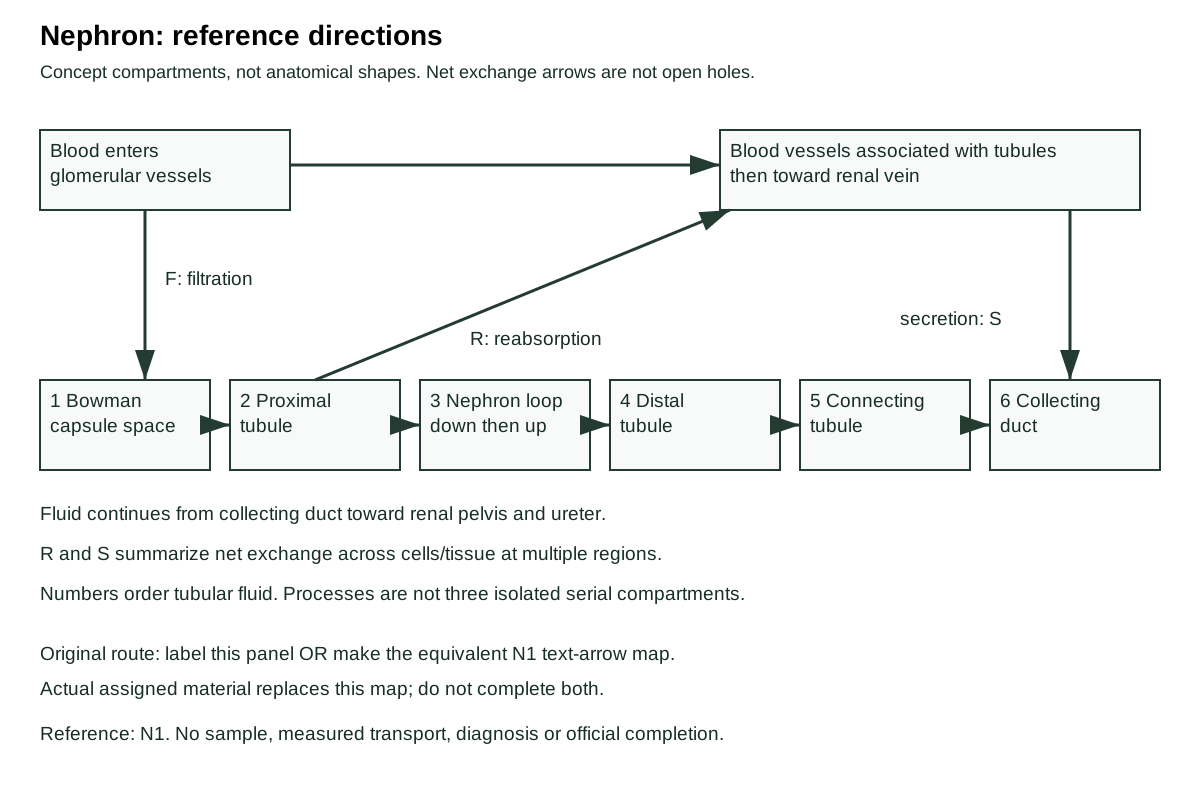
Use the complete reference map or the equivalent text below. Boxes are conceptual compartments, not tissue shapes. Blood stays within vessels. Tubular fluid occupies the inside space, or lumen, of the nephron tubule and its collecting system. The glomerulus is a cluster of small blood vessels. Bowman capsule surrounds it; its space receives filtered fluid (KIDNEY; ANATOMY).
Number the fluid path: 1 Bowman capsule space -> 2 proximal tubule -> 3 nephron loop, descending then ascending -> 4 distal tubule -> 5 connecting tubule -> 6 collecting duct -> onward toward the renal pelvis and ureter. The collecting duct receives fluid from multiple nephrons. This pathway shows order, not a requirement to draw accurate tissue proportions (ANATOMY; SEGMENTS).
Keep a separate blood path: blood enters glomerular vessels, then leaves them and reaches vessels associated with the tubules, before returning toward the renal vein. Blood does not travel down the capsule-space/tubule path (KIDNEY).
Label F, filtration: glomerular blood -> Bowman capsule space. Label R, reabsorption: tubular fluid -> blood. Label S, secretion: blood -> tubular fluid. R and S are net exchange directions across tubule cells and surrounding tissue; they are not open holes connecting the two paths. Water and many small dissolved substances can enter filtrate. Blood cells and most large proteins normally stay in blood.
Filtration, reabsorption and secretion are process names, not three successive numbered anatomical compartments. Reabsorption and secretion occur at multiple regions with different properties. This overview does not assign every substance to a segment or claim that all water leaves the loop. The final urine reflects the combined processing.
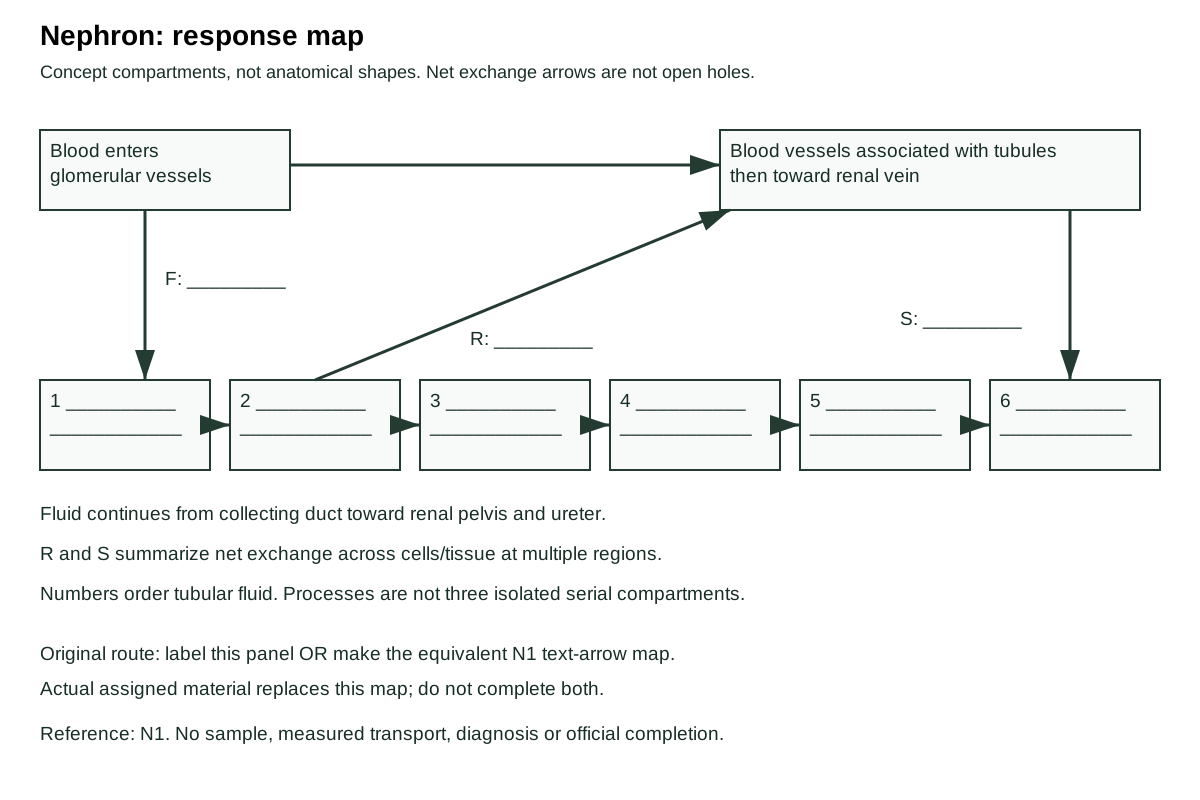
Original route: at 10–28 start one notebook diagram with the six numbered fluid boxes, a separate blood path and F/R/S arrow labels. Use words and arrows instead of an anatomical sketch if useful. Finish/check that same map during 28–45; do not make a second map. Actual route: teacher-assigned notes, task and rubric replace original practice locally. Complete one notebook only. Ask the teacher for the assigned materials and official task before starting that work.
U1: Tests need context
Urinalysis is examination of urine appearance, chemical components and microscopic contents (URINE). These categories can include color, glucose or protein detection, and cells. An indicator is a measured sign. It is not a diagnosis. Different causes can affect a result, and laboratories use their own reference ranges. No sample, chart or result is supplied here.
Gel electrophoresis separates molecules through a matrix using an electric field; movement depends on molecular size and charge. For a simplified comparison of linear DNA fragments under the same stated conditions, smaller fragments generally move farther than larger fragments. Known-size reference fragments permit size estimates. A band is a detected group of molecules at a position, not the name of a disease (GEL).
Equal apparent fragment length does not establish equal DNA sequence. A genetic assay needs a defined target, valid references and an interpretation method. PKD means polycystic kidney disease, a group of disorders involving kidney cysts. A cyst is a fluid-filled sac. Assessment of autosomal dominant PKD can involve imaging, family context and genetic testing (PKD). Generic bands alone cannot determine PKD.
Original route: add a one-sentence definition of urinalysis and one of gel electrophoresis to the same notebook. Add one limit for each: an isolated urine indicator does not identify its cause; a generic band pattern does not establish PKD. No numerical or diagnostic gel exercise is assigned. Actual route: teacher-assigned notes, task and rubric replace original practice locally. Complete one notebook only. Ask the teacher for the assigned materials and official task before starting that work.
P1: Complete the same concept record
At 28–45, original paper preparation replaces unavailable licensed screens for practice only. Finish the N1 map and U1 definitions already started. Check each F, R and S arrow against its N1 label by reading where the arrow starts and where it ends. Check that the numbered boxes describe fluid order, not three isolated process stages. Correct one actual mismatch, or mark one verified arrow if none needs correction.
If teacher-assigned online materials are available and authorized, use the genuine task and its required product instead of this paper practice. Confirm the exact stopping point. The course plan names 4.1.1 and 4.1.2. Ask the teacher which screens, including any digestion screens, are assigned.
No paper map counts as official online completion. Record what is unavailable instead of inventing access, a score or a completion screenshot. Actual route: teacher-assigned notes, task and rubric replace original practice locally. Complete one notebook only. Ask the teacher for the assigned materials and official task before starting that work.
D1: Digestion changes molecules
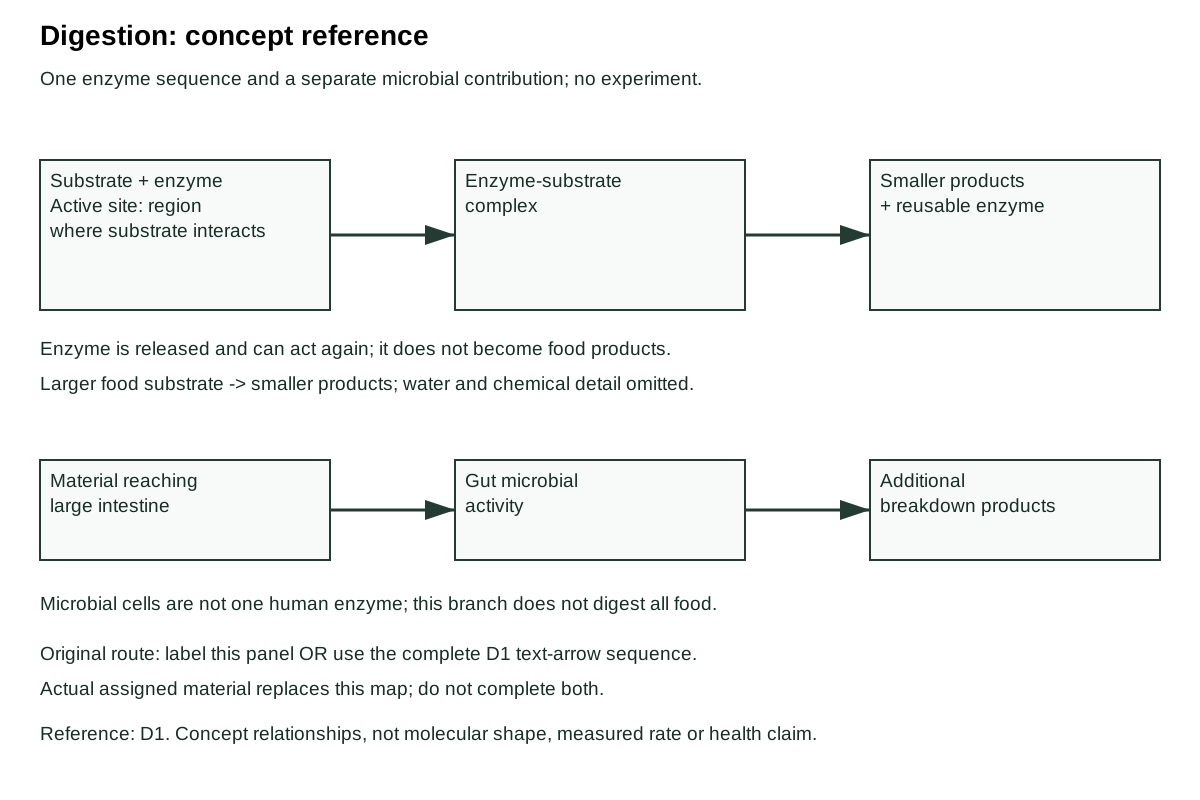
Digestion breaks food into smaller components the body can absorb. Digestive enzymes are biological catalysts: they speed particular chemical reactions and are not consumed as reactants. A substrate is the molecule an enzyme acts on; products are molecules formed. An active site is the enzyme region where the substrate interacts. This is a concept sketch, not a molecular shape model (DIGEST; ENZYME).
Original conceptual diagram: substrate + enzyme -> enzyme-substrate complex -> smaller products + enzyme. Label the enzyme as reusable after release; do not draw it becoming the food products. In this digestion sketch the substrate is a larger food molecule and the products are smaller molecules. The sketch omits water and detailed chemistry. It does not claim every enzyme splits molecules or every food component needs the same enzyme.
Add a separate branch: material reaching the large intestine -> gut microbial activity -> additional breakdown products. Some gut microbes help break down material that reaches the large intestine (DIGEST). Microbiome here means the community of microorganisms in the gut and their associated genetic material. Microbial cells are not a single human digestive enzyme. This branch is a contribution, not a claim that microbes digest all food or guarantee health.
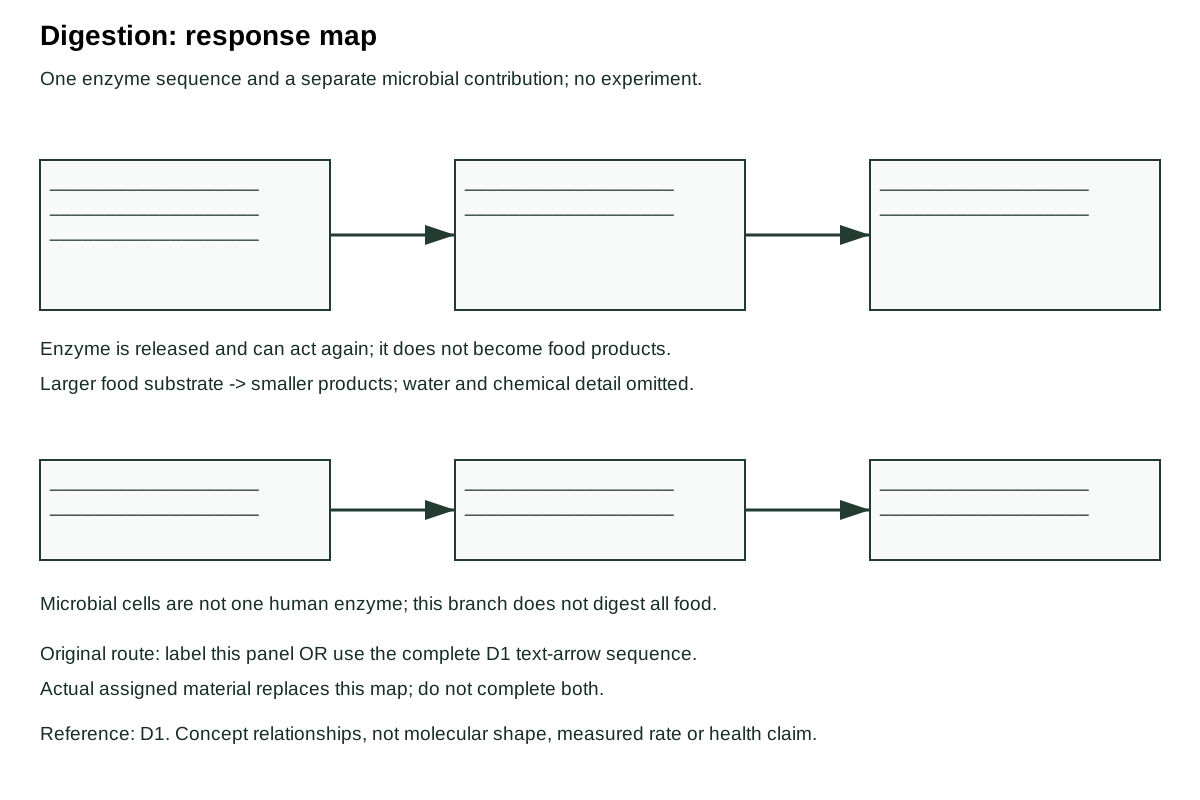
Original route: at 45–58 add this enzyme sequence and the separate microbial branch to the same notebook. Label substrate, enzyme, active site, complex, products and reusable enzyme; one simple shape may stand for each. The supplied text-arrow sequence is an equal alternative to shapes. Actual route: teacher-assigned notes, task and rubric replace original practice locally. Complete one notebook only. Ask the teacher for the assigned materials and official task before starting that work.
Q1: Ask and review honestly
At 58–70 write one kidney or digestion question. Original route: answer it provisionally with one N1/U1/D1 statement and its source ID, then state what that evidence cannot show. A complete solo option is the same question, your own source check and one revision or verified match, labeled self review. Do not invent a partner response.
If a partner genuinely responds, record the brief deidentified idea and check it against the supplied reference; label peer review. Ask the teacher how to take part in any required class activity. A question beyond these references may stay unanswered: specify the missing evidence and a teacher question instead of guessing.
Recovery example: ask which way reabsorption moves material. N1 supplies tubular fluid -> blood. That direction does not tell the amount moved in a real person. Use this method without completing an additional required question. Actual route: teacher-assigned notes, task and rubric replace original practice locally. Complete one notebook only. Ask the teacher for the assigned materials and official task before starting that work.
S1: One notebook and separate checks
Use ten short checks: 1 obtain teacher notes and ask what preparation to submit; 2 open the task for your enrolled course; 3 confirm the exact screens, stopping point and activity number. Also track 4 authentic rubric; 5 actual peer participation if required; 6 genuine official completion. Also check 7 your section and deadline; 8 the saved notebook; 9 that Schoology shows Submitted after uploading; 10 the protocol, authorization and supervision before any future lab. Note evidence from a check you performed or the missing input and a specific next action. Do not write ten narratives.
Assignment: Wk17 Lab notebook: Nephron and filtration. Section 1292: https://clevelandmetro.schoology.com/assignment/8544601217 . Section 6792: https://clevelandmetro.schoology.com/assignment/8544601246 . Confirm your section, acceptance and deadline. Open your section's assignment and, after uploading, check that Schoology shows Submitted.
At 70–80 check/save the same notebook. Submit only to the confirmed destination if authorized. If access is blocked, keep the notebook and tell the teacher what input you need. Check Schoology after uploading. A saved diagram is not proof of actual online or laboratory completion. Actual route: teacher-assigned notes, task and rubric replace original practice locally. Complete one notebook only. Ask the teacher for the assigned materials and official task before starting that work.
M1: Distinct nonclinical route model
Optional original model, no machine was run: a fictional document sorter has a main belt and a side tray. A card moves main belt -> side tray, then side tray -> main belt. A second card moves main belt -> side tray later. These supplied rules represent a routing diagram, not kidney tissue.
Worked record: first arrow is transfer outward; return arrow points to the main belt; later transfer points toward the side tray. I labeled each arrow from its start and destination rather than calling all arrows removal. My check confirms the return arrow ends at the main belt. No actual peer comment is claimed.
Mapping: distinguish paths and directions before naming a process. Limit: cards are not molecules; the sorter has no filtration barrier, living transport cells or enzymes. It cannot explain renal selectivity or rates. Do not submit a second sorter diagram. Actual route: teacher-assigned notes, task and rubric replace original practice locally. Complete one notebook only. Ask the teacher for the assigned materials and official task before starting that work.
Try the decision
Original route: a generic DNA band is visible without a defined assay or clinical context. What conclusion is supported? Actual route: use genuine assigned evidence and its limits.
- Describe the limited separation evidence and request the defined assay/context.
- Declare PKD from the visible DNA band without a defined assay or clinical context.
- Treat equal apparent fragment lengths as proof of equal sequence.
Explain your choice using the reading. Discuss it or say it to yourself. This practice does not add another submission.
Your response record
Use these labels on paper or in your document. The space below also works when this page is printed.
Two brief opening answers
Original route: answer H1’s two questions using H1 only. Actual route: use assigned evidence or state the missing input.
Actual route: teacher-assigned notes, task and rubric replace original practice locally. Complete one notebook only. Ask the teacher for the assigned materials and official task before starting that work.
One ordered map and definitions
Original route: start N1’s six fluid boxes and separate blood path; add F/R/S directions and U1’s two definitions with limits. Use the reference or full text equivalent.
Actual route: teacher-assigned notes, task and rubric replace original practice locally. Complete one notebook only. Ask the teacher for the assigned materials and official task before starting that work.
Finish and check that same map
Original route: use P1 to finish the existing map and verify one arrow or correct a real mismatch. Actual route: genuine official task replaces this preparation, with stopping point confirmed.
Actual route: teacher-assigned notes, task and rubric replace original practice locally. Complete one notebook only. Ask the teacher for the assigned materials and official task before starting that work.
Enzyme sequence and microbial branch
Original route: add D1’s enzyme sequence, six labels and separate microbial contribution to the same notebook. Text arrows are an equal option.
Actual route: teacher-assigned notes, task and rubric replace original practice locally. Complete one notebook only. Ask the teacher for the assigned materials and official task before starting that work.
One question with an honest review
Original route: use Q1 for one question, provisional answer with source/limit, and actual self/peer check. If the supplied evidence cannot answer the question, name exactly what evidence you need.
Actual route: teacher-assigned notes, task and rubric replace original practice locally. Complete one notebook only. Ask the teacher for the assigned materials and official task before starting that work.
Check and save one notebook
Both routes: use S1's ten checks to identify a next action, then save or submit through your section's assignment.
Actual route: teacher-assigned notes, task and rubric replace original practice locally. Complete one notebook only. Ask the teacher for the assigned materials and official task before starting that work.
Check your product
- Original route: one notebook includes six ordered fluid compartments, a separate blood path and correct F/R/S directions.
- Original route: urinalysis and electrophoresis definitions each include the U1 limit; no PKD claim from generic bands.
- Original route: one enzyme sequence shows enzyme reuse and a separate microbial contribution; text-arrow equivalents are accepted.
- Original route: give one question a source-backed provisional answer and limit, or request specific missing evidence. Identify whether you checked alone or with a peer.
- Actual route: assigned materials and rubric replace these original counts and practice requirements; no duplicate notebook.
- Both routes: save the preparation, keep evidence from assigned official work separate and check Schoology after uploading.
Concept arrows show directions and relationships. They cannot establish measured rates, a complete anatomical map, clinical results or completed PLTW work.
Turn in your work
Wk17 Lab notebook: Nephron and filtration
Assignment: Wk17 Lab notebook: Nephron and filtration. Section 1292: https://clevelandmetro.schoology.com/assignment/8544601217 . Section 6792: https://clevelandmetro.schoology.com/assignment/8544601246 . Confirm your section, acceptance and deadline. Open your section's assignment and, after uploading, check that Schoology shows Submitted. Actual route: teacher-assigned notes, task and rubric replace original practice locally. Complete one notebook only. Ask the teacher for the assigned materials and official task before starting that work.
- Section 1292: Wk17 Lab notebook: Nephron and filtration
- Section 6792: Wk17 Lab notebook: Nephron and filtration
Paper concept preparation only. Do not collect samples, run enzyme or electrophoresis experiments, interpret a real genetic record or diagnose a person. If access is blocked, save the notebook and tell the teacher what you need. After uploading, check that Schoology shows Submitted.
Connection to PLTW
Original conceptual notebook preparation. Ask for the assigned online task and follow it separately.
These references locate related course material. Complete only the official work and stopping point your teacher assigns. This local preparation does not establish completion of an online activity.
- Activity 4.1.1 Hello Kidney
- Activity 4.1.2 The Ultimate Collector
Optional practice and examples
Use these resources to practice related skills. Follow the required work and evidence limits above. A simulation does not authorize a live experiment or add another submission.
Slides and optional notes
Paper concept preparation only. Do not collect samples, run enzyme or electrophoresis experiments, interpret a real genetic record or diagnose a person. One notebook with two conceptual diagrams, two definitions/limits and one question/review. Actual route: teacher-assigned notes, task and rubric replace original practice locally. Complete one notebook only. Ask the teacher for the assigned materials and official task before starting that work. Guided notes are optional and do not add a second submission.
Sources and optional reading
- Your Kidneys & How They Work · NIDDK
- Kidney Tubules · NLM MeSH controlled anatomical vocabulary
- Urinalysis · MedlinePlus Medical Encyclopedia
- Electrophoresis · NHGRI
- Autosomal Dominant Polycystic Kidney Disease · NIDDK
- Your Digestive System & How it Works · NIDDK
- Enzyme · NHGRI
- Histology, Nephron · NCBI Bookshelf / StatPearls; segment order verified in indexed excerpt, full page access blocked
Keep going
If you were absent or lost your place, read the word guide and reading first. Try the example, then complete the first unfinished response.
No partner is required. Read your response aloud to yourself and check it against the product checklist.
Take home: Label the path and direction before naming the process; a diagram or isolated test result does not establish a diagnosis.
Thursday May 13 is the next scheduled renal and digestive lesson. Its actual materials, protocol and authorization remain teacher-confirmed inputs. What additional context would a renal or digestive test result need before interpretation?