
Biomedical Innovations · 2027-05-06 · 80 minutes
pGLO setup and DNA-band records
Your goal: Follow the teacher-led approved pGLO workflow and document the setup, controls and gel evidence. Newly plated cultures incubate overnight; count colonies Friday May 7. If the lab or results are unavailable, complete the labeled C1/G1 practice record without claiming physical completion.
One product: One record with actual kit condition labels, setup dates and May 7 colony-count fields marked pending; gel image and lane records when supplied. If unavailable, submit the explicitly invented C1/G1 practice record and identify the missing actual evidence.
Approved pGLO teaching route: use Bio-Rad kit 1660003EDU with the instructor-selected E. coli HB101 K-12 educational strain and the official Quick Guide. This route is limited to the approved educational E. coli HB101 K-12 strain under BSL-1 teaching-laboratory practices; it does not authorize other strains, environmental isolates or unknown cultures. The teacher verifies the kit strain, materials, protective equipment and approved decontamination/disposal plan before handling. Use the linked Lesson 4.1 pGLO Workflow Graphic to orient the sequence, and the Bio-Rad Quick Guide as the procedural authority. Students keep actual records distinct from the invented fallback; kit access or a successful result is never assumed. Save the same supplied-record preparation with missing input, next action and receipt pending.
Start the work
Prior Wednesday May 5 oversight discussion and approval are unverified. Use the complete supplied record; no laboratory clearance or prior prediction is assumed.
- Confirm the teacher-led Bio-Rad pGLO kit route and open the linked Quick Guide. Use only that approved kit SOP; record group code, date and condition labels.
- Follow the teacher through the kit workflow, including its 42°C heat-shock step. Preserve the +pGLO and -pGLO controls and the specified LB, LB/amp and LB/amp/ara plate identities. Do not substitute conditions.
- The teacher tapes and retains the closed plates inverted at 37°C overnight for Friday May 7. Mark new-plate colony counts pending today. Students never reopen incubated plates.
- Use a teacher-prepared digest or a separately approved digest started first, then a pre-run gel image if the full gel workflow will not fit. The pGLO Quick Guide does not specify this separate digest/gel experiment. Record the authentic image ID; otherwise use G1 as labeled nominal practice.
- Follow the teacher’s approved cleanup for tubes and tips: decontaminate everything that touched bacteria in 10 percent household bleach (final concentration) for at least 20 minutes before disposal. Retain the plates for Friday. No food, drink or mouth pipetting; disinfect benches before and after. The teacher switches off and unplugs gel equipment before opening it and uses the required UV-rated eye/face protection. Save the record with honest pending fields.
Show the 80-minute plan
- 0 to 10 minutes. Kit route: Check the kit SOP, safety and labels. Paper fallback: Use H1/C1 to identify source and physical-work holds. Actual route: use genuine teacher-approved records, images and rubric in place of this practice. Complete one chosen-route record. Missing real inputs and approvals remain pending.
- 10 to 30 minutes. Kit route: Follow the teacher-led kit workflow and record setup conditions. Paper fallback: Use C1/K1 for the three counts and supplied expectation key. Actual route: use genuine teacher-approved records, images and rubric in place of this practice. Complete one chosen-route record. Missing real inputs and approvals remain pending.
- 30 to 50 minutes. Kit route: Retain the closed labeled plates for overnight incubation; counts are pending. Paper fallback: Use G1 to interpret lane order and nominal values; no setup or loading. Actual route: use genuine teacher-approved records, images and rubric in place of this practice. Complete one chosen-route record. Missing real inputs and approvals remain pending.
- 50 to 65 minutes. Kit route: Read the teacher-provided pre-run gel image and label its lanes, or use G1 as invented practice. Paper fallback: Use R1 to record the supplied band positions; no run, photograph or real measurement. Actual route: use genuine teacher-approved records, images and rubric in place of this practice. Complete one chosen-route record. Missing real inputs and approvals remain pending.
- 65 to 75 minutes. Kit route: Complete approved cleanup without discarding retained plates. Paper fallback: Use Q1/S1 to review source fidelity and status; no cleanup completion. Actual route: use genuine teacher-approved records, images and rubric in place of this practice. Complete one chosen-route record. Missing real inputs and approvals remain pending.
- 75 to 80 minutes. Kit route: Save one record, noting what awaits Friday and what remains missing. Paper fallback: Use Q1/K1 for one bounded comparison and save the same record. Actual route: use genuine teacher-approved records, images and rubric in place of this practice. Complete one chosen-route record. Missing real inputs and approvals remain pending.
Open your materials
Use the reading, word guide, and worked example below. Keep your answers on paper or in one document.
Printable lesson and response record (PDF). This packet contains the same required reading and work.
Supplied nominal band reference
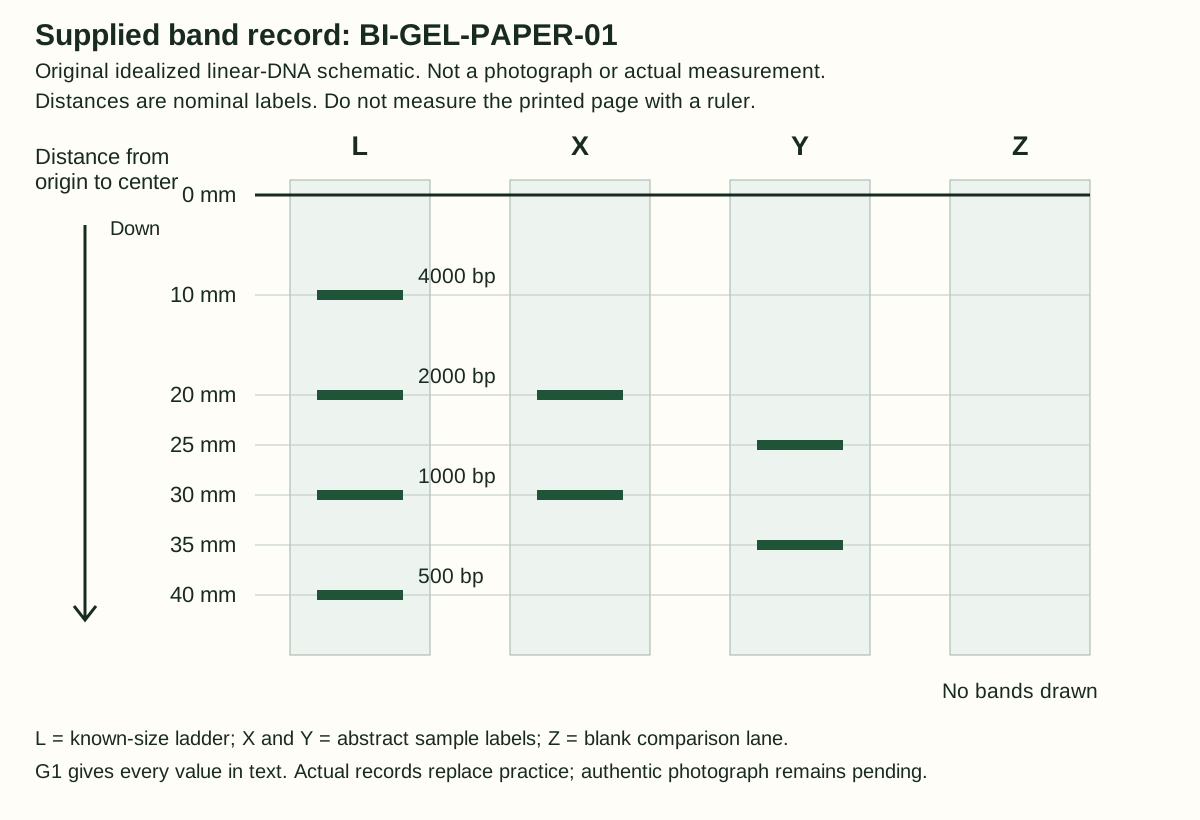
Question: How can you preserve a supplied record without claiming an experiment or photograph you do not have?
Words you will use
- supplied record
- Written input already provided for interpretation.
- fictional
- Invented for teaching, not evidence of a real event.
- nominal
- Assigned teaching value, not a newly measured quantity.
- colony count
- Number of visible colonies on a plate, not individual cells. Record actual counts on May 7 after overnight incubation; supplied fallback counts remain fictional.
- positive comparison
- Record with a declared positive expected signal; not a designed control here.
- negative comparison
- Record with a declared zero expected signal; zero alone does not prove absence of all problems.
- sample label
- Identifier linking a record to its material and condition. Actual pGLO plate labels identify plasmid and medium conditions; P/N/S are abstract fallback record IDs.
- teaching expectation
- Supplied comparison rule, not the student’s earlier prediction.
- prediction
- Expectation recorded before a real observation; not invented afterward.
- match
- Agreement with the specific stated key, not proof of cause.
- uncertainty
- What the available record cannot settle.
- transformation
- Uptake of external genetic material by a cell. The approved pGLO route uses the Bio-Rad Quick Guide; record actual performance and observations separately from the fictional fallback.
- transformation efficiency
- Defined ratio often relating transformant count to DNA amount; raw counts alone are insufficient here.
- digest
- Cleavage of DNA by enzymes, such as restriction enzymes. A digest needs its own approved protocol and inputs; the pGLO transformation Quick Guide does not supply that procedure.
- linear DNA
- DNA represented as a length with two ends, rather than a circular molecule.
- double-stranded DNA
- DNA containing two paired strands.
- gel electrophoresis
- Separation of molecules in an electric field through a gel. The supplied diagram supports paper interpretation; an actual gel requires a separate approved protocol and an authentic image with provenance.
- lane
- One labeled vertical column of the supplied diagram.
- band
- Drawn mark representing DNA at a nominal position, not an actual observation here.
- ladder
- Reference collection of DNA fragments with known lengths.
- base pair
- Two complementary DNA bases paired across strands; bp also counts fragment length.
- bp
- Abbreviation for base pair.
- millimeter
- Length unit abbreviated mm; distances here are nominal labels.
- origin
- Common reference line from which the nominal distance is given.
- band center
- Middle of the drawn mark used as its nominal position.
- raw position
- Supplied distance before any later size estimate.
- fragment size
- DNA length expressed in base pairs, different from migration distance in mm.
- schematic
- Simplified authored drawing, not a photograph.
- photograph
- Image made from a real scene; none is supplied for this fictional record.
- sequence identity
- Specific ordering of DNA bases; band position alone does not establish it.
- provenance
- Where a record came from and what it represents.
- sign-off
- Genuine authorized acknowledgment, not an invented mark.
- receipt
- Evidence that work reached its confirmed destination.
H1: A record is not laboratory completion
Approved pGLO teaching route: use Bio-Rad kit 1660003EDU with the instructor-selected E. coli HB101 K-12 educational strain and the official Quick Guide. This route is limited to the approved educational E. coli HB101 K-12 strain under BSL-1 teaching-laboratory practices; it does not authorize other strains, environmental isolates or unknown cultures. The teacher verifies the kit strain, materials, protective equipment and approved decontamination/disposal plan before handling. Use the linked Lesson 4.1 pGLO Workflow Graphic to orient the sequence, and the Bio-Rad Quick Guide as the procedural authority. Students keep actual records distinct from the invented fallback; kit access or a successful result is never assumed. The teacher tapes and retains the closed plates inverted at 37°C overnight for Friday May 7. Mark new-plate colony counts pending today. Students never reopen incubated plates. Use a teacher-prepared digest or a separately approved digest started first, then a pre-run gel image if the full gel workflow will not fit. The pGLO Quick Guide does not specify this separate digest/gel experiment. Record the authentic image ID; otherwise use G1 as labeled nominal practice. Follow the teacher’s approved cleanup for tubes and tips: decontaminate everything that touched bacteria in 10 percent household bleach (final concentration) for at least 20 minutes before disposal. Retain the plates for Friday. No food, drink or mouth pipetting; disinfect benches before and after. The teacher switches off and unplugs gel equipment before opening it and uses the required UV-rated eye/face protection. Save the record with honest pending fields.
At 0–10 identify the source and missing authentic evidence. Opening input: a paper diagram is labeled idealized teaching record, not photograph. Name one reason saving it cannot prove a real experiment occurred. Use this rule: an authored schematic is evidence of its supplied content, not of a physical event. Answer once. Actual route: use genuine teacher-approved records, images and rubric in place of this practice. Complete one chosen-route record. Missing real inputs and approvals remain pending.
Today is Thursday May 6. Prior Wednesday May 5 discussion or safety approval is not assumed complete. The next listed class is Friday May 7, Gel map. Use every value supplied here; no prior notebook, prelab prediction or actual photo is needed for this paper route. Start S1 status marks during work and update changes only.
C1: Complete invented count cards
Record set BI-RECORD-PAPER-01 is entirely invented for document practice. It is not actual plate data, a student result or a published experiment. Here a colony count means the nominal number written on a supplied record; you do not count organisms or infer how many cells are present.
Columns: ID | role | supplied count. P | positive comparison record | 12. N | negative comparison record | 0. S | sample record | 8. Unit: nominal counted colonies per supplied record. Every row is one count, not a mean or repeated-trial set. There are no photographs to count.
The words positive and negative identify comparison roles in this authored record. They prescribe no control design or biological conditions. Do not add an organism, plasmid, antibiotic, medium, amount or procedure. The source has none. It does not link these three counts to a particular DNA lane.
At 10–30 enter all three rows in one notebook table with columns ID, role, count/unit and evidence limit. Keep zero visible. Counts alone do not establish transformation efficiency, genetic identity or absence of contamination. No DNA-mass denominator or other needed efficiency inputs are supplied. Actual route: use genuine teacher-approved records, images and rubric in place of this practice. Complete one chosen-route record. Missing real inputs and approvals remain pending.
K1: A supplied expectation, not your earlier prediction
Teaching key K-P: P is expected to have a count greater than zero. Teaching key K-N: N is expected to have zero. No expected S count is supplied. These are declared expectations for this fictional record, not proof that any real control worked.
A comparison can say whether a supplied count matches its declared key. It cannot prove why. If no genuine prelab prediction exists, record prelab prediction unavailable. You may compare to K-P or K-N instead, explicitly naming it supplied teaching expectation. Do not backdate the key as your own prediction.
Keep the comparison for the final check. A real result may or may not feel surprising, but no feeling is required or invented. If you have no actual surprise to report, write not reported and name a remaining uncertainty instead. Actual required prediction work remains pending if absent. Actual route: use genuine teacher-approved records, images and rubric in place of this practice. Complete one chosen-route record. Missing real inputs and approvals remain pending.
G1: Full idealized lane and band record
At 30–50 read BI-GEL-PAPER-01. It is an original schematic of idealized linear double-stranded DNA, not an actual gel photograph, restriction map or construct. Lanes run left to right in this exact order: L, X, Y, Z. L is the known-size ladder; X and Y are abstract sample labels; Z is a blank comparison lane.
The common origin is the top reference line, labeled 0 mm. Nominal distance increases downward from that line to the center of each drawn band. Values are supplied whole millimeters, not measurements students made. Printed page scaling is arbitrary; do not use a ruler to invent distances. No measurement uncertainty is supplied.
Complete ladder L: 10 mm has 4000 bp; 20 mm has 2000 bp; 30 mm has 1000 bp; 40 mm has 500 bp. A base pair, abbreviated bp, is a pair of complementary DNA bases; here bp reports fragment length. The reference ladder is a set of known lengths, not the twisted-ladder shape of DNA.
Complete sample positions: lane X has two bands, at 20 mm and 30 mm. Lane Y has two bands, at 25 mm and 35 mm. Lane Z has no bands drawn. Write no bands drawn for Z; do not turn that into zero-mm DNA or proof that no DNA or contamination exists.
Full text alternative: from left to right, L has four centers at 10/20/30/40 mm; X has two at 20/30 mm; Y has two at 25/35 mm; Z has none. Each column starts from the same 0-mm line and extends downward. The SVG shows exactly those eight band centers; text is an equal source if the image is unavailable.
NHGRI explains the general size-separation principle: shorter DNA fragments can move farther through a gel than longer ones under the same comparison. This practice record assumes linear DNA and idealized positions. It supplies no real operating conditions, sequence identity, mass or restriction pattern interpretation. No sample-size calculation is required today. Actual route: use genuine teacher-approved records, images and rubric in place of this practice. Complete one chosen-route record. Missing real inputs and approvals remain pending.
R1: Record the supplied positions honestly
At 50–65 add a lane table to the same notebook record. Columns: lane, role, band ID, nominal position in mm, supplied ladder size if given, and source/status. Use L1–L4 for L’s bands, X1–X2 for X and Y1–Y2 for Y, ordered top to bottom. Keep one Z row saying no bands drawn and size not supplied.
Copy known sizes only for L1–L4. For X/Y size, write not yet estimated; May 7 can use these same supplied positions with a supplied comparison rule. Do not guess a size or reconstruct a DNA sequence now. Raw positions and inferred sizes are different records.
Use the supplied labeled diagram as your lane map, or make one simple text lane map from G1 if the image is unavailable. Do not do both. Keep the label authored schematic, not gel photograph. Authentic photograph: unavailable in this preparation. The actual photograph requirement remains pending; the schematic does not replace it as proof.
An expected-pattern match does not establish sample identity, success of a real digest, or a clean experiment. Count cards and gel lanes are separate supplied records with no stated biological link. Friday’s analysis reuses this same supplied dataset and its limits; it does not assume you completed a lab. Actual route: use genuine teacher-approved records, images and rubric in place of this practice. Complete one chosen-route record. Missing real inputs and approvals remain pending.
Q1: Status review, then one bounded comparison
At 65–75 review source fidelity and genuine status. Check the three counts, lane order, common origin, all eight band centers and Z’s no-band statement. Check that size and distance units stay distinct. Correct an actual transcription mismatch or mark a verified match. This paper check is not PPE, equipment or cleanup completion.
At 75–80 add one short comparison: choose K-P or K-N, cite its expectation and supplied count, then say match or mismatch. Label the source teaching expectation if no genuine prior prediction exists. Add one brief uncertainty or report a real surprise only if it actually occurred. Do not invent feelings or observations.
Save the same notebook record. If a real peer comments, keep the genuine deidentified comment; otherwise mark self review. The supplied worked model is optional and is not another task. Actual route: use genuine teacher-approved records, images and rubric in place of this practice. Complete one chosen-route record. Missing real inputs and approvals remain pending.
S1: Separate preparation from authentic evidence
Track eleven short statuses: 1 teacher acceptance and genuine data/images; 2 actual rubric; 3 approved protocol and safety review; 4 real materials, training and supervision. Also track 5 actual transformation/digest/gel execution; 6 real photograph and measurements; 7 genuine prelab prediction/comparison; 8 actual peer participation; 9 cleanup and sign-off. Finally track 10 official scope/access, saved record and confirmed destination/deadline; 11 genuine receipt. Use completed, pending or not checked with a pointer or missing input.
Paper preparation cannot complete the physical objective or certify an actual photo, measurement, protocol, instrument check, safety training or cleanup. No virtual lab execution is supplied either. Those authentic requirements remain teacher-controlled. Do not use procedures from any other page or assume the prior debate grants clearance.
Ask your teacher whether myPLTW Project 6.1.2 applies today and where to stop. Open the linked BI assignment in Turn in your work. Opening the assignment is not a submission receipt.
If blocked, save the labeled record with missing input, next action and receipt pending. Friday May 7 Gel map is the next class. Its paper interpretation can reuse these supplied inputs; no actual May 6 work is assumed. Actual route: use genuine teacher-approved records, images and rubric in place of this practice. Complete one chosen-route record. Missing real inputs and approvals remain pending.
M1: Distinct complete printing-record model
Optional distinct nonbiological record model, not a second task. An invented printing inspection log has P2, comparison card, count 5 spots; N2, blank-comparison card, count 1 spot. Unit: spots per supplied card. The supplied key expects N2=0; no authentic prelab prediction is present.
A separate printed-stripe diagram has two columns, R2 then T2. The common top line is 0 mm, with nominal distance downward. R2 has stripe centers at 10 mm and 30 mm; T2 has one at 20 mm. No DNA or fragment-size meaning applies to this model.
Worked record: P2/comparison/5 spots; N2/blank comparison/1 spot. Lane R2: stripe1=10 mm, stripe2=30 mm; T2: stripe1=20 mm. Source/status: invented supplied values, not actual measurement or photograph. Genuine prior prediction unavailable.
Worked comparison: supplied key N2 expects zero, but its supplied count is one, so it does not match that key. The record does not tell why. No surprise is claimed. Self-check preserves all counts and distances without correcting the unexpected value. This illustrates honest recording, not proof of an actual print run. Actual route: use genuine teacher-approved records, images and rubric in place of this practice. Complete one chosen-route record. Missing real inputs and approvals remain pending.
Try the decision
Original route: compare N with the supplied key. What may the record say? Actual route: use the genuine source and rubric.
- State whether N matches this key, while cause and actual lab completion remain unknown.
- Transformation succeeded and contamination is absent if N agrees with the supplied key.
- A matching schematic establishes that the required photograph was actually taken.
Explain your choice using the reading. Discuss it or say it to yourself. This practice does not add another submission.
Your response record
Use these labels on paper or in your document. The space below also works when this page is printed.
One evidence-source limit
Original route: Use H1 to distinguish a schematic from an actual photo.
Actual route: use genuine teacher-approved records, images and rubric in place of this practice. Complete one chosen-route record. Missing real inputs and approvals remain pending.
Three supplied count rows
Kit route: create four actual condition rows, +pGLO LB/amp; +pGLO LB/amp/ara; -pGLO LB/amp; -pGLO LB. Record plate ID and setup date; leave colony count and fluorescence fields pending until the May 7 read. Paper fallback only: use C1’s three supplied rows, P=12, N=0 and S=8. Preserve their invented role labels and units; do not relabel them as pGLO conditions. Complete only the chosen route in the same record.
The actual kit has four condition rows; C1 has three unrelated invented count rows. No new-plate count is available during May 6 setup.
Lane map and nominal inputs
Original route: Use G1 to identify all lane positions and supplied reference sizes.
Actual route: use genuine teacher-approved records, images and rubric in place of this practice. Complete one chosen-route record. Missing real inputs and approvals remain pending.
Same notebook band record
Original route: Use R1 to preserve every nominal band center and missing actual-photo status.
Actual route: use genuine teacher-approved records, images and rubric in place of this practice. Complete one chosen-route record. Missing real inputs and approvals remain pending.
Fidelity and genuine-status check
Original route: Use Q1/S1 to check the same record; no physical cleanup is claimed.
Actual route: use genuine teacher-approved records, images and rubric in place of this practice. Complete one chosen-route record. Missing real inputs and approvals remain pending.
One expectation comparison
Original route: Use K1/Q1 for one honest comparison and a remaining uncertainty.
Actual route: use genuine teacher-approved records, images and rubric in place of this practice. Complete one chosen-route record. Missing real inputs and approvals remain pending.
Check your product
- Original route: three count rows preserve P=12, N=0, S=8 and their supplied roles and units.
- Original route: lane order L/X/Y/Z, common 0-mm origin and all eight nominal band centers are preserved.
- Original route: known sizes belong to the four ladder bands only; X/Y remain not yet estimated and Z no bands drawn.
- Original route: one comparison names a supplied key or genuine prediction honestly, with no invented result, prior prediction or surprise.
- Actual route: use genuine teacher-approved records, images and rubric in place of this practice. Complete one chosen-route record. Missing real inputs and approvals remain pending.
- Both routes: actual photo, measurements, biological work, safety/cleanup, approval, official completion and receipt require genuine evidence.
Supplied fictional counts and nominal bands cannot establish any actual transformation, construct identity, absence of contamination, safety clearance or completed laboratory work.
Turn in your work
pGLO setup and DNA-band records
Open the linked BI assignment in Turn in your work. Confirm actual prompt, rubric, destination and deadline. Actual route: use genuine teacher-approved records, images and rubric in place of this practice. Complete one chosen-route record. Missing real inputs and approvals remain pending.
Open this assignment in SchoologyApproved pGLO teaching route: use Bio-Rad kit 1660003EDU with the instructor-selected E. coli HB101 K-12 educational strain and the official Quick Guide. This route is limited to the approved educational E. coli HB101 K-12 strain under BSL-1 teaching-laboratory practices; it does not authorize other strains, environmental isolates or unknown cultures. The teacher verifies the kit strain, materials, protective equipment and approved decontamination/disposal plan before handling. Use the linked Lesson 4.1 pGLO Workflow Graphic to orient the sequence, and the Bio-Rad Quick Guide as the procedural authority. Students keep actual records distinct from the invented fallback; kit access or a successful result is never assumed. Save the same supplied-record preparation with missing input, next action and receipt pending.
Connection to PLTW
Original supplied-record preparation; authentic laboratory evidence pending.
These references locate related course material. Complete only the official work and stopping point your teacher assigns. This local preparation does not establish completion of an online activity.
- Project 6.1.2 Construction and Cloning of Recombinant DNA
Optional practice and examples
Use these resources to practice related skills. Follow the required work and evidence limits above. A simulation does not authorize a live experiment or add another submission.
- Building a Plasmid: Recombinant DNA by Cut and Paste
This separate fictional scenario is not the pGLO protocol or today's data. Follow the assigned Bio-Rad protocol for approved pGLO work. Growth and fluorescence do not establish the complete sequence or identity of a construct. The simulation adds no submission or laboratory authorization.
Slides and optional notes
Use one chosen-route record. Kit route: four actual pGLO condition rows with counts and fluorescence pending until May 7, plus authentic lane records when supplied. Paper fallback: the three invented C1 rows, G1 nominal lane map/positions and one bounded comparison. Keep missing actual observations pending; do not present fallback values as kit results. Guided notes are optional and do not add a second submission.
Sources and optional reading
- Separating the Sequencing Products: Transcript · NHGRI educational transcript; general fragment-size comparison only
- Base Pair · NHGRI glossary; base-pair concept and length unit
- pGLO Transformation Kit Quick Guide · Bio-Rad, manufacturer SOP for approved educational kit
- Lesson 4.1 pGLO Workflow Graphic · Course-posted workflow orientation; use Bio-Rad Quick Guide for the approved kit procedure
Keep going
If you were absent or lost your place, read the word guide and reading first. Try the example, then complete the first unfinished response.
No partner is required. Read your response aloud to yourself and check it against the product checklist.
Take home: Preserve what the source records, label what it cannot establish, and keep actual work separate.
Friday May 7 combines observations after overnight incubation with Gel map analysis. If plates are absent or failed, label that status and use the fictional fallback without claiming completed laboratory work. Keep the nominal BI-GEL-PAPER-01 size analysis separate from actual plate evidence. What do the actual pGLO colony counts and fluorescence observations support when compared across the four plate conditions, and what remains uncertain?