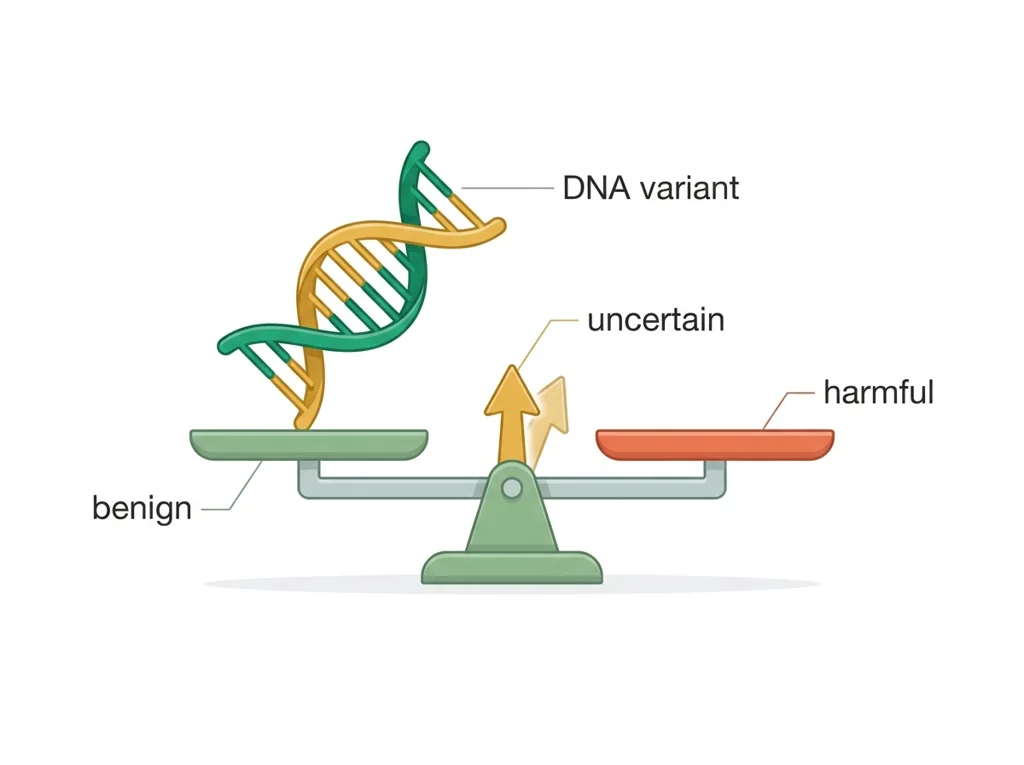
Looking Up a Variant
When we find a DNA change in a patient's gene, where do we look it up, and how do we decide if it is harmful, harmless, or unknown?
💡 A database call is built from the weight of evidence and can change as new evidence comes in; frequency is a major clue.
Prerequisite check
- IRF6 is the gene, and it makes a -factor .
- A variant is a change in DNA, and not all variants are harmful.
What you will learn
Goal: Students will navigate ClinVar and OMIM and classify a variant entry as benign, pathogenic, or a .
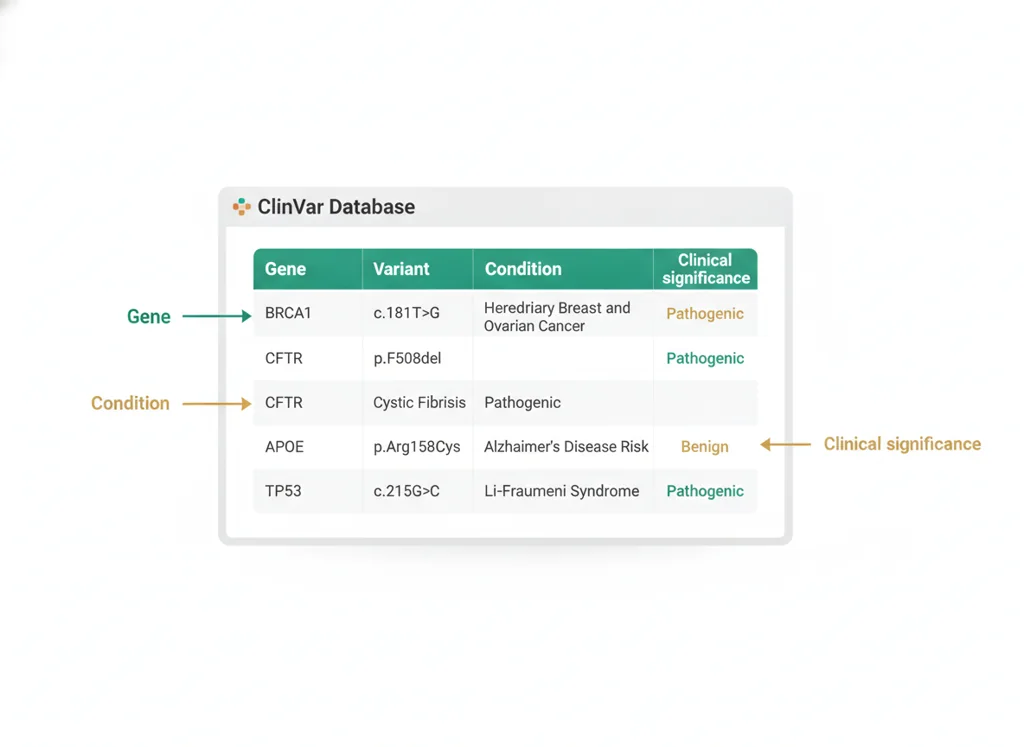
- ClinVar (NIH) stores individual DNA variants and the conditions they have been linked to, each with a clinical-significance call.
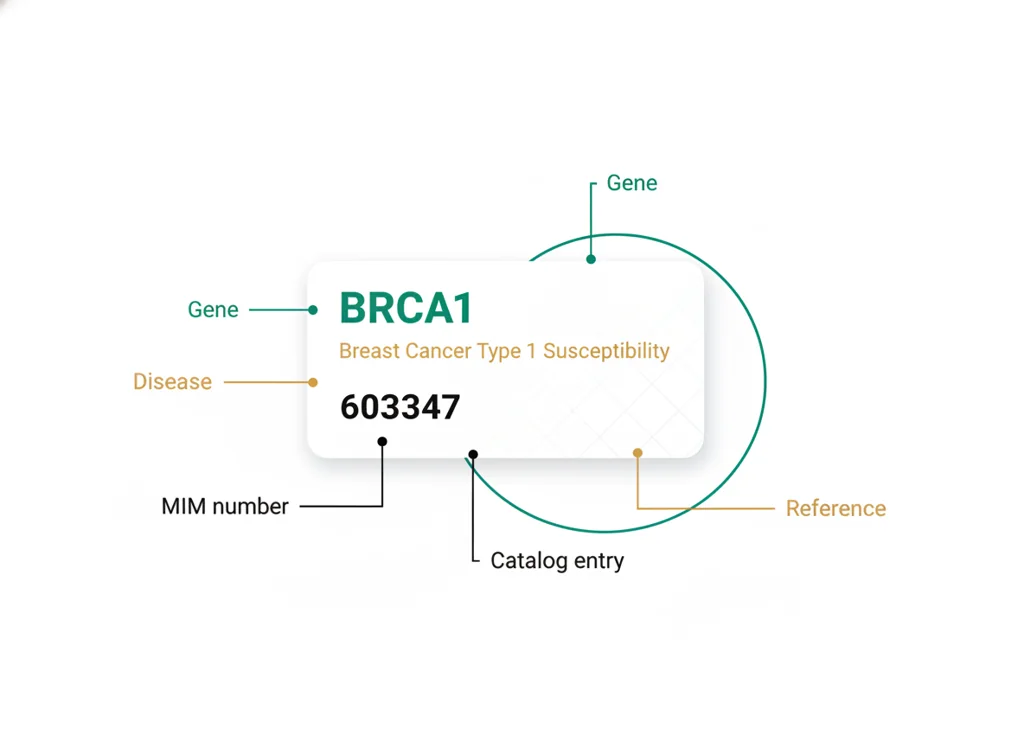
- OMIM catalogs genes and the inherited diseases they cause; IRF6 maps to two diseases, (#119300) and popliteal pterygium syndrome (#119500).
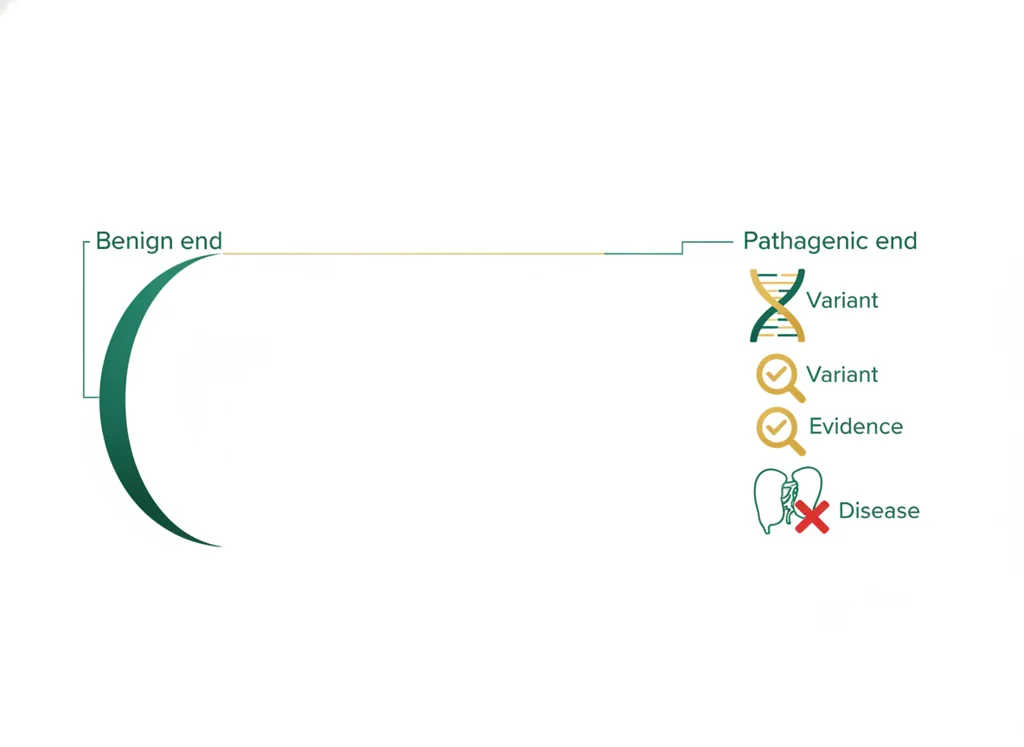
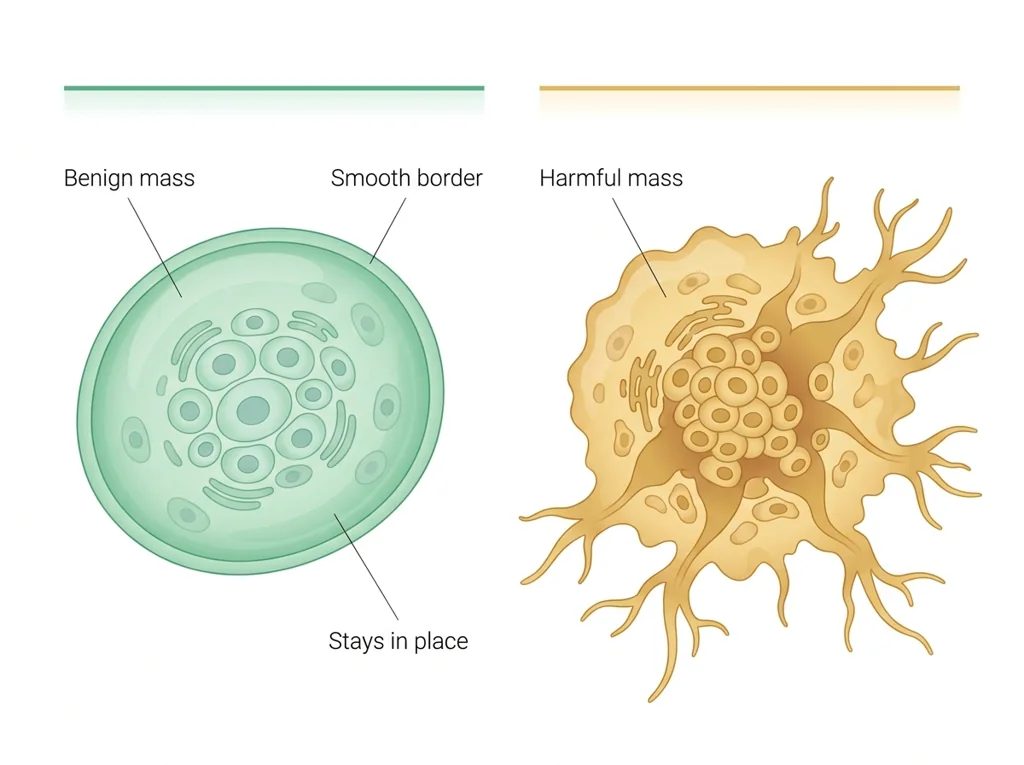
- The three clinical-significance calls are pathogenic, benign, and .
- A change common in healthy people is usually benign, while a rare change concentrated in affected families is a red flag; calls can change as evidence accumulates.
- gnomAD (the Genome Aggregation Database) is the healthy-population yardstick: it reports how often a variant appears in tens of thousands of mostly healthy people, so a damaging change that is absent there is a red flag for pathogenic.
Model: A ClinVar-style table and an OMIM-style card for IRF6
A simplified ClinVar-style table for IRF6, with real variants from the literature: Entry A is R84C, linked to popliteal pterygium syndrome (PPS), called Pathogenic, recurrent in about 70 families. Entry B is R250X, linked to , called Pathogenic, reported in multiple families. Entry C is V274I, used as a common tag marker, called Benign, common (3% of Europeans, 30% of Asians). Entry D is a brand-new change no one has reported, not established, called a , seen once in one new patient.
OMIM is a second database that lists a gene and the named diseases it causes. The IRF6 card connects one gene to two disorders: IRF6 to (VWS1, OMIM #119300) and IRF6 to popliteal pterygium syndrome (PPS, OMIM #119500). Every database entry carries a clinical-significance call, and that call is built from how often a change appears in patients versus healthy people, family patterns, lab tests, and prior reports.
Background and an analogy
- A variant is just a specific change in the .
- How common a change is in healthy people is a major clue to whether it is harmful.
A library catalog tells you whether a book is shelved, checked out, or not yet catalogued, but it only knows what librarians have recorded so far.
How it maps: ClinVar is the catalog. Pathogenic and benign are settled records; a is a book not yet catalogued, waiting for more information before it gets a shelf.
Explore (work the model before reading on)
- Which two entries are labeled Pathogenic, and what conditions are they linked to?
- How often has Entry C (V274I) been seen in the population, and what is its database call?
- In OMIM, how many different diseases does the single gene IRF6 connect to?
- Compare Entry C (seen in up to 30% of people, Benign) with Entry A (about 70 families, Pathogenic). Why might a change found in nearly a third of healthy people be called harmless, while a rarer change is called harmful?
- Entry D was seen only once and no one has reported it before, so the database cannot call it benign or pathogenic. What does that tell you about how a call gets made?
- Suppose three more labs report Entry D in children who also have clefts, never in healthy relatives. How might the database call for Entry D change, and why?
- In one sentence, what pattern did your team find about how a database decides whether a DNA change is benign, pathogenic, or uncertain?
Guided notes
Two databases
- ClinVar (NIH) stores individual DNA ____ and the conditions they have been linked to.
- OMIM stores the link between a ____ and the named diseases it can cause; IRF6 maps to VWS and PPS.
The three calls
- Pathogenic: strong evidence the change ____ disease (example IRF6 R84C, linked to PPS).
- Benign: evidence the change does NOT cause disease, often because it is ____ in healthy people (example IRF6 V274I).
- : not enough evidence yet to call it either way.
How a call is built
- A call is built from ____ (frequency in patients versus healthy people, family patterns, lab tests, and prior reports).
- Calls can ____ as new evidence comes in; a VUS today can become pathogenic or benign tomorrow.
Reading the Research
- Skim the title and abstract first to get the gist.
- Circle the one sentence that states the main claim.
- Box the evidence the authors give for that claim.
- Mark one sentence that confuses you, and move on.
Using the database (what to capture)
Part of today's expected outcome is to actually open the tool below and write down the value it gives you. That captured value is the evidence you will use in your Claim, Evidence, Reasoning. Follow the steps, use the labeled screenshot so you do not get lost, and record each field.
Lists DNA variants that have been reported, the condition each is linked to, and a clinical-significance call.
- 1Open ncbi.nlm.nih.gov/clinvar and search IRF6[gene].
- 2Open one variant from the list (for example R84C).
- 3Read its clinical significance and the review status (how many labs agree).
- Variant name: R84C (or c.250C>T)
- Condition: Popliteal pterygium syndrome
- Clinical significance: Pathogenic
- VUS vs pathogenic call: Pathogenic, not a VUS, because it recurs in many affected families
Catalogs genes and the inherited diseases they cause, with a stable number per entry. It is a professional database; use MedlinePlus Genetics as the student-friendly fallback if access stalls.
- 1Open omim.org and search IRF6, then open the gene entry (#607199).
- 2Scroll to the phenotype (disease) table.
- 3Read the diseases linked to the gene and the inheritance pattern.
- Gene entry (MIM number): IRF6, #607199
- Disease(s) it causes: Van der Woude syndrome (#119300); popliteal pterygium syndrome (#119500)
- Inheritance: Autosomal dominant
A reference catalog of DNA variation from many thousands of mostly healthy people. It tells you how common a variant is overall and within each ancestry group, plus how tolerant a gene is to being broken.
- 1Open gnomad.broadinstitute.org and search the gene IRF6, or paste a specific variant.
- 2Read the global (how often the change appears across all people).
- 3Open the populations breakdown to see the frequency by ancestry, and check the gene constraint scores (is tolerated?).
- Variant or gene searched: IRF6 R84C (or the gene IRF6)
- Global allele frequency: 0 (absent), or a very small number like 0.00001
- Frequency by ancestry: Differs by group; for example rs642961 is ~0.11 in African and ~0.27 in Native American samples
- Gene constraint (LOEUF / pLI): IRF6 is constrained: a low LOEUF / high pLI means broken copies are not tolerated
Vetted readings for this lesson
- Kondo S, et al. 2002. IRF6 mutations cause VWS and PPS. Nat Genet. [PMID:12219090]
- Leslie EJ, et al. 2012. IRF6 variants in VWS and PPS. Genet Med. [PMID:23154523]
- ClinVar (NIH), query gene IRF6
- OMIM IRF6 (#607199); VWS1 #119300; PPS #119500 (professional database; use MedlinePlus Genetics if blocked)
- gnomAD (Broad Institute), gene IRF6: allele frequency in healthy populations
Track your progress today
Check these off as you work through the lesson, then submit. This tells Mr. Mendoza how you're doing so he can help the class. It does not replace turning in your producible.
Use the code Mr. Mendoza gave you, not your name. Saved on this device.
- Read the Model and answered the Explore questions.
- Filled in the guided notes in my own words.
- Defined the new vocabulary with an example.
- Opened ClinVar and OMIM and gnomAD (Genome Aggregation Database) and recorded the value it gave me.
- Built the producible: Given a patient's IRF6 change reported in no database, write the call you would record right now using the three categories and name the one piece of evidence you would most want next to move it off uncertain.
- Wrote my Claim, Evidence, and Reasoning exit ticket.
Exit ticket (Claim, Evidence, Reasoning)
- Claim: A brand-new, never-reported IRF6 variant should be classified as ____ (benign / pathogenic / VUS) at this moment.
- Evidence: The database shows ____ about how often it appears and what conditions it is linked to.
- Reasoning: Therefore the call is ____, because a classification depends on the weight of evidence and can change as more is gathered.
| Criterion | Proficient | Developing | Beginning |
|---|---|---|---|
| Complete | Every required part of the artifact is present and filled in. | Most parts are present, but one is missing or left blank. | Several parts are missing. |
| Accurate | The science and data are correct and match the evidence. | Mostly correct, with a small factual slip. | Key science or data is wrong. |
| Scientific reasoning (CER) | States a claim, backs it with specific evidence, and explains the reasoning. | Has a claim and evidence, but the reasoning is thin or missing. | Gives an answer with no evidence or reasoning. |
| Professional communication | Clear, organized, and labeled the way a clinician or scientist would write it. | Readable but disorganized or missing labels. | Hard to follow. |
| Submitted | Turned in the right way (Schoology for routine work) and confirmed. | Turned in, but in the wrong place or unconfirmed. | Not turned in. |
- CompleteProficient: Nothing is left blank: the model fills every part of "Given a patient's IRF6 change reported in no database, write the call you would record right now using the three categories and name the one piece of evidence you would most want next to move it off uncertain.".
- AccurateProficient: Every number and claim matches the case evidence.
- Scientific reasoning (CER)Proficient: It names a claim, cites the specific evidence, and explains the reasoning, not just the answer.
- Professional communicationProficient: It is organized and labeled like a real chart note.
- SubmittedProficient: It would be turned in on Schoology and confirmed.
Where this leads: careers
What's next: When we read variants we saw codes like R84C and R250X. What kinds of typos in DNA do those codes actually stand for?