Rough draft.This research track is under review with Dr. Atit's lab. Content and sequence may still change.
The Baby Mateo Case
Genetics domainMedical Interventions (MI), with PBS overlapLesson 7 of 20Your seat: Variant analyst

Kinds of Typos in DNA

Discovery question

What kinds of typos can occur in DNA?

💡 and typos usually destroy most of the made from that copy, while a leaves a full-length protein that may work, partly work, or actively misbehave.

The plan

Prerequisite check

Before this page, you should know
  • DNA is read three letters at a time as codons.
  • IRF6's must keep its shape to bind DNA and do its job.
Today's new idea is only
Today's new idea is only this: the KIND of typo (, , , or splice) predicts how much of the survives.
Learn first

What you will learn

Goal: Students will classify a DNA change as , , , or splice from a sequence and predict its effect on the .

Know by the end
  • DNA is read three letters at a time as codons; the run of codons is the .
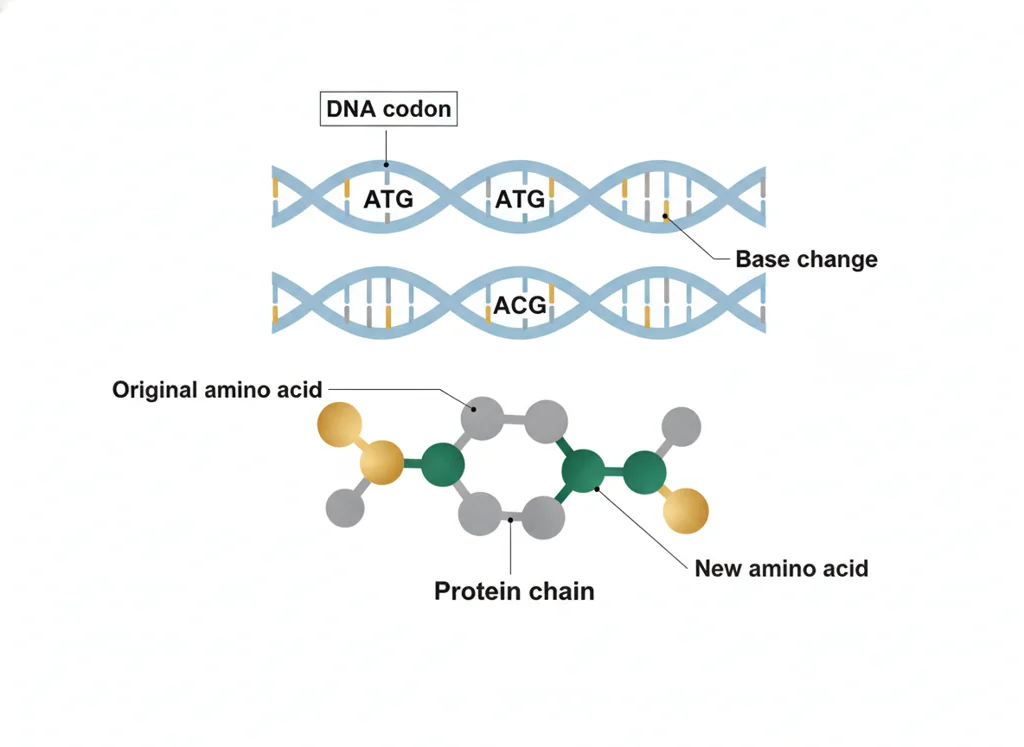
  • A change swaps one amino acid; the stays full length but may be altered.
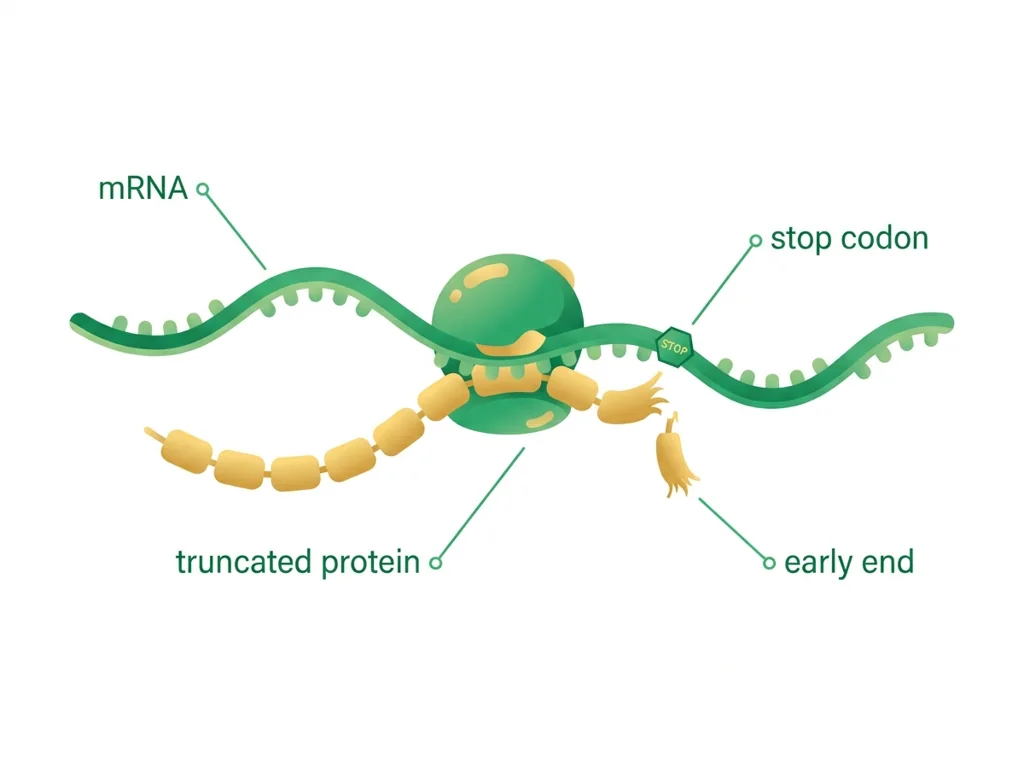
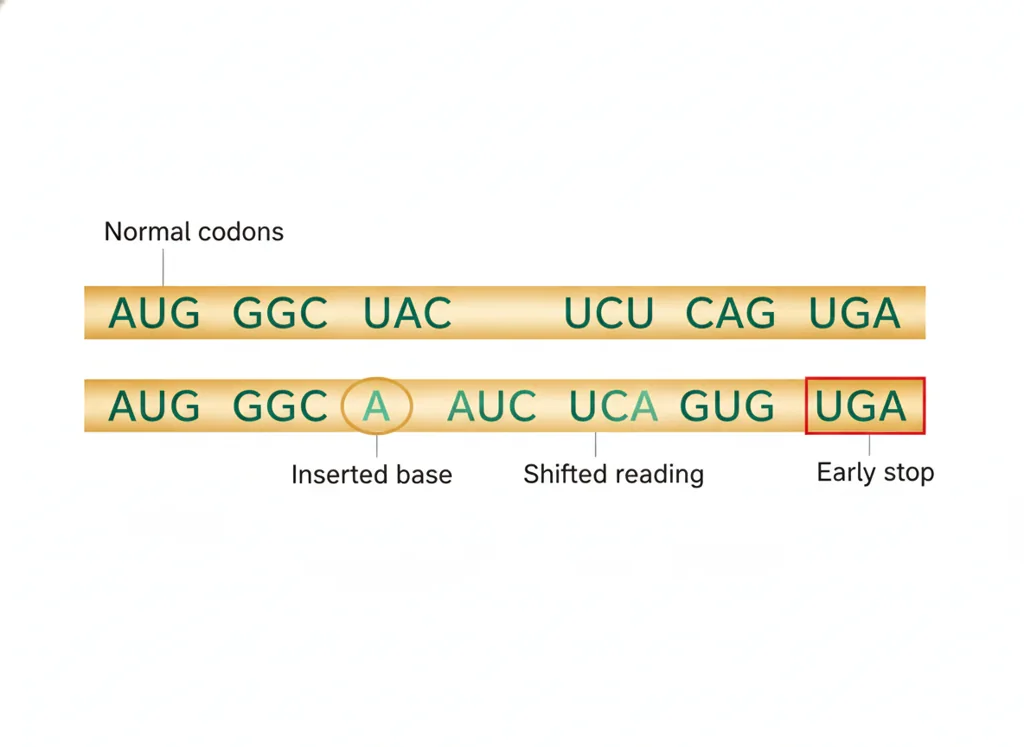
  • A change creates a premature stop codon, cutting the short; a ( or deletion not a multiple of 3) scrambles everything .
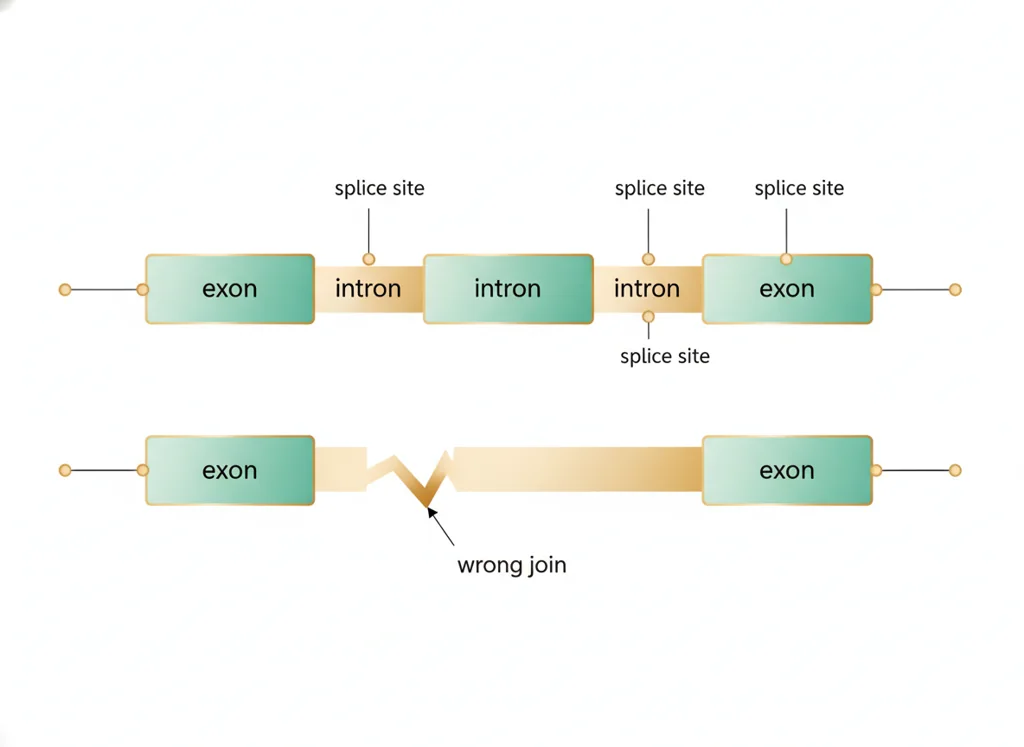
  • A splice-site change at an intron/exon boundary causes wrong joining of the mRNA.
Learn first

Model: Four edits to the same short message, and the four IRF6 typo types

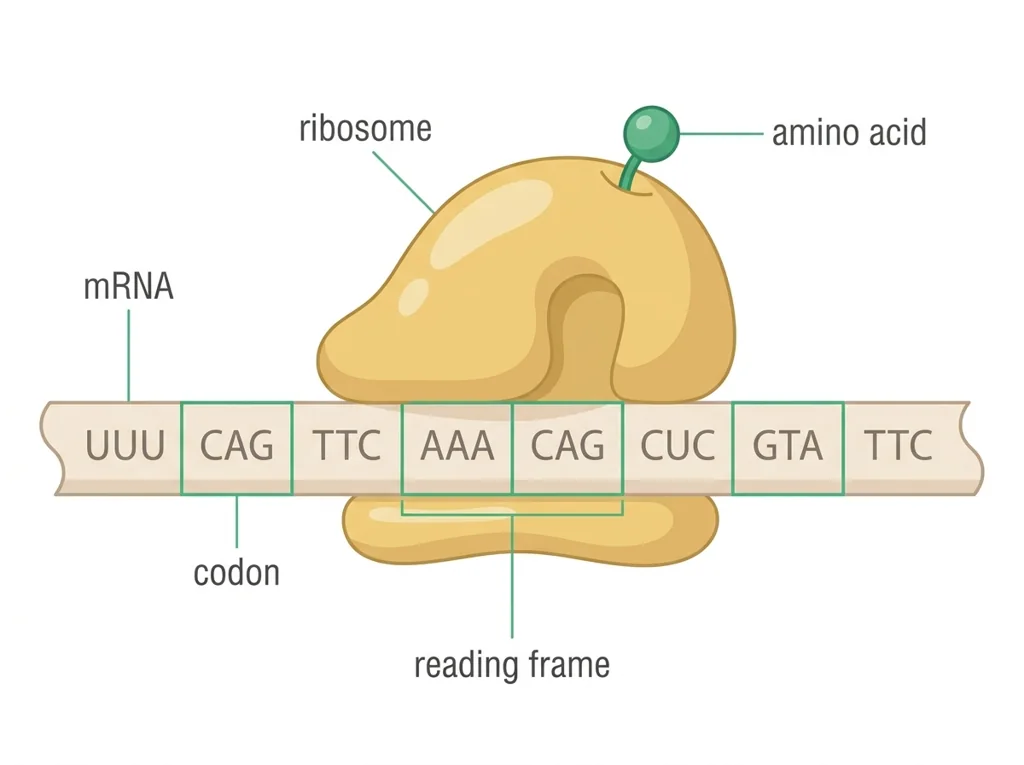
DNA is read three letters at a time, and each three-letter word (a codon) either names one amino acid or says stop. Read this sentence three letters at a time, the way a ribosome reads mRNA: THE BIG RED DOG RAN FAR (each word is one amino acid). Edit 1 changes one letter so RED becomes a different word of the same length (a ). Edit 2 turns DOG into a STOP word, so the reader stops and everything after is lost (a ). Edit 3 deletes one letter, so every word after the deletion is re-grouped wrong and the rest is gibberish (a ). Edit 4 lands exactly at the seam where two pieces are spliced together, so the wrong pieces get joined (a splice-site change).

Real IRF6 variants sort into these same categories. R84C changes amino acid 84 from arginine (R) to cysteine (C): , full-length , possibly broken. R250X turns codon 250 into a STOP (the X): , protein cut short at position 250. An or deletion not a multiple of 3 is a , scrambling everything and usually ending in an early stop. A change at an intron/exon boundary is a . Reading the code: a letter, a number, a letter (R84C) means missense; a letter, a number, then X (R250X) means nonsense.

Read this in pieces, one chunk at a time
Learn first

Background and an analogy

Background you need first
  • A codon is three DNA letters that name one amino acid or say stop.
  • The is the run of codons; shifting it scrambles everything after the change.
An everyday analogy

Read a text message three letters at a time. Change one letter and one word changes. Delete a letter and every word after it gets regrouped into .

How it maps: Changing one letter is a (one amino acid swapped). Turning a word into STOP is a ( cut short). Deleting one letter is a (everything scrambled).

Do the work

Explore (work the model before reading on)

  1. Which edit keeps the sentence the same length but changes one word?
  2. Which edit makes the reader stop early and lose the end of the sentence?
  3. What does the X in R250X stand for?
  4. Compare Edit 1 (one word changed) and Edit 3 (one letter deleted). Why does deleting a single letter damage so much MORE of the message than changing one letter?
  5. R84C and R250X are both IRF6 typos, but one swaps an amino acid and one inserts a stop. Match each to its type, and say which removes part of the .
  6. Predict which type, or , tends to leave a full-length that might still do part of its job, and which leaves no working protein from that copy. Explain using the sentence model.
  7. In one sentence, what pattern links the KIND of typo to how much of the is affected?
The plan

Guided notes

1

Reading frame and codons

Model start: DNA is read three letters at a time in codons; the run of codons is the .
  • DNA is read in three-letter codons, and the run of codons is the reading ____.
  • Each codon names one amino acid or says stop.
2

The four typo types

  • : one base change swaps one ____ for another; the is full length but may be altered (example IRF6 R84C).
  • : a base change creates an early ____ codon; the is cut short (example IRF6 R250X).
  • : an or deletion NOT a multiple of ____ shifts the ; splice-site: a change at an intron/exon boundary so mRNA pieces are joined ____.
3

The big pattern

  • and typos are truncating and usually destroy most of the from that copy.
  • A leaves a full-length that may work, partly work, or actively misbehave.
Explore

Reading the Research

What to read
Skim the variant tables in Leslie et al. (2012) just to see the variant codes (like R84C and R250X); you only need to recognize the format, not memorize them. Leslie EJ, et al. 2012. IRF6 variants in VWS and PPS. Genet Med. [PMID:23154523]
Why this source matters
These are the real IRF6 typo codes; learning to read them is how you tell a one-amino-acid swap from a cut short in Mateo's gene.
Reading moves
  1. Skim the title and abstract first to get the gist.
  2. Circle the one sentence that states the main claim.
  3. Box the evidence the authors give for that claim.
  4. Mark one sentence that confuses you, and move on.
Stop point
You do not need to understand the clinical details or the statistics. Just learn what the variant codes mean.
Your output
Write one claim-evidence sentence: which kind of typo leaves a full-length , and which removes part of it.
Where this fits
Tested on (Ohio WebXam)
Genetics of Disease · 072130
PLTW lesson
MI · Genetics domain · Unit 2 How to Screen Your Genes, 2.1 Genetic Testing and Screening
WebXam domain
Bio-Molecular Technology
Evidence to produce
Classify three IRF6 codes (R84H, R412X, and a single-base deletion in exon 4) as missense, nonsense, frameshift, or splice, and for each state whether the protein is likely full-length-but-altered or truncated.
Lab / skill
Medical Interventions (MI) · Principles of Biomedical Science (PBS)
Words

Vocabulary (the same words your classes use)

The plan

Track your progress today

Check these off as you work through the lesson, then submit. This tells Mr. Mendoza how you're doing so he can help the class. It does not replace turning in your producible.

Use the code Mr. Mendoza gave you, not your name. Saved on this device.

Check off as you finish
  • Read the Model and answered the Explore questions.
  • Filled in the guided notes in my own words.
  • Defined the new vocabulary with an example.
  • Built the producible: Classify three IRF6 codes (R84H, R412X, and a single-base deletion in exon 4) as missense, nonsense, frameshift, or splice, and for each state whether the protein is likely full-length-but-altered or truncated.
  • Wrote my Claim, Evidence, and Reasoning exit ticket.
Pick your period and code first.
Check yourself

Exit ticket (Claim, Evidence, Reasoning)

  • Claim: A ____ typo ( / / ) usually leaves the LEAST of a working from that copy.
  • Evidence: In the sentence model, that edit caused ____.
  • Reasoning: Therefore, knowing the typo type matters because ____.
How this is graded (rubric)
For: Classify three IRF6 codes (R84H, R412X, and a single-base deletion in exon 4) as missense, nonsense, frameshift, or splice, and for each state whether the protein is likely full-length-but-altered or truncated.
CriterionProficientDevelopingBeginning
CompleteEvery required part of the artifact is present and filled in.Most parts are present, but one is missing or left blank.Several parts are missing.
AccurateThe science and data are correct and match the evidence.Mostly correct, with a small factual slip.Key science or data is wrong.
Scientific reasoning (CER)States a claim, backs it with specific evidence, and explains the reasoning.Has a claim and evidence, but the reasoning is thin or missing.Gives an answer with no evidence or reasoning.
Professional communicationClear, organized, and labeled the way a clinician or scientist would write it.Readable but disorganized or missing labels.Hard to follow.
SubmittedTurned in the right way (Schoology for routine work) and confirmed.Turned in, but in the wrong place or unconfirmed.Not turned in.
How the model answer scores against this rubric
  • CompleteProficient: Nothing is left blank: the model fills every part of "Classify three IRF6 codes (R84H, R412X, and a single-base deletion in exon 4) as missense, nonsense, frameshift, or splice, and for each state whether the protein is likely full-length-but-altered or truncated.".
  • AccurateProficient: Every number and claim matches the case evidence.
  • Scientific reasoning (CER)Proficient: It names a claim, cites the specific evidence, and explains the reasoning, not just the answer.
  • Professional communicationProficient: It is organized and labeled like a real chart note.
  • SubmittedProficient: It would be turned in on Schoology and confirmed.
Explore

Where this leads: careers

Variant analyst Molecular pathologist Genetic technologist

What's next: We can sort IRF6 typos by type. But IRF6 causes two different diseases, a milder one and a more severe one. Why would one gene cause two diseases?