
Kinds of Typos in DNA
This reading contains every idea and every piece of evidence needed for today's decision. The research links at the end are optional.
Why this matters
Variant vocabulary becomes useful when it connects a DNA edit to a testable protein or RNA effect.
The question you are trying to answer
Which edit changes one item but keeps the rest?
Begin with the idea you already earned
Variant interpretation combines clinical assertions, population frequency, molecular consequence, and evidence quality.
Study the analogy before the biology
- Which edit changes one item but keeps the rest?
- Which edit stops the message early?
- Which edit shifts every group after it?
Turn the analogy into three rules
Limit: Protein consequences depend on location and biology, not only the editing label.
Map those rules onto the biology
A missense change replaces one amino acid. Its effect depends on the amino acid, location, and protein structure.
Nonsense and frameshift changes may shorten the protein. Cells sometimes destroy RNA containing an early stop.
Splice-site changes can alter how exons are joined. Laboratory, clinical, and population evidence are still needed.
Read Mateo's labeled case evidence
A missense variant replaces one amino acid.
The rest of the reading frame can remain intact.
A nonsense or frameshift variant can create a premature stop.
The protein may be shortened or its RNA degraded.
A splice-site variant can alter exon joining.
The mature mRNA can lose or gain sequence.
Make the concrete decision
You are annotating three IRF6 lab reports.
Report A is missense, B is an early nonsense, and C is a splice-site change near an exon boundary.
- Predict different possible consequences and request location-specific evidence.
- Call all three identical.
- Call every missense benign.
Choose the annotation strategy and cite two distinct mechanisms.
Claim ceiling: You may predict molecular consequences. You may not classify pathogenicity from variant type alone.
Write the 10-year takeaway
DNA variants change proteins in different ways, so variant type is evidence about mechanism, not a verdict by itself.
- Which variant type shifts later codons?
- Why is variant type not a final classification?
Glossary in plain English
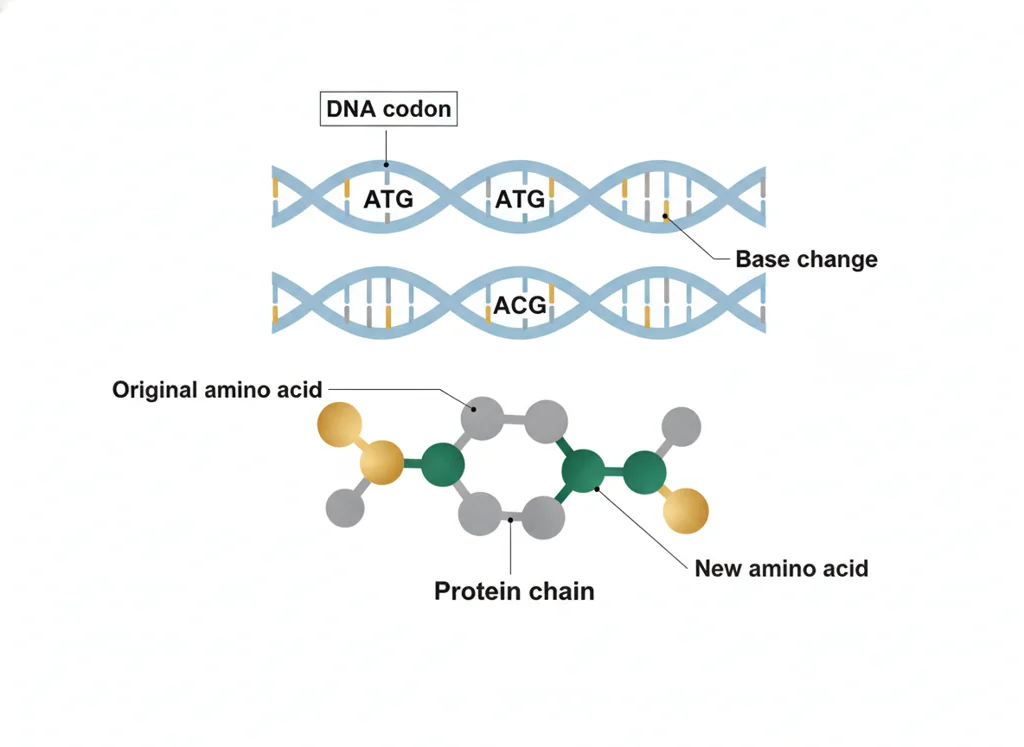
A DNA change that swaps one amino acid in a protein, leaving it full length but possibly altering how it works.
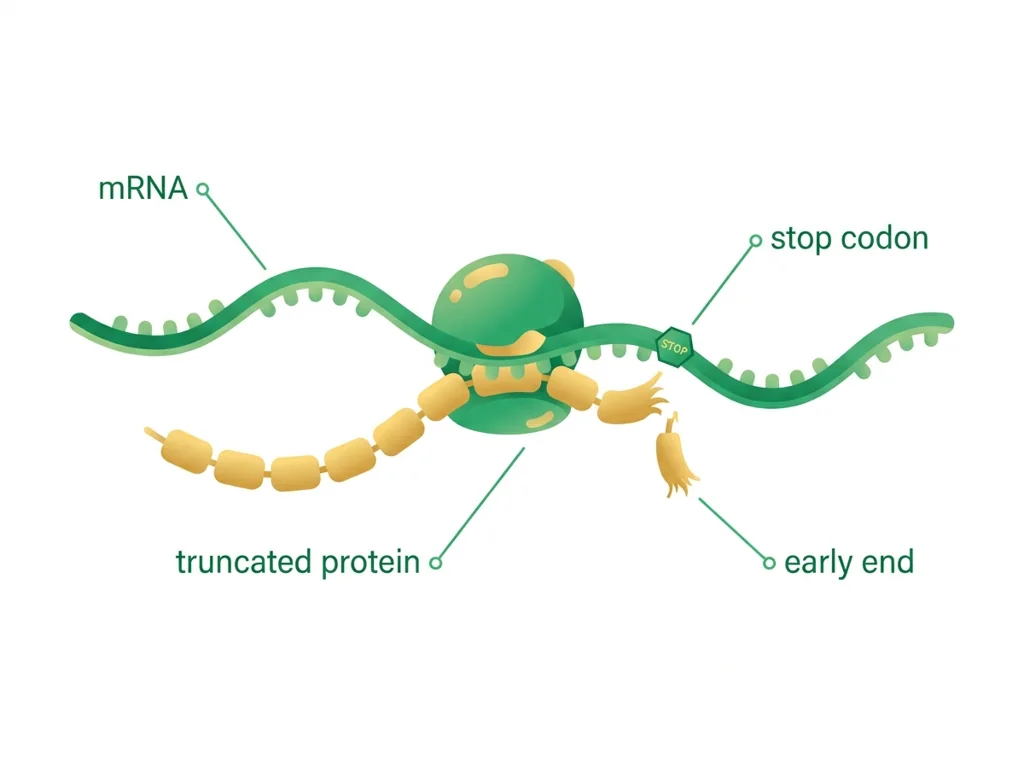
A DNA change that creates an early stop codon, halting translation so the protein is cut short and usually nonfunctional.
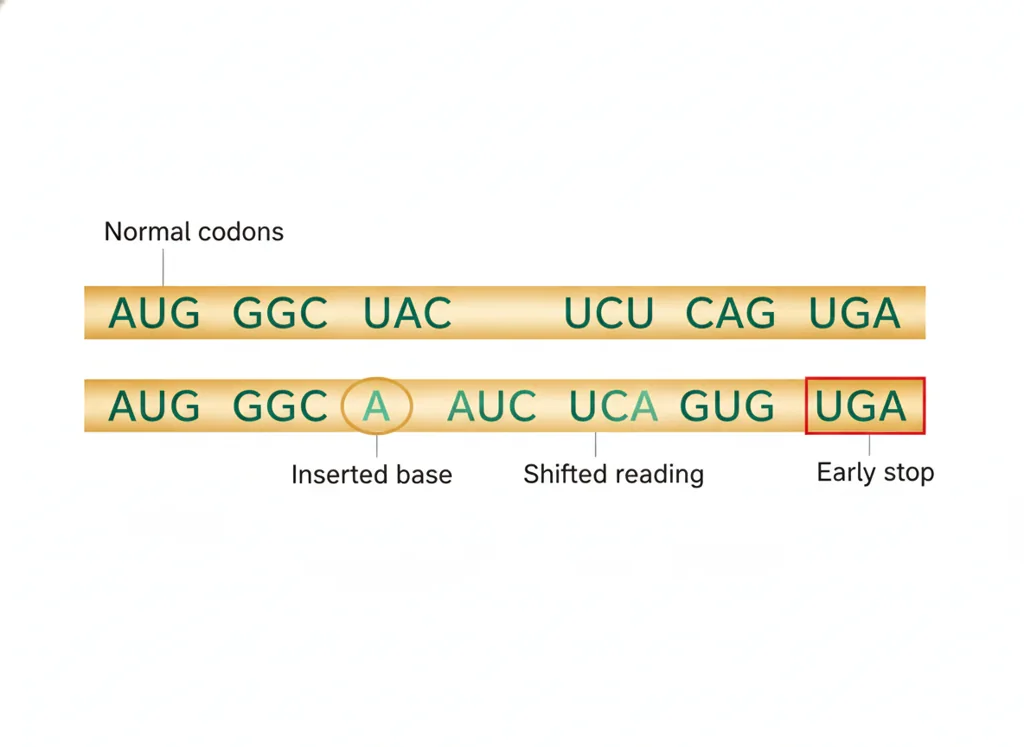
An insertion or deletion not a multiple of three that re-groups every codon after it, scrambling the rest of the protein.
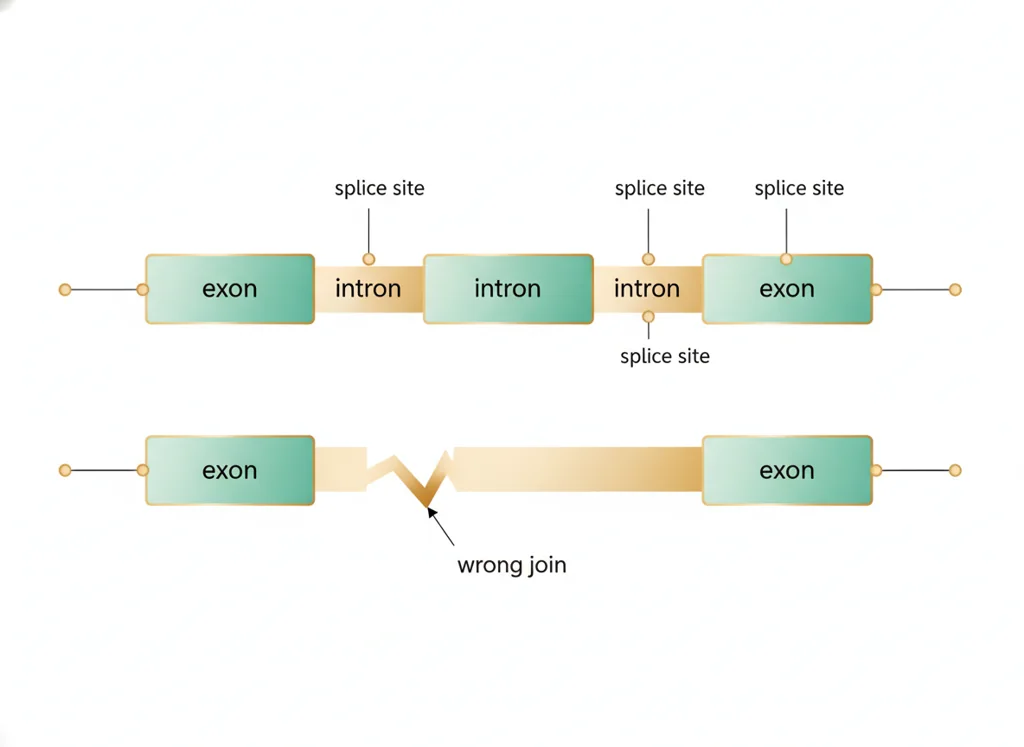
A change at an intron and exon boundary that disrupts mRNA splicing, so the wrong pieces are joined and the protein is altered.
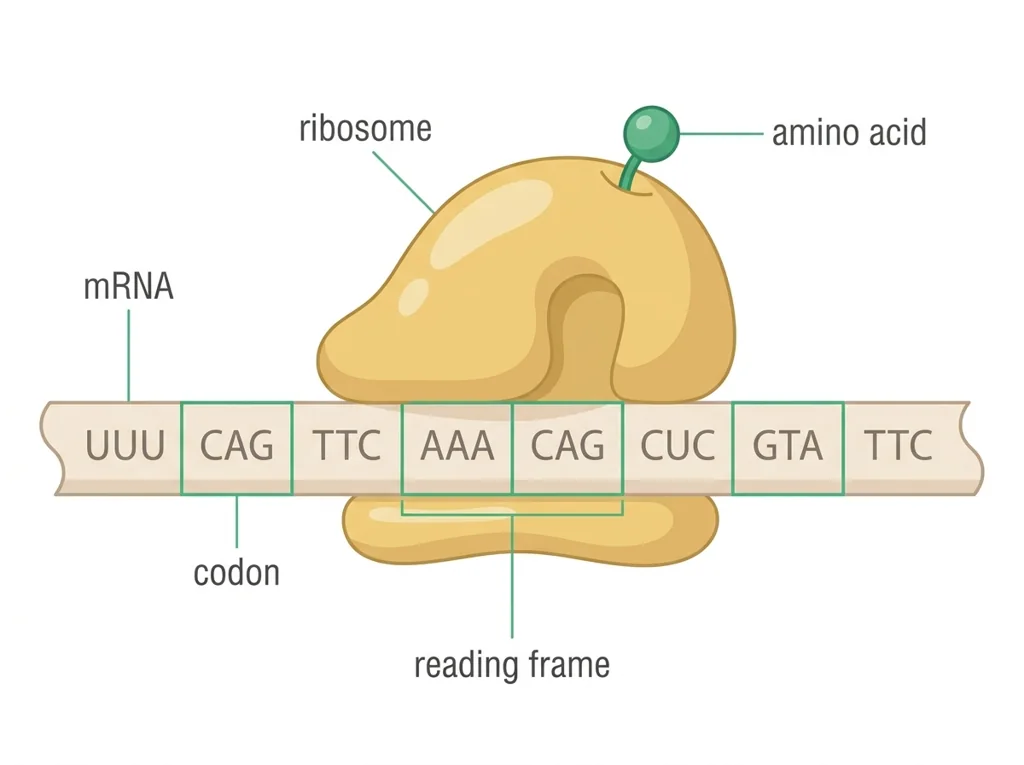
The set of three-letter codons the ribosome reads in order along messenger RNA; a frameshift mutation throws this grouping off.
Research citation trail (advanced)
You do not need these papers or database records to finish the lesson. They document where the plain-language explainer's claims come from and are intended for teachers or advanced readers.