Rough draft.This research track is under review with Dr. Atit's lab. Content and sequence may still change.
The Baby Mateo Case
Disease domainShared clinical backbone (the cleft team)Lesson 19 of 20Your seat: Cleft team coordinator (team design)

How a Team Delivers Care Without Gaps

Discovery question

Why is care delivered by a coordinated team, and how does that team keep an 18-year plan from developing gaps?

💡 Assembling the right specialists is not enough; coordination over years, through a coordinator and shared records, is what the reviews credit for good outcomes.

The plan

Prerequisite check

Before this page, you should know
  • An is a hole that reopens between mouth and nose after repair, causing nasal leakage; the surgeon finds it on exam.
  • is the repaired failing to seal off the nose during speech ( dysfunction), causing ; the SLP catches it.
Today's new idea is only
Assembling the right specialists is not enough; coordination over years, through a coordinator and shared records, is what the reviews credit for good outcomes.
Learn first

What you will learn

Goal: Students will explain why care is delivered by a coordinated multidisciplinary team, name the core specialties and what each contributes, and describe how a coordinator and shared records keep an 18-year from developing gaps.

Know by the end
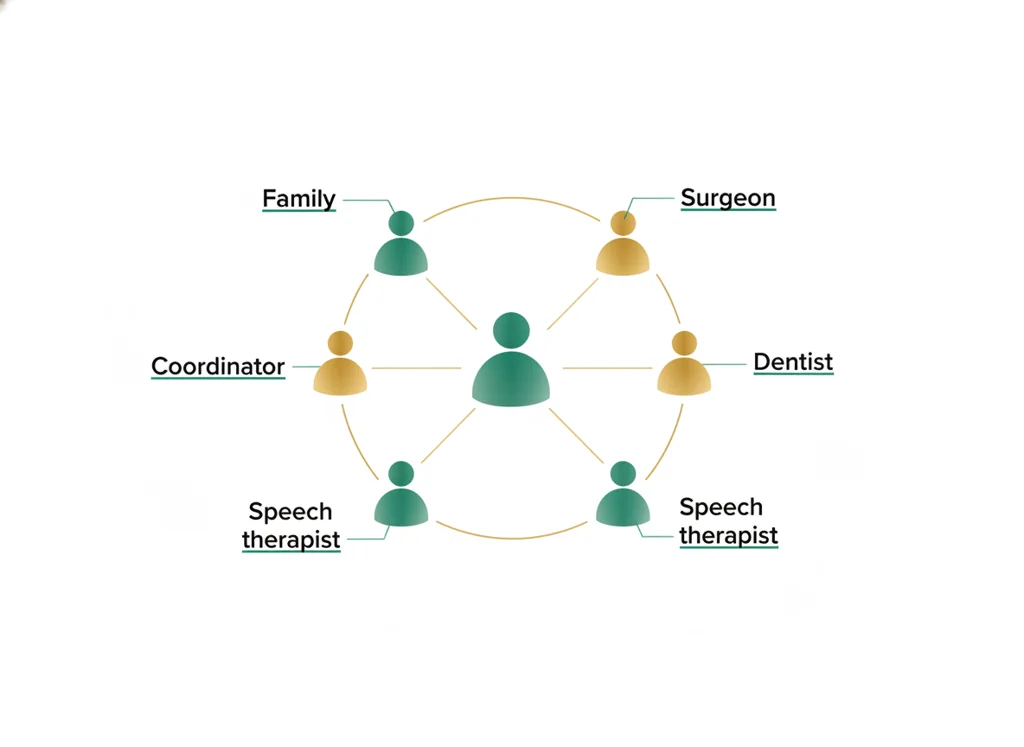
  • Optimal care is delivered by a cleft/craniofacial team spanning dental specialties (orthodontics, oral/maxillofacial surgery, pediatric dentistry, prosthodontics), medical specialties (plastic surgery, ENT, genetics, pediatrics, psychiatry), and allied health (audiology, speech-language pathology, nursing, psychology, social work).
  • The reviews state that coordination of these specialties over years is what drives good functional and esthetic outcomes, not the specialists alone.
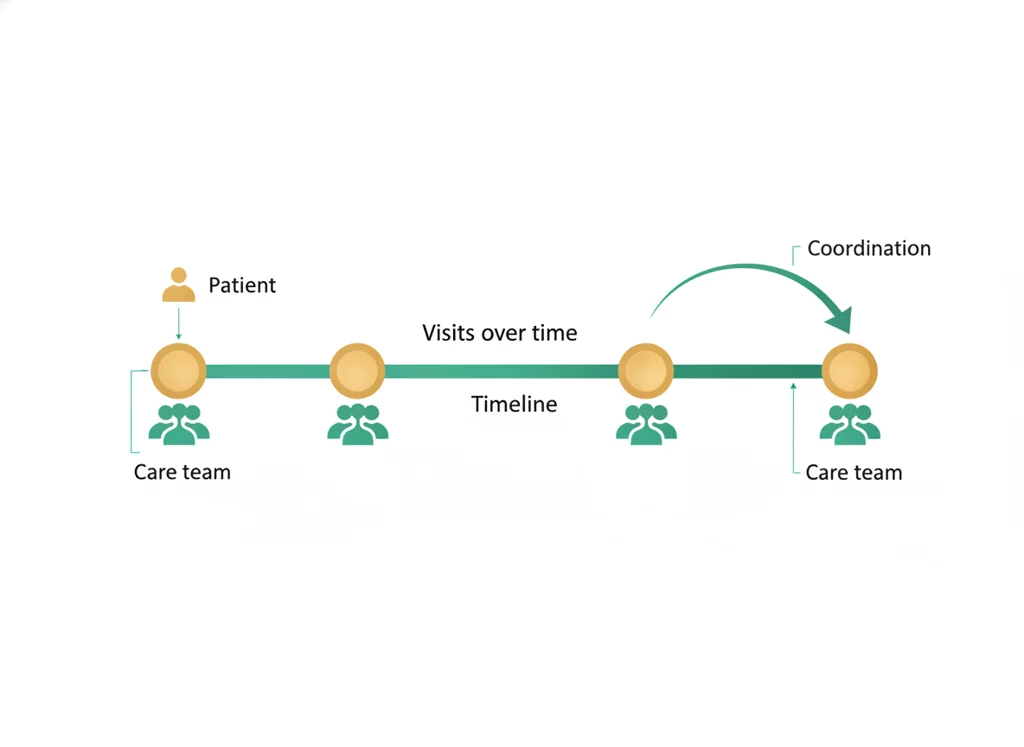
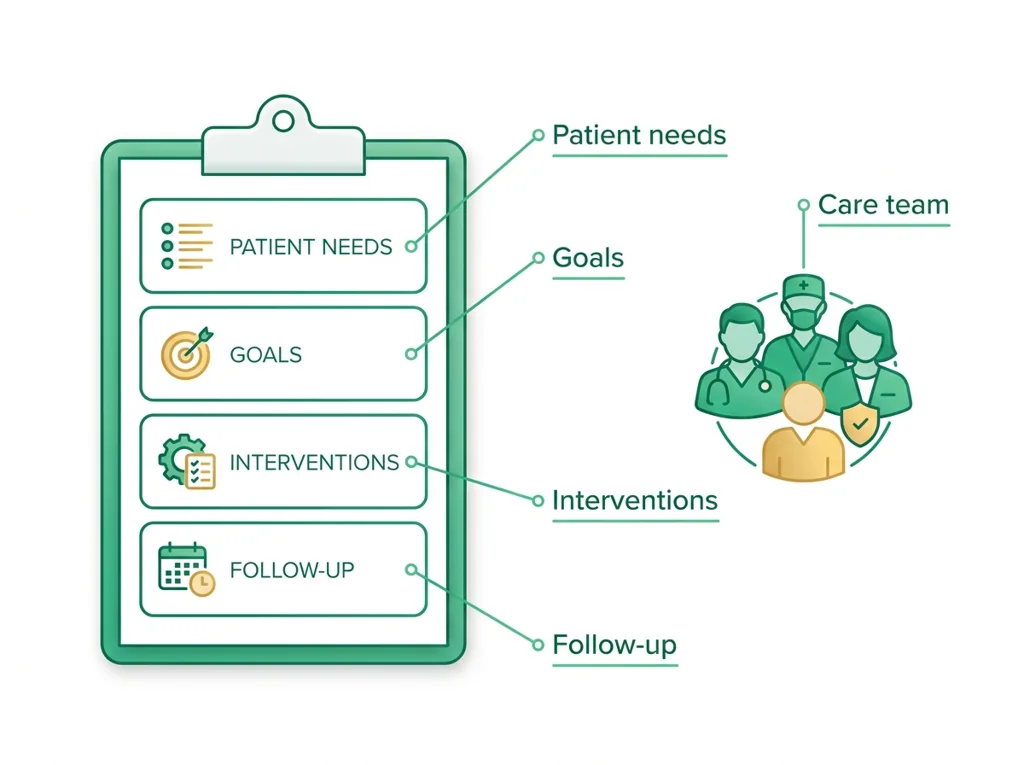
  • A coordinator (often the pediatrician or a nurse navigator) holds the master plan and makes sure each stage happens on time and that findings move between members.
  • Shared records and a shared give and clean handoffs, so the team's knowledge of the child follows him; the team also adapts technique to the child, for example VPI surgery choice can depend on .
Learn first

Model: The cleft team roster, and one handoff that could go wrong

From the team-model section of the disease dossier (SYNTHESIS section 7a), optimal care is delivered by a cleft/craniofacial team spanning dental specialties (orthodontics, oral/maxillofacial surgery, pediatric dentistry, prosthodontics), medical specialties (plastic surgery, otolaryngology, genetics, pediatrics, psychiatry), and allied health (audiology, speech-language pathology, nursing, psychology, social work). The reviews state plainly that coordination of these specialties over years is what drives good functional and esthetic outcomes.

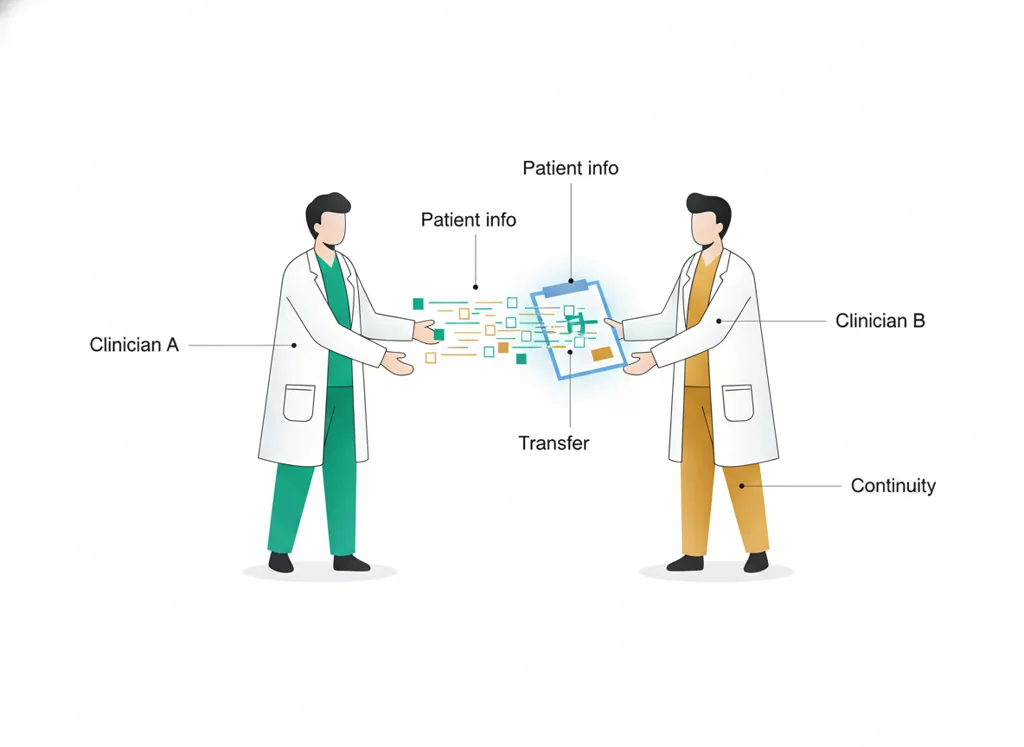
Now picture a coordination failure. Mateo's audiologist notes at age 4 that his hearing has dropped and recommends ear tubes, but the note sits in the audiology file. The pediatrician does not see it, the ENT is never told, and the keeps working on sounds Mateo physically cannot hear well. Months pass, his speech progress stalls, and no one knows why. Now the same moment on a coordinated team: the audiology finding lands in a shared record, the coordinator flags it, ENT places tubes within weeks, and the SLP resumes once hearing is restored. The single piece of information that failed to move is exactly what coordination protects.

Read this in pieces, one chunk at a time
Do the work

Explore (work the model before reading on)

  1. List three specialties from each of the three groups (dental, medical, allied health).
  2. In the failed handoff, what was the single piece of information that failed to move between team members?
  3. The reviews say coordination 'over years' drives good outcomes. Using the failed handoff, explain how a team with all the right specialists could still fail Mateo if they do not communicate.
  4. Across Lessons 11 through 18, different specialists owned different problems (surgery, speech, hearing, teeth, growth, psychosocial). Why does caring for a single require so many different kinds of expertise?
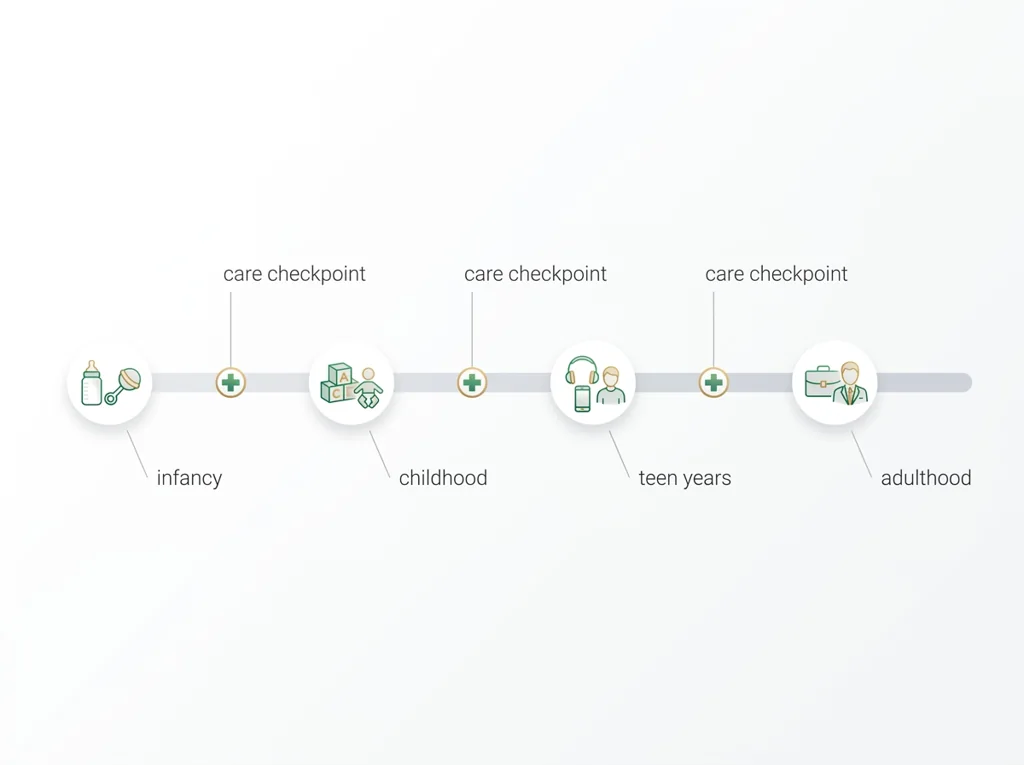
  5. Mateo's care runs from birth to about age 18. Predict one thing that must travel with him across all those years so a specialist he meets at age 12 does not have to rediscover everything from scratch.
  6. In one sentence, what pattern did your team find about how a team avoids gaps?
The plan

Guided notes

1

Why a team, not a list of doctors

Model start: A is not one organ's problem, so it cannot be one specialist's job.
  • Care is delivered by a ______ team (many disciplines together), spanning dental, medical, and allied-health specialties.
  • Each specialist owns a different piece, and the pieces interact: hearing loss stalls speech, changes the bite, psychosocial stress affects everything.
2

What coordination adds

  • The reviews are explicit that the ______ of these specialists over years is what produces good outcomes, not the specialists alone.
  • A coordinator (often the pediatrician or a nurse navigator) keeps the master plan and makes sure findings move between members.
3

Staying gap-free over 18 years

  • A shared and shared records give , so a clean ______ (handoff) from one specialist or stage to the next does not lose information.
  • The care is ______ (longitudinal), following the same patient across a long span rather than treating one visit in .
Explore

Reading the Research

What to read
Why this source matters
This is the published evidence behind today's idea: Assembling the right specialists is not enough; coordination over years, through a coordinator and shared records, is what the reviews credit for good outcomes.
Words to unlock first
multidisciplinary teamcoordinatorcontinuity of carehandofflongitudinal care
Reading moves
  1. Skim the title and abstract first to get the gist.
  2. Circle the one sentence that states the main claim.
  3. Box the evidence the authors give for that claim.
  4. Mark one sentence that confuses you, and move on.
Stop point
You do not need the methods or statistics yet. If a sentence is about lab technique or math you have not learned, mark it and skip it.
Your output
Write one claim-evidence sentence: what this source claims, and the one piece of evidence that backs it up.
Where this fits
Tested on (Ohio WebXam)
Genetics of Disease · 072130
PLTW lesson
MI · Disease domain · Medical Interventions (MI), team-based care and care coordination
WebXam domain
Bio-Molecular Technology
Evidence to produce
Onboard a brand-new coordinator taking over Mateo's case. In a short half-page, explain (1) the three groups of specialties and one member from each, (2) why coordination matters as much as the specialists themselves, citing the review idea that coordination over years drives outcomes, and (3) two concrete tools or habits (for example a shared record and a master timeline) that keep an 18-year plan from developing gaps.
Lab / skill
Clinical backbone (cleft team) · Clinical backbone (cleft team)
Words

Vocabulary (the same words your classes use)

multidisciplinary team
The plan

Track your progress today

Check these off as you work through the lesson, then submit. This tells Mr. Mendoza how you're doing so he can help the class. It does not replace turning in your producible.

Use the code Mr. Mendoza gave you, not your name. Saved on this device.

Check off as you finish
  • Read the Model and answered the Explore questions.
  • Filled in the guided notes in my own words.
  • Defined the new vocabulary with an example.
  • Built the producible: Onboard a brand-new coordinator taking over Mateo's case. In a short half-page, explain (1) the three groups of specialties and one member from each, (2) why coordination matters as much as the specialists themselves, citing the review idea that coordination over years drives outcomes, and (3) two concrete tools or habits (for example a shared record and a master timeline) that keep an 18-year plan from developing gaps.
  • Wrote my Claim, Evidence, and Reasoning exit ticket.
Pick your period and code first.
Check yourself

Exit ticket (Claim, Evidence, Reasoning)

  • Claim: Mateo needs a ____ team, not just a collection of specialists.
  • Evidence: The reviews say ____ over years drives good outcomes, and the failed handoff shows that an audiology finding that never reached the ____ stalled his speech.
  • Reasoning: A coordinator, a shared , and prevent gaps across an 18-year journey because ____.
How this is graded (rubric)
For: Onboard a brand-new coordinator taking over Mateo's case. In a short half-page, explain (1) the three groups of specialties and one member from each, (2) why coordination matters as much as the specialists themselves, citing the review idea that coordination over years drives outcomes, and (3) two concrete tools or habits (for example a shared record and a master timeline) that keep an 18-year plan from developing gaps.
CriterionProficientDevelopingBeginning
CompleteEvery required part of the artifact is present and filled in.Most parts are present, but one is missing or left blank.Several parts are missing.
AccurateThe science and data are correct and match the evidence.Mostly correct, with a small factual slip.Key science or data is wrong.
Scientific reasoning (CER)States a claim, backs it with specific evidence, and explains the reasoning.Has a claim and evidence, but the reasoning is thin or missing.Gives an answer with no evidence or reasoning.
Professional communicationClear, organized, and labeled the way a clinician or scientist would write it.Readable but disorganized or missing labels.Hard to follow.
SubmittedTurned in the right way (Schoology for routine work) and confirmed.Turned in, but in the wrong place or unconfirmed.Not turned in.
How the model answer scores against this rubric
  • CompleteProficient: Nothing is left blank: the model fills every part of "Onboard a brand-new coordinator taking over Mateo's case. In a short half-page, explain (1) the three groups of specialties and one member from each, (2) why coordination matters as much as the specialists themselves, citing the review idea that coordination over years drives outcomes, and (3) two concrete tools or habits (for example a shared record and a master timeline) that keep an 18-year plan from developing gaps.".
  • AccurateProficient: Every number and claim matches the case evidence.
  • Scientific reasoning (CER)Proficient: It names a claim, cites the specific evidence, and explains the reasoning, not just the answer.
  • Professional communicationProficient: It is organized and labeled like a real chart note.
  • SubmittedProficient: It would be turned in on Schoology and confirmed.
Explore

Where this leads: careers

Cleft team coordinator Nurse navigator Health systems manager

What's next: We answered how the team holds it all together: shared records, a coordinator, and continuity across 18 years. That completes the machinery of Mateo's care. So now, with everything from his first to his lifelong team in hand, we can finally ask the biggest question of all: what is Mateo's complete clinical story, and what, after eighteen lessons of evidence, is his actual diagnosis?