Rough draft.This research track is under review with Dr. Atit's lab. Content and sequence may still change.
The Baby Mateo Case
Disease domainShared clinical backbone (the cleft team)Lesson 18 of 20Your seat: Cleft team coordinator (long-term surveillance)

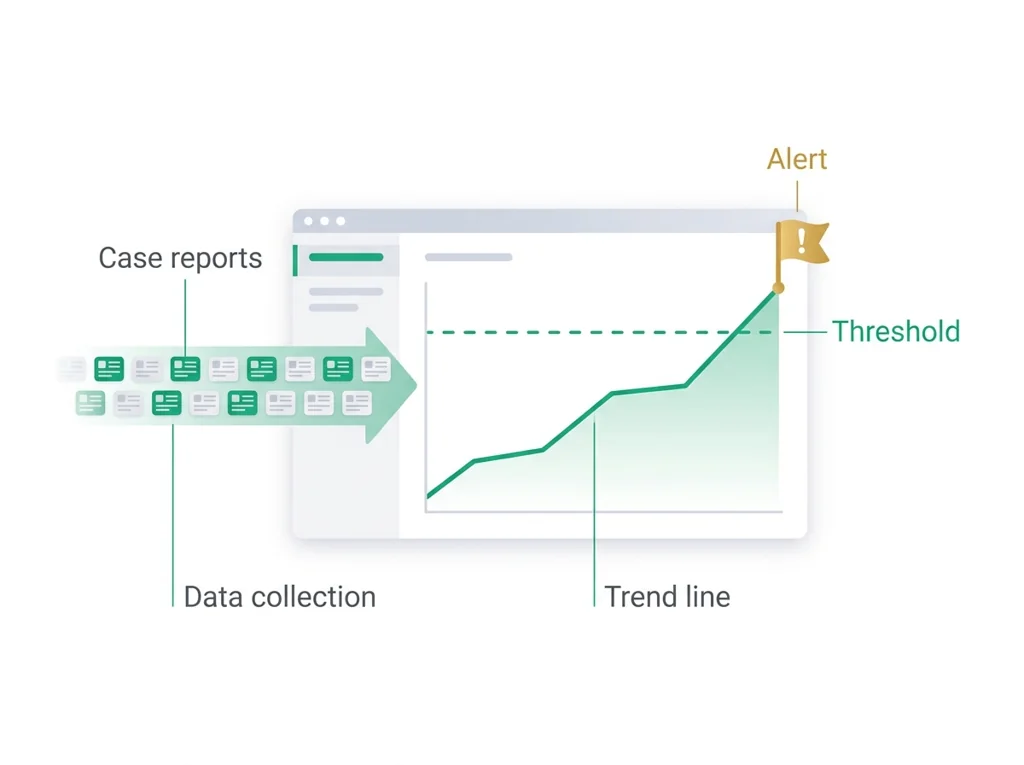
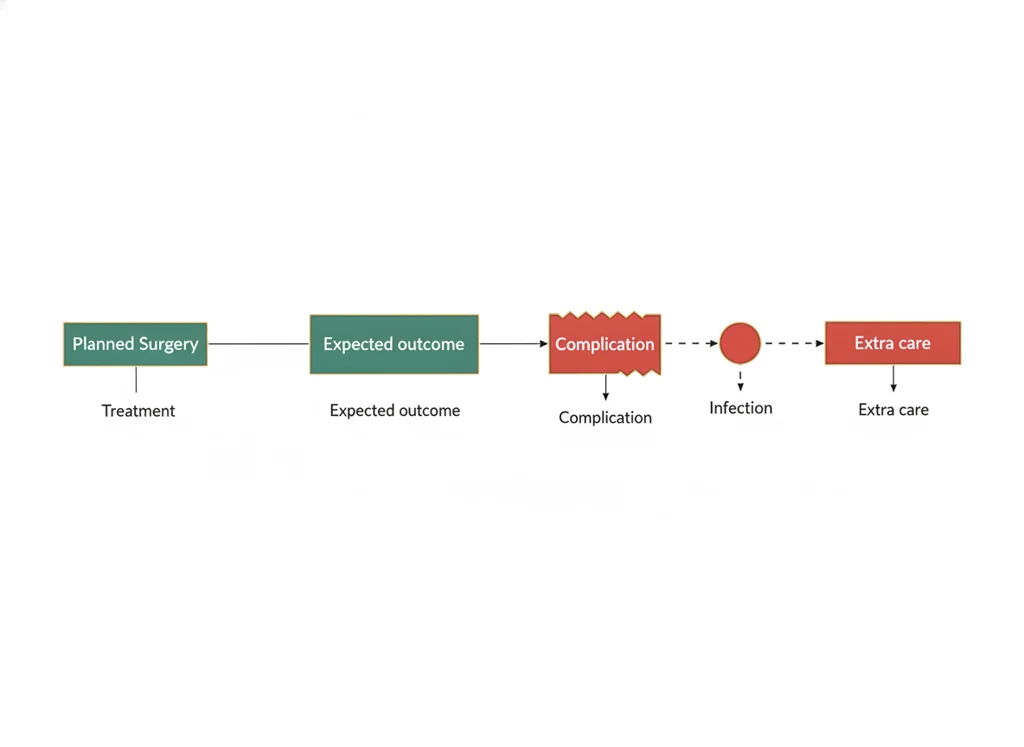
A Repaired Cleft Is Not a Cured Cleft

Discovery question

What can still go wrong for Mateo after his is repaired, and which team member is positioned to catch each problem?

💡 Each long-term complication has a different home specialist and a different detection method, which is exactly why care is delivered by a coordinated team over years.

The plan

Prerequisite check

Before this page, you should know
  • Orofacial clefting affects roughly 1 in 700 live births worldwide, on the order of 220,000 new cases globally per year.
  • varies by population: highest in Asian and Amerindian (American Indian) populations (often around 1 in 500, up to about 4 per 1000), intermediate in European-derived populations (about 1 in 1000), lowest in African-derived populations (about 1 in 2500).
Today's new idea is only
Each long-term complication has a different home specialist and a different detection method, which is exactly why care is delivered by a coordinated team over years.
Learn first

What you will learn

Goal: Students will identify the major long-term complications after repair (, , , otitis media with hearing loss, and ) and explain which team member catches each and how.

Know by the end
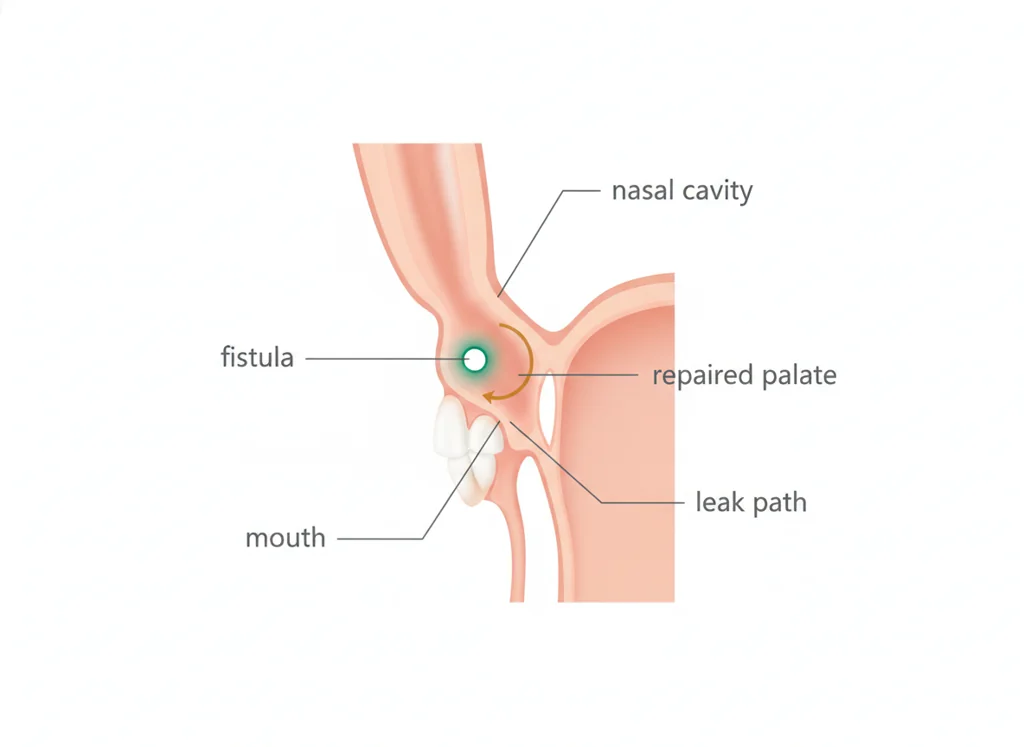
  • An is a hole that reopens between mouth and nose after repair, causing nasal leakage; the surgeon finds it on exam.
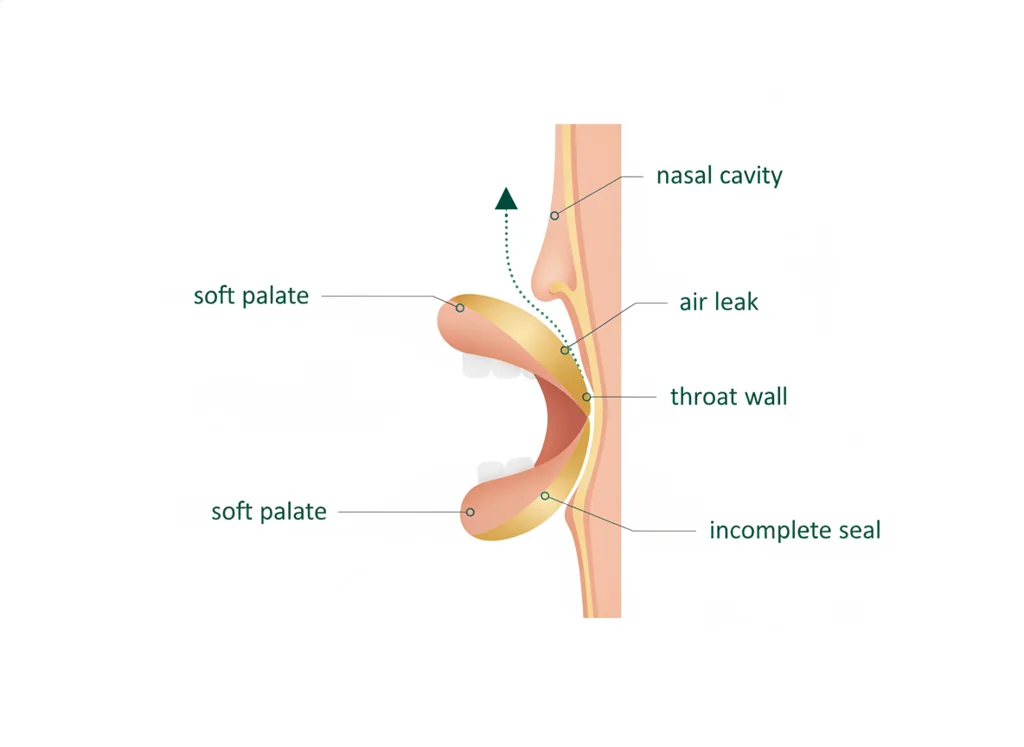
  • is the repaired failing to seal off the nose during speech ( dysfunction), causing ; the SLP catches it.
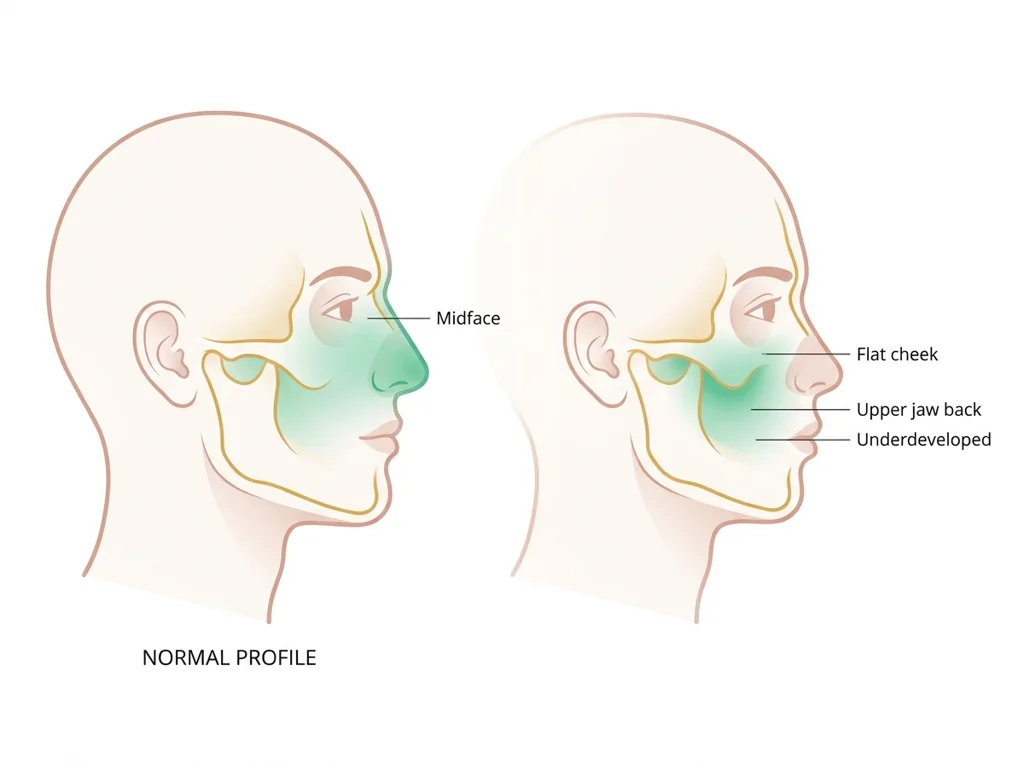
  • is underdevelopment of the middle of the face after repair, causing bite problems in adolescence; the orthodontist and surgeon catch it, and it can be delayed by years.
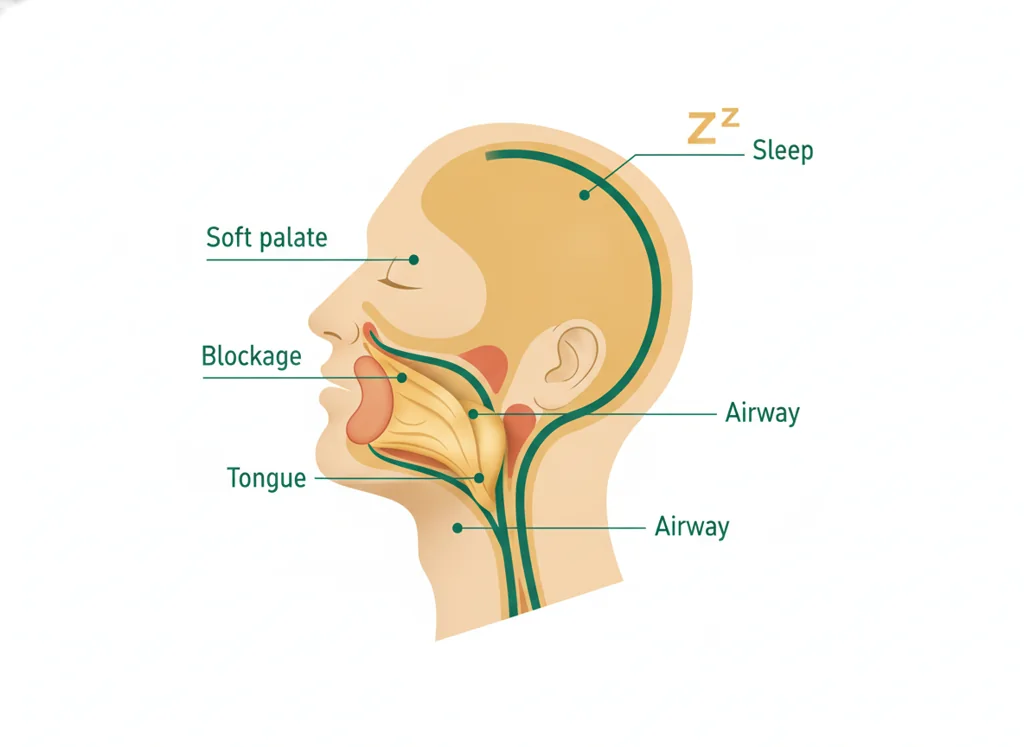
  • Otitis media with hearing loss (tensor veli palatini dysfunction) is caught by the audiologist and ENT, and , a particular concern where the airway is small as in Robin sequence, is caught by history and a sleep study.
Learn first

Model: Five long-term complications, how they surface, and the muscles behind two of them

From the complications and care sections of the disease dossier (SYNTHESIS sections 4 and 7, DATA_TABLES section D), five complications can appear after repair. is a small hole that reopens between mouth and nose after repair; food or liquid leaks into the nose, found on exam by the surgeon. is the repaired palate still not sealing the nose during speech; and nasal air escape are caught by the . is the middle of the face growing too little after palate repair; bite problems and a flat midface in adolescence are caught by the orthodontist and surgeon. Otitis media with hearing loss is repeated middle-ear fluid; failed hearing checks and ear pain are caught by the audiologist and ENT. (OSA) is blocked breathing during sleep, especially relevant where the airway is small as in Robin sequence; snoring and breathing pauses are caught by history and a sleep study.

Two make more sense with the muscles from earlier lessons. VPI is dysfunction of the , the muscle that lifts the soft to close the nose off during speech; if the seal is incomplete after repair, air and sound escape, making speech hypernasal. Otitis media follows dysfunction of the tensor veli palatini, the muscle that opens the Eustachian tube to ventilate the ; when it fails, fluid builds up, infections recur, and hearing drops.

Read this in pieces, one chunk at a time
Do the work

Explore (work the model before reading on)

  1. List the five complications. Next to each, write which team member catches it.
  2. Name the muscle behind VPI and the muscle behind otitis media.
  3. Three of the five (fistula, VPI, ) appear specifically after surgery. Explain why 'a repaired is not a cured cleft' is a fair summary.
  4. Each complication is caught by a different specialist using a different method. Why does catching all five require a whole team rather than a single doctor?
  5. shows up years after the repair, in adolescence. Predict why a problem caused by an early surgery might not become visible until the face has grown for a decade.
  6. In one sentence, what pattern did your team find about complications and how they are caught?
The plan

Guided notes

1

Surveillance, not the end of care

Model start: A repaired is not a cured cleft; some problems only appear after the surgeries, sometimes years later.
  • Problems that can appear later are ______ (complications), and watching for them over years is surveillance.
  • A successful early repair is the beginning of surveillance, not the end of care.
2

The five to know

  • (caught by the surgeon) and VPI, from ______ veli palatini dysfunction (caught by the SLP).
  • (orthodontist and surgeon), otitis media with hearing loss from tensor veli palatini dysfunction (audiologist and ENT), and , or ______ (history and sleep study).
3

Why it takes a team

  • Each complication has a different home ______ and a different detection method.
  • No single clinician can watch for all of them, which is why care is delivered by a coordinated team that follows the child for years.
Explore

Reading the Research

What to read
Why this source matters
This is the published evidence behind today's idea: Each long-term complication has a different home specialist and a different detection method, which is exactly why care is delivered by a coordinated team over years.
Words to unlock first
oronasal fistulavelopharyngeal insufficiencymidface hypoplasiaobstructive sleep apneasurveillance
Reading moves
  1. Skim the title and abstract first to get the gist.
  2. Circle the one sentence that states the main claim.
  3. Box the evidence the authors give for that claim.
  4. Mark one sentence that confuses you, and move on.
Stop point
You do not need the methods or statistics yet. If a sentence is about lab technique or math you have not learned, mark it and skip it.
Your output
Write one claim-evidence sentence: what this source claims, and the one piece of evidence that backs it up.
Where this fits
Tested on (Ohio WebXam)
Genetics of Disease · 072130
PLTW lesson
MI · Disease domain · Medical Interventions (MI), long-term outcomes and surveillance
WebXam domain
Bio-Molecular Technology
Evidence to produce
Write Mateo's ten-year 'watch list' as a five-row table: complication, the specialist who owns it, and the one check or symptom that would catch it. Then add one sentence to his parents explaining, in plain language, why his cleft being 'fixed' does not mean his appointments are over.
Lab / skill
Clinical backbone (cleft team) · Clinical backbone (cleft team)
Words

Vocabulary (the same words your classes use)

The plan

Track your progress today

Check these off as you work through the lesson, then submit. This tells Mr. Mendoza how you're doing so he can help the class. It does not replace turning in your producible.

Use the code Mr. Mendoza gave you, not your name. Saved on this device.

Check off as you finish
  • Read the Model and answered the Explore questions.
  • Filled in the guided notes in my own words.
  • Defined the new vocabulary with an example.
  • Built the producible: Write Mateo's ten-year 'watch list' as a five-row table: complication, the specialist who owns it, and the one check or symptom that would catch it. Then add one sentence to his parents explaining, in plain language, why his cleft being 'fixed' does not mean his appointments are over.
  • Wrote my Claim, Evidence, and Reasoning exit ticket.
Pick your period and code first.
Check yourself

Exit ticket (Claim, Evidence, Reasoning)

  • Claim: Mateo will need ____ (no further / long-term) monitoring even after a successful repair.
  • Evidence: Three post-repair complications and their catchers are: ____ (surgeon), ____ (SLP), and ____ (orthodontist and surgeon).
  • Reasoning: Detecting these requires a coordinated team rather than one doctor because ____.
How this is graded (rubric)
For: Write Mateo's ten-year 'watch list' as a five-row table: complication, the specialist who owns it, and the one check or symptom that would catch it. Then add one sentence to his parents explaining, in plain language, why his cleft being 'fixed' does not mean his appointments are over.
CriterionProficientDevelopingBeginning
CompleteEvery required part of the artifact is present and filled in.Most parts are present, but one is missing or left blank.Several parts are missing.
AccurateThe science and data are correct and match the evidence.Mostly correct, with a small factual slip.Key science or data is wrong.
Scientific reasoning (CER)States a claim, backs it with specific evidence, and explains the reasoning.Has a claim and evidence, but the reasoning is thin or missing.Gives an answer with no evidence or reasoning.
Professional communicationClear, organized, and labeled the way a clinician or scientist would write it.Readable but disorganized or missing labels.Hard to follow.
SubmittedTurned in the right way (Schoology for routine work) and confirmed.Turned in, but in the wrong place or unconfirmed.Not turned in.
How the model answer scores against this rubric
  • CompleteProficient: Nothing is left blank: the model fills every part of "Write Mateo's ten-year 'watch list' as a five-row table: complication, the specialist who owns it, and the one check or symptom that would catch it. Then add one sentence to his parents explaining, in plain language, why his cleft being 'fixed' does not mean his appointments are over.".
  • AccurateProficient: Every number and claim matches the case evidence.
  • Scientific reasoning (CER)Proficient: It names a claim, cites the specific evidence, and explains the reasoning, not just the answer.
  • Professional communicationProficient: It is organized and labeled like a real chart note.
  • SubmittedProficient: It would be turned in on Schoology and confirmed.
Explore

Where this leads: careers

Cleft team coordinator Sleep medicine physician Craniofacial nurse navigator

What's next: We answered what can still go wrong and who catches it. But Mateo now needs a surgeon, a , an audiologist, an orthodontist, and more, all watching different things across many years. How does one team deliver all of this care without anything falling through the cracks?