
Chain of infection notes
This page has four parts, in the order you use them. Part 1 is what you need to know. Part 2 says what to do, in plain English. Part 3 shows the work done once on a case that is not yours. Part 4 is your own work and where to turn it in.
Open your materials, follow the steps, then turn in your work.
Students take notes on the chain of infection, pathogens, and the immune response, then complete the PLTW online task.
Check you have the right sheet: the top of it prints today's portal day, Chain of infection notes. The PLTW activity itself is in myPLTW and is not posted here.
Optional: listen or watch a unit review▸
Part 1 of 4 · Background and definitions▸
💡 Big idea: Infection spreads through six ordered links, so breaking any single link stops because the germ can no longer complete its path to a new host.
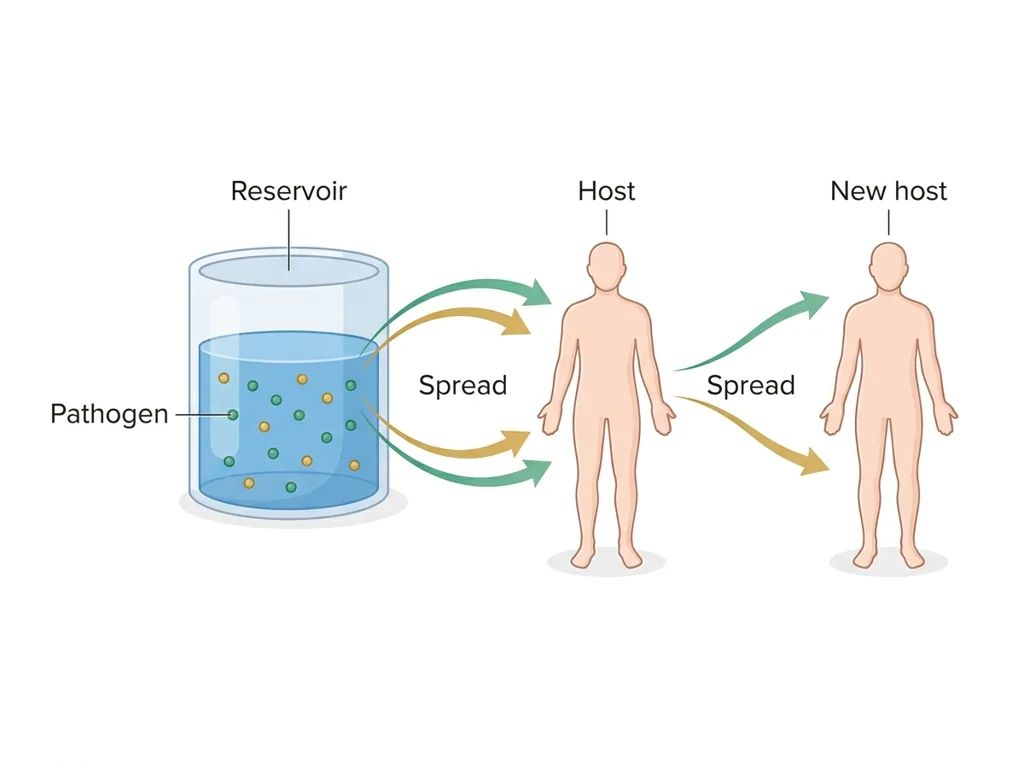
- • The six links of the chain of infection are: infectious agent, reservoir, portal of exit, mode of , portal of entry, susceptible host.
- • and each interrupt a specific link in the chain, not the whole chain at once.
- • immunity responds immediately; builds targeted memory over days.
A recommendation earns trust because it names a specific condition, cites multiple data sources, and states its own limits, so a clinician can act on it instead of guessing.
Infection spreads through six ordered links, so breaking any single link stops because the germ can no longer complete its path to a new host.
Driving question: A nurse washing hands, a patient in a private room, and a mask over a cough each stop a different step of the same infection. Which link is each one breaking?
What you already know: A recommendation earns trust because it names a specific condition, cites multiple data sources, and states its own limits, so a clinician can act on it instead of guessing.
New idea: Infection spreads through six ordered links, so breaking any single link stops because the germ can no longer complete its path to a new host.
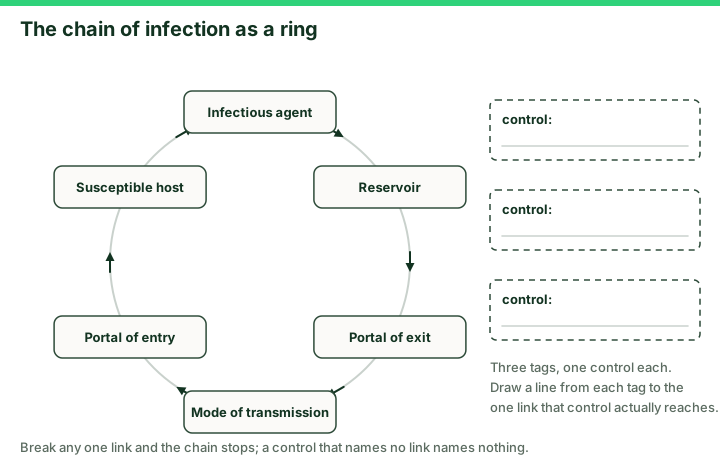
- Observe or measure the relevant feature in chain of infection notes.
- Organize the observation with a stable evidence ID.
- Apply this rule: Patterns across time and connection can narrow a explanation without proving it by themselves.
- Choose the option the evidence supports and state the limit of the conclusion.
Real biomedical example: A nurse washing hands, a patient in a private room, and a mask over a cough each stop a different step of the same infection. Which link is each one breaking?
What the evidence supports: E1 to E3 and the figure support the daily take-home when the response meets the stated success criteria.
What it cannot prove: The package does not support claims beyond this lesson's or any real patient diagnosis.
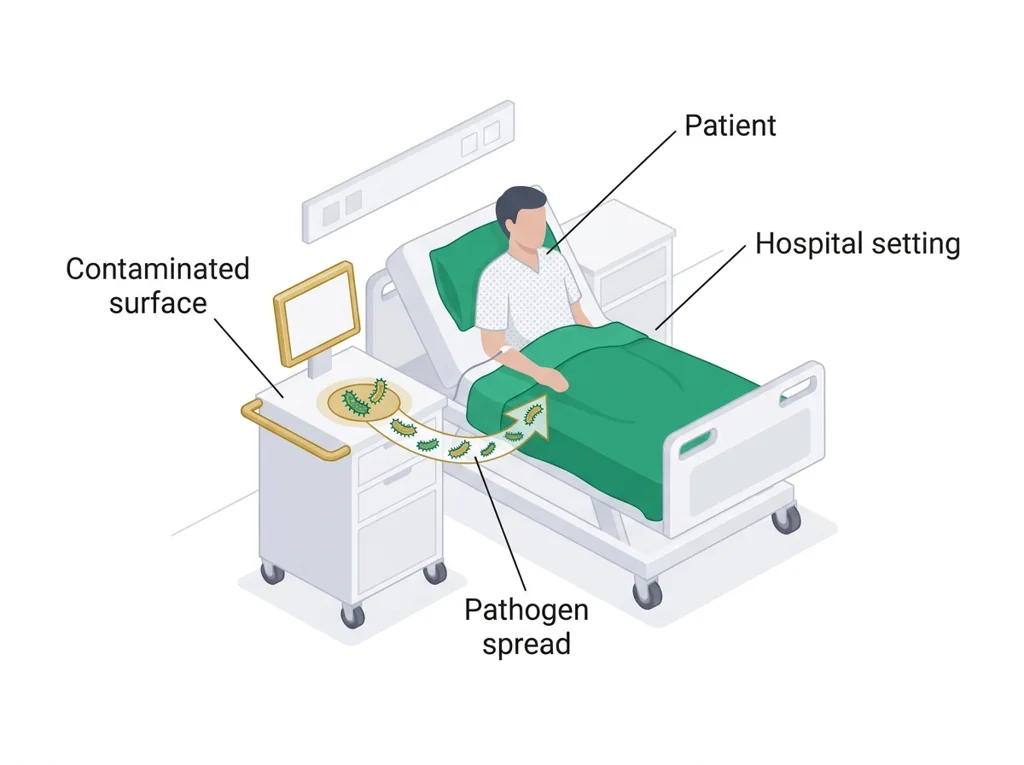
- • nosocomial: Describes an infection that a patient catches while in a hospital or healthcare setting rather than bringing it in from outside.
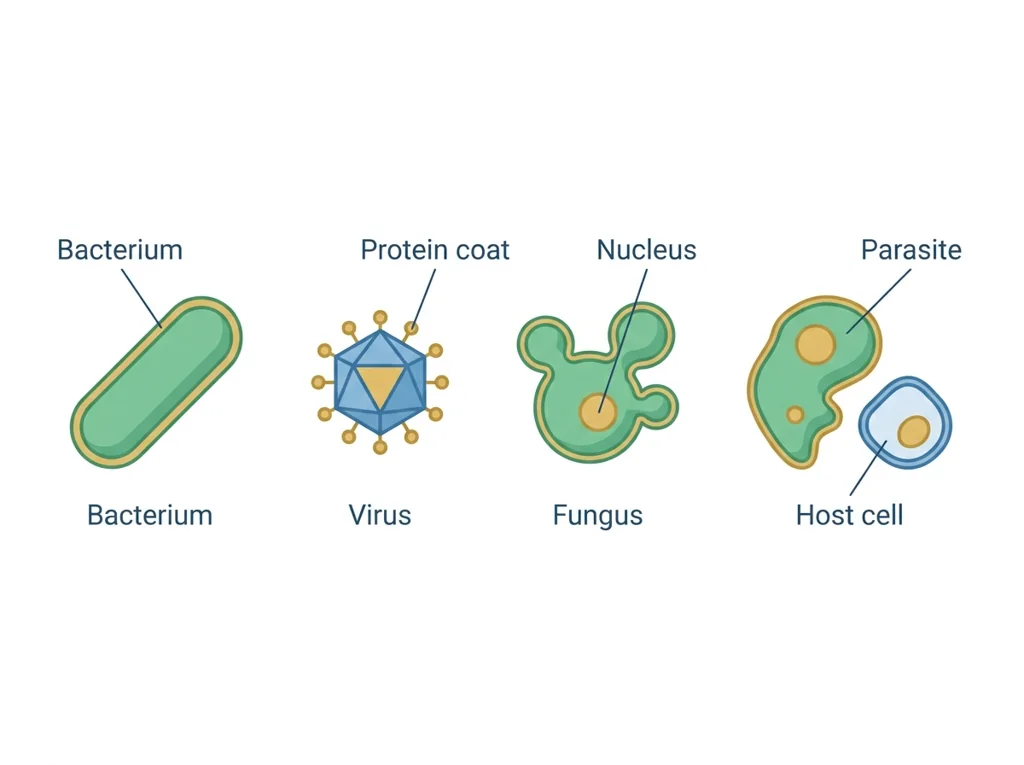
- • : A microorganism such as a bacterium, virus, fungus, or parasite that can cause disease in its host.
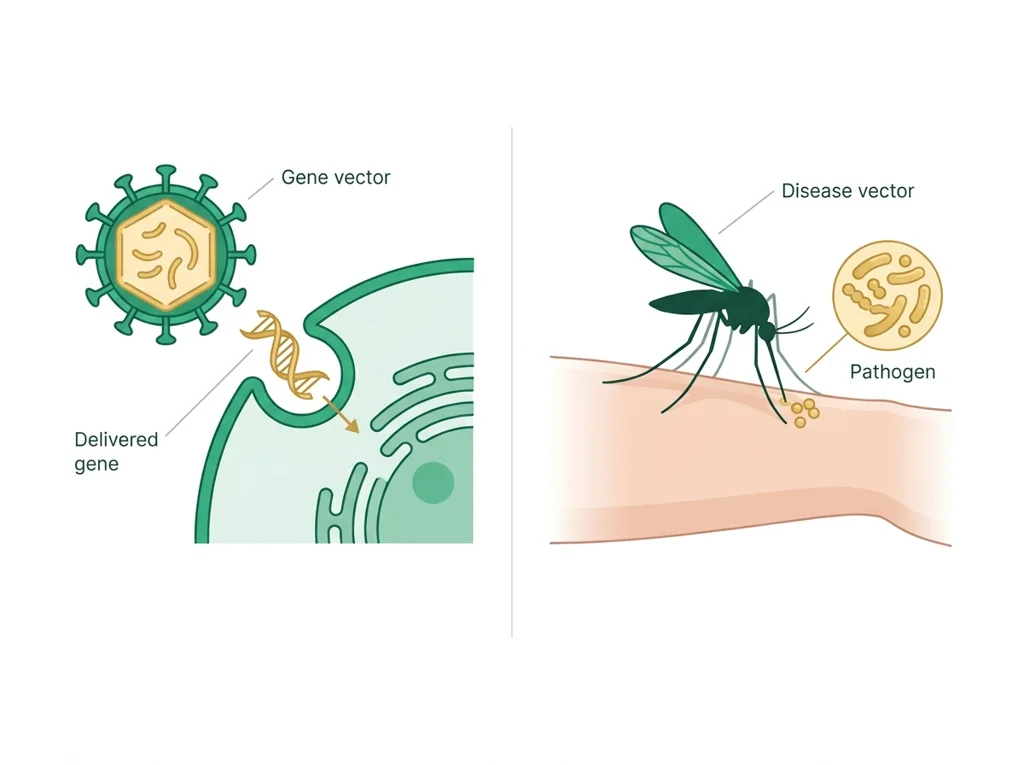
- • vector: Two senses, set by the lesson. In infection control, a living , usually an insect such as a mosquito or a tick, that moves a from one host to the next. In genetics, a or virus engineered to carry into a cell.
- • reservoir: A living host or environment where a normally lives and multiplies, serving as the source from which infections spread.
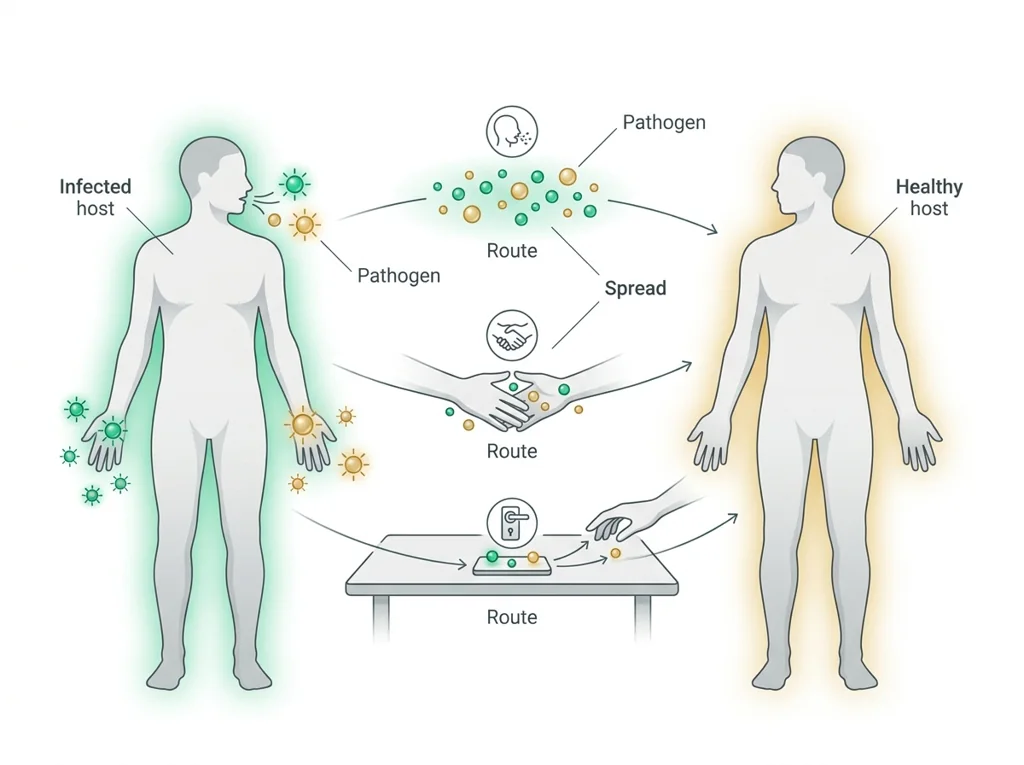
- • : The passing of a disease-causing agent from one host to another, by routes such as contact, droplets, contaminated objects, or vectors.
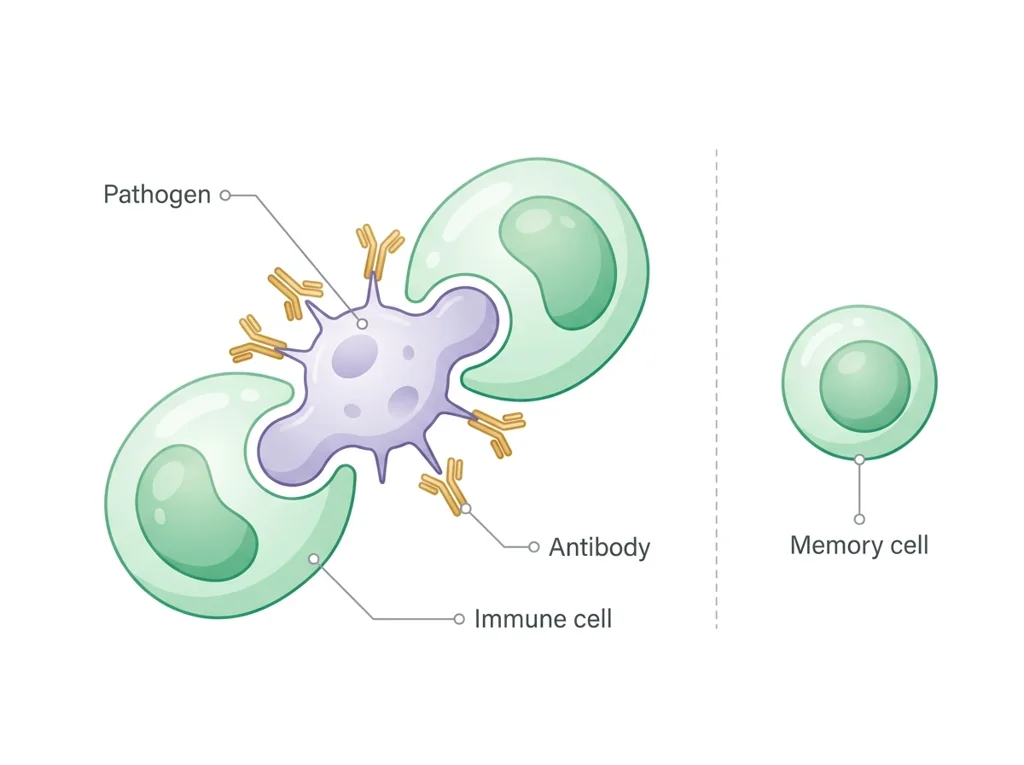
- • : The body's coordinated defense against a harmful invader, in which immune cells recognize, attack, and remember the threat.
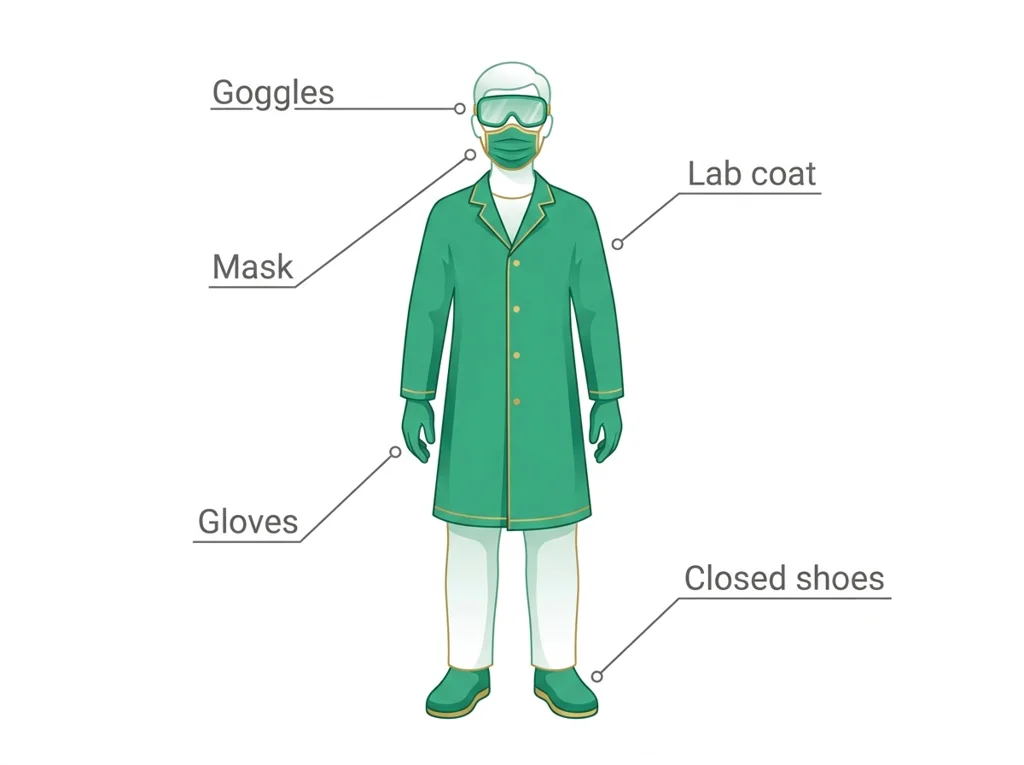
- • : Personal protective equipment, the gear like gloves, goggles, lab coats, and masks worn to shield the body from chemical, biological, or physical hazards.
- • : Describing techniques that keep an area free of harmful microbes so cultures and patients are not contaminated.
Use it now: Choose one decision option. Cite E1 and E3, then explain how the rule connects the evidence to your choice. This is thinking practice for the one turn-in named under Turn in, not a second submission.
Go further, optional: The source links below are optional enrichment. Every fact required for today's local evidence decision appears in this lesson package.
Infection prevention targets links that allow an infectious agent to reach a susceptible host, and the selected control must match the route and evidence in the case.
Limit: The classroom chain model simplifies host, , environment, timing, and implementation factors and cannot establish a real outbreak source.
Patterns across time and connection can narrow a explanation without proving it by themselves.
Limit: People change behavior, infections have periods, and surveillance data can be incomplete.
Label all six links in the chain of infection accurately.
Limit: E3 defines the classroom product or success criterion. It is not independent scientific evidence and cannot justify a clinical or causal claim.
Today's decision · Simulated classroom evidence scenario
Your role: biomedical investigator
Decision: Your team must decide what the evidence from chain of infection notes supports before submitting the notebook record named on today's page.
- • Match each control to the single link it breaks, since handwashing, the private room, and masking differ.
- • Choose handwashing as the answer for all three, because one strong precaution breaks the whole chain of infection.
- • Wait until we know how the germ in each situation travels, since a control breaks only the route it uses.
Response: State one choice, cite at least two evidence IDs, explain the rule that connects them, and add one limitation. Use it inside the one turn-in named under Turn in; it is not a separate submission.
Claim ceiling: Today's evidence supports a classroom claim about chain of infection notes. It cannot prove causation, diagnose a real patient, or justify action outside this room.
Reason for review: Your team must decide what the evidence from chain of infection notes supports before submitting the notebook record named on today's page.
Context: Infection is not random contact; it moves through six predictable links, and stopping any one link stops the whole spread.
- • T1: Annotate the six links in the chain of infection from reservoir to susceptible host.
- • T2: Classify common hospital pathogens as bacterial, viral, or fungal.
- • T3: Outline the and adaptive immune responses to invading pathogens.
- • T4: Connect and to specific links in the chain.
- • T5: Complete the assigned PLTW online activity on hospital-acquired infections.
- • E1: Infection prevention targets links that allow an infectious agent to reach a susceptible host, and the selected control must match the route and evidence in the case.
- • E2: Patterns across time and connection can narrow a explanation without proving it by themselves.
- • E3: Label all six links in the chain of infection accurately.
Measurements: No patient measurement is supplied unless it appears explicitly in E1-E3 or F1. Do not invent a value.
Figure finding: Six rounded boxes arranged in a ring with arrows between them, labeled infectious agent, reservoir, portal of exit, mode of , portal of entry and susceptible host, and three empty dashed control tags to the right with instructions to draw a line from each tag to the one link its control reaches.
Uncertainty: This is a composite classroom scenario. Missing history, measurements, or confirmation tests remain unknown and limit the conclusion.
Students often think one strong precaution, like handwashing, breaks the entire chain of infection at once. The trap: Each control only interrupts one specific link, because a germ can still spread through any link you left open. Handwashing blocks by hands, but it does nothing about a shared portal of entry like an IV line, so real infection control layers several controls.
- CER:
- Claim, Evidence, Reasoning: make a claim, back it with evidence, explain your reasoning.
- SOP:
- Standard Operating Procedure, the exact steps to follow (especially in a lab).
- Tracker:
- Your PLTW progress log where you record completed evidence.
- myPLTW:
- The PLTW course site where you do the online activities. Find it in Clever with your Microsoft sign-in, right next to Schoology.
Tap the speaker to hear a term. Add two of these to your notebook glossary with a definition and an example in your own words.
Pick just 2 or 3 words from today and make them yours: write what each one means in your own words, name the context clue or evidence that helped, then give one example from what you actually did in Chain of infection notes. Try your own words first; the glossary is there if you get stuck. This is voluntary and counts as extra credit, so keep it short.
Saved on this device. Show Mr. Mendoza or add these to your notebook glossary to claim the extra credit.
Part 2 of 4 · Directions in plain English▸
2.1 Open your materials
Use the materials named in the first step below. Open lesson resources.
2.2 Start the work
Annotate the six links in the chain of infection from reservoir to susceptible host.
Show all 5 required steps
- Annotate the six links in the chain of infection from reservoir to susceptible host.
- Classify common hospital pathogens as bacterial, viral, or fungal.
- Outline the innate and adaptive immune responses to invading pathogens.
- Connect PPE and aseptic technique to specific links in the chain.
- Complete the assigned PLTW online activity on hospital-acquired infections.
Lost your place? You should have the six links annotated and hospital pathogens sorted into bacterial, viral, or fungal. If the pathogen sort is missing, resume at step 2, then finish with the PLTW online activity in step 5.
- 0-5 minWarm-up: name one way you have personally prevented spreading an illness.
- 5-30 minTeacher-led notes: six links of the chain of infection with examples for each.
- 30-45 min classification (bacterial, viral, fungal) and overview.
- 45-55 minMap and to specific chain links on a diagram.
- 55-75 minPLTW online activity on hospital-acquired infections (individual, self-paced).
- 75-80 minExit check: label all six links on a blank chain diagram from memory.
- • Every hospital infection that harms a patient failed at one of six points in a predictable chain.
- • Once you know the chain, you can identify exactly which intervention breaks it.
- • your end-of-course WebXam Handling/Preparation/Storage/Disposal strand asks you to connect to prevention.
- • Finish the PLTW activity today: the case analysis next class uses this exact chain.
PLTW connection and today's work
In myPLTW, open Lesson 3.1 Nosocomial Nightmare and go to Activity 3.1.2 Agents of Disease.
Today's stopping point: Unit 3 is open. Today finish Activity 3.1.2 Agents of Disease, the first part of Lesson 3.1, so the case analysis next class uses the correct chain. The rest of Lesson 3.1 runs over the next two weeks.
PLTW activity titles identify the course connection. If your account will not open, use the posted materials for today and tell Mr. Mendoza. Do not mark an online activity complete unless you completed it.
Use the turn-in directions in Part 4 of this page. Do not create a second submission unless your teacher asks for one.
Show another explanation or a smaller first step
Need help? Choose a starting point
Part 3 of 4 · Worked example▸
This is a parallel case, not your own. Read it for the order of the work, then do your own in Part 4.
Parallel setting, not the hospital: the same notes format worked on a summer-camp stomach bug, so the hospital version stays yours to build.
Chain of infection (six links, in order):
- Infectious agent: norovirus.
- Reservoir: the gut of a camper who is ill.
- Portal of exit: vomit and stool.
- Mode of transmission: hands and a shared serving spoon carry the virus to food (indirect, through a vehicle).
- Portal of entry: the mouth.
- Susceptible host: the next camper in the lunch line.
Where controls break this chain:
- Handwashing with soap after the bathroom removes the virus before it reaches the spoon (mode of transmission).
- Single-use serving utensils take the vehicle out of the chain (mode of transmission).
- Keeping ill campers out of the kitchen for two days after symptoms end closes the reservoir and its portal of exit.
Immune response outline, same format for any pathogen:
- Innate immunity acts immediately and is non-specific: skin, stomach acid, mucus, inflammation, and white blood cells that engulf invaders.
- Adaptive immunity is slower but specific: B cells make antibodies and memory cells form, so the next exposure is met faster.
Key idea: you only have to break one link to stop the spread, so name the link a control actually reaches. For the hospital, map PPE and aseptic technique to their own links yourself.
| Chain link | Camp control that breaks it | How it works |
|---|---|---|
| Mode of transmission | Handwashing with soap | Removes the virus before it reaches the spoon |
| Mode of transmission | Single-use serving utensils | Takes the vehicle out of the chain |
| Reservoir and portal of exit | Ill campers kept out of the kitchen | No source in the food line |
This model shows the level of evidence and organization needed to complete: Completes the infection-control note-taking task: a labeled six-link chain of infection with PPE and aseptic technique mapped to specific links, plus a short innate versus adaptive immunity outline.
- Date and label the entry.
- Record the procedure, observation, or design decision clearly.
- End with what the evidence means and the next step.
Keep the structure. Replace the question, facts, measurements, and evidence. Then recheck units, vocabulary, and whether the conclusion goes beyond the evidence.
Also due today: Photograph or scan your notes and submit one PDF in Schoology; keep the originals in your notebook for the infection-control case next class.
Wet footprints appear across connected rooms after one person enters from the rain.
- Which footprint came first?
- Which rooms connect?
- What pattern would support more than one entry point?
Patterns across time and connection can narrow a explanation without proving it by themselves.
People change behavior, infections have periods, and surveillance data can be incomplete.
- • Footprints map to recorded cases.
- • Room connections map to exposures.
- • The route hypothesis maps to a limited claim.
Part 4 of 4 · Your work▸
Check your work before submitting
- Label all six links in the chain of infection accurately.
- Submit the PLTW online task fully completed.
4.1 Turn in your work
DueCheck the Schoology assignment for this day- Hand in
- Annotated six-link chain of infection diagram with PPE and aseptic technique mapped to specific links, plus a brief innate vs. adaptive immune response outline.
How to submit and name your file
Photograph or scan your notes and submit one PDF in Schoology; keep the originals in your notebook for the infection-control case next class.
In Schoology, open your course and the assignment for this lesson. Attach your file, select Submit, and check that it appears in the submission.
PDF upload helpYou get two school days for every day you were absent, so this deadline moves with you.
Today's lesson is in Schoology
Each school day has one lesson page in Schoology that holds everything for the day: the goal, the story so far, every table and data value, the numbered steps, and what to turn in. Open it first and work from it. The other rows for this day, if any, are the score line for a paper quiz or test and the John Carroll debate item; they do not add work. Check Schoology for each deadline.
- Today's Lesson · Tue 11/17 · Wk13 · Disorder Detectives cases, then Riley's karyotype and diagnosis(today's lesson page: the goal, the data, the steps, and what to turn in are all on it)
Link will not open? Open Schoology, choose your course and section, and find the title shown above.
- CompleteEvery required part of the artifact is present, nothing left blank.
- AccurateThe science and the data are correct and match the evidence.
- Scientific reasoningYou explain your claim with evidence and reasoning (CER), not just an answer.
- Professional communicationClear, organized, labeled, and written the way a clinician or scientist would.
- SubmittedGo to Schoology to turn this in. Submit one PDF. Schoology attaches your name to your upload; on the page itself, write your period and code. Name the file: FirstName LastName - Assignment Title - YYYY-MM-DD.pdf. If you cannot get in, see Mr. Mendoza. Do not skip the work.
How this lesson connects
Keep using what you learned last class: A recommendation earns trust because it names a specific condition, cites multiple data sources, and states its own limits, so a clinician can act on it instead of guessing. Today: Infection spreads through six ordered links, so breaking any single link stops transmission because the germ can no longer complete its path to a new host.
Practice: try a question, then check your answer▸
Claim ceiling for this check: Today's evidence supports a classroom claim about chain of infection notes. It cannot prove causation, diagnose a real patient, or justify action outside this room.
List the six links of the chain of infection in order, and name the two links that PPE like gloves and masks is designed to block.
Write an answer and pick a confidence to unlock the key.
Fast retrieval with instant answers, not the commit-then-reveal check above. Try each from memory first: write what you remember about the earlier units, then check yourself here.
Missed class or ready for more?▸
Optional practice for this unit's lab skills. Nothing in it is due today.
What today's skills lead to. These are real health-science careers this course builds toward. Tap one to see, on the US Department of Labor's O*NET site, what the job actually involves, what it pays, and how fast it is growing.
Today is individual work you can do from home: complete the same target above, then submit your Notebook check.
Go to Schoology to turn this in. Submit one PDF. Schoology attaches your name to your upload; on the page itself, write your period and code. Name the file: FirstName LastName - Assignment Title - YYYY-MM-DD.pdf. If you cannot get in, see Mr. Mendoza. Do not skip the work.
Class still runs. Complete today's work as this page describes (it is self-guided). Need the concept taught without a teacher? Use this authoritative explainer:
CDC: infection control basics and the chain of infectionThe optional extra-credit track is open. Complete reserved-unit work from home, including virtual labs, for extra credit. Each item shows its correct submission route.
Open the extra-credit trackSources: slides, readings, and resources▸
The deck carries the prior idea forward, lets you inspect an analogy, maps the rule to biology, and ends with the same evidence decision and exit ticket used on this page.
Hand-picked readings and interactives for this lesson, from authoritative open organizations and PLTW's own public course outline.
This week
My Progress dashboard