
Human Body Systems · 2027-04-29 · 80 minutes
Wk15 Vocabulary: Innate and adaptive immunity
Your goal: Distinguish innate from adaptive immunity using teacher notes and the PLTW online task.
One product: Lymphatic system body diagram with key nodes and vessels labeled, plus written definitions of antigen, antibody, and lymphocyte in your own words.
If access is unavailable, save the dated practice work and tell the teacher. After uploading, check that Schoology shows Submitted. Use only screenshots or notes from work you actually do.
Start the work
A comparison needs the values, the rule connecting them and a clear limit.
- Take notes on innate barriers and adaptive responses.
- Define antigen, antibody, and lymphocyte.
- Use the assigned PLTW immune-response portion when you can open it; otherwise use D1 practice and ask the teacher for the official task.
- Map the lymphatic system on a body diagram.
- Write one question about immune memory.
Show the 80-minute plan
- 0 to 10 minutes. Attempt all three predictions and classify three sorts.
- 10 to 28 minutes. Record paired notes, a MedlinePlus fact and three own-word definitions; recite and revise.
- 28 to 45 minutes. Complete the accessible assigned portion or write both original case explanations.
- 45 to 58 minutes. Label seven structures and add seven linked protective functions.
- 58 to 70 minutes. Write one memory question, answer it, challenge and revise. Complete the first-encounter check.
- 70 to 80 minutes. Revise warmups, check diagram and definitions, and write the exit response and prepare for May 3.
Open your materials
Use the reading, word guide, and worked example below. Keep your answers on paper or in one document.
Printable lesson and response record (PDF). This packet contains the same required reading and work.
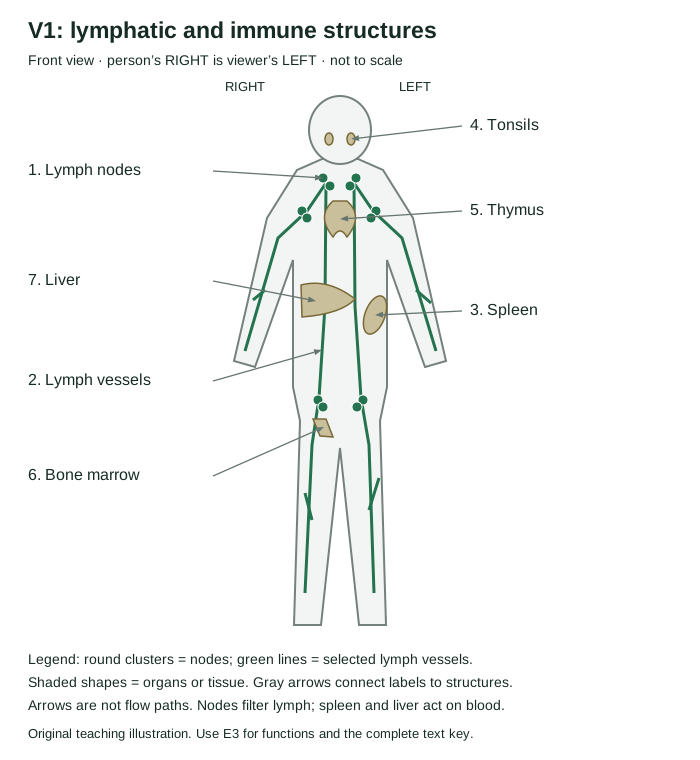
V1: original reference map
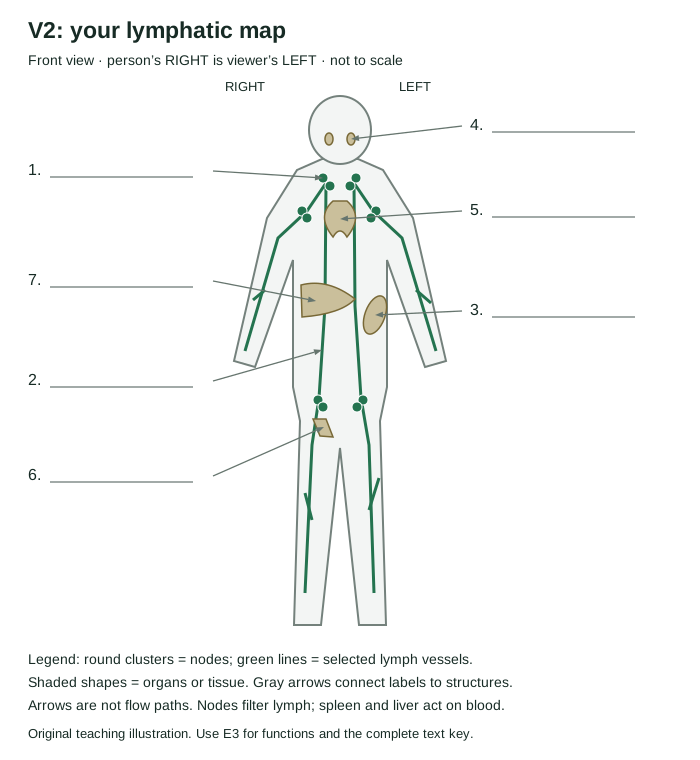
V2: original blank task map
Question: How do innate and adaptive responses work together without sharing one fixed clock?
Words you will use
- immune system
- A network of cells, tissues and organs that helps defend the body.
- innate immunity
- Defense using barriers and cells that recognize shared patterns of microbes or damage.
- acquired immunity
- Another name for adaptive immunity.
- active protection
- Protection arising from a person’s own immune response.
- passive protection
- Temporary protection from antibodies made by another source; it does not itself create recipient B- or T-cell memory.
- adaptive immunity
- Defense based on specific B- and T-cell receptors, with responses that can form memory.
- antigen
- A molecular structure recognized by an antibody or a lymphocyte receptor.
- antibody
- A protein released by plasma cells that binds a matching antigen structure.
- lymphocyte
- A white blood cell in the B-cell, T-cell or natural-killer-cell groups.
- B cell
- A lymphocyte that can develop into an antibody-secreting plasma cell after activation.
- T cell
- A lymphocyte that matures in the thymus and can coordinate defense or act on target cells.
- plasma cell
- An activated B-cell descendant that releases antibodies.
- memory cell
- A long-lived B or T cell that can respond to a later encounter with its target.
- immune memory
- Changed responsiveness after exposure; specific B- and T-cell memory is a key adaptive feature.
- receptor
- A cell molecule that binds a target and can help trigger a response.
- pathogen
- An agent that can cause disease.
- infection
- Entry and multiplication of an infectious agent in the body.
- barrier
- A physical or chemical defense that helps block entry or remove material.
- mucus
- A sticky secretion that traps material on moist body surfaces.
- phagocyte
- A cell that engulfs particles, microbes or cell debris.
- phagocytosis
- The process in which a cell engulfs material.
- inflammation
- A response to injury or infection that changes local vessels and recruits defenses.
- activation
- A change that makes an immune cell begin a response.
- expansion
- An increase in the number of cells, often through cell division.
- trained immunity
- Changed innate responsiveness after prior exposure, distinct from specific B- and T-cell memory.
- lymph
- Fluid inside lymphatic vessels, collected from spaces between tissue cells.
- lymphatic system
- A vessel and tissue network that returns tissue fluid to blood and supports immune defense.
- lymph node
- A small organ along lymph vessels that filters lymph and supports immune-cell interactions.
- lymph vessel
- A channel that carries lymph toward its return to blood.
- spleen
- An organ in the upper left abdomen that filters blood and supports immune responses.
- tonsils
- Lymphoid tissue near the throat that responds to material entering through the mouth or nose.
- thymus
- An organ behind the upper breastbone where T cells mature.
- bone marrow
- Tissue within bones where blood cells arise and B cells mature.
- liver
- An organ mainly in the upper right abdomen with metabolic and immune functions.
- duct
- A larger channel; lymph ducts return lymph to veins near the neck.
- vein
- A blood vessel that carries blood toward the heart.
- lymphoid tissue
- Tissue containing many lymphocytes that supports immune functions.
- helper T cell
- A T cell that sends signals supporting other immune cells.
- cytotoxic T cell
- A T cell that can kill a target cell after specific recognition.
- natural killer cell
- An innate lymphocyte that can attack certain infected or abnormal cells.
- CD4
- A surface protein used to identify a major helper T-cell group.
- HIV
- Human immunodeficiency virus, which attacks CD4 T cells and can weaken defense.
- protective function
- An action that helps prevent harm or respond to a threat; it does not guarantee safety.
- schematic
- A simplified drawing showing selected relationships rather than exact anatomy.
- legend
- A key explaining the symbols in a figure.
- callout
- A label and connector identifying a feature in a figure.
- claim
- A statement that evidence and reasoning can support or limit.
- evidence
- An observation or source fact used to support an explanation.
- limit
- A boundary on what the available evidence can establish.
H1: your work and its limits
This original lesson supplies a body reference, practice cases and a blank mapping figure. It uses no patient record. Use it to build the diagram and your own definitions. It cannot establish completion of the assigned PLTW online activity.
The previous respiratory lesson taught that a comparison needs values, a connecting rule and a clear limit. Carry that reasoning forward. Describe only spirometry data you actually collected or a client-clearance CER you actually wrote; do not present the supplied practice as either task.
First attempt the two do-now warmups, the four-hour prediction and the three-item sort. Then read E1 through E4 and revise your predictions. Classify each defense by what it does. Fast versus slow alone is not a reliable sorting rule.
E1: barriers and innate responses
MedlinePlus describes the immune system as a network of cells, tissues and organs. Skin and mucus help keep germs out. Stomach acid is a chemical barrier. A sneeze can help remove material from the airway. These defenses are already present before a new infection.
Innate immune cells recognize patterns associated with microbes or tissue damage. They do not treat every invader in exactly the same way. Phagocytes engulf material. Inflammation recruits defenses and changes local blood flow and vessel leakage. It can also occur after injury without infection.
Innate responses can act quickly. They also help activate adaptive responses. The two systems work together; one does not have to finish before the other begins. Redness or the day symptoms start cannot, by itself, identify which response is active.
E2: specific recognition and memory
An antigen is a molecular structure recognized by an antibody or a lymphocyte receptor. It need not be a whole germ. B and T cells have receptors with particular targets. On a first encounter, suitable cells must be activated and expand. This often takes days, while innate defenses continue.
Activated B cells can become plasma cells that release antibodies. An antibody binds a matching part of an antigen. Binding can help block a pathogen or mark it for other defenses. Binding does not guarantee destruction. Some activated B and T cells become memory cells.
On a later encounter with the same target, memory cells can support a quicker response. Protection varies and is not always lifelong or complete. Adaptive immunity is not always slow. Stronger inflammation is not automatically better protection.
Adaptive immunity is also called acquired immunity. Active protection develops through your own response. Passive protection comes from receiving antibodies made elsewhere. Transferred antibodies can protect for a time, but do not by themselves create your own B- or T-cell memory.
Innate cells can also show changed responses after earlier exposures. This is called trained immunity. It differs from B- and T-cell memory based on particular receptors. Do not use the rule that innate immunity can never change after exposure.
E3: map seven structures
The reference shows a front view. The person’s right is on the viewer’s left. It is a teaching sketch, not to scale. Nodes and vessels appear in many more places than shown. The numbered callouts identify seven structures; node groups are one target.
1. Lymph nodes: clusters shown at the neck, armpits and groin. They filter lymph and provide sites where immune cells meet targets. 2. Lymph vessels: branching channels in the limbs and trunk. They collect fluid from tissues and return lymph to veins near the neck.
3. Spleen: in the person’s upper left abdomen. It helps remove microbes and worn blood cells from blood. It is not a lymph-filtering node. 4. Tonsils: near the back of the throat. This lymphoid tissue helps respond to material entering through the mouth or nose.
5. Thymus: behind the upper breastbone. T cells mature there. 6. Bone marrow: inside bones, with a sample shown in the pelvis. Blood cells arise in marrow, and B cells mature there. 7. Liver: mainly in the upper right abdomen. Its resident immune cells help defend against material carried in blood.
Legend: round clusters indicate lymph nodes; branching lines indicate selected lymph vessels. Shaded organ shapes mark organs or tissue, not lymph flow. Thin callout arrows point from each label to a structure. They do not show fluid moving through every organ.
Lymph returns to the blood through ducts near the neck. Blood filtration by the spleen and liver is distinct from lymph filtration by nodes. The sketch does not trace every duct or claim that all lymph travels through the spleen or liver.
E4: memory questions and the extension
CDC says recovery from chickenpox usually gives lifelong immunity, but a second infection is possible. Many viruses can cause a common cold. Repeated colds do not prove that the immune system has no memory. These are population-level explanations, not a diagnosis of a classmate.
Helper T cells coordinate parts of the response through signals to other immune cells. They can support B cells and cytotoxic T cells. Cytotoxic T cells can kill infected cells after recognizing a target. Natural killer cells are lymphocytes too, but belong to innate defense.
NIH explains that HIV attacks CD4 T cells. Losing these cells makes fighting infections harder. This does not mean that every defense stops at once. Treatment can protect CD4 cells. Use this supplied fact for the extension without discussing anyone’s health or proposing treatment.
D1: original practice inputs
Sort A: intact skin blocks entry. Sort B: a sneeze helps expel airway material. Sort C: a plasma cell releases an antibody that binds a particular viral antigen. These are invented descriptions, not measurements. For each, name the action and classify it as a barrier or an adaptive response.
Case R: a fictional person scratches a hand on a rough gate. Redness appears soon afterward; tiredness is reported two days later. No pathogen test, cell measurement or cause is supplied. Explain why these times cannot prove that innate immunity stopped and adaptive immunity started.
Case S: imagine a first encounter with a new pathogen after it crosses a barrier. Show the barrier already in place, an early innate response, and adaptive activation that can overlap. Name which cells can support specific memory. Do not invent exact hours or guarantee future protection.
Memory prompts for independent work: Why might a repeat exposure lead to a faster response? Why could someone still become ill despite memory? Choose one if you need a starting question. Answer from E2 and identify one limit.
T1: practice route and recovery
If the official online task is accessible and the assigned portion is confirmed, work on that portion during minutes 28 through 45. If not, use D1 Cases R and S. Label both explanations as practice and ask for the official task.
If you need a restart, locate the next item to work on: notes, definitions, online task or practice, diagram, memory question. For extra support, compare skin with the specific antibody in Sort C. Write one example of each, then return to all three definitions and the full map.
For a partner exchange, share your memory question and record the actual answer. Working alone, answer one supplied memory prompt, then challenge your answer with the other prompt. Revise one sentence. Label this a solo exchange; it is not a classmate’s response.
For the extension, contrast helper and cytotoxic T cells. Use the NIH CD4 fact to explain one reason helper-cell loss can weaken defense. State why this does not prove instant loss of all immunity. Finish required work before extending.
P1: official work and dated follow-through
Ask your teacher which parts of Activities 3.2.1 and 3.2.2 are assigned. Activity 3.2.1 Powers of Protection includes To Drain and Protect, with an organizer and a seven-structure model linking protective functions with arrows. Follow the actual organizer and model requirements separately; today's practice map does not replace them.
Official 3.2.1 also refers to Amazon Travel Journal pages 1–2 and other sections. Its organizer, model and remaining materials are not supplied here. Confirm the assigned portion and completion evidence. Use evidence from those actual tasks only after doing them.
Activity 3.2.2 Immune Defense includes cell-role research, bacterial-versus-viral comparisons, teacher-led origami demonstrations and a ten-term concept map. Its video, model tours, journal pages 7–8, full template and build sequence are not supplied. Follow the teacher's directions for assigned demonstrations, notebook work and assessment; use only evidence from work you actually do.
The official concept map names innate, acquired, neutrophil, macrophage, memory B, dendritic, antibodies, helper T, cytotoxic T and plasma B. Today’s three definitions do not complete that separate map. Ask your teacher whether a separate immunity-comparison chart is also required.
April 29 preparation lists Submit tracker and evidence, 25 minutes, in Class Records. Record actual completion separately from this 80-minute lesson. After genuine official work, preserve the required screenshot or note for the tracker. If access is absent, record the missing input instead.
Keep the weekly spirometry and client-clearance CER work through Activity 3.1.6 on your checklist. Ask for the teacher-posted data/model packet and assigned Khan respiratory resources if they are unavailable.
An immunity checklist also lists work through 3.2.3 Going Un-Viral and an Immune defense model: vaccine-data CER, pathogen transmission, a plaque assay and eye dissection, plus a teacher packet and Khan immune resources. Ask which items apply and obtain the required instructions. Today’s original map does not complete those separate tasks.
The next class is Monday, May 3. Prepare antigen, antibody and B-cell definitions for the antigen-antibody model, and explain why binding depends on matching structure. Confirm the actual model materials with your teacher before use.
May 3 preparation lists Innate and adaptive immunity, 25 minutes, in Class Records. April 30 is a catch-up day, not another scheduled class. Keep the teacher-posted packet, tracker and official-task evidence separate, and check Schoology after uploading. Do not invent a peer response, screenshot or completion record.
M1: a different worked explanation
Original example M concerns a fictional airway exposure, not D1’s scratched hand. Mucus traps some particles before they reach deeper tissue. A phagocyte engulfs material that passes the barrier. Both actions support innate defense, but they use different mechanisms.
In this teaching example, a matching B cell is activated and later becomes a plasma cell. Its antibodies bind their target. This is adaptive recognition. The description does not give a response time or prove that all particles were removed.
My model memory question is: Would antibodies against target A necessarily bind target B? My answer is no; matching depends on the recognized structure. A memory response to A does not guarantee protection against a different target. I would need evidence about binding to B.
My map caption would distinguish a node filtering lymph from the spleen filtering blood. The arrow from my caption points to the named structure. It is a label connection, not a claim that lymph flows into the spleen.
Try the decision
What can Case R’s symptom timing establish?
- It cannot separate innate from adaptive activity; the responses can overlap and the cause is unknown.
- Early redness proves only innate activity, and day-two tiredness proves only adaptive activity.
- The response guarantees lifelong protection from every later infection, regardless of the unknown cause.
Explain your choice using the reading. Discuss it or say it to yourself. This practice does not add another submission.
Your response record
Use these labels on paper or in your document. The space below also works when this page is printed.
Three initial predictions
Before reading, explain what skin, stomach acid and mucus have in common. Then predict why chickenpox is usually a one-time illness while colds can recur. Also predict what may happen in the first four hours after a new pathogen enters. Keep all three initial answers for revision.
Use general ideas only. No personal illness history is needed. Revisit all three answers using E1 and E4.
Three-item prerequisite sort
Classify D1 Sorts A, B and C. For each, name the action and justify barrier or adaptive response.
Do not classify solely by speed. Skin blocks entry; a sneeze expels material; the specific antibody binds a target.
Notes with a cited fact
Record two innate actions and two adaptive actions. Include one accurate MedlinePlus fact from E1 and name the source. Explain one way the responses work together.
Use E1 and E2. A list of fast and slow labels is not enough.
Three definitions in your own words
Define antigen, antibody and lymphocyte without copying. Recite them with the page covered, then correct or confirm each definition.
Use the vocabulary and E2. Do not define all lymphocytes as adaptive or every antigen as a whole germ.
Online portion or original recovery
Work on the confirmed official portion if available. Otherwise explain D1 Cases R and S, including why symptoms cannot time the two responses. Record the route you used.
T1 provides a complete practice route. Use online-task evidence only from the task you actually do; ask for any missing directions.
Lymphatic system body diagram
Label all seven structures on V2 or your own body outline. Add one protective function for each and connect it to the structure with a callout arrow. Include the orientation and legend.
Use V1 and E3: nodes, vessels, spleen, tonsils, thymus, bone marrow and liver. Show the spleen on the person’s left and liver mainly on the right. Arrows label structures; they are not flow claims.
One question, answer and revision
Write one question about immune memory. Record an actual partner answer, or use T1’s solo exchange. Revise one sentence with E2 evidence and a limit.
A question may ask about speed, specificity or incomplete protection. Label any solo response honestly.
First encounter self-check
For D1 Case S, explain what is already present, what can act early and what can develop while other defenses continue. Identify specific memory cells. Then revise all three initial predictions. Do not treat four hours as a fixed switch.
Use overlap rather than a strict two-step clock. Include B and T memory, and avoid guaranteed lifelong protection.
Helper-cell extension
After required work, contrast helper and cytotoxic T cells. Use the NIH CD4 fact to explain how helper-cell loss can weaken defense, with one limit.
E4 supplies all required information. Do not infer anyone’s diagnosis or propose a treatment.
Exit and next preparation
Check the diagram, three definitions and memory question. Identify the online task and whether you worked with a partner or alone. Check the tracker and ask for missing weekly materials; check Schoology after uploading. Prepare the three terms for May 3.
Use P1. A finished original map does not show that an online activity or weekly CER was submitted.
Check your product
- Distinguish innate and adaptive responses by mechanism, with overlap and memory limits.
- Label seven structures with protective functions and write the three definitions in your own words.
- Keep the required memory question with evidence of online-task work you performed, or a specific request for unavailable inputs. After uploading, check that Schoology shows Submitted.
Original reference and practice support explanations. They cannot establish a diagnosis, timed prediction, actual online completion or submission.
Turn in your work
Wk15 Vocabulary: Innate and adaptive immunity
Submit the complete diagram and three own-word definitions through your confirmed enrolled section: 1292 https://app.schoology.com/assignment/8544596065 or 6792 https://app.schoology.com/assignment/8544596096 . Keep the memory question and notes with the record; report actual PLTW completion separately.
- Section 1292: Wk15 Vocabulary: Innate and adaptive immunity
- Section 6792: Wk15 Vocabulary: Innate and adaptive immunity
If access is unavailable, save the dated practice work and tell the teacher. After uploading, check that Schoology shows Submitted. Use only screenshots or notes from work you actually do.
Connection to PLTW
Original immunity reference and practice; actual online and weekly work remain distinct.
These references locate related course material. Complete only the official work and stopping point your teacher assigns. This local preparation does not establish completion of an online activity.
- Activity 3.2.1 Powers of Protection
- Activity 3.2.2 Immune Defense
Optional practice and examples
Use these resources to practice related skills. Follow the required work and evidence limits above. A simulation does not authorize a live experiment or add another submission.
Slides and optional notes
Keep the seven-structure diagram and seven protective functions, three definitions, memory question, notes and evidence from your actual assigned task together. Guided notes are optional and do not add a second submission.
Sources and optional reading
- 21.1 Anatomy of the Lymphatic and Immune Systems · OpenStax, Rice University
- 21.2 Barrier Defenses and the Innate Immune Response · OpenStax, Rice University
- 21.3 The Adaptive Immune Response: T lymphocytes and Their Functional Types · OpenStax, Rice University
- 21.4 The Adaptive Immune Response: B-lymphocytes and Antibodies · OpenStax, Rice University
- Immune System and Disorders · MedlinePlus, National Library of Medicine
- HIV and AIDS: The Basics · NIH HIVinfo
- Insights into How Immune Cell Recruits Are Programmed To Defend the Liver · NIDDK
- Defining trained immunity and its role in health and disease · Netea and colleagues, Nature Reviews Immunology; review abstract
- About Chickenpox · CDC
- About Common Cold · CDC
Keep going
If you were absent or lost your place, read the word guide and reading first. Try the example, then complete the first unfinished response.
No partner is required. Read your response aloud to yourself and check it against the product checklist.
Take home: Barriers, innate responses and adaptive responses cooperate; specific memory can improve later responses without guaranteeing protection.
Use antigen, antibody and B-cell definitions to explain matching in the May 3 model after its materials and instructions are confirmed. What makes an antibody's interaction with an antigen specific in the model?