
Human Body Systems · 2027-03-23 · 80 minutes
Wk10 Vocabulary: Endocrine glands and signaling
Your goal: Map the major endocrine glands and the hormones they secrete using teacher notes and the PLTW online task.
One product: Annotated body diagram labeling at least four endocrine glands with their primary hormones, plus definitions of hormone, target cell, and receptor.
If access is unavailable, save the same diagram and definitions and tell the teacher. Ask for the actual matching task and correct submission route.
Start the work
Weigh medical evidence, the young person's voice and real tradeoffs before defending a treatment policy.
- Take guided notes on the pituitary, thyroid, pancreas, and adrenal glands.
- Define hormone, target cell, and receptor in your own words.
- Complete the assigned PLTW online gland-and-hormone matching activity.
- Annotate a body diagram with each gland and its primary hormone.
- Write one question about a gland you still find confusing.
Show the 80-minute plan
- 0 to 10 minutes. Complete both warmups with supplied examples.
- 10 to 30 minutes. Take the four-gland notes using E2/E3.
- 30 to 45 minutes. Define the three key terms; compare with a partner or the supplied text.
- 45 to 60 minutes. Attempt actual myPLTW matching or labeled G1 recovery.
- 60 to 72 minutes. Annotate V1 with four gland types and their hormones.
- 72 to 80 minutes. Write and share the lingering question; submit and check Schoology after uploading.
Open your materials
Use the reading, word guide, and worked example below. Keep your answers on paper or in one document.
Printable lesson and response record (PDF). This packet contains the same required reading and work.
Map four endocrine gland types
Question: How can a hormone made in one gland change a distant target cell?
Words you will use
- hormone
- A chemical signal released by cells that affects cells with a matching receptor.
- endocrine gland
- A gland that releases hormones into blood.
- target cell
- A cell able to respond to a particular hormone through its receptor and signaling machinery.
- receptor
- A protein on or in a cell that binds a matching signal.
- secrete
- Release a substance from a cell.
- source
- The place a signal is produced or released.
- target tissue
- A group of cells affected by a signal.
- circulation
- Movement of blood through the body.
- signaling machinery
- Cell parts and processes that turn a received signal into a response.
- pituitary
- A small gland at the base of the brain with anterior and posterior parts.
- hypothalamus
- A brain region that helps regulate endocrine signals and other body functions.
- anterior
- Toward the front; the anterior pituitary is its front part.
- posterior
- Toward the back.
- GH
- Growth hormone, made by the anterior pituitary.
- TSH
- Thyroid-stimulating hormone, released by the anterior pituitary to stimulate the thyroid.
- thyroid
- A gland at the front of the neck that makes T4 and T3.
- T4 / thyroxine
- A thyroid hormone with four iodine atoms.
- T3 / triiodothyronine
- A thyroid hormone with three iodine atoms.
- metabolism
- The body's chemical processes for using and changing matter and energy.
- pancreas
- An abdominal organ with hormone-secreting islets and a digestive role.
- islet
- A cluster of hormone-secreting cells in the pancreas.
- beta cell
- An islet cell that releases insulin.
- alpha cell
- An islet cell that releases glucagon.
- insulin
- A pancreatic hormone that helps lower blood glucose.
- glucagon
- A pancreatic hormone that helps raise blood glucose.
- glucose
- A sugar used as fuel by cells.
- adrenal gland
- One of a pair of glands near the upper ends of the kidneys.
- cortex
- An outer region; the adrenal cortex makes cortisol.
- medulla
- An inner region; the adrenal medulla releases epinephrine.
- cortisol
- An adrenal cortex hormone involved in metabolism and stress responses.
- epinephrine / adrenaline
- An adrenal medulla hormone involved in stress responses.
- negative feedback
- A control process that opposes a change in the regulated condition.
- homeostasis
- Keeping internal conditions within workable ranges.
- hypothyroidism
- Too little thyroid hormone for the body's needs.
- hyperthyroidism
- An overactive thyroid making too much thyroid hormone.
- fatigue
- A feeling of tiredness or low energy.
- annotate
- Add labels or explanatory notes to a figure.
E1: a source is not a target
Endocrine glands release hormones into blood. Circulation distributes them widely; it does not guarantee the same exposure at every cell. A target cell has a receptor that can bind that hormone. The cell's signaling machinery also helps determine the response.
The gland is the source of the signal. A distant tissue may be a target, not another source of that hormone. Receptors may be on a cell surface or inside a cell. Reaching a tissue does not mean every cell there responds in the same way.
For both warmups, name one gland and a role from E2/E3, then explain why broad blood transport does not cause one identical response everywhere. Do not infer a hair follicle lacks insulin receptors just because its response differs from a muscle cell.
E2: head and neck gland notes
Pituitary: near the base of the brain, connected to the hypothalamus. Its anterior part makes and releases growth hormone, GH, and thyroid-stimulating hormone, TSH. GH supports growth-related processes; TSH stimulates the thyroid. These are examples, not its complete hormone list.
Thyroid: in the front of the neck, with lobes on either side of the windpipe. It makes T4, called thyroxine, and T3, called triiodothyronine. These hormones influence energy use in many tissues. TSH comes from the anterior pituitary, not from the thyroid.
For your map, use pituitary - GH, with TSH as a second example, and thyroid - T4/T3. A gland can produce several hormones; primary hormone here means a representative taught example, not its only hormone.
E3: abdominal gland notes
Pancreas: across the upper abdomen behind the stomach. Its islet beta cells secrete insulin; its alpha cells secrete glucagon. These cells are the sources. Liver and muscle are examples of tissues affected by insulin; they are not the source of pancreatic insulin.
Adrenal glands: a pair near the upper ends of the kidneys. The outer cortex secretes cortisol, which helps regulate metabolism and stress responses. The inner medulla releases epinephrine, also called adrenaline, during stress responses. The adrenal gland is not the kidney itself.
For your map, use pancreas - insulin/glucagon and adrenal glands - cortisol from cortex or epinephrine from medulla. Label both adrenal positions as the same gland type. Four gland types, not five different types, complete this map.
G1: supplied body diagram and matching input
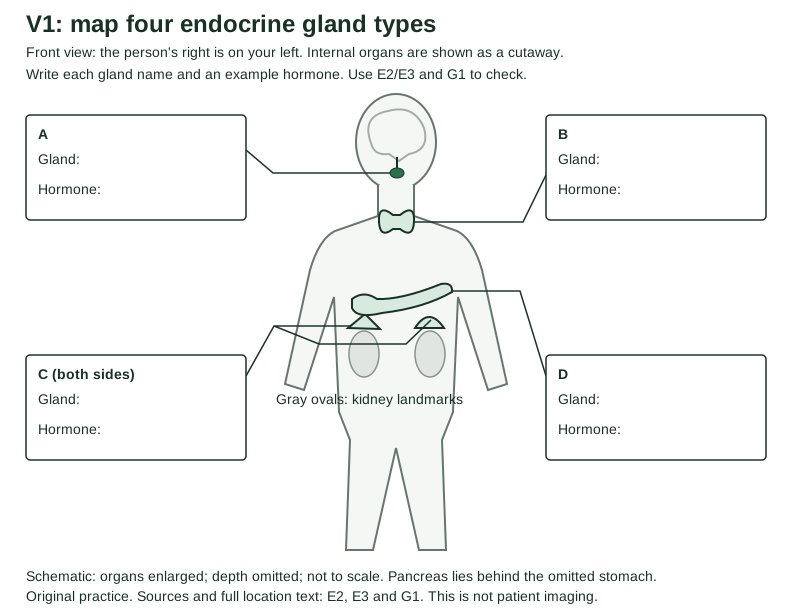
V1-endocrine-outline.svg is the original annotation sheet. It is a front-view teaching cutaway, not a scan or a scale drawing. The person's right is on the viewer's left. Internal structures are enlarged; depth and exact size are simplified.
Text equivalent: A marks the pituitary at the base of the brain. B marks the thyroid at the front of the neck. C marks both adrenals near the kidney tops. D marks the pancreas in the upper abdomen; it lies behind the stomach, which is omitted. Gray kidney landmarks are not endocrine targets to label for this task.
Add the gland name and at least one correct hormone to each blank A-D area. Use E2/E3 to check your choices. If the SVG is missing from the delivered page, report that missing diagram input; do not call a list alone a completed body diagram.
Original matching practice: match 1 anterior pituitary, 2 thyroid, 3 pancreatic beta cells and 4 adrenal cortex to A cortisol, B GH, C insulin and D T4/T3. Check after trying: confirm each pair against the gland and hormone statements in E2 and E3. This practice does not submit or finish the assigned myPLTW matching items.
E4: feedback and the thyroid extension
A negative-feedback loop opposes a change and helps keep internal conditions in a workable range. In thyroid regulation, hypothalamus and pituitary signals help regulate thyroid output; circulating thyroid hormone feeds back on that control. This is regulation, not the gland aiming hormone at one body part.
For the extension, compare the pituitary-thyroid pair and contrast hypothyroidism with hyperthyroidism. Hypo means below; hyper means above. Hypothyroidism means too little thyroid hormone for the body's needs. Hyperthyroidism means an overactive thyroid making too much.
NIDDK describes cold intolerance and fatigue with hypothyroidism, and heat intolerance or sweating with hyperthyroidism. Higher thyroid activity can increase energy use, but people with hyperthyroidism may also feel tired. More hormone does not guarantee more usable energy or a better mood.
Predict those general patterns using the hormone level and prefix, not a measured fever or a diagnosis of a person. Symptoms vary and overlap with other conditions. The sources explicitly state that symptoms alone cannot establish either diagnosis.
P1: full product and authentic work
Take notes on all four gland types. Define hormone, target cell and receptor in your own words. In pair-work, compare definitions; if working alone, compare yours with E1 and mark the solo route. Explain in one sentence why exposure and response differ.
During minutes 45-60, complete every assigned gland-and-hormone match in Activity 2.2.1 The Endocrine System on myPLTW. Obtain the actual screens and teacher stopping point. If the official matching task is unavailable, use G1 practice and ask the teacher for that task. Do not assume yesterday's introduction is complete.
Your product is the annotated four-gland body diagram plus the three definitions. Add one question about a gland still confusing you. Submit through the confirmed section route and retain a screenshot or note of actual official completion on the weekly tracker.
Absent or interrupted: use these guided notes, attempt the actual matching when available, finish the diagram and write the lingering question. Local practice does not replace the official task. No homework is due before this class.
March 26 is no school. Check the actual assignment deadline.
The week retains a feedback-loop organizer, hormone feedback model, blood-glucose CER and later experimental design. Its absence route needs the actual teacher-posted data/model packet. March 24 needs the assigned cards/tokens, body diagram and glucose tracking sheet for meal and fasting runs. None of those model results is supplied here.
The weekend item remains Submit reflex evidence in Exit Tickets. The March 22 consent exit and any unresolved introductory activity remain separate. Ask for missing inputs; no new recording, classmate reply or treatment task is added.
M1: different model, shared radio message
An invented workshop sends one radio message across the room. Receiver A has the right tuner and turns on a lamp. Receiver B has a different tuner and does not react. Receiver C has the right tuner but is connected to a buzzer.
Model explanation: the same broadcast can produce no response or different responses because receiving parts and connected machinery differ. Hormone maps likewise separate the source, transport and target response.
The prerequisite key-and-lock analogy also helps: name the biological lock as the receptor. Neither analogy means hormones are metal keys, cells are houses, or every tissue receives the same amount. Use E1 for the biological explanation.
Try the decision
Which explanation fits the map and E1?
- The source releases a hormone into blood; a matching receptor and cell processes help determine the target response.
- Pancreatic insulin is aimed only at the liver, so circulation does not matter.
- Different tissue responses prove that every less responsive cell has no receptor.
Explain your choice using the reading. Discuss it or say it to yourself. This practice does not add another submission.
Your response record
Use these labels on paper or in your document. The space below also works when this page is printed.
Both warmups
Name a gland and one role, then explain why wide hormone transport does not make every cell respond alike.
Use E1-E3 and M1; name the receptor as the biological lock.
Four-gland notes and definitions
Record the location, example hormone and role for pituitary, thyroid, pancreas and adrenal glands; define hormone, target cell and receptor in your own words.
Use E2/E3. Compare definitions with a partner or label solo comparison. Do not confuse hormone source with target.
Actual matching and local practice
Attempt all assigned myPLTW gland-and-hormone matches in the 45-60 minute window; use G1 practice if access is missing.
Describe only what you checked and ask for anything you need. G1 includes a check method for local review and is not official completion.
Annotate the body diagram
Label A-D on V1 with the four gland types and at least one taught hormone each; include the three definitions with your diagram.
Use the location text in G1 and E2/E3. The paired adrenals count as one type. A list alone does not meet the diagram task.
Response check and thyroid extension
Explain in one sentence how source, blood and receptor connect; explain why different tissue responses do not prove absence of a receptor.
For extension, contrast hypo/hyperthyroidism for the pituitary-thyroid pair using E4, including temperature tolerance, energy use and the diagnosis limit.
Question and submission check
Write one lingering gland question, share it and submit the annotated diagram with definitions through your section route.
Retain actual official completion evidence for the tracker or list the missing screens. Keep weekly model and data tasks separate.
Check your product
- The diagram locates pituitary, thyroid, pancreas and both adrenal glands with correct example hormones.
- Hormone, target cell and receptor are defined in the student's own words.
- The explanation distinguishes source, broad blood transport and receptor-dependent response.
- One lingering gland question is recorded.
- Keep evidence from the matching task and weekly work you actually do. Ask for missing inputs.
Original anatomy and signaling practice only. It cannot establish a patient diagnosis, measured hormone level, treatment advice, official submission or model-lab completion.
Turn in your work
Wk10 Vocabulary: Endocrine glands and signaling
Submit the annotated body diagram and three definitions under the exact assignment title. Section 1292: https://clevelandmetro.schoology.com/assignment/8544581660. Section 6792: https://clevelandmetro.schoology.com/assignment/8544581693. Confirm that your section's assignment is open.
- Section 1292: Wk10 Vocabulary: Endocrine glands and signaling
- Section 6792: Wk10 Vocabulary: Endocrine glands and signaling
If access is unavailable, save the same diagram and definitions and tell the teacher. Ask for the actual matching task and correct submission route.
Connection to PLTW
Original diagram and matching practice; actual myPLTW items remain separate.
These references locate related course material. Complete only the official work and stopping point your teacher assigns. This local preparation does not establish completion of an online activity.
- Activity 2.2.1 The Endocrine System
Optional practice and examples
Use these resources to practice related skills. Follow the required work and evidence limits above. A simulation does not authorize a live experiment or add another submission.
Slides and optional notes
Keep the annotated diagram, three definitions and lingering question together; track actual official work separately. Guided notes are optional and do not add a second submission.
Sources and optional reading
- Characteristics of Hormones · National Cancer Institute, SEER Training
- Pituitary & Pineal Glands · National Cancer Institute, SEER Training
- Thyroid & Parathyroid Glands · National Cancer Institute, SEER Training
- Pancreas: Islets of Langerhans · National Cancer Institute, SEER Training
- Adrenal Gland · National Cancer Institute, SEER Training
- Hypothyroidism · National Institute of Diabetes and Digestive and Kidney Diseases
- Hyperthyroidism · National Institute of Diabetes and Digestive and Kidney Diseases
Keep going
If you were absent or lost your place, read the word guide and reading first. Try the example, then complete the first unfinished response.
No partner is required. Read your response aloud to yourself and check it against the product checklist.
Take home: Name the hormone source, follow its route through blood, and explain the response using the target cell's receptor.
March 24 uses the assigned blood-glucose negative-feedback model; bring the gland map and obtain the actual model inputs. How could a pancreatic signal contribute to a blood-glucose feedback loop?