
Biomedical Innovations · 2027-05-10 · 80 minutes
Notebook audit: trace records and preserve limits
Your goal: Paper notebook preparation only. Do not perform or design a biological experiment. Supplied records do not establish actual laboratory work, transformation success or DNA identity. Today’s objective, authentic completion still pending: Assemble and submit a complete transformation and gel laboratory notebook.
One product: Complete transformation and gel laboratory notebook: transformation notes, plate colony counts with units, gel standard curve, fragment-size estimates with units, conclusion about band-pattern consistency with an identity limit, one error source, and one future improvement.
Paper notebook preparation only. Do not perform or design a biological experiment. Supplied records do not establish actual laboratory work, transformation success or DNA identity. Save the same record with missing input, next action and receipt pending.
Start the work
Approved May 6/7 teaching inputs are supplied in full. A matching size pattern supports consistency, not DNA identity. Prior actual student work and laboratory completion remain unverified.
- Paper notebook preparation only. Do not perform or design a biological experiment. Supplied records do not establish actual laboratory work, transformation success or DNA identity. Step: Use N1/C1/D1/G1/T1 to complete four inventory rows from the supplied notebook pages.
- Paper notebook preparation only. Do not perform or design a biological experiment. Supplied records do not establish actual laboratory work, transformation success or DNA identity. Step: Use C1/G1/T1 for one count trace and one size trace, with units.
- Paper notebook preparation only. Do not perform or design a biological experiment. Supplied records do not establish actual laboratory work, transformation success or DNA identity. Step: Write a bounded count-and-pattern conclusion that keeps its identity limit.
- Paper notebook preparation only. Do not perform or design a biological experiment. Supplied records do not establish actual laboratory work, transformation success or DNA identity. Step: Use A1 to label one possible documentation error and one documentation improvement.
- Paper notebook preparation only. Do not perform or design a biological experiment. Supplied records do not establish actual laboratory work, transformation success or DNA identity. Step: Use Q1 to check labels, sources, missingness, units and limits, then submit the notebook and confirm it in your tracker.
Show the 80-minute plan
- 0 to 5 minutes. Use H1 for one short opening answer.
- 5 to 25 minutes. Use N1/C1/D1/G1/T1 to complete four inventory rows; retain the supplied pages without recopying or redrawing.
- 25 to 45 minutes. Use C1/G1/T1 for one count trace, one size trace and a bounded count-and-pattern conclusion.
- 45 to 60 minutes. Use A1 to label one possible documentation error and one documentation improvement; do not invent an actual error.
- 60 to 72 minutes. Use Q1 to check labels, sources, missingness, units and limits in the same record.
- 72 to 80 minutes. Use Q1/S1 to save and report genuine delivery, receipt and acceptance states.
Open your materials
Use the reading, word guide, and worked example below. Keep your answers on paper or in one document.
Printable lesson and response record (PDF). This packet contains the same required reading and work.
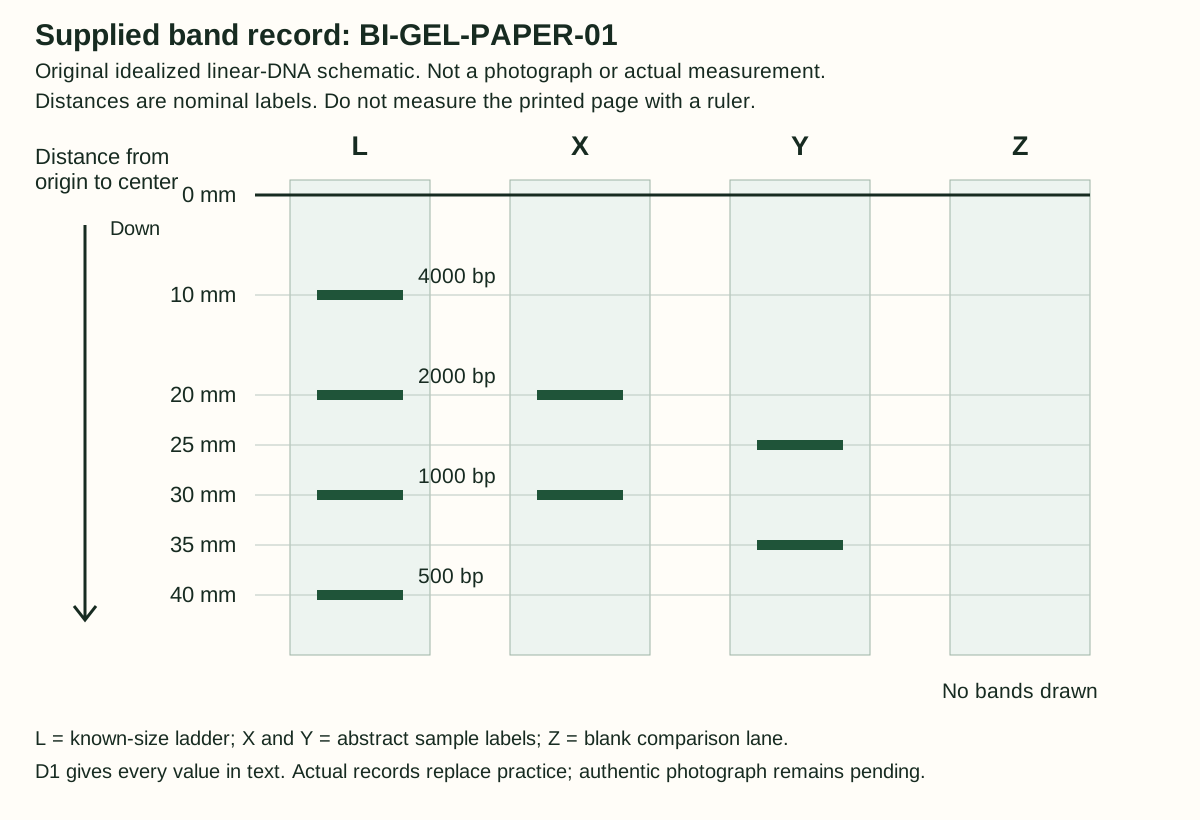
Complete supplied nominal band reference
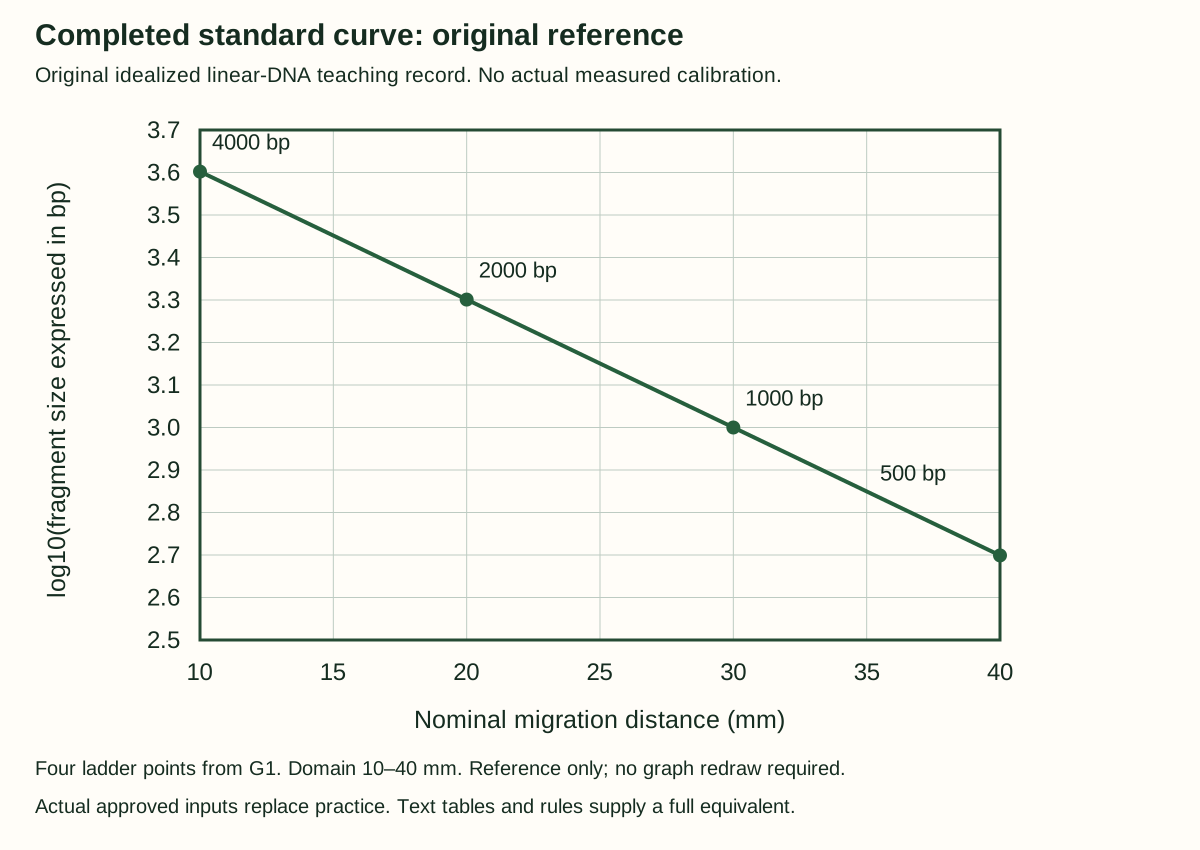
Completed standard-curve reference
Question: How can one notebook show what the evidence supports and what still remains unverified?
Words you will use
- nominal
- Assigned teaching value, not a new measurement.
- lane
- Labeled column of the supplied band diagram.
- band
- Drawn mark at a stated nominal position.
- ladder
- Reference set of known DNA fragment lengths.
- migration distance
- Distance from the declared origin to band center, nominal here.
- origin
- Common reference line labeled 0 mm.
- millimeter
- Length unit abbreviated mm, used here for migration distance.
- base pair
- Pair of complementary DNA bases; bp also counts fragment length.
- bp
- Abbreviation for base pair.
- fragment size
- DNA length in bp, different from distance in mm.
- linear DNA
- DNA with two ends rather than a circular form.
- double-stranded DNA
- DNA containing two paired strands.
- topology
- Molecular form, such as linear or circular.
- standard curve
- Reference relation used to estimate an unknown value within its stated domain.
- base-10 logarithm
- Exponent to which 10 is raised to obtain a positive number.
- exponent
- Number indicating a power, as 3 in 10 cubed.
- inverse
- Operation that reverses another; 10 to a power reverses log10.
- log space
- Scale on which values are logarithms instead of original sizes.
- interpolation
- Estimate between reference points within their domain.
- extrapolation
- Estimate beyond the reference range; not allowed here.
- domain
- Input range where the stated model applies.
- midpoint
- Position halfway between two reference positions.
- rounding
- Reporting a value at a stated precision.
- nearest 10
- Closest multiple of ten, using the stated halfway rule.
- estimate
- Value inferred through a declared model, not a direct identity measurement.
- expected pattern
- Supplied comparison lengths and band count, not proof of a construct.
- tolerance
- Declared allowed difference for comparison; not measured uncertainty here.
- inclusive
- Including the stated endpoints.
- pattern consistency
- Agreement with all stated pattern rules; not confirmation of identity.
- sequence identity
- Exact order of DNA bases; not established by size alone.
- construct
- An engineered DNA arrangement; none is designed or identified here.
- restriction map
- Description of positions where specified enzymes cut DNA; no real map is supplied here.
- gene orientation
- Direction of a gene within DNA, not determined by these sizes.
- limitation
- Evidence boundary restricting a conclusion.
- uncertainty
- What the supplied information cannot settle.
- receipt
- Evidence that a submission reached its intended destination.
- transformation
- In this bacterial context, uptake and establishment of DNA by a cell.
- plasmid
- DNA molecule that can exist separately from a cell’s chromosome.
- colony
- Visible group of microorganisms on a solid medium.
- count
- Number of items in a stated record; not automatically a concentration.
- concentration
- Amount or number per specified volume or other stated quantity.
- transformation efficiency
- Measure relating transformants to DNA amount; not established by these counts.
- inventory
- List locating the sections of the notebook and their status.
- provenance
- Source and history of a record.
- audit trail
- Preserved history showing the original entry and documented changes.
- hypothetical
- Proposed as a possibility, not claimed as an observed event.
- documentation error
- Mistake in recording or labeling information, distinct from an observed experimental problem.
- correction
- Documented change tied to evidence and its reason.
- missingness
- State in which a required value or evidence is unavailable.
- method record
- Account of what was actually done; a concept summary cannot replace it.
- acceptance
- Teacher confirmation that work meets the assigned requirements.
- tracker
- Record of actual work and delivery status, not evidence of receipt by itself.
- expression
- Use of genetic information to produce an RNA or protein product.
H1: A record needs a claim and its boundary
Paper notebook preparation only. Do not perform or design a biological experiment. Supplied records do not establish actual laboratory work, transformation success or DNA identity.
Opening input: a count states how many; a conclusion explains what that count supports against a stated expectation. A limitation says what it cannot settle. The Office of Research Integrity says records should reflect what was actually done and achieved. At 0–5 write one reason a data-only notebook needs a conclusion and limitation.
Today is Monday May 10. All needed May 6/7 teaching records appear here; prior student work is not assumed. Tuesday May 11 is the next dated class. Begin S1 status marks during work and update changes only.
N1: Conceptual notes and one inventory
In this bacterial context, transformation concerns uptake and establishment of DNA by a cell. Uptake does not by itself establish expression of every gene. A plasmid is a DNA molecule that can exist separately from a cell’s chromosome. Neither the count labels nor the band lengths identify a real plasmid here.
A colony is a visible group of microorganisms on a solid medium. A nominal colony count here is an authored number, not a photograph or real observation. Gel electrophoresis can separate DNA fragments; the supplied model assumes linear double-stranded DNA, with shorter fragments moving farther in the same comparison. These concepts are not a procedure.
At 5–25 index four supplied sections: N1 conceptual notes; C1 counts/key; D1/G1 gel reference and completed curve, with your May 7 estimates; T1 comparison rule. Use one row per section with section ID, location and supplied/checked/missing status. Keep these reference pages with the record; do not recopy every value or draw another graph.
Add an actual-method status beside N1. Add your actual May 7 plate rows. Write unavailable/pending only for a protocol, photograph, measurement or method record you do not have as teacher-confirmed evidence. Conceptual notes cannot stand in for actual methods.
C1: Complete supplied count record
BI-RECORD-PAPER-01 is the approved fictional teaching record from May 6. P | positive comparison record | 12; N | negative comparison record | 0; S | sample record | 8. Unit for each is nominal counted colonies per supplied record. These are counts, not concentration, percentages or actual plate observations.
Complete authored expectation key: P is greater than zero; N is zero; no expected S count is supplied. Compare P and N with that teaching key. S has a supplied count but no key-based success judgment. No real control is verified and no actual transformation success follows.
The counts do not establish transformation efficiency. The needed experimental evidence and DNA-amount basis are absent. No count label P/N/S is linked to a gel label X/Y/Z; do not invent that connection. Retain zero for N because it is supplied; do not turn a genuinely missing value into zero.
D1: Complete nominal gel record
BI-GEL-PAPER-01 is the same approved idealized linear-DNA record from May 6/7. Lane order is L, X, Y, Z. Common origin is 0 mm. Distances increase downward to band centers. All distances are supplied whole-mm nominal values, not measurements students made. Do not measure the printed page. No actual measurement uncertainty is supplied.
Ladder: L1 10 mm / 4000 bp; L2 20 mm / 2000 bp; L3 30 mm / 1000 bp; L4 40 mm / 500 bp. Samples: X1 20 mm; X2 30 mm; Y1 25 mm; Y2 35 mm. Z has no bands drawn, not a zero-sized fragment or proof that DNA is absent.
Full image alternative: four ladder centers descend at 10/20/30/40 mm. X has two at 20/30; Y has two at 25/35; Z has none. Each lane starts at the same 0-mm line. bp means DNA length in base pairs; mm means nominal migration distance.
G1: Completed curve and estimate reference
A completed graph is supplied, not an additional drawing task. Horizontal axis: nominal migration distance, 10–40 mm, ticks every 5. Vertical axis: log10(fragment size expressed in bp), 2.5–3.7, ticks every 0.1. Four ladder points are (10,3.6021), (20,3.3010), (30,3.0000), (40,2.6990), joined by the idealized trend.
The authored relation is size(bp)=4000×2^(-(distance_mm−10)/10), only for 10–40 mm inclusive. This is not a universal gel law. A 45-mm position is not estimable here. The model assumes linear DNA and is not validated for other molecular forms. No error bars or real repeats are supplied.
Log10 is the exponent that gives a positive number when 10 is raised to that power. Inverse conversion uses 10 raised to the log. At a halfway distance, average the two log values, not bp values. Complete lookup, log → approximate bp: 3.6021 → 4000.369; 3.4515 → 2828.134; 3.3515 → 2246.467; 3.3010 → 1999.862; 3.2505 → 1780.328; 3.1515 → 1417.425; 3.1505 → 1414.165; 3.1495 → 1410.912; 3.0505 → 1123.311; 3.0000 → 1000.000; 2.9495 → 890.225; 2.8505 → 708.761; 2.8495 → 707.131; 2.8485 → 705.505; 2.7495 → 561.694; 2.6990 → 500.035.
Use your May 7 estimates table: lane/band, mm, log, inverse bp and final bp for X1, X2, Y1 and Y2, plus your Z no-band row. If a row is missing, rebuild it from D1 and the lookup above.
Logs retain four decimal places. Round only the final size to nearest 10 bp, with halfway values rounded upward. For example, 1234 becomes 1230 and 1235 becomes 1240. Both Y midpoint logs and all inverse values are in the lookup, so no calculator is needed. At 25–45 trace one fragment estimate, not recalculate all four.
T1: One bounded count-and-pattern conclusion
Fictional pattern T expects exactly two bands, 2000 and 1000 bp, larger first. Declared classroom tolerance is 5%, with inclusive bounds 1900–2100 and 950–1050 bp. This is a teaching convention, not measured uncertainty or a validated identity test. Every band and each lane counts.
Use your May 7 comparison: check each X and Y estimate against both bounds, and check whether Z shows the two expected bands. Your teacher will confirm the class values at the start of class. A match cannot confirm plasmid identity, sequence or gene orientation; different sequences can have the same length.
At 25–45 trace one count to C1 and one size estimate to G1 with units. Write one short two-part conclusion in the same notebook. Address the count key and X/Y/Z pattern comparisons, then state why actual transformation and identity remain unestablished. Do not infer that a successful experiment produced these invented records.
A1: Honest correction, error and improvement
At 45–60 record one hypothetical documentation error and one matching documentation improvement. A possibility is losing units while copying a value; an improvement is checking that entry against its identified source. Label the error hypothetical unless genuine evidence shows it occurred. Do not invent an actual mistake or propose changes to a biological experiment.
If you find a real copying discrepancy in your current paper record, preserve the original entry, add the correction, source, reason and actual correction date. If a value or unit cannot be established from a source, mark it unavailable and request clarification. Do not guess a missing value or backdate an entry.
M1 is a complete distinct optional example. You do not have to copy its correction or create an error. If your own record has no discrepancy, say one checked value matched its source.
Q1: Check the same notebook and save
At 60–72 audit the four inventory rows, both numerical traces with units, conclusion and limits, hypothetical error and improvement. Label the lesson date May 10, 2027 separately from your actual work date. Add page labels and section IDs so another reader can locate each source. Do not invent a historical date.
At 72–80 save this same record and update S1. Submit only through the teacher-confirmed assigned route. A saved file is not evidence of delivery; delivery is not proof of teacher acceptance. If access is missing, record missing input, next action and receipt pending. No second lab report is required.
S1: Twelve genuine statuses
Use one short status per item, with an evidence pointer or missing input: 1 teacher acceptance/rubric; 2 actual protocol and method record; 3 actual experiment and approval; 4 genuine photograph. Also track 5 measured data; 6 real expected map and identity evidence; 7 actual participation; 8 official Project 6.1.2 scope/completion. Finish with 9 confirmed destination/deadline; 10 local saved notebook; 11 genuine submission receipt; 12 portfolio acceptance/tracker state.
Mark completed, pending or not checked truthfully. No method, lab, photograph, identity or participation is proved by these supplied pages. The class schedule says to finish Project 6.1.2, but actual teacher instructions and acceptance remain unverified. Paper preparation does not satisfy authentic project milestones.
Open the linked BI assignment in Turn in your work. Confirm destination and deadline with the teacher. A tracker can truthfully say saved, receipt pending; it must not claim confirmed submission without evidence. Tuesday May 11 follows; no actual lab completion is carried forward.
M1: A complete distinct library-record audit
M1 is a distinct fictional library-record example, not another task. Complete reference LIB-R states: shelf card A has 6 books; shelf card B has 0 books; shelf card C has no count supplied. The authored key expects A greater than zero and B zero. No expectation is given for C. Delivery receipt: unavailable.
The complete flawed draft says: A=6; B=0; C=0; all shelves checked and submitted. Corrected model: A=6 books, B=0 books, C=count unavailable. A and B fit the stated key; C cannot be checked. No actual shelf inspection or submission is established.
Audit trail retains the flawed draft, then adds the corrected entry and pointer LIB-R. Reason: A/B units were omitted, C missingness became zero, and completion lacked evidence. In real use, date a correction when you actually make it. This model supplies no invented historical signature or correction date.
Hypothetical documentation error: a blank field could be copied as zero. Documentation improvement: compare each entry with LIB-R and preserve missingness. Status: record prepared; receipt and acceptance pending. This checks evidence without inventing a result.
Try the decision
Original route: your paper notebook is saved but no submission receipt exists. What status is supported? Actual route: inspect genuine evidence.
- Saved work is documented, while a submission receipt and acceptance remain pending.
- Completing the saved paper notebook means the official lab is complete and submitted.
- Matching the estimated fragment sizes confirms the plasmid’s identity in the notebook.
Explain your choice using the reading. Discuss it or say it to yourself. This practice does not add another submission.
Your response record
Use these labels on paper or in your document. The space below also works when this page is printed.
One reason for a conclusion and limit
Original route: Use H1 for one short opening answer.
See H1: A record needs a claim and its boundary.
Index four supplied reference sections
Original route: Use N1/C1/D1/G1/T1 to complete four inventory rows; retain the supplied pages without recopying or redrawing.
See N1: Conceptual notes and one inventory.
Trace two values and write one conclusion
Original route: Use C1/G1/T1 for one count trace, one size trace and a bounded count-and-pattern conclusion.
See C1, G1 and T1 for the count record, the size estimate and the conclusion.
One hypothetical documentation error and improvement
Original route: Use A1 to label one possible documentation error and one documentation improvement; do not invent an actual error.
See A1: Honest correction, error and improvement.
Audit this same notebook
Original route: Use Q1 to check labels, sources, missingness, units and limits in the same record.
See Q1: Check the same notebook and save.
Save and record genuine status
Original route: Use Q1/S1 to save and report genuine delivery, receipt and acceptance states.
See Q1 and S1: Twelve genuine statuses.
Check your product
- Original route: four inventory rows point to conceptual notes, counts, complete gel references and pattern rule. Actual methods stay separate.
- Original route: one count and one fragment estimate are traced with correct units; supplied tables and graph need no recopying.
- Original route: one conclusion addresses the count key and X/Y/Z pattern, without claiming transformation success or DNA identity.
- Original route: one hypothetical documentation error and documentation improvement preserve evidence and missingness.
- Actual route: teacher-selected genuine records and rubric replace this original practice. Audit one notebook only. Missing authentic inputs, approval, destination and receipt stay pending.
- Both routes: work date, lesson date, saved file, receipt and teacher acceptance are reported truthfully.
The supplied count key and size-pattern rule support bounded paper comparisons only. They cannot establish any actual experiment, transformation efficiency, sequence identity, approval or submission.
Turn in your work
Notebook audit: trace records and preserve limits
Open the linked BI assignment in Turn in your work.
Open this assignment in SchoologyPaper notebook preparation only. Do not perform or design a biological experiment. Supplied records do not establish actual laboratory work, transformation success or DNA identity. Save the same record with missing input, next action and receipt pending.
Connection to PLTW
Original notebook preparation; authentic experiment, identity and submission remain unverified.
These references locate related course material. Complete only the official work and stopping point your teacher assigns. This local preparation does not establish completion of an online activity.
- Project 6.1.2 Construction and Cloning of Recombinant DNA
Optional practice and examples
Use these resources to practice related skills. Follow the required work and evidence limits above. A simulation does not authorize a live experiment or add another submission.
- Building a Plasmid: Recombinant DNA by Cut and Paste
This separate fictional scenario is not the pGLO protocol or today's data. Follow the assigned Bio-Rad protocol for approved pGLO work. Growth and fluorescence do not establish the complete sequence or identity of a construct. The simulation adds no submission or laboratory authorization.
Slides and optional notes
Paper notebook preparation only. Do not perform or design a biological experiment. Supplied records do not establish actual laboratory work, transformation success or DNA identity. One notebook with four inventory rows, two traces, one bounded conclusion, hypothetical error/improvement and truthful statuses. Guided notes are optional and do not add a second submission.
Sources and optional reading
- Data collection · HHS Office of Research Integrity; truthful records and documented corrections
- Glossary of biotechnology and genetic engineering: T · FAO; narrow conceptual transformation definition only
- Plasmid · NHGRI; separate DNA molecule concept only
- Separating the Sequencing Products: Transcript · NHGRI; general size-ordering concept only
- Base Pair · NHGRI; base-pair concept and DNA length
- LOG10 mathematical reference · NIST Dataplot; positive inputs and base-10 inverse relationship
Keep going
If you were absent or lost your place, read the word guide and reading first. Try the example, then complete the first unfinished response.
No partner is required. Read your response aloud to yourself and check it against the product checklist.
Take home: A trustworthy record links a claim to its source, preserves missingness and distinguishes preparation from completed work.
Tuesday May 11 is the next dated class. Carry this labeled paper record and genuine status, not an invented experiment or receipt. What responsibility does an accurate record create for the person making a claim?