All careers
Career

Medical Equipment Preparer (Sterile Processing)

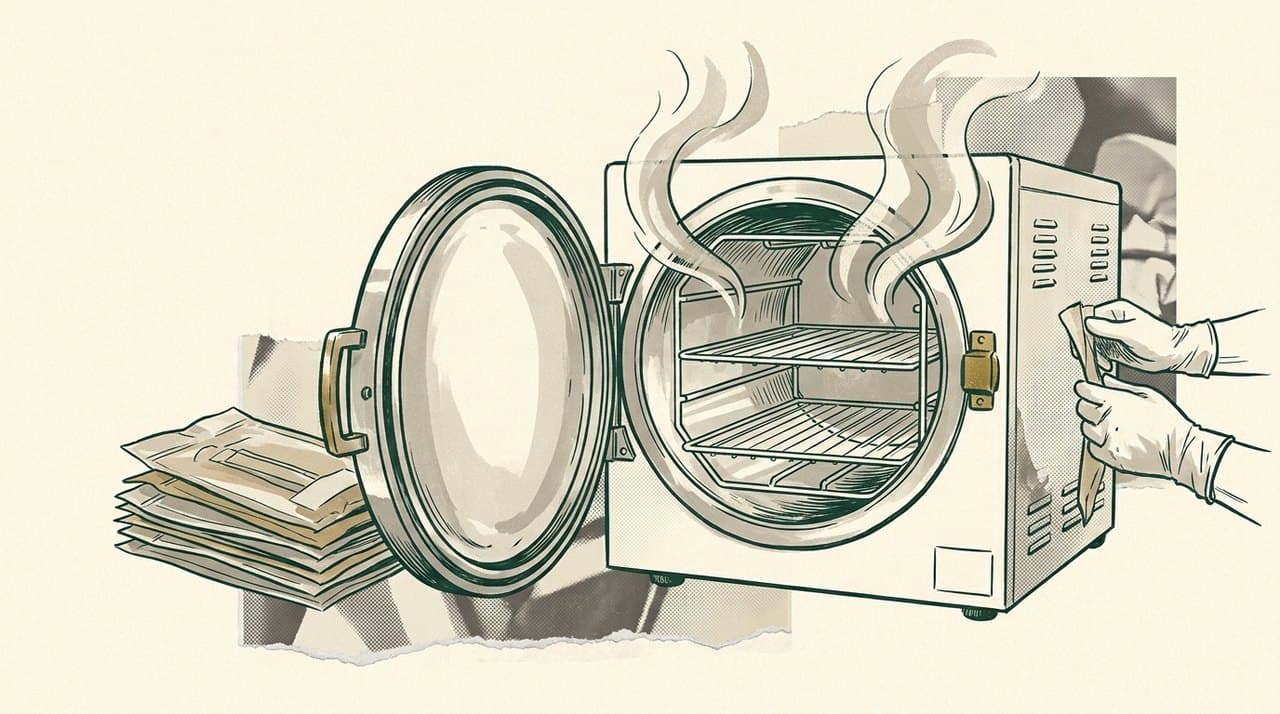
Every surgical instrument used on a patient has to be cleaned, inspected, and sterilized first, and the sterile processing technician is the person who does that work and signs the record saying the tray is safe to open.

Median pay (US)

$47,700

2025 · $22.93 an hour

O*NET source

Job outlook

Much faster than average

O*NET's band for this category is 7% or higher, 2024-2034

O*NET source

To get in the door

See the programs below

typical entry-level education

Openings a year

10,900

projected, nationally

O*NET source

What the day actually looks like

  • Run dirty instruments through decontamination, then load and operate steam autoclaves, keeping a record of every load, what was in it, and what maintenance was done (O*NET task list for 31-9093.00).
  • Assemble routine and specialty surgical instrument trays to a count sheet, and fill special requests coming from the operating room (O*NET task list).
  • Inspect equipment for leaks, worn or loose parts, and other signs of disrepair, and report anything defective to a supervisor (O*NET task list).
  • Record sterilizer test results and check sterile supplies so nothing outdated ever reaches a patient (O*NET task list).
  • Wear protective equipment every shift, because the job means regular exposure to contaminants and infection (CareerOneStop career video transcript for Medical Equipment Preparers).

Skills you need first

  • Reading comprehension and following a written procedure exactly, which O*NET lists among this occupation's core skills.
  • Monitoring and critical thinking, meaning watching gauges and catching a problem before a tray leaves the department (O*NET core skills).
  • Medical terminology. Cuyahoga Community College requires HTEC-1060 Medical Terminology I with a C or higher before program acceptance.
  • College-level reading and writing. Tri-C requires ENG-1010 College Composition I with a C or higher.
  • Comfort working in personal protective equipment around contaminated instruments (CareerOneStop video transcript).
  • Basic computer and inventory software use. O*NET lists inventory management, database, and spreadsheet software as everyday tools for this job.

How long people stay

Partly unverified. No published median tenure, burnout rate, or turnover rate for sterile processing technicians was located. An earlier draft of this profile estimated the churn by doing its own arithmetic on BLS numbers; that estimate has been removed, because a number we calculated is not a number anyone published. What BLS does publish is about 10,900 job openings a year for this occupation over 2024 to 2034, against total employment near 77,000 (BLS Employment Projections, filter by code 31-9093. On physical and health demands, CareerOneStop states these workers wear protective equipment every day because they are frequently exposed to contaminants, disease, or infection. Ohio requires no state license, so a technician can enter, leave, and return to the field without re-licensure (Tri-C consumer information page).

Where it is needed, and the different ways to do it

Demand is real and BLS-documented. BLS Employment Projections put employment at 76.5 thousand in 2024 growing to 84.2 thousand in 2034, a 10.0 percent increase, with roughly 10,900 openings a year (filter by code 31-9093. One correction to a phrase families will see elsewhere: "much faster than average" is not a BLS label for this job. BLS publishes no growth descriptor here, because this occupation has no Occupational Outlook Handbook profile. That phrase belongs to O*NET and CareerOneStop, which flag this occupation with a Bright Outlook and define that band as 7 percent growth or higher. On the shortage question specifically, two named sources say so rather than us: Columbus State Community College, describing a joint training investment with OhioHealth, states that its new training center will "address workforce shortages in Sterile Processing" and four other health professions. And in the peer-reviewed literature, according to PubMed, Heibeyn, Witte, and Radermacher open their study of a decontamination robot by stating that using robots to handle medical devices in the Central Sterile Supply Department can reduce risks and address staff shortages (Journal of Hospital Infection, 2023,. Geographically the work is spread nationwide, with California (8,720), Florida (5,250), New York (5,190), Texas (4,520), and Pennsylvania (3,450) holding the most jobs (BLS OEWS state table, May 2025).

Hospital central sterile department

By far the biggest employer. General medical and surgical hospitals account for 53,280 of the 77,420 US jobs (BLS OEWS industry table, May 2025). This is the classic setup: a decontamination side, a clean assembly side, and autoclaves in between, running shifts around the operating room schedule.

Dental offices

7,090 jobs nationally, the second largest industry (BLS OEWS, May 2025). Smaller instrument sets, smaller teams, and often no separate department, so the same person may handle sterilization plus stocking.

Physician offices

4,510 jobs (BLS OEWS, May 2025). Clinic-scale reprocessing for procedures done in the office rather than in an operating room.

Outpatient care centers and ambulatory surgery

4,250 jobs (BLS OEWS, May 2025). Same-day surgery means fast tray turnaround on a tight, predictable case list.

Staffing and travel assignments

1,710 jobs sit in employment services, meaning agency and contract work (BLS OEWS, May 2025). Certified technicians can take temporary assignments at hospitals that are short-staffed.

Equipment-focused and home delivery roles

O*NET lists disinfecting respirators, hospital beds, oxygen and dialysis equipment, and delivering equipment to hospital locations or to patients' residences among this occupation's tasks, so some jobs are about patient care equipment rather than surgical trays.

AI and this career

exposure: moderate

The paperwork half of this job is genuinely exposed; the hands-and-eyes half is not, at least not yet. O*NET already lists inventory management, database, and document management software among the occupation's everyday tools, and a meaningful share of its 16 listed tasks is records and inventory work that software absorbs well. The physical side is a live research target rather than a deployed product: according to PubMed, Heibeyn and colleagues studied a robot gripper for handling contaminated instruments in the Central Sterile Supply Department and framed it as a way to reduce risk and address staff shortages, but their 2023 paper is a bench study of whether the gripper itself can be cleaned, which tells you how early the technology is. Meanwhile BLS is not projecting decline: it projects 10.0 percent growth for 2024 to 2034 with high school entry and moderate-term on-the-job training. The honest read is that AI and automation are likely to reshape what a technician spends time on before they reduce how many technicians a hospital needs.

Tasks likely to change

  • Record keeping and load documentation. Operating autoclaves while logging loads, contents, maintenance, and sterilizer test results is a large share of the O*NET task list, and O*NET already names inventory management, database, and document management software as tools of the trade. Scanning and automated tracking are likely to keep taking over the clerical part of that.
  • Inventory and supply ordering. O*NET tasks include maintaining usage records, ordering when stock is low, and checking that sterile supplies are not outdated. Expiration tracking and reorder triggers are exactly the kind of rule-based work software handles, so this may shift from a technician's checklist to a system alert a technician verifies.
  • Handling on the decontamination side. This is the one physical task with published research behind it. According to PubMed, Heibeyn, Witte, and Radermacher designed and tested a robot gripper for reprocessing reusable surgical instruments in the CSSD decontamination area, motivated explicitly by risk reduction and staff shortages. If such systems mature, the dirtiest and most repetitive lifting and sorting may be the first thing to move.

Tasks that stay human

  • Inspection judgment. O*NET lists critical thinking and monitoring among the occupation's top skills, and the tasks include examining equipment for leaks, worn or loose parts, and other signs of disrepair, then deciding to pull it and report it. Deciding that something is not right and stopping the line is the part of the job a patient depends on.
  • Hands in the room. The robotics work that exists is a bench study of whether a gripper can itself be cleaned without biofilm buildup, not a system running a department. Until that gap closes, decontamination, assembly, and packaging stay manual work done in personal protective equipment, with frequent exposure to contaminants and infection as CareerOneStop describes.
  • The credential is built on hands-on hours. Certification requires documented hands-on experience, 400 hours for the HSPA CRCST and 240 hours for the CBSPD CSPDT (Tri-C consumer information page). A credential defined by hours at the sink and the assembly table is hard to satisfy with software.
  • Working with the operating room in real time. O*NET tasks include filling special requests and assembling specialty trays. When a case changes and a surgeon needs a set now, someone has to negotiate that.

What medical equipment preparer (sterile processing) work may look like

Ten years out, a shift may start not with a clipboard but with a screen that already knows what came back from which room, what is overdue, and which tray failed its last check. The technician's first job may be to agree or disagree with it. Cameras over the assembly table may count and identify instruments against the set list, so the technician's eyes are freed from counting and pointed at condition instead: the hinge that no longer moves cleanly, the lumen that a borescope should see, the sheen that says something was not fully cleaned. On the dirty side, a robot arm may take the first pass at sorting and loading, which would take some of the sharps risk and some of the lifting out of the day, though the research so far is still asking whether such an arm can be cleaned reliably at all. What likely does not change is who is accountable. The record may be generated automatically, but a person still releases the load, and a person still decides that a tray does not go out. The plausible future is a smaller amount of writing, a larger amount of judging, and a job that stays physical, hot, and unglamorous while quietly remaining one of the few reasons surgery is safe. None of this is certain, and hospital capital budgets, not technology demos, will set the pace.

Sources:[1][2][3][4][5]

Open questions on this career

  • Corrected wording: Stark State's page does not affirmatively state that it has no GPA, prerequisite coursework, placement test, or selective admission process. It is simply silent on those points, and this profile no longer treats that silence as a printed fact.
  • Corrected wording: New Bridge's page says 20 weeks and 700 clock hours inclusive of a 400 hour clinical experience. The words externship and healthcare partner sites are not on the page, so this profile now uses New Bridge's own terms.
  • There is no BLS Occupational Outlook Handbook profile for Medical Equipment Preparers. Pay therefore comes from BLS OEWS (May 2025) and growth from BLS Employment Projections (2024 to 2034) instead of from the Handbook.

Pay and outlook come from O*NET, the US Department of Labor's occupation site, and every figure links back to it. We do not publish tuition or cost figures here: those change often, so use each school's own page and phone number below. Tell Mr. Mendoza if anything looks wrong.

Where you can train for it

3 programs

Read these as minimums, not targets.Meeting the numbers below is what lets you apply; it is not what gets you in. Selective programs admit far fewer people than apply, and admitted students are usually well above the minimum. Call the program and ask what last year's admitted class actually looked like. That one phone call is worth more than any number on this page.

Cuyahoga Community College (Tri-C)

Cleveland, OH · Certificate of Proficiency, 30 to 32 credit hours, includes SURT-1861 Clinical Experience and 240 hours of hands-on clinical time in an area hospital

Sterile Processing and Distribution Technology

What they ask for

  • High school diploma or GED, and a 2.0 GPA for admission and 2.0 overall (Tri-C academic catalog).
  • ENG-1010 College Composition I completed with a C or higher (Tri-C academic catalog).
  • HTEC-1060 Medical Terminology I completed with a C or higher (Tri-C academic catalog).
  • Criminal background check required (Tri-C academic catalog).
  • All prerequisite courses must be finished by the end of Spring Semester and the application deadline is May 31. Tri-C states plainly that meeting the deadline does not guarantee a seat in the cohort.

Closest option to John Hay. Graduates are eligible to sit for the CSPDT exam from the Certification Board for Sterile Processing and Distribution (CBSPD). Program director listed as Beth Stokes, CST, CSPDT. Tri-C also states there is no Ohio state license for this work, so certification is voluntary and national. Where students are placed for their clinical hours is not stated on any Tri-C page we read, so ask that on the phone.

New Bridge Cleveland

Cleveland, OH · Program certificate of completion. In New Bridge's own words: 20 weeks and 700 clock hours inclusive of a 400 hour clinical experience. Prepares students to sit for the HSPA Certified Registered Central Service Technician (CRCST) exam

Sterile Processing Technician

What they ask for

  • Cohort admission through an open application window. As of this writing the site states applications are closed for the June 8, 2026 class, so families must apply while a window is open.
  • Full-time weekday availability. New Bridge lists current classes Monday through Friday from 9:00 am to 3:00 pm, with the June 8, 2026 cohort meeting Monday, Wednesday, and Friday from 9:00 am to 3:00 pm.
  • Willingness to complete the 400 hour clinical experience that New Bridge counts inside the 700 clock hours.

A Cleveland nonprofit workforce program. The 400 hour clinical experience lines up with the hands-on hours HSPA requires for the CRCST (Tri-C consumer information page), so this route builds those hours in rather than leaving them to the student to arrange. Caution: New Bridge does not publish academic entrance requirements such as GPA, diploma, or placement testing on its program page, so call to confirm eligibility and whether recent high school graduates are accepted.

Stark State College

North Canton, OH · Non-credit workforce certificate of completion, 100 percent online, finished in 12 months or less; prepares for the HSPA Certified Registered Central Service Technician (CRCST) exam, with an exam voucher included in the course

Sterile Processing Technician (vouchers included)

What they ask for

  • High school diploma or equivalent. Stark State states that to sit for the national certification exam candidates must have a high school diploma or equivalent, and recommends having it before enrolling.
  • Open enrollment with flexible start dates. The page lists no GPA, prerequisite coursework, placement test, or selective admission requirement. It is silent on those points rather than ruling them out, so confirm by phone.

Important limitation to raise with families: this is a 100 percent online course with no clinical placement, and the HSPA CRCST credential requires 400 hours of hands-on experience (Tri-C consumer information page). A student would need to arrange those hospital hours separately. Also note that Stark State's own page quotes an older BLS average wage that does not match current BLS OEWS figures; the numbers in this profile come from BLS directly.

Need help or have feedback?
Ask a question Family feedback