
All careers
Career

Radiation Therapist

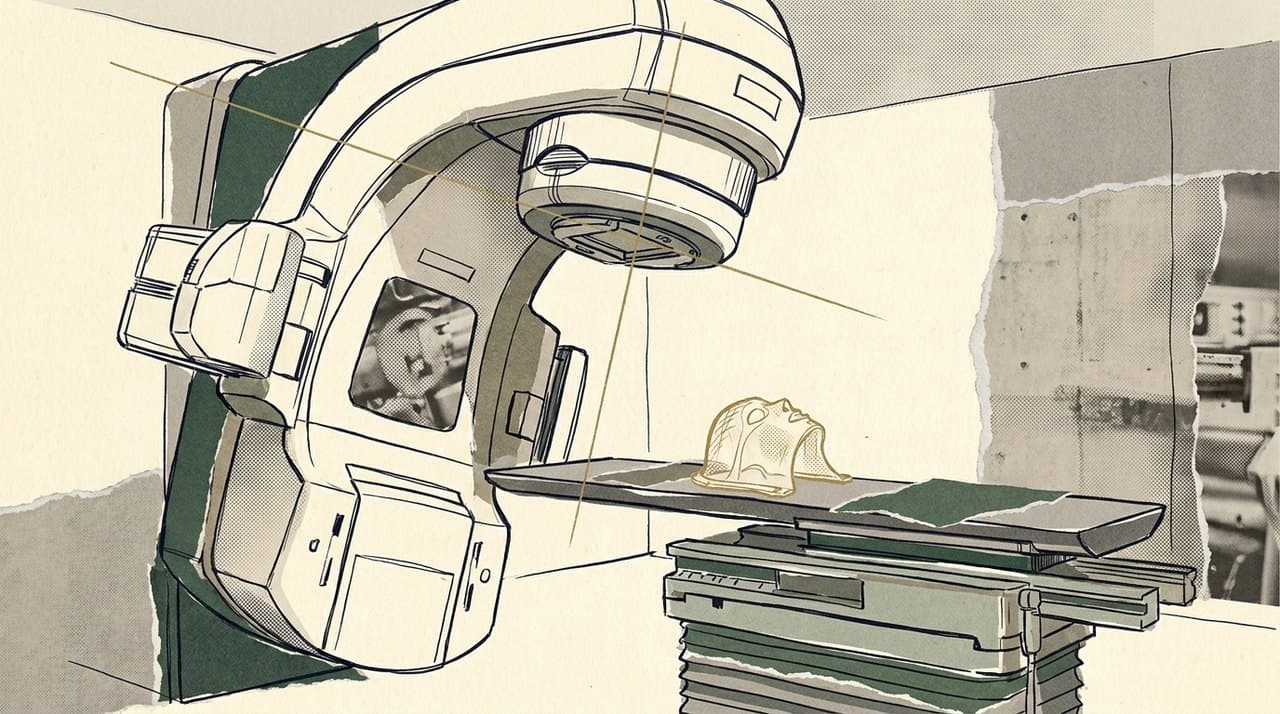
A radiation therapist runs the machine that aims radiation at a cancer patient's tumor, lining the person up within millimeters and doing it again every weekday for weeks until the course of treatment is finished.

Median pay (US)

$105,310

2025 · $50.63 an hour

O*NET source

Job outlook

Slower than average

O*NET's band for this category is 1% to 2%, 2024-2034

O*NET source

To get in the door

Training or an associate degree

Most of these occupations require training in vocational schools, related on-the-job experience, or an associate's degree.

Openings a year

900

projected, nationally

O*NET source

What the day actually looks like

  • Explain the day's treatment and answer questions from the same patients you will see every weekday for four to eight weeks.
  • Position the patient precisely on the table, using immobilization devices, and confirm the tumor location before any beam turns on.
  • Operate the linear accelerator from a shielded control area in a different room, wearing a film badge dosimeter that tracks your own exposure.
  • Watch the patient during treatment for unusual reactions and report side effects to the radiation oncologist and oncology nurses.
  • Keep detailed records of every treatment delivered and enter the data into the department's computer system.

Skills you need first

  • Algebra, and then more math: the University of Toledo requires College Algebra and Introduction to Statistics with a grade of B or better. Kent State's catalog lists mathematics requirements without naming these specific courses, and Ohio State's specific math prerequisites were not confirmed.
  • Anatomy and physiology, usually two semesters with labs.
  • Physics, because you are working with a machine that accelerates particles and with dose that must be calculated correctly.
  • Precision and attention to detail: BLS notes therapists must follow exact instructions and input exact measurements so the patient gets the correct dose.
  • Compassion and the ability to stay steady around people who are seriously ill and frightened.
  • Communication and teamwork with radiation oncologists, medical physicists, dosimetrists, and oncology nurses.

How long people stay

Mixed and only partly measurable. BLS reports the work is physical: therapists stand for long periods and may need to lift or turn patients, and they must follow radiation safety procedures, including standing in a separate room during delivery and wearing a dosimeter badge. Schedules are comparatively humane for healthcare: BLS says most work full time with a regular schedule because treatments are planned in advance. On burnout, a systematic review of the medical radiation sciences (Shields M, James D, McCormack L, Warren-Forward H. Burnout in the disciplines of medical radiation science: A systematic review. J Med Imaging Radiat Sci. 2021;52(2):295-304, reported that seven of nine studies of radiation therapists found low or moderate burnout, one found elevated emotional exhaustion and depersonalization, and one found high emotional exhaustion. On turnover, ASRT's Radiation Therapy Staffing and Workplace Survey 2026 found 63.0 percent of responding departments had turnover in the past year, and reported an average of 3.12 full-time-equivalent departures per affected department in 2025 counting radiation therapists and medical dosimetrists together, so that number is not therapist-only. No published figure for typical years in the role, or career length, for US radiation therapists was found.

Where it is needed, and the different ways to do it

Real but narrow, and the two honest signals point in different directions. BLS projects employment to grow only 2 percent from 2024 to 2034, slower than the 3 percent average for all occupations, with about 900 openings per year over the decade, most of them from workers transferring to other occupations or retiring rather than from new positions. It is a small occupation: about 19,200 jobs nationally in 2024. At the same time, employers report unfilled posts. ASRT's Radiation Therapy Staffing and Workplace Survey 2026 estimates that 11.4 percent of budgeted full-time-equivalent radiation therapist positions are unfilled (N=501 departments), down from 13.6 percent in 2024, which ASRT notes is the first drop since 2014; in the East North Central region that includes Ohio the rate is 11.3 percent. The University of Toledo's own program page asserts that there is a shortage of radiation therapists locally and nationally, but that is a program's recruiting claim, not an independent labor analysis, and it sits against BLS's slower-than-average projection. The fair summary for a family: openings exist and vacancy rates are real, but this is a small field with few programs and few seats, so getting in is the bottleneck more than getting hired.

Hospital radiation oncology department

The largest employer by far. BLS reports hospitals (state, local, and private) held 56 percent of radiation therapist jobs in 2024. In Cleveland that means the radiation oncology departments of the large hospital systems.

Physician offices and freestanding cancer centers

BLS reports 33 percent of jobs in offices of physicians and 4 percent in outpatient care centers. Outpatient care centers posted the highest median pay of any setting in May 2024 at $121,360, above the hospital median of $101,740.

Proton therapy center

A specialized setting using proton beams instead of photons. University Hospitals says it was the first to bring proton therapy to Cleveland, so a Cleveland student can train toward this setting without leaving town. Note that this is a Cleveland-first claim on UH's own page, not a state or regional first.

CT simulation and treatment planning side of the department

O*NET lists CT Simulation Therapist and Dosimetrist among the job titles for this occupation. BLS notes that with additional education and certification, therapists may become medical dosimetrists, the people who calculate the radiation dose.

Adaptive treatment console

A newer hybrid role. Jones et al. (J Med Radiat Sci. 2024;71(2):290-298, describe hybrid roles in which treatment therapists apply planning skills day to day on online adaptive plans, checking that the organ outlines are accurate and that the intended treatment is still being delivered, while the patient is still on the table.

Teaching and clinical education

Programs run on program faculty and clinical preceptors who are credentialed therapists. All three Ohio programs publish a radiation therapist as program director: Shellie Warino, M.Ed., R.T.(R)(T) at Kent State, Haley Griffin, MS, RT(T) at Ohio State, and Kelsey Hoffman at the University of Toledo.

AI and this career

exposure: moderate

The planning and checking half of radiation oncology is being automated faster than almost anything else in the radiologic sciences, while the delivery half stays stubbornly human. ASRT's own follow-up research found that radiation therapy was the one exception where use of automated equipment features rose significantly between its 2019 and 2022 surveys of technologists. Peer-reviewed work from the field projects that for common cases, treatment plans may eventually be generated end to end by software, with clinicians approving rather than drawing. What that likely produces is a changed job, not a deleted one: fewer hours spent contouring and checking parameters, more hours spent judging whether a machine-made plan is right for this patient today, and the same hours spent positioning a frightened person on a table. Regulation reinforces this: Ohio attaches a radiation therapist license to a person, and the joint ESTRO and AAPM guideline frames AI models in radiation therapy as tools requiring clinical validation and human oversight.

Tasks likely to change

  • Contouring and treatment planning. Jones et al. describe manual image segmentation as time-consuming and deep-learning auto-segmentation as the next generation, and project that plan assessment skills will remain but that for common cases all elements of treatment plans may eventually be fully automated. Clinicians still approve the contours.
  • Plan and chart quality assurance. The same paper calls QA ideal for automation because it is repetitive checking of similar plan parameters, and expects AI-based checking methods to increase, including software that checks contours.
  • Machine-side automation during daily treatment. ASRT's 2022 follow-up survey of technologists found few significant changes in AI feature use across the radiologic sciences, with one major exception: in radiation therapy there were several significant increases in the use of automated features.
  • A new hybrid role at the console. Jones et al. point to hybrid roles in which treatment therapists apply planning skills to assess online adaptive plans day to day, which pulls planning judgment onto the treatment floor while the patient is still on the couch.

Tasks that stay human

  • The physical work. BLS describes standing for long periods, lifting or turning patients, immobilization devices, and millimeter positioning. No current evidence suggests software does this part.
  • Human approval and accountability. The joint ESTRO and AAPM guideline (Hurkmans C et al., Radiother Oncol. 2024;197:110345) sets expectations for development, clinical validation and reporting of AI models in radiation therapy, and Jones et al. warn against black-box outputs whose logic cannot be verified and state that increased efficiency should not come at the cost of oversight and safety.
  • Licensure attached to a person. Ohio Administrative Code 3701-72-02 makes radiation therapist a licensed category requiring completion of a department-accredited program, with ARRT certification substituting for the state exam. A model cannot hold that license.
  • The relationship. BLS lists compassion and interpersonal skills as core, because therapists work closely with the same patients over multiple weeks. Noticing that a patient's skin has broken down in week four, or that she has stopped eating, is observation in a room, not inference from a record.

What radiation therapist work may look like

What this career may look like once AI is genuinely applied to it: the shift may start before the first patient arrives, with the therapist opening a plan whose organ outlines were drawn overnight by a deep-learning model and whose beam arrangement was generated automatically. The morning's real work may be judging whether that plan fits this person's anatomy today, and flagging the one contour the model got wrong. On the treatment floor, the daily imaging match may arrive pre-computed, so the therapist may be verifying a match rather than making one from scratch. The bigger change is likely adaptive treatment: if the tumor shrank or the bladder is fuller than yesterday, the therapist may sit at the console and accept or reject a re-optimized plan in the minutes while the patient waits on the couch, a decision that used to take a planning team days. What probably does not change is what fills the day. Someone still has to walk a scared sixty-year-old into a shielded room, set her within a millimeter, watch her face during the beam, notice the burn on her neck in week four, and put a licensed name on the dose that was delivered. The plausible version of this job in ten years is a therapist who draws less and decides more, and whose most valuable skill is understanding the model well enough to catch it when it is confidently wrong.

Sources:[1][2][3][4][5][6]

Open questions on this career

  • Narrowed: the math requirement. Requiring College Algebra and Statistics with a B or better is confirmed for the University of Toledo only. It had been written as though it applied to all Ohio programs.
  • Corrected for Toledo: the required clinic observation is arranged by the program, not by the student. The earlier wording could have sent an applicant chasing something the program sets up for them.
  • Corrected a partial quotation. A sentence from the Jones et al. paper about the hybrid console role had eleven words silently cut from the middle. It is now paraphrased instead of quoted.

Pay and outlook come from O*NET, the US Department of Labor's occupation site, and every figure links back to it. We do not publish tuition or cost figures here: those change often, so use each school's own page and phone number below. Tell Mr. Mendoza if anything looks wrong.

Where you can train for it

3 programs

Read these as minimums, not targets.Meeting the numbers below is what lets you apply; it is not what gets you in. Selective programs admit far fewer people than apply, and admitted students are usually well above the minimum. Call the program and ask what last year's admitted class actually looked like. That one phone call is worth more than any number on this page.

Kent State University, Salem Campus

Salem, OH · Bachelor's degree (B.R.I.T.); graduates are eligible to sit for the ARRT radiation therapy certification exam

Radiologic Imaging Sciences, Radiation Therapy concentration (Bachelor of Radiologic and Imaging Sciences Technology)

What they ask for

  • First-year admission to Kent State's regional campuses, including Salem, is open to anyone with a high school diploma or its equivalent, so the selective step comes later.
  • Acceptance into technical study (required before taking any Radiologic and Imaging Sciences courses) is selective because of limited clinical slots, and requires completion of the required non-RIS courses in biology, chemistry, mathematics, psychology and Kent Core plus a minimum 2.750 overall GPA.
  • Minimum C grade required in all RIS courses to stay in the program.
  • Application deadlines, interview and ranking rules, and shadowing requirements are set by the program and change by cohort. Call the program director for the current cycle rather than relying on any date printed here.

This is the closest option to John Hay High School and the only place in Ohio offering this particular degree. The program is accredited by JRCERT, stated in the Kent State catalog. Program Director is Shellie Warino, M.Ed., R.T.(R)(T), and the phone number above is her line as published on the program page. Clinical placement details, including which hospitals a student rotates through and how far a student may be assigned to travel, should be asked about directly; this record no longer states them because they could not be traced to a page a family can open.

The Ohio State University

Columbus, OH · Bachelor of Science (BS) in Radiologic Sciences and Therapy

Radiologic Sciences and Therapy, radiation therapy track

What they ask for

  • Minimum 2.5 cumulative GPA in science courses.
  • At least 36 semester credit hours including all admission prerequisite courses completed with a grade of C- or higher.
  • Eight hours of documented patient contact experience in the chosen modality, meaning radiation therapy.
  • Electronic application deadline of January 31 for autumn semester entry; the program admits once per year.
  • Admission is selective and OSU states that completing all admission criteria does not guarantee admission; the radiation therapy class size is approximately 7 to 10 students.

The school reports more than 1,600 hours of clinical experience and more than 30 clinical sites across central Ohio. The phone number above is the main line for the School of Health and Rehabilitation Sciences as published on the school's contact page, not a program-specific line; the school directs applicants to HRSStudentServices@osumc.edu. The Radiation Therapy Program Director is Haley Griffin, MS, RT(T), whose direct line, 614-293-6203, is published on her OSU faculty page. Accreditation status is not stated here because no accreditation statement was found on OSU's own program pages; ask the program directly.

University of Toledo

Toledo, OH · Bachelor of Science (B.S.) in Radiation Therapy, 122 semester hours, College of Medicine and Life Sciences

Radiation Therapy

What they ask for

  • Pre-professional track admission out of high school: minimum 3.0 GPA if applying without test scores, or a 2.75 to 2.99 GPA with a 19 ACT or 1030 SAT.
  • A math placement test is required regardless of test scores.
  • Admission to the pre-professional track does not guarantee a seat in the professional track, because clinical site space is limited; students apply again after two years.
  • Professional track requires a minimum 2.75 overall GPA and a minimum B grade in each of eight named prerequisites, including College Algebra, Human Anatomy and Physiology I and II with labs, Introduction to Statistics, Human Pathophysiology, and Introduction to Physics.
  • Eight hours of documented clinical observation in a radiation therapy clinic, plus a written observation report and a report from clinical preceptors. The program arranges this clinic visit, which happens while the student is taking RDON 1010, so it is not something the applicant has to line up alone.

UToledo states this is the only radiation therapy program in northwest Ohio and one of just three in the state. Two years of pre-specialization coursework on Main Campus, then two years of professional training on Health Science Campus with labs in the Department of Radiation Oncology and clinical training in local radiation therapy clinics, including the Dana Cancer Center. The phone number above is the line for Program Director Kelsey Hoffman as published on the program home page (https://www.utoledo.edu/med/depts/radther/radiation-therapy/).

Need help or have feedback?
Ask a question Family feedback