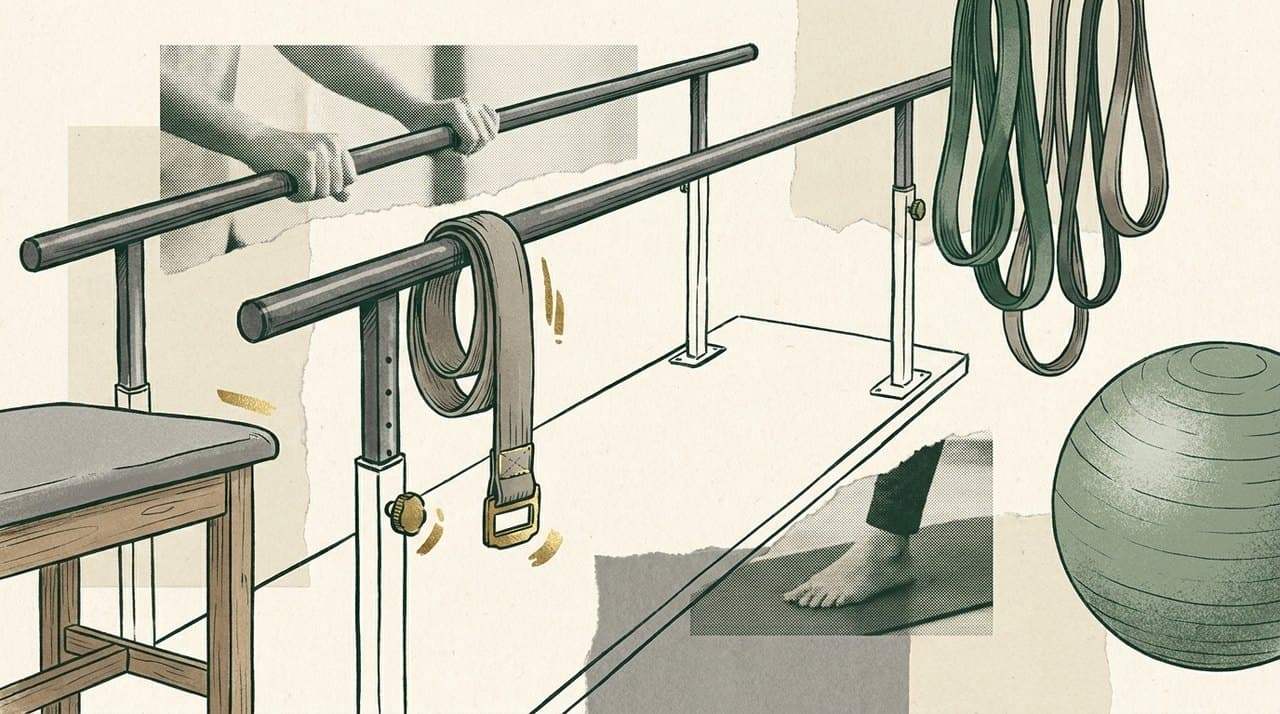
A physical therapist helps people move again after an injury, a stroke, surgery, or illness, using hands-on treatment and a plan of exercises built for that one person.
Examine a new patient, review their medical history, and measure what they can and cannot do yet (O*NET task list for SOC 29-1123).
Build and carry out an individually designed treatment plan using exercise, stretching, massage, and hands-on therapy (CareerOneStop career video transcript, U.S. Department of Labor).
Teach patients and families how to use equipment like canes, walkers, or prosthetics, and what recovery will actually feel like.
Write documentation and track progress visit by visit, then change the plan when the numbers or the patient tell you it is not working.
Lift and move people and heavy equipment, and direct the work of physical therapist assistants and aides.
Skills you need first
Human anatomy and physiology, with lab. This is the course sequence every Doctor of Physical Therapy program builds on, and programs typically expect strong grades in it specifically.
Two semesters of general chemistry for science majors, with lab.
Two semesters of algebra-based physics for science majors, with lab. Physics is how you reason about force, levers, and gait.
Biology beyond anatomy and physiology, plus statistics, so you can read research and outcome measures.
Psychology, because most of the job is getting a person in pain to keep doing hard things.
Documented observation hours in a clinic under a licensed physical therapist. Programs set their own minimum and often want hours split across more than one setting, so ask each program for its current number in writing.
How long people stay
The physical demands are real and are named by the U.S. Department of Labor's own career video for this occupation: lifting and moving people and heavy objects are part of the day's work. On burnout and staying in the field, the published evidence is thin for the U.S. and should be read with its limits attached. A cross-sectional study of 671 Italian physical therapists, surveyed about a year into the COVID-19 pandemic, found 25% at high burnout risk and 40% scoring high on emotional exhaustion, so those are pandemic-period numbers and not a steady-state reading of the job. A survey of licensed U.S. physical therapists found imposter phenomenon in 51.2%, strongly associated with emotional exhaustion. An Australian workforce study of 7,535 respondents found 80.2% intended to stay in the profession and 10.3% intended to leave, citing retirement, pay, lack of career advancement, dissatisfaction, and burnout. A UK realist review of first-contact physiotherapists concluded that burnout and turnover intention come mainly from organizational factors such as role ambiguity, thin supervision, and caseload overload rather than individual weakness. No U.S. average career length, retirement age, or annual turnover rate for physical therapists was found, and three of these four studies are not U.S. studies.
Where it is needed, and the different ways to do it
Demand is strong and federally documented. O*NET OnLine puts employment at 267,200 in 2024, rates the outlook \"Much faster than average (7% or higher)\" through 2034, and lists 13,200 projected job openings for 2024-2034. On a shortage specifically, the American Physical Therapy Association's workforce data page states that the peer-reviewed forecast it links \"projects a fluctuating shortfall in the supply of physical therapists relative to projected demand through 2037\". That forecast is Zarek et al., Physical Therapy 2025;105(3), which estimated 233,890 full-time-equivalent physical therapists in 2022 against a shortfall of 12,070 FTEs (5.2%), and projects supply reaching 273,070 FTEs by 2037 against demand of 282,230, leaving a shortfall of 9,120 FTEs (3.3%) in the main scenario. Read it as an interested party's peer-reviewed estimate rather than a neutral one: the study drew on APTA's own member database and an APTA member survey. Ohio-specific employment and wage numbers are not reported here because the state data behind them could not be opened and checked.
Outpatient clinic
The setting most people picture: patients arrive on their own, usually for knees, backs, shoulders, and post-surgical recovery. Named as a core work setting in the U.S. Department of Labor career video for this occupation.
Hospital and acute care
Getting people moving days after surgery, a stroke, or an ICU stay. Ohio State runs a dedicated acute care physical therapy residency, along with cardiovascular and pulmonary, neurologic, and oncology residencies, which is a good map of what hospital PT actually splits into.
Home health care
You go to the patient's house. Named as a core work setting in the U.S. Department of Labor career video. The work is judgment-heavy because you are adapting to that person's stairs, bathroom, and family, with no gym and no colleague down the hall.
Nursing homes and long-term care
Also named in the DOL career video. Heavily geriatric, focused on strength, balance, and fall prevention. Ohio State runs a geriatric residency for therapists who specialize here.
Sports and performance
Listed in the DOL career video as a common specialization. Ohio State offers a sports residency plus orthopaedic and orthopaedic manual therapy fellowships, which is the formal path into this work after the DPT.
Pediatrics and specialty practice
Pediatrics is named in the DOL career video as a specialization, and Ohio State runs a pediatric residency alongside pelvic and women's health, neurologic movement disorder, and upper extremity programs. Specialty practice usually means a residency or fellowship after licensure.
AI and this career
exposure: moderate
The exposure here is real but it sits in the paperwork and the monitoring, not in the hands. Documentation, scheduling, progress tracking, home-exercise-program drafting, remote monitoring between visits, and risk prediction are all being automated or assisted now. The physical examination, the manual therapy, the in-the-moment safety call when a patient's knee buckles, and the work of convincing a person in pain to keep going are much harder to hand off. In one interview study of 27 licensed physical therapists in Saudi Arabia (mean age 29), most "viewed AI as a complementary tool rather than a replacement for clinical judgment," while 44% raised patient data privacy concerns and 52% named cost, workload, time, and space as barriers to adoption. That is a small, single-country sample, so treat it as a signal about attitudes rather than a measurement of U.S. practice. The federal outlook has not been lowered: O*NET still rates this occupation as growing much faster than average, 7% or higher, through 2034. Be honest about the other direction too: a systematic review of 18 rehabilitation-technology studies concluded these tools can support injury prevention, movement monitoring, and coordination of rehabilitation programs "with minimal or negligible intervention from the physical therapist". That is a task-level warning worth taking seriously even if it is not a job-level one.
Tasks likely to change
Documentation and administrative load. AI note-drafting, coding assistance, scheduling, and prior-authorization paperwork are the most exposed tasks in the day, and they are the tasks therapists complain about most.
Monitoring between visits. Wearables plus AI analytics can track pain, joint mobility, and activity in real time and flag a patient who is sliding backward, which may shift some in-clinic check-in visits to remote review (systematic review of AI in knee osteoarthritis care, Pain Management Nursing 2026,.
Measurement and equipment in the clinic. Robotic gait devices are moving from research into cost arguments: a probabilistic cost-effectiveness analysis found robotic exoskeleton therapy cost-effective compared with conventional physiotherapy for stroke gait rehabilitation across all patient groups studied in Singapore. Expect to run and interpret machines, not just your hands.
Patient education and adherence coaching. Chatbots and virtual assistants are already answering routine questions, walking patients through home exercises, and sending reminders, which may absorb the repetitive teaching and leave the harder conversations to the therapist.
Tasks that stay human
Hands-on examination and manual treatment. Physical therapy "relies heavily on hands-on assessments and individualized clinical reasoning," which is exactly why AI adoption in this field has lagged other medical specialties.
Physical presence and safety judgment. Someone has to be close enough to catch a patient mid-transfer. The U.S. Department of Labor's own occupation video names lifting and moving people and heavy objects as part of the day's work.
The licensed decision and the accountability that comes with it. Entry requires a doctoral degree, a national examination, and a state license, and no AI tool holds that license or carries the legal responsibility for the plan of care.
The relationship. Rehabilitation works when a person in pain does uncomfortable things repeatedly for weeks. Persuasion, trust, and reading a patient's fear are the load-bearing parts of the job, and they are the least automatable.
What physical therapist work may look like
A day in this career in ten years may look calmer on the computer and busier with people. You may walk into a first visit with the intake already summarized, the patient's wearable data already charted, and a draft plan of care already suggested, so the hour you used to lose to typing goes back into hands and eyes on the patient. You may spend part of the morning reviewing flagged patients you are not seeing in person, the ones whose step counts dropped or whose pain scores climbed, and deciding which of them needs to come in. Some of your gait work may happen alongside a robotic device or a camera-based motion system that measures what you used to estimate, and part of your skill may become knowing when the machine's number is wrong. The likely risk is not that the job disappears. It is that a system tries to use these tools to raise your caseload rather than to give you back your attention, and the burnout research already points at caseload, role ambiguity, and thin supervision as the things that push therapists out. The therapists who do best in that world will probably be the ones who can read a model's output critically, explain it plainly to a scared patient, and still put a hand on a shoulder and say, one more set.
No Cleveland-area salary figure was ever verified, and none is given. Do not read the national median as a Cleveland number.
Walsh's accreditation status was added because leaving it out was unfair to the comparison. CAPTE lists Walsh's accreditation as expiring 12/31/2026 with the next visit in Spring 2026. The earlier version examined Cleveland State's probation in detail and said nothing about this.
Walsh's GPA minimum and prerequisite course list are still unverified. That content sits behind a script that would not load for us, and Walsh's own FAQ declines to publish a fixed GPA number.
Pay and outlook come from O*NET, the US Department of Labor's occupation site, and every figure links back to it. We do not publish tuition or cost figures here: those change often, so use each school's own page and phone number below. Tell Mr. Mendoza if anything looks wrong.
Read these as minimums, not targets. Meeting the numbers below is what lets you apply; it is not what gets you in. Selective programs admit far fewer people than apply, and admitted students are usually well above the minimum. Call the program and ask what last year's admitted class actually looked like. That one phone call is worth more than any number on this page.
Cleveland State University
Cleveland, OH · Doctor of Physical Therapy (DPT)
Doctor of Physical Therapy Program, School of Health Sciences
What they ask for
Apply through PTCAS. CSU's PTCAS cycle opens July 1 annually and the priority deadline is October 1, with first acceptance notifications in late November or early December.
GPA floor is enforced: "Applications with GPAs that fall under 3.2 will not be reviewed"
Prerequisite courses must be completed with grades by the time of application, and no more than two grades below B- will be counted toward prerequisites.
Selective and competitive. CSU states it has no early admissions process and that admissions are processed on a competitive basis, with cohorts of about 40 students.
Read this one carefully before applying. CSU's own accreditation statement says "The program's current status is probationary accreditation," and the CAPTE accredited-program directory also lists Cleveland State University as "Accreditation - Probationary," expiring 6/30/2028 with the next visit in Fall 2027. A separate CSU page still says the program was re-accredited for a full 10-year cycle in 2017. Call the program at (216) 687-3566 and ask directly what probationary status means for a student entering now. CSU's posted outcomes for 2025 graduates: 84% graduation rate, 91% first-time licensure exam pass rate, 97% ultimate pass rate, 100% employment within 6 months of licensure. For tuition and fees, use CSU's own cost of attendance page rather than any figure repeated here.
North Canton, OH · Doctor of Physical Therapy (DPT)
Doctor of Physical Therapy (DPT), School of Behavioral and Health Sciences
What they ask for
Two routes in: Traditional Entry is a 4+3 model (finish a bachelor's degree first), and Pre-PT Early Assurance is a 3+3 direct-from-high-school model open to a limited number of graduating high school seniors who enroll in Walsh's Biology Pre-PT or Exercise Science Pre-PT Early Assurance major.
Apply through PTCAS (Physical Therapist Centralized Application Service).
An interview is required: "All qualified students applying to our program are required to successfully complete an interview prior to being accepted"
Walsh does not publish a fixed GPA minimum. Its own FAQ says mean overall and prerequisite GPAs vary from year to year, so ask the program what this year's admitted range looked like.
Ask about accreditation timing first. The CAPTE directory lists this program's accreditation as expiring 12/31/2026, with the last accreditation review on 11/11/2015 and the next visit in Spring 2026, so a family applying now should ask Walsh directly where that review stands. The 3+3 Early Assurance route is the other thing to ask about while you are still in high school, because it is decided at freshman entry, not after college. Walsh posts a 94.6% graduation rate for the classes of 2024 and 2025, and for those same classes 100% of graduates eventually passed the National Physical Therapist Examination while 86.5% passed on the first attempt. The phone number listed is the one Walsh prints as the direct program and institution contact in its CAPTE accreditation statement; the CAPTE directory separately lists (330) 490-7286 for the program chair. For costs, ask Walsh for its current published tuition and fee schedule.
Doctor of Physical Therapy (DPT), Bitonte College of Health and Human Services
What they ask for
Treat every requirement on this card as unconfirmed and get it from the program in writing. YSU's program page would not open for us, so no admission requirement, deadline, or outcome number for YSU is repeated here.
Call (330) 941-2558 and ask for the current application deadline, the minimum overall and prerequisite GPA, the required observation hours, the reference requirements, and whether the GRE is required.
Ohio DPT programs generally apply through PTCAS, and YSU also requires a separate graduate school application, so confirm both steps and both deadlines.
This is a real, currently accredited Ohio DPT program: the CAPTE accredited-program directory lists its accreditation running through 12/31/2035 and lists (330) 941-2558 as the program line for chair Nancy Landgraff, PT, PhD. It is on this list for that reason alone. The program's own web page returned an access error to every attempt we made, so nothing that page says is repeated here, including its licensure exam pass rate and its claim about being one of the most cost-effective DPT programs in Ohio. Ask for those numbers by phone and ask YSU to send its Program Financial Fact Sheet.
Doctorate in Physical Therapy, School of Health and Rehabilitation Sciences
What they ask for
August 1 is the deadline to submit the PTCAS application for early action; September 1 is the final deadline for both the PTCAS application and the supplemental application. Classes begin in May.
Interviews are required and are multiple: "Our interview process involves multiple individual interviews with faculty members and clinical instructors." Early-action applicants interview September 25; general applicants November 13 and 21.
Admission is by comprehensive review, not grades alone. OSU weighs essays, recommendation letters, the interview, and how you balanced work, service, and activities alongside coursework.
Detailed course requirements are published separately on OSU's DPT Program Guide site rather than on the admissions page.
Program length is on OSU's own program-details page, which states "The DPT degree requires 9 semesters and includes two intermediate clinical internships, two terminal clinical internships, and a final specialized clinical practicum." Admission deadlines and interview dates live on a separate page: https://hrs.osu.edu/academics/graduate-programs/clinical-doctorate-in-physical-therapy/admissions-details. This is Ohio's oldest accredited PT program, with initial accreditation in 1956 per the CAPTE directory, and it runs 12 post-licensure residencies and fellowships, which matters if a student thinks they want to specialize later. OSU does not print a tuition figure on its costs page, so ask the program for the current per-semester rate and the DPT Student Financial Fact Sheet.