All careers
Career

Neurosurgeon

A neurosurgeon is a doctor who operates on the brain, spinal cord, and nerves, the parts of the body that control how you move, feel, and remember.

Median pay (US)

$414,010

2025 · $199.04 an hour

O*NET source

Job outlook

Average

O*NET's band for this category is 3% to 4%, 2024-2034

O*NET source

To get in the door

See the programs below

typical entry-level education

Openings a year

600

projected, nationally

O*NET source

What the day actually looks like

  • Rounds in the neuro ICU before most people are awake, checking small things that mean everything: can this patient squeeze a hand, follow a finger, say her own name.
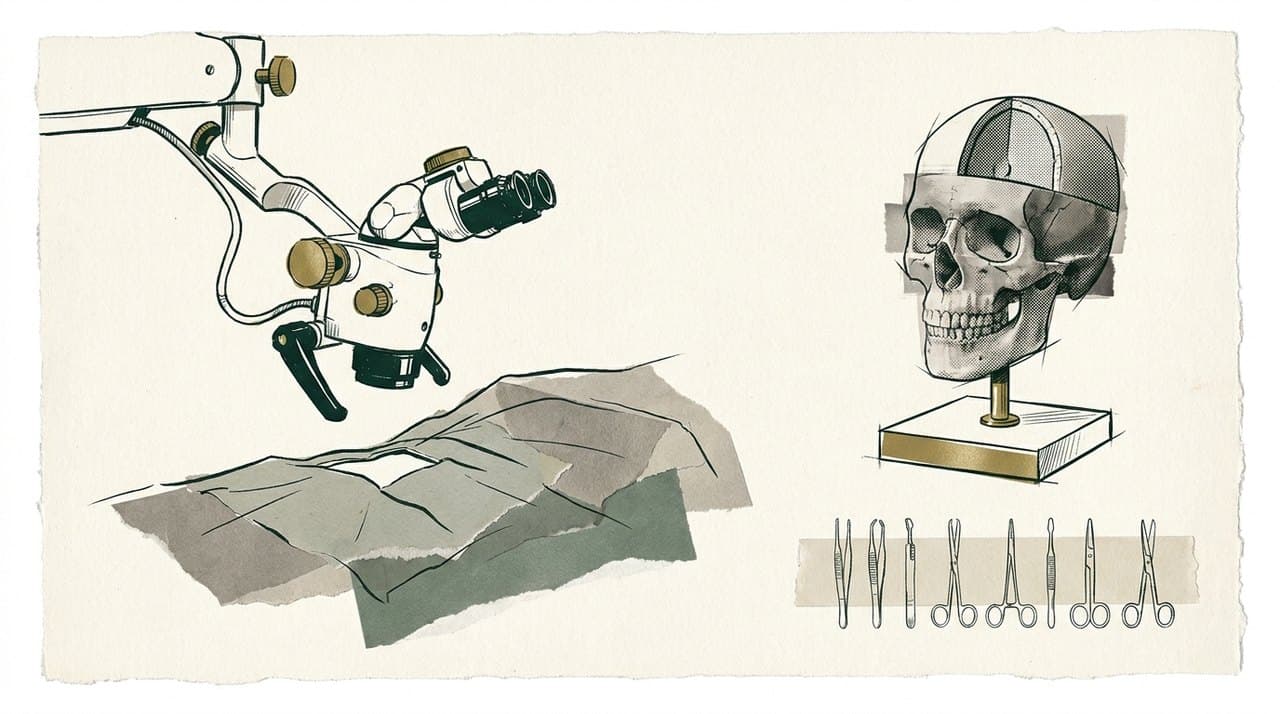
  • Long operations at a microscope, working within millimeters of tissue that will not grow back.
  • Reading CT and MRI slices and building a three-dimensional picture of one specific person's anatomy, then planning where to enter and what to leave alone.
  • Clinic days that are mostly spine, back, and nerve pain, where part of the work is deciding who should not have surgery.
  • Overnight and weekend call for head trauma and brain bleeds, which arrive on no schedule and can need an operating room urgently.

Skills you need first

  • Spatial reasoning strong enough to read flat scan slices as a three-dimensional body, and steady, patient hands.
  • Stamina for very long blocks of unbroken concentration, including standing or sitting still for many hours.
  • Biology, chemistry, and physics taken seriously in high school, then a demanding premed sequence: two semesters of biology, general and organic chemistry with labs, biochemistry, and physics.
  • Comfort reading dense technical papers and basic statistics, because the field changes and you have to judge new evidence yourself.
  • The ability to explain frightening things plainly to a scared family, and to sit with them when the answer is not good.
  • Tolerance for a long training runway: four years of college, four years of medical school, then a seven-year neurosurgery residency (the seven-year length is verified on Cleveland Clinic's residency page). And tolerance for outcomes that no amount of skill can fix.

How long people stay

The runway is long and the work is heavy. Neurosurgery residency is seven years after four years of medical school, verified on Cleveland Clinic's residency page. A nationwide survey of 783 US neurosurgeons (24 percent of 3,247 AANS members invited) found an overall burnout rate of 56.7 percent, higher in nonacademic practice (62.9 percent) than academic practice (47.7 percent), and only 26 percent believed their professional lives would improve while 52 percent believed they would worsen. The same survey found more than 80 percent were at least somewhat satisfied with their career and 70 percent would choose neurosurgery again. Source: McAbee JH, Ragel BT, McCartney S, et al. J Neurosurg. 2015 Jul;123(1):161-73 (PMID 25679276). Note this survey is from 2015 and had a 24 percent response rate.

Where it is needed, and the different ways to do it

Demand is real but the number of jobs is small and grows slowly. BLS OEWS counted 25,140 jobs nationally in the broader SOC 29-1249 'Surgeons, All Other' category in May 2025, and BLS Employment Projections expect that category to grow 3.9 percent from 2024 to 2034, with 0.6 thousand openings per year, which is close to the average for all occupations. Read that 3.9 percent as a projection for 2024 to 2034, not as recent history: BLS's May 2025 count for this category is lower than the count BLS published for the same category in its May 2023 release, so the recent direction has been flat to down rather than up. Separately, the Association of American Medical Colleges projects that "the United States will face a physician shortage of up to 86,000 physicians by 2036" in its report The Complexities of Physician Supply and Demand: Projections From 2021 to 2036, published March 21, 2024. Note honestly: that 86,000 figure is for physicians overall, not neurosurgeons. Neurosurgery-specific shortage claims circulate widely, but the ones found here traced back to dated or secondary sources and could not be verified, so no neurosurgeon-specific shortage number is claimed. The practical bottleneck is training capacity: neurosurgery residency slots are few and each takes seven years to fill a single graduate.

Academic medical center

A teaching hospital where a neurosurgeon operates, trains residents, and often runs a research lab. Cases skew rare and complex, and the schedule includes teaching and grant writing. Cleveland Clinic's program, for example, takes three residents per year across seven subspecialties.

Level I trauma center on call

Nights and weekends covering head injuries and brain bleeds from crashes, falls, and gunshot wounds. The work is unscheduled and urgent, often decided in minutes from a CT scan, and it is the least controllable part of the job.

Community hospital or private practice

Higher volume, more predictable, and heavily weighted toward spine surgery for back and neck problems rather than brain cases. In a 2015 nationwide survey of American Association of Neurological Surgeons members, published in the Journal of Neurosurgery, burnout was higher in nonacademic practice (62.9 percent) than in academic practice (47.7 percent). That survey is dated and had a 24 percent response rate, and it is not a federal statistic.

Subspecialty practice

Most neurosurgeons narrow their focus after residency, often with an extra fellowship: pediatric neurosurgery, cerebrovascular and endovascular work on aneurysms, functional neurosurgery such as deep brain stimulation for Parkinson's and epilepsy surgery, neuro-oncology, spine, or peripheral nerve. Pediatric neurosurgeons are counted under a different BLS code (29-1243, Pediatric Surgeons).

Clinic and non-operative care

Much of a neurosurgeon's patient contact happens in an office, not an operating room, evaluating back pain, headaches, and nerve symptoms. Many of these visits end with a decision not to operate, which is itself a core skill.

Research and device development

Some neurosurgeons spend protected years in the lab or work with engineers on implants, imaging, and brain-computer interfaces. Cleveland Clinic's residency builds in two years (PGY-5 and PGY-6) of laboratory research, clinical research, or clinical training.

AI and this career

exposure: low

Low exposure to replacement, meaningful exposure at the task level. To be clear about what that label is: the word 'low' here is our own editorial reading of the evidence below, not a rating published by any source. The diagnostic and planning work that feeds a neurosurgical decision is being automated fast and measurably well, while the operative core of the job, the licensure, and the accountability are not. A 2025 systematic review of 193 studies in Neurosurgical Review put it directly: AI is "more akin to another technological advance, such as the MRI, rather than a replacement for diagnostic neurosurgery." The honest framing for a student is that AI is likely to change what a neurosurgeon spends the day doing, not whether the job exists.

Tasks likely to change

  • Reading and outlining scans. The 2025 review found AI performing tumor detection, grading, and segmentation with a median accuracy of 91 percent for tumor identification and a median Dice similarity coefficient of 87 percent for segmentation. The surgeon's job on that step may shift from drawing the tumor boundary to checking and correcting a boundary already drawn.
  • Emergency triage. Automated detection reached a median AUC of 97 percent for intracranial hemorrhage and 88 percent for stroke, which may mean a bleed is flagged and routed to the on-call neurosurgeon faster and at any hour, without waiting for a human first read.
  • Diagnostic support outside the brain and outside oncology. The same review reports median accuracies of 94 percent for Parkinson's disease diagnosis, 92 percent for epilepsy detection and seizure localization, and 91 percent across its spinal studies taken as a group, which are the everyday inputs to functional and spinal neurosurgery.
  • Where the hours go. The review says these tools "can save doctors time, but also present legal liability considerations." That points toward less time producing a first interpretation and more time auditing one, with the new failure mode being a plausible output accepted without challenge.

Tasks that stay human

  • The operation itself. Microsurgical execution, and the judgment about when to keep going and when to stop, remains manual work done by a licensed human. Nothing in the reviewed evidence base automates it.
  • Judgment when the anatomy contradicts the scan. Models are trained on what is typical, and the moments that decide a neurosurgical outcome are often the ones where a specific patient is not typical.
  • Accountability and trust. The review names AI interpretability, surgeon trust, regulatory approval, and workflow integration as unresolved barriers. Someone licensed still has to own the decision and explain it.
  • The pathway. BLS still classifies this work as requiring a doctoral or professional degree plus internship and residency, and neurosurgery residency remains seven years. AI has not shortened the runway.

What neurosurgeon work may look like

What follows is projection, not a sourced fact. A day may open with the scans already marked up. The tumor is outlined, its grade estimated, and an overnight bleed was flagged and routed while everyone slept, so the neurosurgeon's first task is likely to be deciding whether the machine drew the line in the right place rather than drawing it. Planning that once took an hour of tracing may take a fraction of that in checking and correcting, and notes may increasingly assemble themselves. What probably does not change is the next part: scrubbing in, sitting down at the microscope, and working within millimeters of tissue that will not grow back, in the moment when the anatomy turns out not to match the picture and no model can tell you whether to continue or stop. The hardest conversations may get harder rather than easier, because families are likely to arrive having already read a confident-sounding number and will want to know why their surgeon sounds less certain than the software. The most plausible shape of this career is a surgeon who spends less time preparing and documenting, more time operating and deciding, and who carries a genuinely new obligation: recognizing when a tool that is right most of the time is wrong about the person on the table. None of this is settled. The reviewed evidence is mostly retrospective, built on small datasets, and not yet validated in real-world practice, so read the direction, not a date.

Sources:[1][2]

Open questions on this career

  • Corrected: a quote from that same review had been cut short in a way that dropped the rest of its own sentence. The full sentence, now used, is that these tools can save doctors time but also present legal liability considerations.
  • The AI exposure rating of "low" is our editorial judgment, not a measured value. No source we found assigns an AI-exposure level to this occupation.
  • The projection section about life after AI is labeled as projection. It is reasoning, not evidence, and it should not be read the same way as the sourced statistics above it.

Pay and outlook come from O*NET, the US Department of Labor's occupation site, and every figure links back to it. We do not publish tuition or cost figures here: those change often, so use each school's own page and phone number below. Tell Mr. Mendoza if anything looks wrong.

About these figures. The US Department of Labor does not publish separate numbers for neurosurgeon. The pay and outlook below are published for Surgeons, All Other (29-1249.00), a broader group, so treat them as the closest official figures rather than this job exactly.

Where you can train for it

4 programs

Read these as minimums, not targets.Meeting the numbers below is what lets you apply; it is not what gets you in. Selective programs admit far fewer people than apply, and admitted students are usually well above the minimum. Call the program and ask what last year's admitted class actually looked like. That one phone call is worth more than any number on this page.

Case Western Reserve University School of Medicine

Cleveland, OH · Doctor of Medicine (MD)

MD University Program

What they ask for

  • Baccalaureate degree from an accredited college or university in the US or Canada completed before matriculation. Applicants with an international degree must complete at least one year of advanced science coursework at a US institution.
  • Minimum MCAT score of 502 required to receive the secondary application. The MCAT range for interviewed applicants was 502 to 528.
  • Prerequisite coursework: general chemistry, two semesters with two semesters of lab; organic chemistry, one semester with lab; biochemistry including metabolism, one semester; writing or college English, one semester.
  • Letters of recommendation required. CASPer and PREview are not required.
  • GPA range for interviewed applicants was 2.56 to 4.00 cumulative and 2.38 to 4.00 science, with no published minimum.

Closest MD program to John Hay High School, on the Health Education Campus at 9501 Euclid Avenue. Phone verified on the school's official contact page at https://case.edu/medicine/md/about/contact-us (Office of Admissions). Application deadlines were not verified. No cost or tuition figure is given here; ask the school or check its own cost page.

Cleveland Clinic

Cleveland, OH · Completion of a seven-year ACGME neurosurgery residency, the training required after an MD or DO to practice as a neurosurgeon

Neurosurgery Residency Program

What they ask for

  • An MD or DO degree is required first. This is the step after medical school, not an alternative to it.
  • USMLE score of at least 230.
  • Three letters of recommendation, including one addressing neurosurgical experience.
  • Research experience in neurosurgery.
  • Only complete applications are considered. Three positions are available per year.

Included because this is the actual training step that produces a neurosurgeon, and it is in Cleveland. Structure: PGY-1 internship, PGY-2 through PGY-4 clinical rotations across seven subspecialties, PGY-5 and PGY-6 two years of laboratory research, clinical research, or clinical training, PGY-7 chief resident year. The phone number printed on the page is Cleveland Clinic's main line, not a dedicated residency office line. Residency positions are salaried rather than tuition-based, but no salary figure was verified and none is given.

The Ohio State University College of Medicine

Columbus, OH · Doctor of Medicine (MD)

MD Program

What they ask for

  • Required premedical coursework, all with a minimum grade of C- or higher: biology, two semesters or three quarters; general chemistry, two semesters or three quarters; biochemistry, one semester or quarter; organic chemistry, two semesters or three quarters; physics, two semesters or three quarters with a laboratory experience.
  • MCAT is required and must be taken within three years of the application.
  • Premedical coursework must be completed within the ten years leading up to the enrollment date.
  • No minimum GPA is published. The school states GPA is compared to the average of the most recently accepted class and is only one factor in the decision.

Phone and email (medicine@osu.edu) printed on the requirements page fetched. The page we read states a laboratory requirement only for physics, so any chemistry lab requirement should be confirmed directly with admissions at 614-292-7137. Application deadlines were not verified. No cost or tuition figure is given here.

University of Cincinnati College of Medicine

Cincinnati, OH · Doctor of Medicine (MD)

MD Program, Office of Medical Student Admissions and Special Programs

What they ask for

  • Must be a United States citizen or permanent resident with a permanent residency visa.
  • Minimum of 90 semester hours completed at a US accredited institution. Applicants holding an international degree must complete at least 20 hours of science coursework at a US college or university.
  • One-year courses in biology, general chemistry, organic chemistry, physics, and mathematics. Coursework in social, cultural, and behavioral sciences plus statistics and computer literacy is recommended.
  • Applicants must complete all degree requirements of any professional or graduate degree program in which they are currently enrolled.

Phone and email (MDadmissions@uc.edu) verified on the official contact page at https://med.uc.edu/admissions/medical-student-admissions/contact-us-staff. MCAT minimum score, GPA minimum, letter requirements, and deadlines were not stated on the page fetched. No cost or tuition figure is given here.

Need help or have feedback?
Ask a question Family feedback