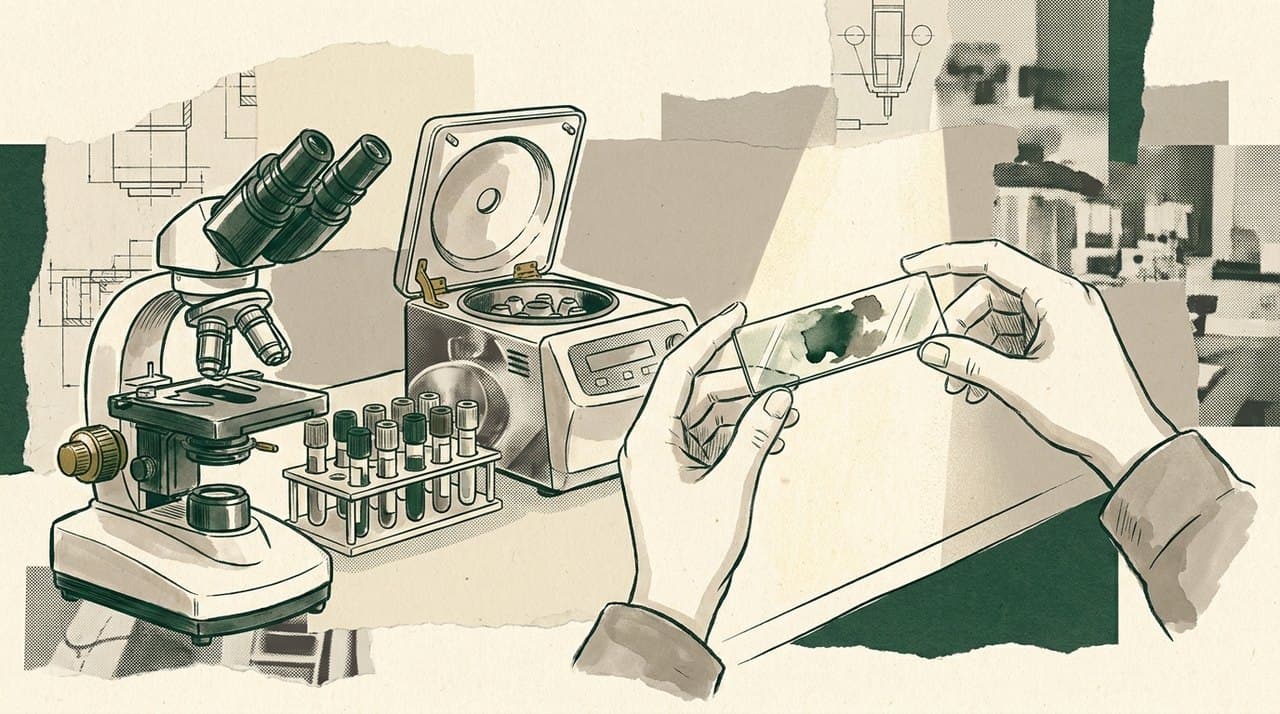
When a doctor says "we are running tests," the medical laboratory scientist is the person who actually runs them, reading blood, urine, tissue, and cultures to find out what is wrong with a patient.
Run blood, urine, and body fluid samples on analyzers, then verify the numbers are trustworthy before they land in a doctor's chart.
Study blood samples under the microscope to count cell types, do blood typing, and flag abnormal cells.
Grow and identify bacteria from a patient sample, then determine which antibiotics will work.
Conduct blood typing and antibody screening so a transfusion is safe for the person receiving it.
Run quality control, set up and maintain instruments like spectrophotometers, and enter test data into the lab computer system.
Skills you need first
Chemistry strong enough to carry into college organic chemistry and biochemistry. The Cleveland Clinic and Akron programs on this list ask for about 16 semester credits of chemistry.
Biology deep enough for microbiology, immunology, anatomy and physiology, and genetics. Those same two programs ask for about 16 semester credits of biology.
Math through a college-level statistics course. The Akron program names one college-level statistics course, and Tri-C names Elementary Probability and Statistics I or higher.
Careful measurement and documentation. A mislabeled tube or a skipped control ruins a result no matter how good the instrument is.
Attention to detail under time pressure, because results are often needed while a patient is still waiting in the ED.
Comfort with instruments and lab software, since most results move through an analyzer and a laboratory information system before a human signs off.
How long people stay
Mixed, and worth discussing honestly. The federal Occupational Outlook Handbook page for this occupation describes work with infectious specimens and other biohazardous substances, standing for long periods, risk of repetitive motion injuries, and shifts that include nights, weekends, or holidays because hospitals never close. ASCP's Job Satisfaction, Well-Being, and Burnout Survey of Laboratory Professionals (Garcia E, Kundu I, Kelly M, Soles R, Mulder L, Talmon GA. Am J Clin Pathol. 2020;153(4):470-486, found burnout to be common while most respondents were still satisfied with their jobs, and named quantity of workload and understaffing as the main drivers. The precise percentages that used to sit here are behind a paywall, so they are not printed. The ASCP 2024 Vacancy Survey (Am J Clin Pathol. 2025;164(5):759-777, reported retirement rate increases in 10 of the 17 laboratory departments surveyed. A typical number of years people stay in the role is not published in any source we could verify.
Where it is needed, and the different ways to do it
Real and steady, but driven by replacement rather than expansion. O*NET, republishing the federal projections for this occupation, describes the 2024 to 2034 outlook as slower than average at 1 to 2 percent, on employment of 351,200 in 2024, while still projecting about 22,600 job openings a year. Openings on that scale alongside slower-than-average growth point to replacement hiring rather than new positions. On the shortage question, the citation is ASCP's own biennial survey: the ASCP 2024 Vacancy Survey of medical laboratories in the United States (Garcia E, Diaz J, Kundu I, Kelly M, Soles R. Am J Clin Pathol. 2025;164(5):759-777, reports that vacancy rates declined compared with 2022 but remain elevated relative to those observed before the COVID-19 pandemic, and concludes there are continued challenges in recruitment plus an urgent need to expand laboratory education and credentialing pathways. ASCP's own reporting on that survey adds that hiring staff for most departments takes three months to a year, and hiring supervisors three months to over a year.
Hospital laboratory
Hospitals run around the clock, so expect night, weekend, and holiday shifts, and expect stat results that someone in the emergency department is waiting on. Employer-share and pay-by-industry figures were removed from this card because their source page could not be opened to check them.
Medical and diagnostic laboratory
The high-volume reference labs that specimens get shipped to, often with deep specialization in one testing area.
Offices of physicians
A smaller test menu and more regular hours, physically closer to the patients whose samples you are running.
University and teaching laboratories
Where training, method development, and research work sit. O*NET lists supervising and training laboratory staff among this occupation's tasks.
Blood bank and transfusion service
A specialty inside hospital labs rather than a separate industry. O*NET lists blood typing and antibody screening as core tasks for this occupation, and the transfusion side is where a wrong answer is most immediately dangerous.
AI and this career
exposure: moderate
Specific, well-defined tasks in this job are already being automated, and federal projections put employment growth for 2024 to 2034 at slower than average. But adoption is still early, and the parts of the work that carry accountability, deciding whether a result is real, chasing down why an instrument is lying, and telling a clinician what it means, are the parts AI is furthest from taking. Treat this as a job whose task mix is changing rather than a job that is disappearing.
Tasks likely to change
Routine result review. Lippi and Plebani describe automated verification and validation modules integrated with the laboratory information system entering laboratory practice, which shifts some of the work of checking unremarkable results onto software. Note that the article does not claim results are released without human review, and this record no longer says it does (Lippi and Plebani, 2025).
Blood smear and slide reading. Digital morphology in laboratory hematology pre-sorts and pre-classifies cells, so the scientist increasingly confirms or corrects a machine's first pass instead of starting at a blank microscope field (Lippi and Plebani, 2025).
Sample processing and quality control. Machine learning models are being applied to optimize sample processing and QC management, moving more of the pre-analytic and monitoring workload onto instruments (Lippi and Plebani, 2025).
The size of the workforce. The federal projections republished by O*NET put growth for 2024 to 2034 at slower than average, 1 to 2 percent, so the number of these jobs is expected to rise only slightly even as testing volume grows.
Tasks that stay human
Judging whether a result is real. When a value does not fit the patient, someone has to suspect a clotted specimen, a mislabeled tube, an interfering substance, or a drifting analyzer, and go find out. Lippi and Plebani note that "AI systems currently lack the adaptive capacity to interpret data with equivalent contextual understanding" and that current tools need "interactive learning frameworks and human oversight for reviewing the initial classification."
Hands-on instrument work. Setting up, cleaning, maintaining, and troubleshooting analyzers is physical, and it is listed among the core tasks for this occupation on O*NET.
Developing and modifying laboratory procedures and methods, and monitoring quality assurance programs. These are O*NET-listed tasks that require a qualified person who is accountable for the answer.
Talking to clinicians. O*NET lists providing technical information about test results to physicians as a core task. Someone has to own that conversation, and the pace of change is slower than the headlines suggest: in the ASCP 2024 Vacancy Survey, only 17.4 percent of responding laboratories reported having incorporated AI tools, and the range across departments runs from about 33.3 percent in laboratory information systems and quality departments down into the single digits in departments such as cytology and molecular pathology.
What medical laboratory scientist work may look like
What a shift may look like in ten years: you badge into a hospital lab that is quieter than today's, because the analyzers and the lab information system have already worked through most of the normal results before you looked at them. Your screen is not a list of every result, it is a worklist of exceptions, the samples the software could not resolve and the ones it resolved with low confidence. You may spend more of your day on the hard cases and less on the routine ones. The digital morphology station likely hands you a pre-sorted screen of cells to confirm or overrule rather than a slide to scan from scratch. You still gown up, still handle infectious specimens, still stand for hours, still get called at 2 a.m. because the chemistry analyzer is drifting and the ED needs a troponin now. The judgment calls may get harder rather than easier, because the routine work that used to build your instincts is the work the machine took first, which is exactly why the profession is arguing about credentialing and training right now. Pay and headcount probably do not jump, given a slower-than-average growth projection, but the person who can validate a new method, defend a quality program, and explain to a physician why the number is wrong may be more valuable in that lab, not less. None of this is certain. Adoption has been slower than vendors promised, and a lab that cannot hire enough people has a hard time finding the capacity to implement new technology in the first place.
Changed the growth figure from a flat 2 percent to the published range of 1 to 2 percent. The page we can open states a range, so this record states a range. Narrowing a range to one number is a guess dressed as a fact.
Narrowed three prerequisite lines that said or implied every program on this list requires the same chemistry, biology, and statistics coursework. Only the Cleveland Clinic and Akron programs list the 16-semester-credit science requirements, and only Akron and Tri-C name a statistics course.
Corrected the AI adoption range in the section on what stays human. The old text presented 21.7 percent as the low end. The actual range continues down into the single digits in some laboratory departments, which makes the case that adoption is early, not the opposite.
Pay and outlook come from O*NET, the US Department of Labor's occupation site, and every figure links back to it. We do not publish tuition or cost figures here: those change often, so use each school's own page and phone number below. Tell Mr. Mendoza if anything looks wrong.
About these figures. The US Department of Labor does not publish separate numbers for medical laboratory scientist. The pay and outlook below are published for Medical and Clinical Laboratory Technologists (29-2011.00), a broader group, so treat them as the closest official figures rather than this job exactly.
Read these as minimums, not targets. Meeting the numbers below is what lets you apply; it is not what gets you in. Selective programs admit far fewer people than apply, and admitted students are usually well above the minimum. Call the program and ask what last year's admitted class actually looked like. That one phone call is worth more than any number on this page.
Cleveland Clinic
Cleveland, OH · Certificate of Completion from the Medical Laboratory Science Program. Students in the 3+1 route earn their bachelor's degree from an affiliated university at the same time.
Medical Laboratory Science Program
What they ask for
"Biology, chemistry, math and overall GPAs must be greater than 2.5 to apply. GPAs greater than 2.80 are considered competitive."
"At least 16 semester credits of biology, 16 semester credits of chemistry, a math course as well as enough credits to complete the degree"
"All application materials and transcripts must be received electronically by 12/1 at midnight" (the page does not say which year, so confirm the deadline for the year your student would apply).
4+1 applicants must have a degree conferred in a biological, chemical, or medical lab science before the first day of the program. 3+1 applicants must be enrolled at an affiliated university and able to graduate at the completion of the program.
Program runs approximately 50 weeks, with 47 weeks of lecture and laboratory experience.
Closest MLS program to John Hay. The program page lists no program-specific phone number, only the program email MLSProgram@ccf.org and program director Barbara Zingale, MSIT, MLS(ASCP)CM, at Cleveland Clinic, 9500 Euclid Ave, L13, Cleveland, OH 44195. The 800.223.2273 number on the page is Cleveland Clinic's general contact line, not the program's, so it is not reported here as the program phone. For tuition, fees, and book costs, ask the program directly by email.
Program page phone not confirmed: use the program page
Akron Children's (Akron Cooperative Medical Laboratory Science Program)
Akron, OH · Certificate on completion of the clinical year, with a bachelor's degree awarded by the partner university for 3+1 students. NAACLS accredited.
Akron Cooperative Medical Laboratory Science Program (ACMLSP)
What they ask for
Minimum overall GPA 2.70 and a combined chemistry and biology GPA of 2.5.
Chemistry, 16 semester hours including organic or biochemistry. Biology, 16 semester hours including microbiology, immunology, anatomy and physiology, and genetics or molecular biology. Mathematics, one college-level statistics course.
Completion of at least three years of college credit, 90 or more semester hours.
Call the program for the current application deadline. The only dated deadline notice on the page had already expired when this record was checked, so no deadline is printed here.
This is a strong Northeast Ohio option for a student who wants to stay local for the bachelor's degree. The page lists nine partner institutions: Kent State, The University of Akron, Youngstown State, Bowling Green State, Ashland, Malone, Miami University, University of Mount Union, and Commonwealth University of Pennsylvania. The 330-543-8720 number is printed as the program director's office number. The clinical year runs July to July. Ask the program for current tuition and fees.
The Ohio State University, School of Health and Rehabilitation Sciences
Columbus, OH · Bachelor's degree in Medical Laboratory Science
Medical Laboratory Science
What they ask for
"Students are required to have a minimum GPA of 2.50 to be considered for admission into any undergraduate track."
"Students who wish to apply to the MLS program must have completed all of the prerequisite course equivalents or their equivalent with a C- or higher."
Autumn admission deadline of Dec. 1 for the Certification Track. The separate Medical Science Track deadline is May 15 for the following autumn. Confirm both for the year your student would apply.
Selective admission. "Our maximum enrollment is limited to 32 students for the certification track and 20 for the online MLT to MLS track," and "Completion of all admission criteria does not assure that the applicant will be selected for admission."
The (614) 366-7677 number is printed on the page as the Admissions Coordinator. The page also prints (614) 292-9444 for the Professional Admissions Office, for questions about the application process and transfer credits. This is a full four-year bachelor's route in state, and it also runs an online MLT to MLS bridge for students who start with an associate degree. For cost, use Ohio State's own tuition and fees pages.
Cleveland, OH · Associate of Applied Science (A.A.S.) in Medical Laboratory Technology. This is the technician credential, one rung below MLS, and it is the standard first step for students who then bridge to an MLS bachelor's degree.
Medical Laboratory Technology
What they ask for
Minimum GPA of 2.50 overall.
Prerequisite courses with a grade of C or higher: Principles of Biology I (BIO-1500), Medical Terminology I (HTEC-1060), Elementary Probability and Statistics I or higher (MATH-1410), Introduction to Medical Laboratory Science (MLT-1001), and College Composition I (ENG-1010) or Honors College Composition I (ENG-101H).
"All science and math courses must have been completed within seven years of application submission, and may only be repeated once to improve a grade."
High school diploma or GED, and a criminal background check.
Named here because it is the closest and most realistic entry point for a CMSD student, and because Ohio State's online MLT to MLS bridge is built for exactly this path. Be clear with families that this is MLT, not MLS. The link above goes to the Tri-C catalog page, which is where the admission requirements above are actually printed. The program's own page at https://www.tri-c.edu/programs/health-careers/medical-laboratory-technology/index.html carries 216-987-4438 as the program office number and states that the program "Meets educational requirements" for the State of Ohio. The program starts in the Spring semester. Confirm the current cohort and the cost with the program office.