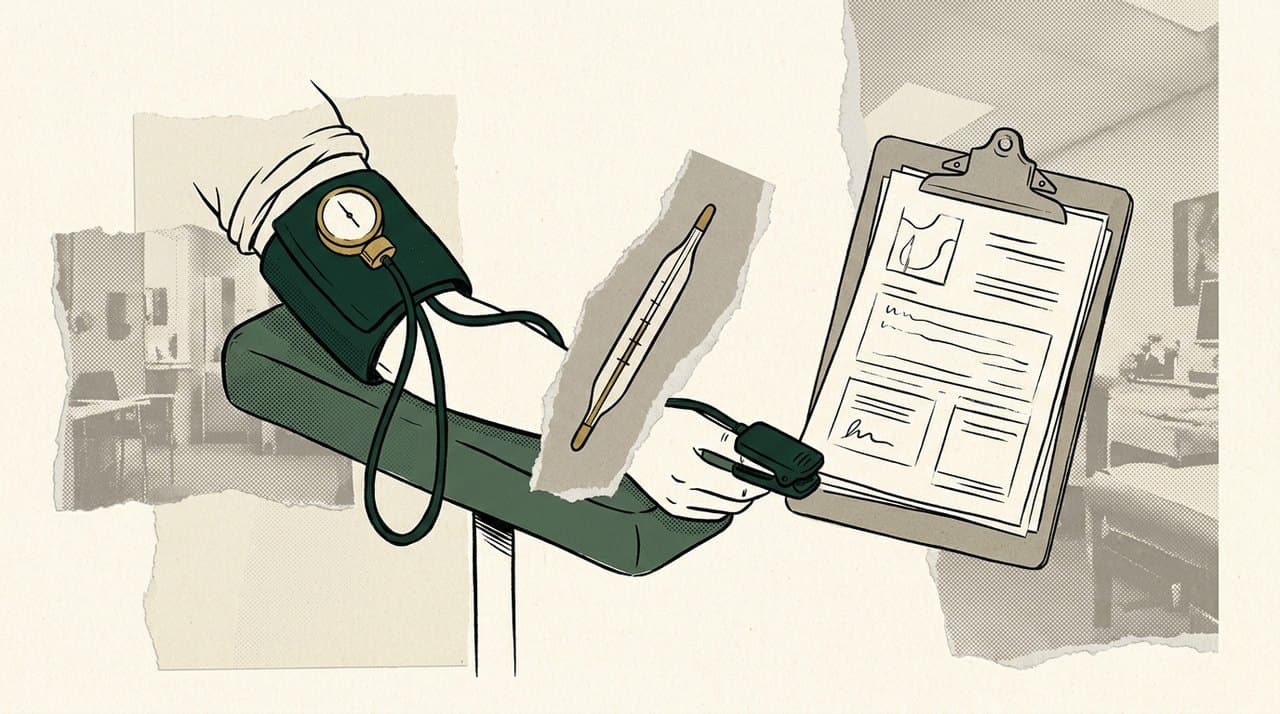
A medical assistant is the person who walks you back to the room, takes your blood pressure, asks what brought you in, and has the chart and the room ready before the doctor walks in.
Room patients and measure vital signs such as blood pressure and weight, and interview them to record their medical history (BLS Occupational Outlook Handbook duties list).
Enter patient information, vital signs, and test results into the medical record so the physician reads them before entering the room.
Collect and prepare blood and other specimens for laboratory tests, and run routine tests the practice and state law allow.
Give injections or medications as directed by the physician and as permitted by state law, including intramuscular, intradermal, and subcutaneous injections (American Association of Medical Assistants).
Keep the practice running: schedule appointments, answer telephones, file and update records, prepare exam rooms, sterilize instruments, and maintain supply inventory.
Skills you need first
High school biology and chemistry. BLS states directly that high school students interested in this career should take science classes, including biology and chemistry.
Analytical skill. BLS lists it as a key quality: medical assistants must be able to understand medical charts and diagnoses.
Communication. BLS lists conveying important information to patients, from scheduling to explaining medical instructions.
Compassion under pressure. BLS notes these workers interact with patients who are sick or injured and who may be in extreme pain or distress.
Steady hands and careful attention for vitals, blood draws, ECGs, and injections.
Comfort working in an electronic health record, since the chart, the schedule, and patient messages all live on a computer.
How long people stay
BLS reports most medical assistants work full time, with some working evening, weekend, or holiday shifts in facilities open around the clock, and notes that many of the roughly 112,300 annual openings come from workers transferring to different occupations or exiting the labor force, so churn in this role is real. On physical demand, BLS says some medical assistants spend a lot of time standing or walking while others sit at a computer for much of the day. On burnout, a 2021 study of 261 medical assistants at a single health system (Stanford Health Care, 52 percent response rate) found average burnout was low (2.32) and professional fulfillment high (4.08), with negative perceptions of organizational culture the strongest predictor of burnout. Source, readable free: (Journal of Healthcare Management, 2021;66(2):111-121,. That is one employer, not the country. No national average tenure or turnover rate for US medical assistants was verified for this card.
Where it is needed, and the different ways to do it
BLS projects employment of medical assistants to grow 12 percent from 2024 to 2034, much faster than the average for all occupations, rising from 811,000 jobs in 2024 to 912,200 in 2034, with about 112,300 openings projected each year on average over the decade (BLS Occupational Outlook Handbook,. BLS attributes the demand to the growing size of the older adult population, which typically has more healthcare concerns than younger age groups, and says more medical assistants will be needed to support healthcare teams in physicians' offices, hospitals, and other care settings. The separate BLS OEWS May 2025 survey counted 817,870 medical assistants employed nationally, concentrated in offices of physicians (452,150), general medical and surgical hospitals (133,400), outpatient care centers (85,840), and offices of other health practitioners (63,000), read in the data.bls.gov OEWS profile tool. O*NET flags the occupation as a Bright Outlook occupation, meaning it is expected to grow rapidly and have large numbers of openings. No formal shortage declaration from a named body was verified, so this card claims strong projected demand rather than a shortage.
Doctor's office (by far the most common)
57 percent of medical assistants work in offices of physicians (BLS OOH). Small team, the same families coming back, and you often know patients by name. The BLS median for this setting was $43,880 in the May 2024 survey year. That is an older survey year than the $45,690 May 2025 median above, so the difference is largely a one-year survey gap and not proof that doctors' offices pay below median.
Hospital
17 percent work in hospitals, state, local, and private (BLS OOH), and the BLS OEWS May 2025 survey counted 133,400 of these jobs in general medical and surgical hospitals. Shift work is more likely here, including evening, weekend, and holiday shifts. The BLS median for this setting was $45,930 in the May 2024 survey year, again a different survey year from the headline median.
Outpatient clinic or surgery center
10 percent work in outpatient care centers (BLS OOH). Of the four main settings this one had the highest median in the BLS May 2024 industry table, $47,560. All four setting medians come from that same May 2024 survey year, so they compare fairly to each other.
Specialty practice
7 percent work in offices of other health practitioners (BLS OOH). This group had the lowest of the four setting medians in the May 2024 survey year, $37,510. BLS notes assistants often specialize according to the practice, for example those working for ophthalmologists and optometrists show patients how to insert, remove, and care for contact lenses.
Clinical lane versus administrative lane
BLS states medical assistants often focus on either clinical or administrative tasks, although some do both, so two people with the same job title can have very different days. Which tasks you are allowed to do also varies by state.
Staffing and float roles
The BLS OEWS May 2025 survey counted 11,660 medical assistants employed through employment services, meaning staffing agencies that place them across different offices and clinics.
AI and this career
exposure: moderate
This job splits into a hands-on half and a paperwork half, and only one of them is exposed. Vitals, blood draws, ECGs, injections, rooming patients, sterile setup, and inventory require a body in the room. The exposed tasks are the administrative ones BLS and O*NET list explicitly: entering information into the medical record, scheduling, answering phones, filing records, and capturing billing and insurance coding information. Ambient AI documentation is already deployed in real clinics and has been measured, and the strongest randomized evidence to date shows modest and uneven time savings rather than task elimination. Worth telling families plainly: BLS Employment Projections still calls for 12 percent growth from 2024 to 2034, so the federal projection does not anticipate AI-driven decline in this occupation.
Tasks likely to change
Writing the visit note and entering data into the chart. A 2025 randomized trial of 238 outpatient physicians (NEJM AI) found one ambient AI scribe cut time in the note by 9.5 percent versus control while a second showed no significant change, so documentation time is genuinely moving, unevenly, by vendor. Abstract with the numbers:.
Phones, scheduling, reminders, refill requests, and first-draft replies to patient messages. These are routine, text-based, and repetitive, which is where automation lands first, and they make up a large share of the administrative side of the role.
Part of the work may shift from producing documentation to checking it. In the same trial, physicians rated clinically significant AI inaccuracies as occurring 'occasionally' (2.7 and 2.8 on five-point scales), so someone has to catch what the machine got wrong.
Insurance and billing information capture, which the BLS OEWS occupation definition and O*NET both list in this occupation's administrative duties, is rules-heavy and likely to be increasingly software-assisted.
Tasks that stay human
Hands on the patient. Blood pressure, temperature, weight, phlebotomy, ECGs, and injections happen in the room, on a person, and no current model performs them.
Reading the human in front of you. BLS lists compassion and communication as core qualities because patients may be in extreme pain or distress, and noticing that changes what you do next.
Physical setup and infection control. Preparing treatment rooms, sterilizing instruments, disposing of contaminated supplies, and keeping stock are physical tasks.
Accountability. Medical assistants work under the direction of a physician and within what state law permits, so a licensed team and a named person remain answerable for what happens to a patient.
What medical assistant work may look like
A clinic day several years from now may open exactly the way it does today: you call a name into the waiting room, walk someone back, cuff their arm, and ask what brought them in. What may be different is the typing. The visit note may compose itself from the room conversation while you and the physician work, which likely turns part of your job into reading that note critically and fixing what it misheard. The phone may ring less because scheduling, reminders, and refill requests get handled before they reach you, and the patient message basket may show up pre-drafted, waiting for a human to approve, correct, or escalate. Those saved minutes may not become a lighter day; clinics may spend them on more patients, so the pace could hold or tighten even as the keyboard work shrinks. The parts least likely to move are the ones that need a body and a face: the difficult draw on a hard vein, the injection, the sterile field, the moment you notice a patient is frightened and slow down. BLS still projects 12 percent growth in this occupation through 2034, which is a useful check on any claim that the role is about to vanish. The likeliest shape is a job whose administrative half thins out while its hands-on, in-person half becomes most of what the title means.
Corrected: this card previously said medical assistants work under the 'direct supervision' of a physician. That phrase has a specific legal and billing meaning that varies by state and neither source used it. BLS says medical assistants work as directed by physicians and as permitted by state law.
Corrected: Tri-C evening availability. The card previously implied Metro Campus days and West Campus nights are both available generally. Tri-C lists West Campus nights for fall only, with spring and summer at Metro during the day. Confirm with the program office before planning around an evening schedule.
Corrected: Stark State class days. The card previously said Monday through Thursday. That is the fall schedule; spring and summer run Tuesday through Thursday.
Pay and outlook come from O*NET, the US Department of Labor's occupation site, and every figure links back to it. We do not publish tuition or cost figures here: those change often, so use each school's own page and phone number below. Tell Mr. Mendoza if anything looks wrong.
Read these as minimums, not targets. Meeting the numbers below is what lets you apply; it is not what gets you in. Selective programs admit far fewer people than apply, and admitted students are usually well above the minimum. Call the program and ask what last year's admitted class actually looked like. That one phone call is worth more than any number on this page.
Cuyahoga Community College (Tri-C)
Cleveland, OH · Certificate of Proficiency. Accredited by the Commission on Accreditation of Allied Health Education Programs (CAAHEP) upon recommendation of the Medical Assisting Education Review Board (MAERB), valid through Spring 2030. Graduates are eligible for the CMA (AAMA) certification exam.
Medical Assisting, Certificate of Proficiency
What they ask for
High school diploma or GED.
2.00 overall GPA required.
ENG-1010 College Composition I completed with a grade of C or higher.
MA-1200 Introduction to Medical Assisting completed with a C or higher (Tri-C notes MA-1200 is offered for the first time in Summer 2026), plus HTEC-1050 or HTEC-1060 with a C or higher.
Math placement qualifying for MATH-1190, or eligibility for the MATH-0930 and MATH-1190 co-requisite pairing.
Two semesters full time, plus 160 hours of supervised, unpaid practicum required for completion. Campus availability changes by term: Metropolitan Campus (days) runs across terms, and West Campus (nights) is listed for fall only, with spring and summer offered at Metro during the day. If you need evenings, ask the program office before you plan around it. Program office is on the Metropolitan Campus, 2900 Community College Ave., Cleveland, OH 44115. Program director is Mary Elizabeth W. Regis, PhD, CMA (AAMA), CCMA, BCPA; 216-987-4439 is listed for both the director and the Medical Assisting program. Published five-year averages for 2020-2024: 72 percent retention, 72 percent job placement, 74 percent certification exam passage, 100 percent graduate and employer satisfaction. Note for families: Tri-C states no new students will be accepted into the Associate of Applied Science Degree portion of the medical assisting program after Aug. 22, 2025, so the certificate is the active entry route. Call the program office for current tuition, fees, scholarships, and application deadlines.
Kirtland, OH · Certificate / Area of Specialization. Program accredited by the Commission on Accreditation of Allied Health Education Programs (CAAHEP).
Medical Assisting Certificate/Area of Specialization (3550)
What they ask for
Complete the college application.
Complete the college placement test or meet test exemption requirements.
Minimum 2.0 GPA for admission.
Place into MATH 0850 Beginning Algebra or successfully complete MATH 0745.
Place into ENGL 1110 or ENGL 1111 or successfully complete ENGL 0111.
32 credit hours across four semesters (summer, fall, spring, summer). Campus at 7700 Clocktower Drive, Kirtland, OH 44094, east of Cleveland in Lake County. Important: 440.525.7000 is the college's main line as printed on the catalog page (800.589.8520 is also printed); no program-only direct number was verified, so ask to be transferred to the medical assisting program director. Ask the program office for current tuition, fees, and application deadlines.
North Canton, OH · Certificate. Program accredited for 10 years (2019-2029) by the Commission on Accreditation of Allied Health Education Programs upon recommendation of the Medical Assisting Education Review Board (MAERB).
Medical assisting certificate (one-year certificate)
What they ask for
GPA of 2.0 or better.
Clean background check.
Placement test score.
36 credit hours over three semesters full time, in person. Class days change by term: Monday through Thursday in fall, and Tuesday through Thursday in spring and summer. Offered at the main campus, 6200 Frank Ave. NW, North Canton, OH 44720, and at Stark State College Akron, 360 Perkins St., Akron, OH 44304, both south of Cleveland in Stark and Summit counties. 330-494-6170 is the college main line as printed; the page also prints program coordinator Mirjana Ilijevski at 330-966-5458 ext. 4515 or 330-494-6170 ext. 4515, and a toll-free 1-800-797-8275. Stark State does publish an estimated cost sheet for this certificate; ask the program office for the current version rather than relying on a figure printed here.