
All careers
Career

EMT and Paramedic

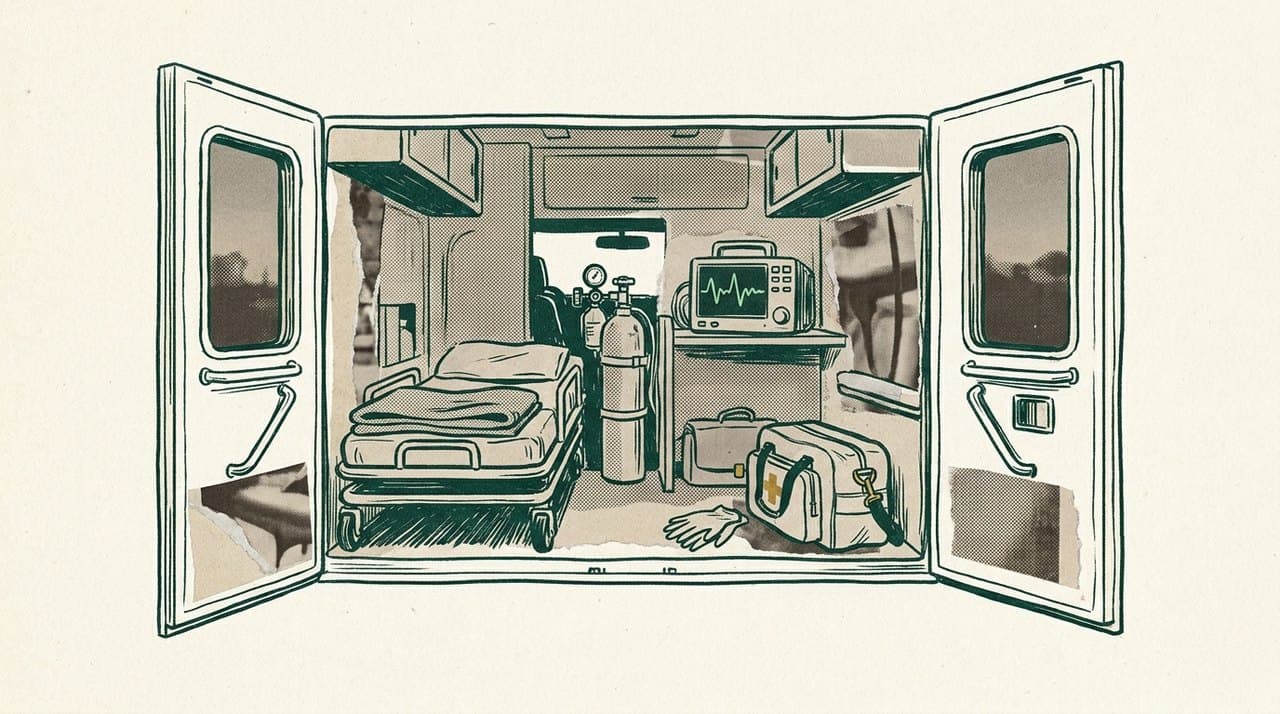
You ride the ambulance: when someone calls 911 you get to them, figure out what is wrong, treat them where they are lying, and keep them alive on the way to the hospital.

Median pay (US)

$60,600

2025 · $29.13 an hour

O*NET source

Job outlook

Faster than average

O*NET's band for this category is 5% to 6%, 2024-2034

O*NET source

To get in the door

Training or an associate degree

Most of these occupations require training in vocational schools, related on-the-job experience, or an associate's degree.

Openings a year

4,900

projected, nationally

O*NET source

What the day actually looks like

  • Respond to calls for medical help and get to the scene, which BLS describes as anywhere from a car crash to a home to a nursing facility.
  • Assess the patient fast and decide what care is needed and in what order. BLS states the duty as assessing a person's condition and determining what treatment, if any, is needed. O*NET's task statement for this job is to assess the nature and extent of illness or injury in order to establish and prioritize medical procedures.
  • Treat at the level your certification allows. An EMT manages respiratory, cardiac, and trauma emergencies. A paramedic also gives medications including intravenously, performs advanced airway management, and interprets EKGs.
  • Move the patient safely to the ambulance, then either drive or ride in back monitoring vital signs while your partner drives. Some paramedics do this as helicopter or airplane flight crew.
  • Document and report what you saw and did to the physicians and nurses taking over, then restock supplies, clean equipment, and decontaminate the ambulance after a patient with a contagious disease.

Skills you need first

  • Physical strength and stamina. BLS says you must be comfortable bending, lifting, and kneeling across a whole shift, and that the work is physically strenuous.
  • Problem-solving under a clock. BLS lists evaluating symptoms and determining the appropriate treatment as a core quality.
  • Clear communication. You listen to patients describe what happened, take information from dispatchers, and give instructions other people have to follow immediately.
  • Compassion. BLS names this explicitly: providing care and emotional support to people in life-threatening situations or extreme mental distress.
  • Teamwork. You coordinate with a partner, and on scene with 911 dispatchers, police, and firefighters.
  • Paperwork you can pass before you start: CPR and basic life support certification are typical program entry requirements, and employers usually require a driver's license.

How long people stay

Turnover is the number to look at and it is high. The AAA/Newton 360 2021 Ambulance Industry Employee Turnover Study (American Ambulance Association, Newton 360, Doverspike Consulting, and The Center for Organizational Research, July 14, 2021), covering 19,688 employees at 258 EMS organizations, found voluntary and overall turnover in the 20 to 30 percent range for EMTs and paramedics and wrote that at those rates an organization replaces most of its workforce within a four-year period. It also reported that 32 percent of employees who leave depart in the first year, and that turnover has been trending upward since 2008. An undated AAA shortage one-pager says its 2024 study of nearly 20,000 employees at 258 organizations found the same 20 to 30 percent annual range. On the body: BLS states that EMTs and paramedics have one of the highest rates of injuries and illnesses of all occupations, that the job involves considerable kneeling, bending, and lifting, that some shifts run 12, 18, or 24 hours, and that the work can be stressful in life-or-death situations. Not established: we found no reliable data on total career length, retirement age, or a published burnout prevalence rate. Organizational turnover is not the same as how long a person stays in the field, and BLS documents paramedic-to-RN accelerated programs as a real exit ramp upward.

Where it is needed, and the different ways to do it

BLS counted 282,900 EMT and paramedic jobs in 2024 (181,000 EMTs and 101,900 paramedics) and projects 297,200 by 2034, a 5 percent increase of 14,300 jobs, with about 19,000 openings per year over the decade. BLS is explicit that many of those openings come from replacement rather than growth: workers who transfer to different occupations or exit the labor force. The demand drivers BLS names are continuing emergencies (car crashes, natural disasters, drug abuse incidents, acts of violence) plus growth in the middle-aged and older population producing more falls, heart attacks, and strokes. Separately, and this is a claim with an interested party behind it, the American Ambulance Association calls this a "crippling shortage" of paramedics and EMTs in an undated one-pager lobbying Congress for the PARA-EMT Act (H.R. 2220). It cites its own 2024 AAA/Newton 360 turnover study of nearly 20,000 employees at 258 EMS organizations, says turnover runs 20 to 30 percent annually, says paramedics are being pulled away by hospitals covering the nursing shortage, and says the shortage is lengthening 911 response times. Read that as the employers' position, not a neutral measurement. One more caveat that cuts the other way: BLS says its employment counts exclude volunteer EMTs and paramedics, who do much of the same work.

Private and contracted ambulance services

The largest single employer for both roles. BLS puts 45 percent of EMTs and 39 percent of paramedics here. It is also the lowest-paying setting for EMTs, with a May 2024 median of $39,190.

Fire department and municipal EMS

BLS category "local government, excluding education and hospitals," which covers fire-based and city third-service EMS. It employs 26 percent of EMTs and 38 percent of paramedics, and it is the top-paying major setting for paramedics at a $59,840 median. Combined fire and EMS programs do exist locally, including a Fire and Emergency Medical Services associate degree at Tri-C and the University of Akron's Fire/Medic option.

Hospital-based EMS and emergency departments

BLS lists private hospitals and local government hospitals as separate employer categories for this occupation, each holding a meaningful share. EMTs and paramedics work inside emergency departments, not only on trucks. See the Employment by industry table on the BLS Pay tab for the current share of each category.

Air medical flight crew

BLS notes that some paramedics work as part of a helicopter's or an airplane's flight crew, transporting critically ill or injured patients. Cleveland has a long-running example in MetroHealth's Metro Life Flight, which has operated since 1982 and is CAMTS-accredited.

Interfacility and critical care transport

Not every call is a 911 emergency. BLS describes moving patients between medical facilities, for instance to a hospital that specializes in a particular injury or to a long-term care facility.

Clinics, physician offices, and volunteer squads

A small share work in outpatient care centers and offices of physicians, and notably that is where EMT pay was highest in May 2024 at a $67,990 median in outpatient care centers. Separately, BLS says its employment numbers leave out volunteer EMTs and paramedics, who share many of the same duties and who staff much of rural and small-town EMS.

AI and this career

exposure: low

The exposure here concentrates in the paperwork and in the dispatch layer around the call, not in the work done at the patient's side. The most exposed tasks are writing the patient care report, flagging cardiac arrest while a 911 call is still in progress, forecasting where to post ambulances, and scoring which patients are sickest. The least exposed are the physical and judgment-heavy core: lifting and extricating, hands-on airway and IV work in a moving vehicle, reading an uncontrolled scene for danger, and carrying legal responsibility under a state license. Two findings should keep expectations honest. A 2023 scoping review of 106 prehospital AI studies across 25 countries found 83 percent were retrospective, only 8.5 percent used external validation, 90.6 percent did not report calibration, and concluded the field is still in its infancy. And in the one randomized trial of AI in emergency call handling, the model beat the dispatchers on sensitivity yet recognition of cardiac arrest did not improve, because the dispatchers did not act on the alerts.

Tasks likely to change

  • The patient care report, which is the single most exposed task. ESO shipped an auto-generated narrative feature and told JEMS in June 2025 that it saved over 35,700 hours in the first month of general availability. Separately, the same article says more than 1,670 EMS agencies had adopted the feature since May. Those are two different measurements: the 1,670 is cumulative adoption, not the group the 35,700 hours was measured across. Provider review and approval are required before any narrative is finalized. One fire chief quoted in that piece reported crews cutting 20 minutes per report. These are the vendor's own numbers, not an audit, but the product is real and shipping.
  • The dispatch and deployment layer around you. In a 2023 review of 106 studies, ambulance demand prediction and dispatch resource optimization were major categories, and a 2025 scoping review found dispatch forecasting was the most common application area studied. Weigh that second review lightly: it included only 16 articles, most of them conducted in China, and it is scoped to low- and middle-income countries, so it does not directly describe US EMS. Where the truck waits and what the dispatcher already suspects may both be model-shaped before you arrive.
  • Triage and prognostication, the largest research category in the 2023 review by far: 52 of 106 studies, 49.1 percent. Expect prediction scores appearing next to vitals suggesting this patient is sicker than they look. Whether they help depends on whether crews trust and act on them, which is exactly what the randomized trial found was the weak link.
  • Pattern reading on the monitor. EKG interpretation is a defined paramedic skill in the BLS description and the kind of pattern task algorithms handle well, so the machine may offer its read faster. The licensed interpretation and the treatment decision stay with the paramedic.

Tasks that stay human

  • The hands. Lifting a patient down a narrow stairwell, extricating someone from a car, kneeling on a bathroom floor, holding an airway, starting an IV while the truck moves. BLS calls the work physically strenuous and says EMTs and paramedics have one of the highest rates of injuries and illnesses of all occupations.
  • Scene judgment in an uncontrolled environment. Deciding whether it is safe to go in, waiting for police to clear a violent situation, working outdoors in all weather, improvising when the room and the equipment do not cooperate. None of this arrives as clean structured data.
  • Being a person with a frightened patient and a frightened family. BLS lists compassion as a core quality: providing care and emotional support to people in life-threatening situations or extreme mental distress.
  • Legal accountability. Every state licenses EMTs and paramedics. The drug pushed, the airway placed, and the signature on the chart belong to a licensed human, and the ESO narrative tool is built that way on purpose, requiring provider review before anything is finalized.

What emt and paramedic work may look like

Picture a shift five or ten years out. The tones drop, and what you know on the way may already be better sorted: a model listening to the 911 call may have flagged possible cardiac arrest before the caller finished the address, and the ambulance may have been parked closer to begin with because a demand model predicted this block at this hour. On scene, remarkably little changes. The stairwell is still narrow, the patient still weighs what they weigh, and the IV still has to go in while the truck moves over Cleveland potholes. Your monitor may be quicker to tell you what it thinks the rhythm is, and a score may sit next to the vitals suggesting this patient is sicker than they look, which you may believe or override. The clearest difference is likely to land after the call. Instead of twenty minutes in the ER hallway typing a narrative, you may talk through what happened, read what the system drafted, fix what it got wrong, and sign it. That signature looks like the part least likely to move, because the license and the responsibility are yours. The honest caveat is that this has arrived slower than the demonstrations promise. In the only randomized trial of AI in emergency call handling, the model was measurably better than the dispatchers at spotting cardiac arrest, and recognition still did not improve, because the humans did not comply with the alerts. Being right in a study and being trusted at three in the morning are different achievements.

Sources:[1][2][3][4][5]

Open questions on this career

  • Cleveland-Elyria metro area wage data. Not verified, same access problem, so nothing local is claimed here.
  • Whether the BLS Occupational Outlook Handbook page has been updated since August 28, 2025. The version read carries that last-modified date and still shows May 2024 wages and 2024-2034 projections.
  • National Registry pass rates for any of these three programs, beyond Tri-C's own statement that its paramedic pass rates were 3 percent below the required standard over a three-year period. Ask each program for its current pass rate. It is a fair question and they track it.

Pay and outlook come from O*NET, the US Department of Labor's occupation site, and every figure links back to it. We do not publish tuition or cost figures here: those change often, so use each school's own page and phone number below. Tell Mr. Mendoza if anything looks wrong.

Two jobs, two sets of numbers. EMT and paramedic are separate occupations and the pay is not close. The tiles below are for Paramedics. For Emergency Medical Technicians, O*NET publishes a median of $44,470, outlook Faster than average (5% to 6%). See the EMT page. Becoming an EMT is the usual first step toward paramedic.

Where you can train for it

3 programs

Read these as minimums, not targets.Meeting the numbers below is what lets you apply; it is not what gets you in. Selective programs admit far fewer people than apply, and admitted students are usually well above the minimum. Call the program and ask what last year's admitted class actually looked like. That one phone call is worth more than any number on this page.

Cuyahoga Community College (Tri-C)

Cleveland, OH · Certificate of Proficiency in Paramedic, 40 credit hours. Those 40 hours already contain the EMT-Basic coursework, which appears inside the 40-hour plan of study under Program Admissions Requirements. Do not add the EMT-Basic short-term certificate's 11 credit hours on top of the 40; that would overstate both the time and the cost.

Paramedic, Certificate of Proficiency (entered after the Emergency Medical Technician-Basic, Short-Term Certificate; the college also offers an Emergency Medical Technology AAS)

What they ask for

  • The EMT-Basic entry certificate requires you to be 18, or 17 and a high school senior, which means a John Hay senior can start before graduating. Applications are due at least two weeks before the EMT-1303 class begins.
  • ENG-0995 Applied College Literacies or an appropriate score on the English Placement Test, plus MATH-0915 Basic Arithmetic and Pre-Algebra or qualified Math Placement.
  • For the paramedic certificate: completion of the EMT Short-Term Certificate and a current, valid State of Ohio EMT certification before the first day of EMT-2330 Paramedic Theory I.
  • Anatomy and physiology: EMT-1401 Anatomy and Physiology for Paramedics, or BIO-2331 and BIO-2341.
  • Minimum 2.00 GPA in certificate courses. One year of EMT-Basic experience is recommended but not required.

216-987-4247 is the Health Careers Enrollment Center, printed on the catalog page; the program's own EMT information line is 216-987-4449. Ask about accreditation directly, and ask before you enroll rather than after. The college's accreditation page states the paramedic program is accredited by CAAHEP and CoAEMSP, both listed valid through December 31, 2026, and that the program was placed on probationary status through January 31, 2029 after national registry exam pass rates came in 3 percent below the required standard over a three-year period. The college states the program remains accredited during probation. Tri-C also holds State of Ohio Division of EMS accreditation number 312. Because the accreditation dates above run out on December 31, 2026, confirm current standing with CoAEMSP at 214-703-8445 or CAAHEP at 727-210-2350.

Lakeland Community College

Kirtland, OH · Certificate / Area of Specialization, 28 credit hours. Completion makes you eligible to sit the National Registry paramedic certification exam for Ohio paramedic certification.

Emergency Medical Technology-Paramedic Certificate/Area of Specialization (3254)

What they ask for

  • High school diploma or GED.
  • Current Ohio EMT-Basic certification in good standing, so you complete EMT training first.
  • Current American Heart Association BLS certification.
  • Anatomy and physiology: HLTH 1238 Structure, Function, Disease, and Therapeutics of the Human Body, or both BIOL 2210 and BIOL 2220. Coursework from other institutions is subject to program director review.
  • Criminal background check and drug test.

Read this before you compare programs. Lakeland's own EMT department page states: "Lakeland Community College's EMS Program is currently under a consent agreement with the Ohio State Board of Emergency Medical, Fire, and Transportation Services," and directs questions to the Program Director (https://www.lakelandcc.edu/web/about/emt-departments). Ask the Program Director what the consent agreement covers and where the program stands now. On contacts: 440.525.7693 is the Emergency Medical Technology department line printed on Lakeland's contacts page, and the interim program director is listed at 440.525.7182. Lakeland is in Lake County, roughly a half hour east of Cleveland, so the commute is realistic for an east-side student.

University of Akron

Akron, OH · Associate of Applied Science, 64 to 65 credit hours

Emergency Medical Services Technology, Fire/Medic Option, AAS

What they ask for

  • Admission to the University of Akron.
  • At matriculation, an official paramedic transcript from an accredited EMS training facility with a graduation date of 1985 or later, in order to receive academic transfer credit for certified paramedic education.
  • By the end of the first 48 credit hours attempted, completion of the required General Education English, Mathematics, Statistics and Logic, and Communication (Speech) requirements.

330-972-6092 is Ben Rochester, the academic advisor named on the bulletin page. Read this one carefully: it is the degree-completion route, built to award transfer credit for paramedic training you already hold, so it stacks on top of a certificate rather than replacing it. It is the four-year-university option in Northeast Ohio and it sits in the School of Disaster Science and Emergency Services. Search results referenced a separate EMT/Paramedic Option AAS, but both bulletin URLs for that option returned 404 and Akron's own Disaster Science program list shows no such option, so only the Fire/Medic Option is confirmed here. Call and ask which option fits a student starting from zero.

Need help or have feedback?
Ask a question Family feedback