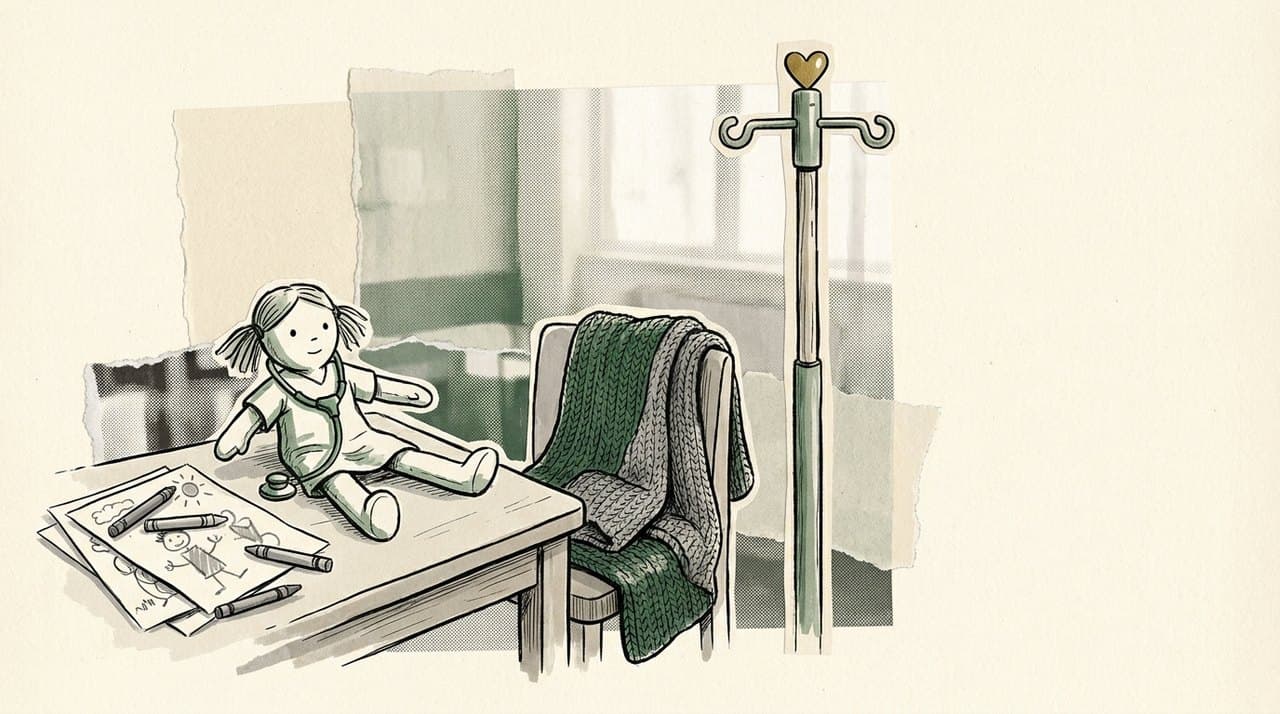
A child life specialist is the person in a children's hospital whose whole job is helping a scared kid understand what is about to happen to them, and helping them get through it.
Meet a child and family, often with no advance warning, and figure out what they are most afraid of. The senior specialist BLS interviewed for its Career Outlook profile asks directly: what are you most worried about, staying overnight, needles, being surrounded by strangers?
Prepare a child for a procedure using play and honest, age-appropriate explanations. Akron Children's describes therapeutic play with special dolls, stuffed animals and medical equipment so a child can show their fears instead of holding them.
Support the rest of the family, including siblings. The BLS interview gives the example of a baby in the ICU whose two-year-old sibling does not need the playroom for treatment reasons but does need help missing Mom.
Chart every interaction. The specialist BLS interviewed names this as a real workload problem: full time is 40 hours a week, which is a challenge, because everything you do has to be documented.
Serve on hospital committees and run program work. The specialist BLS interviewed lists pain management, quality improvement and bereavement committees, plus donations, special events, trainings, and in small programs even keeping the toys clean.
Skills you need first
Child development knowledge deep enough to predict what a 3-year-old, a 9-year-old and a 15-year-old each need. ACLP requires two child development courses plus a family systems course.
Talking with frightened people and listening harder than you talk. The specialist BLS interviewed names communication and listening as the core skills, above any medical background.
Steadiness around loss. ACLP requires a loss and bereavement or death and dying course, and the University of Akron certificate builds it in as Death and Dying for Health Care Professionals.
Play as a working tool, not a break. ACLP requires a dedicated play course, and Miami University's approved list includes Therapeutic Play.
Basic medical vocabulary and anatomy. The specialist BLS interviewed is blunt that child life specialists do not do the medical procedures or deliver medical news, but need enough terminology and anatomy to follow the team. Ohio University's child life concentration requires medical terminology and anatomy and physiology with a lab before you start.
Writing and record keeping, because everything gets charted, and research literacy: ACLP requires a research methods course.
How long people stay
Honest answer: no verified national data on how long child life specialists stay in the job. What is documented is the demand and the strain. The specialist BLS interviewed describes hospital-based child life work as constant motion, a lot of running around with very little sitting, in buildings open 365 days a year, with more programs moving to 7-day coverage, and she names the hardest part this way: the loss of innocence, no longer being able to ignore that terrible things happen. On emotional toll there is one peer-reviewed data point that included this role: a study of 177 pediatric emergency department staff at Children's Mercy Kansas City (physicians, nurses, technicians, social workers and child life specialists) found 26 percent with high burnout scores, 20 percent with high secondary traumatic stress, and 5 percent meeting criteria for compassion fatigue (Nilan et al., Pediatr Emerg Care 2019;35(11):777-781,. That study pools staff types, so it is not a child-life-only rate. Certification also runs on a five-year cycle with annual maintenance and recertification, so staying in the field means continuing education for as long as you practice.
Where it is needed, and the different ways to do it
Real but narrow, and hard to get into rather than hard to fill. On the demand side, the American Academy of Pediatrics, with the Association of Child Life Professionals, issued a policy statement that child life programs are an important component of pediatric hospital-based care (Romito, Jewell, Jackson; AAP Committee on Hospital Care; Pediatrics 2021;147(1):e2020040261,. ACLP reports more than 4,500 members representing at least 600 organizations worldwide, which is membership rather than a count of credential holders. The nearest BLS demand figure is for the stand-in occupation, healthcare social workers, projected to grow 8 percent from 2024 to 2034. On the supply side, the pinch point is the entry gate, not the job market: ACLP states that internships are competitive, applicants are not always offered placements the first time they apply, and it is common to apply for more than one cycle. The specialist BLS interviewed says the same thing from inside the field: internship programs are more competitive than when she started, and she does not think some people realize how hard it is to get into this field. Two things this record will not pretend to know. It has no evidence of a national shortage of child life specialists. And on that same ACLP About page, ACLP itself names the staffing crisis and concerns about low wages that its members have raised, and describes a leadership task force whose leading task is a salary advocacy toolkit specialists can use with hospital decision-makers. Read that as a field arguing for better pay, not as a field with open jobs waiting.
Children's hospital, inpatient units
The core setting. The AAP policy statement on child life services describes specialists working inside the interdisciplinary hospital team, using therapeutic play, expressive methods and psychological preparation to help children cope with treatment.
Right here in Northeast Ohio
Cleveland Clinic Children's, University Hospitals Rainbow Babies and Children's, and Akron Children's all describe child life services. Akron Children's staffs specialists in Akron and at its Beeghly Campus in Boardman and offers pre-surgery tours. Confirm current services, and any cost question, with the hospital itself; this record carries no source link for hospital claims.
Newborn intensive care
Some specialists work specifically with NICU babies and their parents. Johns Hopkins All Children's Hospital published a behind-the-scenes look at its NICU child life specialist role.
Outside the hospital entirely
Miami University's program notes that Certified Child Life Specialists often work in pediatric hospitals but may also work in other spaces such as courtrooms, funeral homes, or bereavement services, where children face illness-related trauma.
Program and committee work
The specialist BLS interviewed describes a second half of the job that is not bedside: sitting on pain management, quality improvement and bereavement committees, handling donations, special events and trainings, and mentoring, with more of it falling on you in a small program.
AI and this career
exposure: low
The exposed parts of this job are the paperwork and the props, not the work itself. What a child life specialist actually does, sitting with a frightened eight-year-old and figuring out in real time which specific fear to address, is close to the least automatable thing in a hospital: physical presence, reading a face, and earning trust from a person who did not choose to be there. What AI is genuinely likely to touch is the charting that the specialist BLS interviewed names as a workload problem, the preparation and education materials, and the growing kit of digital distraction tools. No study was found that measures AI's effect on child life practice specifically, so everything here is inference from adjacent evidence, and it is labeled as such.
Tasks likely to change
Charting. Everything a specialist does gets documented, and the specialist BLS interviewed names that as the reason a 40-hour week is a challenge. Ambient AI documentation is already showing measurable relief in adjacent clinical roles: in a Stanford pilot with 48 physicians, paired analysis of 38 found large drops in task load and burnout scores after ambient AI scribes were introduced (Shah et al., J Am Med Inform Assoc 2025;32(2):375-380). That study is physicians, not child life specialists, so read it as a signal rather than a result.
Preparation and distraction tools. Digital tools are already entering the exact niche child life owns. A meta-analysis of 11 studies and 1,099 pediatric patients found virtual reality exposure reduced children's anxiety during medical procedures (SMD -0.61, 95 percent CI -0.93 to -0.28) with no significant effect on pain, and the authors flag that 7 of the 11 studies came from the same research project (Hu et al., J Pediatr Nurs 2024;78:e364-e374). The likely effect is a bigger toolkit, with the specialist still deciding which child gets which tool.
Family-facing explanation materials. Drafting a procedure explanation at a first-grade reading level, or in a family's home language, is the kind of task generative tools do quickly, which may shift the specialist's time from producing materials to checking and delivering them.
Who gets seen first. On a unit with more patients than staff, AI-flagged risk lists pulled from the medical record may start informing triage. This one is speculative; no source verified here shows it in use in child life.
Tasks that stay human
Reading the particular child in front of you. The specialist BLS interviewed draws the line precisely: knowledge of child development may help anticipate what helps children in general, but we do not know what will help a particular patient. That gap between the general and the particular is the job.
Being physically present. She describes the work as a lot of running around with very little sitting. A model cannot hold a hand during an IV placement or stay in the room.
Helping adults be honest with children in a crisis. The specialist BLS interviewed named this as both her favorite and the most important part of the work, and gave the example of walking a father through why telling his older children the truth about their dying sibling was not avoidable. She also named the hardest part plainly: the loss of innocence, no longer being able to ignore that terrible things happen. That is human negotiation under grief.
Judgment inside a team. The AAP policy statement describes child life specialists collaborating with the entire interdisciplinary team to promote coping, with interventions including therapeutic play, expressive modalities and psychological preparation. That collaborative clinical judgment is accountable work that a hospital assigns to a credentialed person, not to a tool.
What child life specialist work may look like
What a shift may look like in ten years: you arrive and the unit list is already sorted, with a few children flagged by a model that read overnight notes and prior visits, so you spend less time hunting for who needs you and more time deciding whether the flags are right, because a chart cannot tell you that room 12 has stopped talking. You walk into a pre-op room with a tablet that can render this child's exact surgery as a story, in Spanish, at her reading level, generated while you walked down the hall, and you use maybe half of it, because she is six and what she actually wants is to put the mask on the bear first. A headset may be in your bag for the dressing change, and the evidence suggests it will likely help her anxiety more than her pain, which means you are still the one managing the pain conversation. The charting may largely write itself from ambient capture, and if the physician pilots hold, that is the piece that likely gives you real time back, the difference between staying late and going home. None of this is certain, and one thing seems unlikely to move: the part of the day where a parent asks what to tell the siblings, and there is no tool for that, only you, a chair, and the truth.
There is no BLS or O*NET occupation for child life specialists. That means no official salary, no official job count, and no official growth rate exists for this exact job. Any number you see elsewhere that looks official is borrowed from a different occupation.
None of the hospital descriptions in this record carry a source link. What remains is general. Confirm services, programs and any cost question with the hospital before relying on it.
Corrected: Akron Children's description of therapeutic play. The hospital says special dolls, stuffed animals and medical equipment. The word real had been added to the quote.
Pay and outlook come from O*NET, the US Department of Labor's occupation site, and every figure links back to it. We do not publish tuition or cost figures here: those change often, so use each school's own page and phone number below. Tell Mr. Mendoza if anything looks wrong.
About these figures. The US Department of Labor does not publish separate numbers for child life specialist. The pay and outlook below are published for Community and Social Service Specialists, All Other (21-1099.00), a broader group, so treat them as the closest official figures rather than this job exactly.
Read these as minimums, not targets. Meeting the numbers below is what lets you apply; it is not what gets you in. Selective programs admit far fewer people than apply, and admitted students are usually well above the minimum. Call the program and ask what last year's admitted class actually looked like. That one phone call is worth more than any number on this page.
University of Akron
Akron, OH · Undergraduate certificate, 30 credit hours (21 required credits plus 9 credits of additional coursework)
Pre-Child Life Specialist, Certificate
What they ask for
The bulletin page publishes no admission criteria for this certificate. It is coursework added alongside undergraduate enrollment at Akron, so admission to the university is the real gate.
Completion requirement, not an admission requirement: the listed courses must be completed with a minimum 2.0 overall grade point average for the certificate to be noted on the student's record.
Required course sequence includes CHFD 485 Seminar in Child and Family Development (Working with Children in Hospitals), CHFD 265 Child Development, CHFD 440 Family Crisis, CHFD 380 Play and Human Development, SOWK 345 Death and Dying for Health Care Professionals, and SOWK 442 Social Work Research.
The page states ACLP has approved the required courses of this certificate, and that it covers the 10-course academic requirement for Child Life Certification. It directs students to ACLP for the remaining certification requirements.
Listed in the 2026-2027 Undergraduate Bulletin.
Closest option to Cleveland. The printed program contact is Dr. Timothy McCarragher, Director, School of Social Work and Family Sciences, at the number above.
Oxford, OH · Co-major, 33 credit hours, completed alongside a bachelor's degree in any major
Child Life Specialist Co-Major
What they ask for
Minimum GPA of 3.0.
Students must apply for the co-major. The page states the application process is selective but not competitive.
Application requires a personal statement on why you chose the field of Child Life and what experience you have working with children, plus a resume or list of work and volunteer experiences with children including hours completed in each position.
Open only to current Miami undergraduates. High school students are told to apply to the co-major after they have begun as a Miami student. There is no deadline, but students are encouraged to apply by Nov. 1 of their junior year.
The page states this is the only co-major preparing students for careers as child life specialists in Ohio. The number above is the Department of Family Science and Social Work; Undergraduate Admission is printed as 513-529-2531. The page also warns that the required 600-hour clinical internship is highly competitive, that volunteer, practicum and paid work hours are not accepted toward it, and that Miami does not guarantee acceptance. Ohio hospitals on the page's list of alumni child life placements include Cleveland Clinic, Cincinnati Children's, Dayton Children's and Nationwide Children's.
Child and Family Studies, Master of Science, Child Life Concentration
What they ask for
Minimum 3.0 GPA in a relevant or related undergraduate program.
Three letters of recommendation, with at least one from an academic professor in the applicant's undergraduate discipline.
Written personal statement in APA style covering reasons for graduate study, and for the child life concentration it must describe the applicant's introduction to the profession, relevant background, and interest in the profession.
Child life concentration adds a medical terminology course and an anatomy and physiology course with a lab.
Volunteer hours: the page publishes two different numbers and contradicts itself. Its admission requirements block says 75 minimum hours of volunteer experience within a hospital child life department, documentation required. Its child life concentration section says applicants with 50 hours minimum in a hospital child life department will be given priority application review. Ask the department which figure applies before planning around either.
The graduate route, for students who finish a bachelor's degree first. Printed contact is Social Public Health, Grover Center W324, sph@ohio.edu, at the number above. Two cautions when reading the page itself: the department appears to be mid-rename, so the breadcrumb now reads Human Development and Family Science Programs, and the page still calls the credentialing body the Child Life Council, an outdated name. The organization is the Association of Child Life Professionals; CCLS is the credential, not the organization.