Rough draft.This research track is under review with Dr. Atit's lab. Content and sequence may still change.
The Baby Mateo Case
Genetics domainMedical Interventions (MI), with PBS overlapLesson 12 of 20Your seat: Structural biologist

How Does One Wrong Amino Acid Break the Protein?

Discovery question

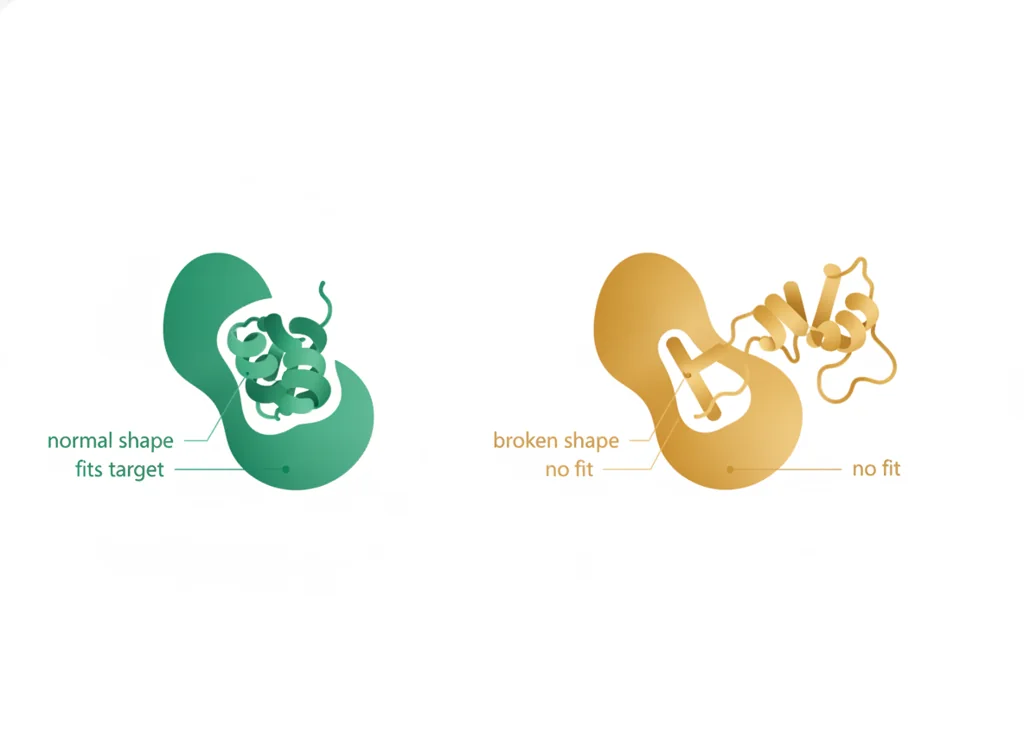
How can changing one single amino acid in a 467-amino-acid stop the whole protein from doing its job?

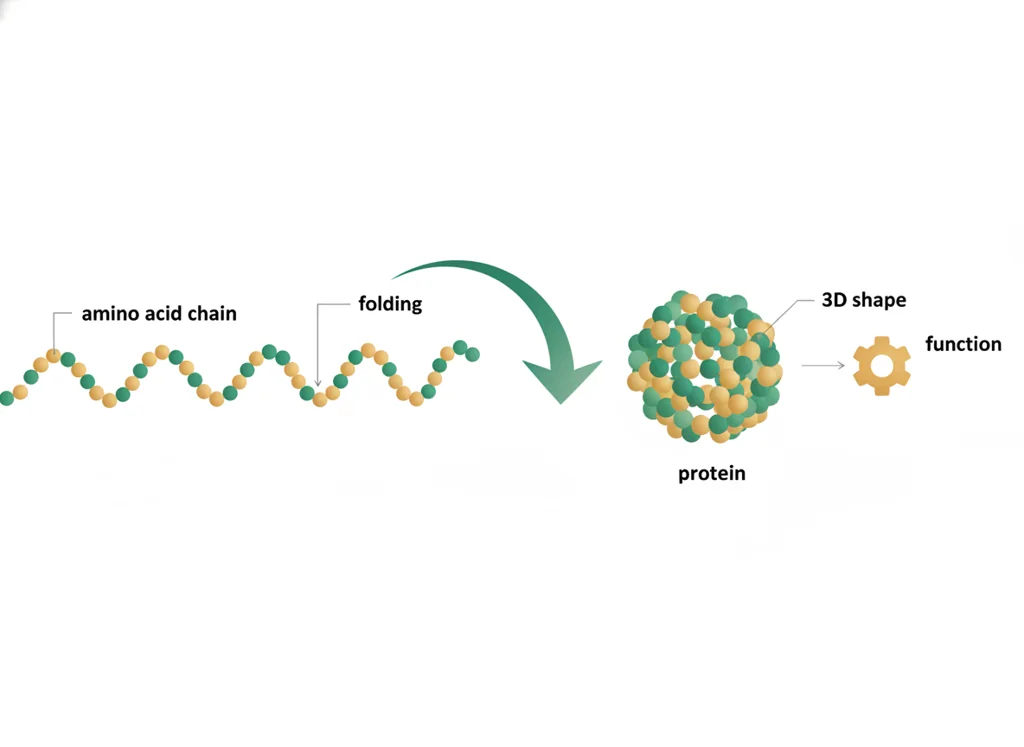
💡 Shape is function, so a change that ruins the shape ruins the function, which is why one wrong letter in the conserved can break IRF6.

The plan

Prerequisite check

Before this page, you should know
  • An ortholog is the matching version of the same gene or in a different species.
  • Conservation is how unchanged a sequence stays across species; high conservation means evolution protected it.
Today's new idea is only
Shape is function, so a change that ruins the shape ruins the function, which is why one wrong letter in the conserved can break IRF6.
Learn first

What you will learn

Goal: Use an view of the IRF6 to connect structure to function, and predict how a single change disrupts either DNA binding directly or the fold itself.

Know by the end
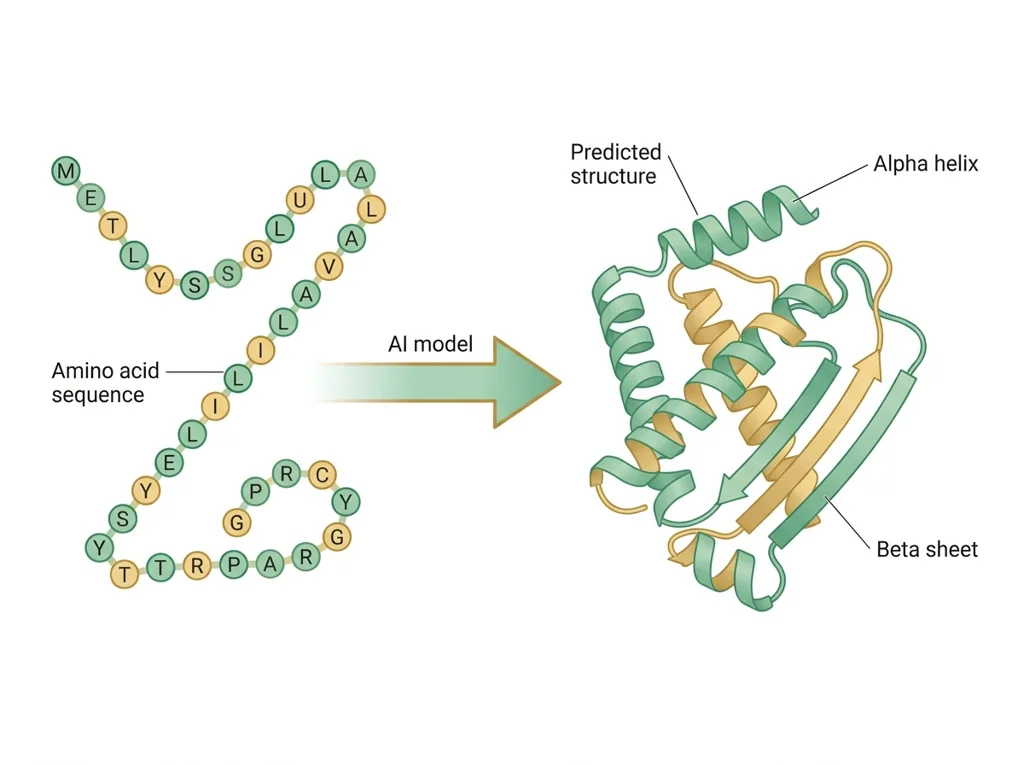
  • predicts a 's folded 3D shape from its amino-acid sequence; the IRF6 model is AF-O14896-F1.
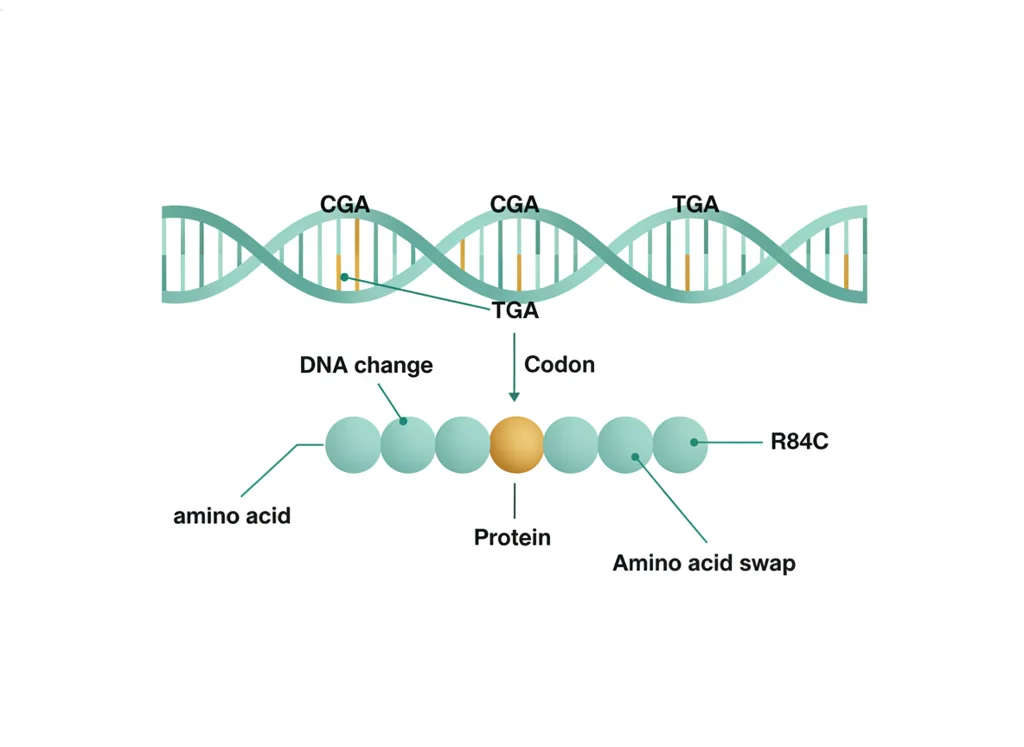
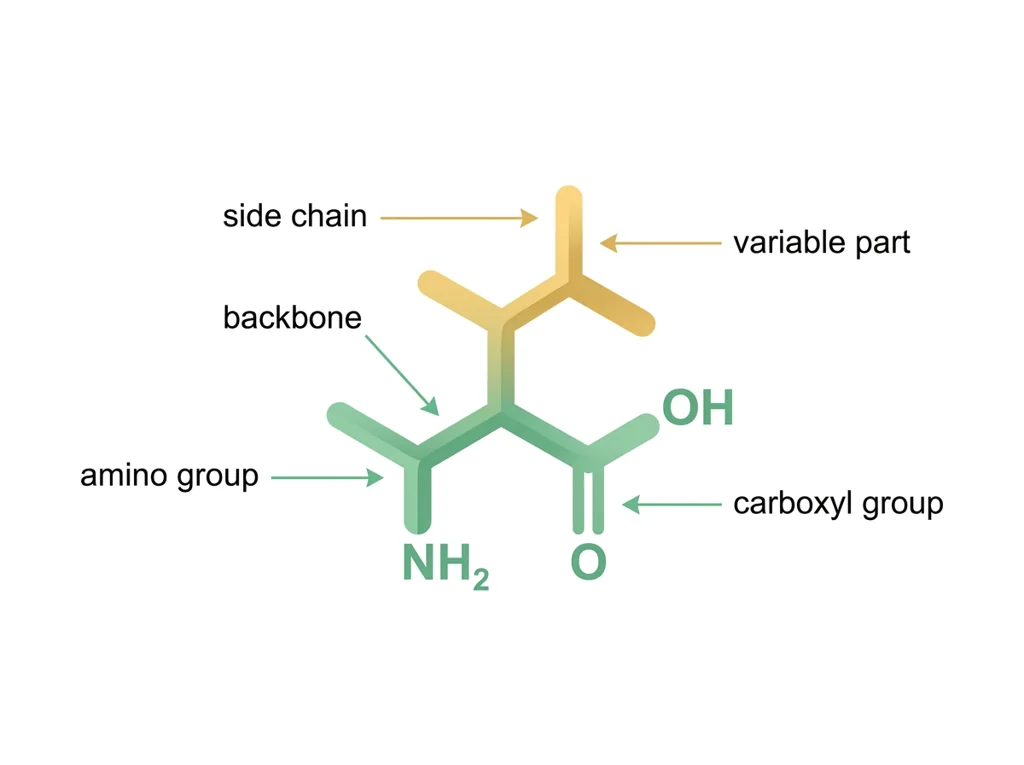
  • A swaps one amino acid for a different one; every amino acid has a with its own size and charge.
  • R84C removes a positive charge that grips the negatively charged DNA, so IRF6 cannot hold the DNA.
  • L22P puts a proline into a spot that must stay straight, kinking the fold so the whole domain misfolds even though L22 never touched the DNA.
Learn first

Model: An AlphaFold sketch of the DNA-binding domain, plus two real patient variants

The IRF6 folds into a winged-helix shape that reaches down onto a strand of DNA. Amino acid R84 (arginine) sits right on the gripping surface and reaches a long, positively charged toward the DNA backbone, which is negatively charged. Opposite charges attract, so that contact is part of how IRF6 holds on.

Two real disease variants from the Leslie 2012 and Kondo 2002 studies show two different ways one swap can break the . R84C changes arginine (long, positively charged) into cysteine (small, no charge), which is on the DNA-gripping surface and abolishes DNA binding. L22P changes leucine into proline, a kink-maker that breaks helices, deep inside the folded core; it also abolishes DNA binding even though L22 never touches the DNA. Leslie 2012 found that disease-causing changes are crowded into this and not into the .

Read this in pieces, one chunk at a time
Do the work

Explore (work the model before reading on)

  1. In the model, what is R84's doing, and what charge is it? What charge is the DNA backbone?
  2. R84C swaps a long positive for a small uncharged one. What physical grip is lost?
  3. Opposite charges attract. Explain why losing the positive charge at position 84 would make IRF6 let go of the DNA.
  4. L22 is buried inside the fold, not on the surface, yet L22P also abolishes DNA binding. How can a change far from the DNA still stop binding?
  5. Leslie 2012 found mutations crowd into the but spread out in the . Predict why a wrong amino acid in the DNA-binding domain is more likely to be disease-causing than one in the floppy linker.
The plan

Guided notes

1

Two ways one swap breaks a protein

Model start: A swaps one amino acid for a different one. Whether it matters depends on the amino acid's job in the 3D shape, because is how the chain twists into a shape, and that shape is the function.
  • First way: it removes a chemical contact. R84C removes the positive ____ that R84 used to grip the negative DNA, so IRF6 cannot hold on.
  • Second way: it wrecks the fold. L22P inserts a ____, which kinks the backbone so the whole domain misfolds.
  • This is the principle: shape is ____.
2

Why disease crowds into the conserved domain

  • Disease mutations crowd INTO the ____-binding domain, the same region Lesson 11 proved was conserved.
  • That is why a single wrong letter out of 467 can cause a : the conserved domain's shape is ____-bearing.
Explore

Reading the Research

What to read
Read the title and the abstract only, not the whole paper. Kondo et al. 2002, Mutations in IRF6 cause VWS and PPS (Nat Genet)
Why this source matters
This is the published evidence behind today's idea: Shape is function, so a change that ruins the shape ruins the function, which is why one wrong letter in the conserved can break IRF6.
Reading moves
  1. Skim the title and abstract first to get the gist.
  2. Circle the one sentence that states the main claim.
  3. Box the evidence the authors give for that claim.
  4. Mark one sentence that confuses you, and move on.
Stop point
You do not need the methods or statistics yet. If a sentence is about lab technique or math you have not learned, mark it and skip it.
Your output
Write one claim-evidence sentence: what this source claims, and the one piece of evidence that backs it up.
Lab day

Using the database (what to capture)

Part of today's expected outcome is to actually open the tool below and write down the value it gives you. That captured value is the evidence you will use in your Claim, Evidence, Reasoning. Follow the steps, use the labeled screenshot so you do not get lost, and record each field.

AlphaFold
Open the tool

Shows a predicted 3D shape of a , colored by how confident the prediction is.

When you use this: Use this when you have a variant and want to see WHERE in the folded it lands, so you can judge whether it sits in a part that matters.
What the screen looks like
alphafold.ebi.ac.uk/entry/O14896 IRF6 (O14896) 1 3D structure viewer 2 Confidence color of the DNA-binding domain Dark blue (very high) ~res 13-113 3 1 Open the IRF6 entry (O14896). 2 Find the DNA-binding domain. 3 Read the confidence color (blue = trust the shape).
A labeled map of the screen. The circled numbers match the steps.
Step by step
  1. 1Open .ebi.ac.uk and search the accession O14896 (human IRF6), or open the entry directly.
  2. 2Rotate the 3D model and find the near the front of the .
  3. 3Read the confidence color of that region from the legend (dark blue means trust the shape).
Capture these fields
  • Confidence color (pLDDT band): Dark blue = very high, light blue = confident, yellow/orange = low
  • Domain you are looking at: The DNA-binding domain near the front of the protein
  • Amino-acid range: Roughly residues 13-113
How to read it: Dark-blue regions are predicted well and you can trust their shape; yellow/orange regions are flexible or uncertain, so do not over-read them. A change inside a well-folded, high-confidence domain is more likely to matter than one in a floppy, low-confidence loop.
Lost? How to read AlphaFold confidence

The reference record for a : its length, its domains, and what each part does.

When you use this: Use this when you need to know which PART of the a variant hits, so you can predict whether it breaks a working region.
What the screen looks like
uniprot.org/uniprotkb/O14896 IRF6 human 1 Protein entry: IRF6 2 Length + domains 467 aa · DNA-binding + SMIR domains 3 1 Open the IRF6 entry (O14896). 2 Go to the Family & Domains section. 3 Read the length and which domains exist.
A labeled map of the screen. The circled numbers match the steps.
Step by step
  1. 1Open uniprot.org and search IRF6 human, then open entry O14896.
  2. 2Scroll to the Family and Domains section.
  3. 3Read the length and which domains exist (for example the ).
Capture these fields
  • Accession (the protein's ID): O14896
  • Length (amino acids): 467 aa
  • Domains / regions: A DNA-binding domain and a protein-partner (SMIR) domain
How to read it: The domains tell you which part of the does which job. A variant that lands inside the is more likely to break IRF6's -factor function than one in a spacer region.
Lost? UniProt help: reading protein domains
Where this fits
Tested on (Ohio WebXam)
Genetics of Disease · 072130
PLTW lesson
MI · Genetics domain · Molecular structure and protein function
WebXam domain
Bio-Molecular Technology
Evidence to produce
A lab report lists a variant at a residue right on the DNA-contacting surface that swaps a charged side chain for an uncharged one. In two or three sentences, predict the effect on DNA binding and state whether you would call this variant "likely damaging" or "likely tolerated," using structure-function reasoning, not a database lookup.
Lab / skill
Medical Interventions (MI) · AP Biology
Words

Vocabulary (the same words your classes use)

The plan

Track your progress today

Check these off as you work through the lesson, then submit. This tells Mr. Mendoza how you're doing so he can help the class. It does not replace turning in your producible.

Use the code Mr. Mendoza gave you, not your name. Saved on this device.

Check off as you finish
  • Read the Model and answered the Explore questions.
  • Filled in the guided notes in my own words.
  • Defined the new vocabulary with an example.
  • Opened AlphaFold and UniProt and recorded the value it gave me.
  • Built the producible: A lab report lists a variant at a residue right on the DNA-contacting surface that swaps a charged side chain for an uncharged one. In two or three sentences, predict the effect on DNA binding and state whether you would call this variant "likely damaging" or "likely tolerated," using structure-function reasoning, not a database lookup.
  • Wrote my Claim, Evidence, and Reasoning exit ticket.
Pick your period and code first.
Check yourself

Exit ticket (Claim, Evidence, Reasoning)

  • Claim: A single change in the IRF6 can stop the from working (agree or disagree).
  • Evidence: Use R84C or L22P: R84C removes a ____ on the gripping surface, or L22P inserts a ____ that breaks the fold.
  • Reasoning: By the principle, a change that ruins the ____ ruins the function, so the can no longer bind DNA.
How this is graded (rubric)
For: A lab report lists a variant at a residue right on the DNA-contacting surface that swaps a charged side chain for an uncharged one. In two or three sentences, predict the effect on DNA binding and state whether you would call this variant "likely damaging" or "likely tolerated," using structure-function reasoning, not a database lookup.
CriterionProficientDevelopingBeginning
CompleteEvery required part of the artifact is present and filled in.Most parts are present, but one is missing or left blank.Several parts are missing.
AccurateThe science and data are correct and match the evidence.Mostly correct, with a small factual slip.Key science or data is wrong.
Scientific reasoning (CER)States a claim, backs it with specific evidence, and explains the reasoning.Has a claim and evidence, but the reasoning is thin or missing.Gives an answer with no evidence or reasoning.
Professional communicationClear, organized, and labeled the way a clinician or scientist would write it.Readable but disorganized or missing labels.Hard to follow.
SubmittedTurned in the right way (Schoology for routine work) and confirmed.Turned in, but in the wrong place or unconfirmed.Not turned in.
How the model answer scores against this rubric
  • CompleteProficient: Nothing is left blank: the model fills every part of "A lab report lists a variant at a residue right on the DNA-contacting surface that swaps a charged side chain for an uncharged one. In two or three sentences, predict the effect on DNA binding and state whether you would call this variant "likely damaging" or "likely tolerated," using structure-function reasoning, not a database lookup.".
  • AccurateProficient: Every number and claim matches the case evidence.
  • Scientific reasoning (CER)Proficient: It names a claim, cites the specific evidence, and explains the reasoning, not just the answer.
  • Professional communicationProficient: It is organized and labeled like a real chart note.
  • SubmittedProficient: It would be turned in on Schoology and confirmed.
Explore

Where this leads: careers

Structural Biologist Protein Scientist

What's next: We found that one wrong amino acid in the conserved domain can stop IRF6 from gripping DNA. But a never works alone. Who switches IRF6 on, and who carries the signal once IRF6 has done its part? We chase that next.