Rough draft.This research track is under review with Dr. Atit's lab. Content and sequence may still change.
The Baby Mateo Case
Experimental Design domainBiomedical Innovations (BI)Lesson 4 of 20Your seat: Epidemiologist on the cleft research team

Studying a Cause You Cannot Assign

Discovery question

If we cannot assign a suspected harmful exposure, how can we still gather evidence about whether it raises the chance of a ?

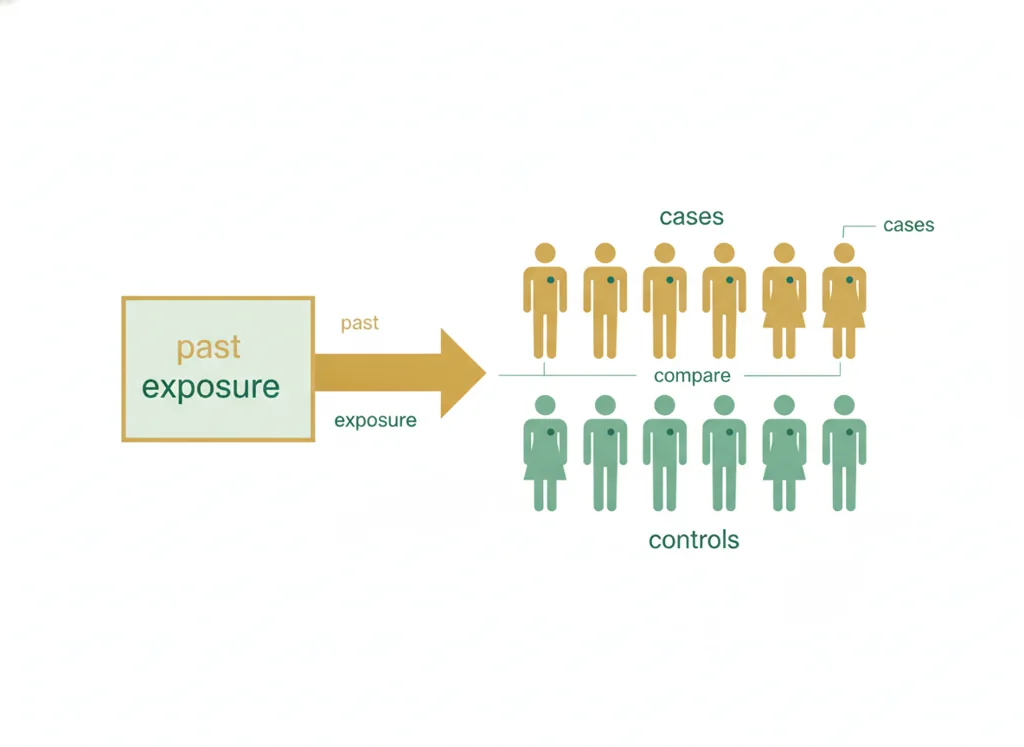
💡 A works backward from outcome to exposure, and the with its tells us whether the association is real.

The plan

Prerequisite check

Before this page, you should know
  • The () ranks designs from weaker to stronger by how well each controls bias, a feature that pushes a result away from the truth.
  • A has no comparison group; an (case-control, cohort) watches groups without assigning the exposure and can be misled by confounding.
Today's new idea is only
A works backward from outcome to exposure, and the with its tells us whether the association is real.
Learn first

What you will learn

Goal: Students will explain how a works backward from outcome to exposure, compute and interpret a simple with its , and name as its signature flaw.

Know by the end
  • A starts with the outcome (cases versus controls) and looks backward at the suspected exposure; it is the workhorse for a rare outcome like a (about 1 in 700 births).
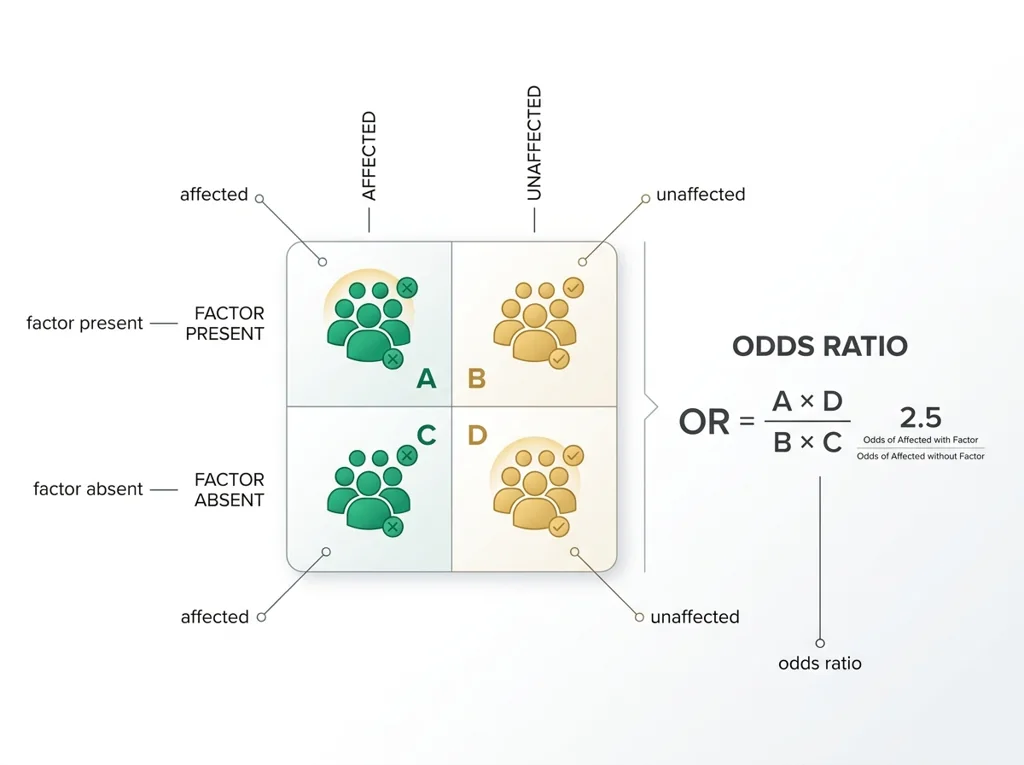
  • The is the odds of exposure in cases divided by the odds in controls; above 1 suggests a , equal to 1 means no association, below 1 means less common in cases.
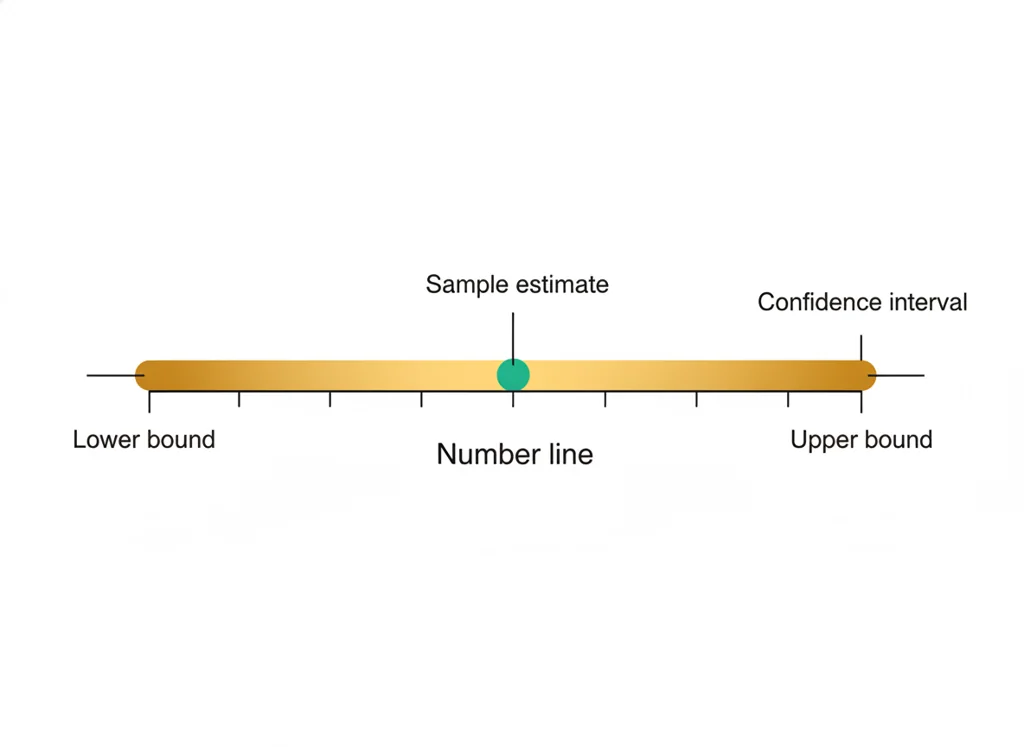
  • If the includes 1.0, the association is not statistically significant because no effect is still plausible.
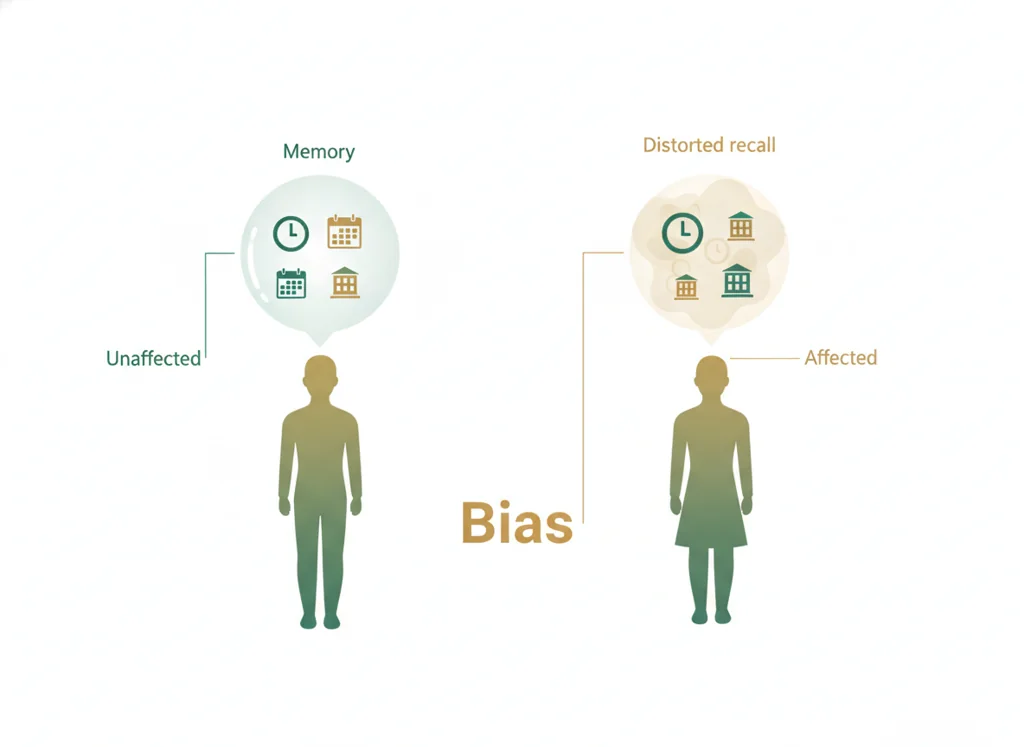
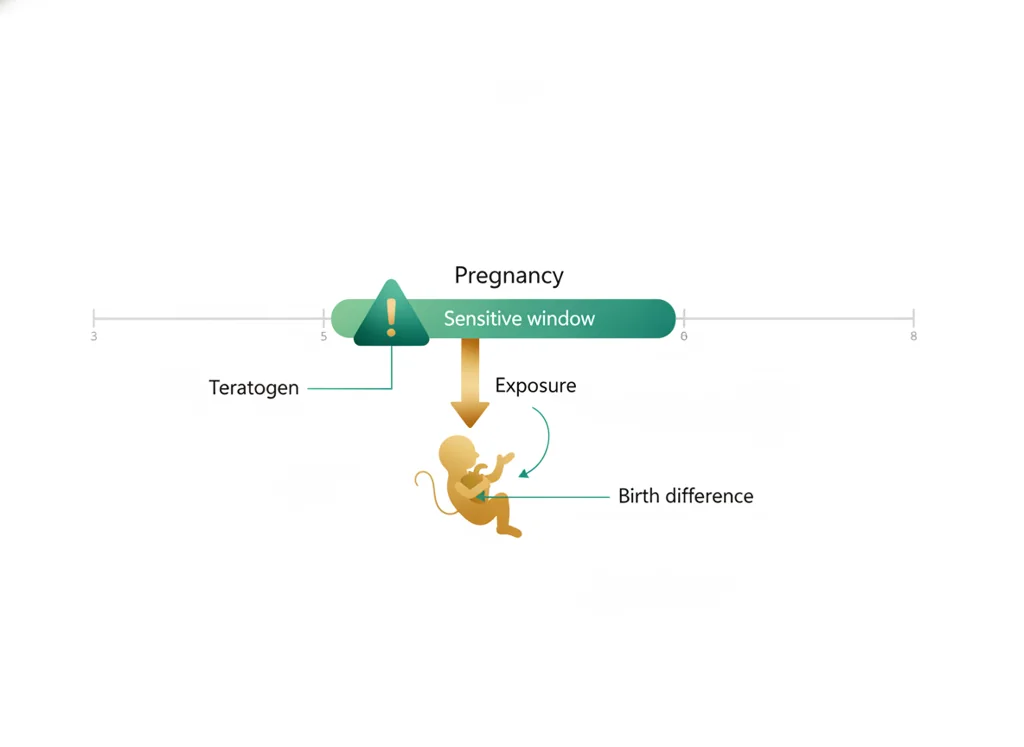
  • The signature flaw is : mothers of affected babies may remember exposures differently, which can inflate the ; a teratogen is an agent that can disrupt development.
Learn first

Model: A real case-control study, and the numbers it produces

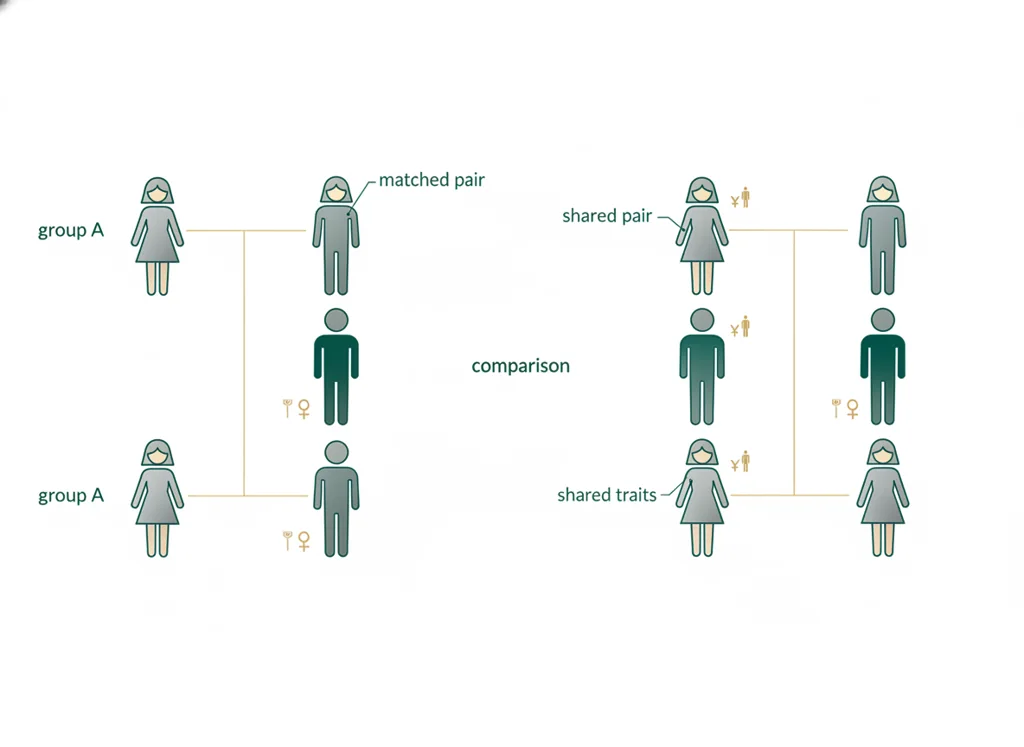
A five-country collected mothers of babies born with a non- (cases) and mothers of babies born without a (controls), matched by hospital and month of birth, and asked both groups about pregnancy exposures [PMID:37118740]. Notice the direction of the arrow: the researchers started with the outcome (cleft or no cleft) and looked backward at exposures. They did not assign anything.

To see how the math works, here is a small worked table in that same backward style. The specific cell counts are a constructed teaching dataset, not the paper's actual numbers; they are sized to give a clean for students to compute. Among 100 mothers of babies WITH a (cases): 40 reported the exposure, 60 did not. Among 100 mothers of babies WITHOUT a cleft (controls): 20 reported the exposure, 80 did not. In a 2-by-2 table, cases are 40 exposed and 60 not, controls are 20 exposed and 80 not.

Read this in pieces, one chunk at a time
Do the work

Explore (work the model before reading on)

  1. Did the researchers start by choosing exposed and unexposed mothers, or by choosing mothers of affected and unaffected babies?
  2. In the table, what fraction of cases were exposed? What fraction of controls were exposed?
  3. The odds of exposure among cases are 40 to 60. The odds among controls are 20 to 80. Divide the case odds by the control odds, (40/60) divided by (20/80). What number do you get, and is it above or below 1?
  4. Both groups were matched by hospital and month of birth. Why would the comparison be weaker if cases came from a city hospital and controls from a rural one?
  5. These mothers reported exposures after the birth, from memory. Predict how a mother who just had a baby with a might search her memory differently, and which way that would push the .
  6. In one sentence, what does a compare, and in which time direction does it look?
The plan

Guided notes

1

Working backward

Model start: A starts with the outcome and looks backward at exposure, the right design for a rare outcome like a .
  • A starts with the outcome: you gather cases (babies with a ) and controls (similar babies without one), then look ____ (backward) in time at the suspected exposure.
  • This is the workhorse for a rare outcome, because a happens in roughly 1 in 700 births and a forward study would need an enormous group to catch enough cases.
2

The odds ratio

  • OR greater than 1 means the exposure is more common in cases (a possible ); OR equal to 1 means no association; OR less than 1 means it is ____ (less) common in cases.
  • In the worked table, OR = (40/60) / (20/80) = 0.667 / 0.25 = about 2.7, meaning the odds of that exposure were about 2.7 times higher among cases.
3

Confidence interval and recall bias

  • We report a around the OR; if the interval includes 1.0, the association is not statistically significant because no effect is still plausible.
  • The signature flaw is : mothers of an affected baby may remember pregnancy exposures more intensely, which can inflate the OR; a also cannot give the true population rate of clefts.
Explore

Reading the Research

Why this source matters
This is the published evidence behind today's idea: A works backward from outcome to exposure, and the with its tells us whether the association is real.
Words to unlock first
case-control studyexposureodds ratio95 percent confidence intervalrecall bias
Reading moves
  1. Skim the title and abstract first to get the gist.
  2. Circle the one sentence that states the main claim.
  3. Box the evidence the authors give for that claim.
  4. Mark one sentence that confuses you, and move on.
Stop point
You do not need the methods or statistics yet. If a sentence is about lab technique or math you have not learned, mark it and skip it.
Your output
Write one claim-evidence sentence: what this source claims, and the one piece of evidence that backs it up.
Where this fits
Tested on (Ohio WebXam)
Genetics of Disease · 072130
PLTW lesson
MI · Experimental Design domain · Epidemiology, risk factors, and the case-control design
WebXam domain
Bio-Molecular Technology
Evidence to produce
For a different exposure (cases: 30 exposed, 70 not; controls: 15 exposed, 85 not) build the 2-by-2 table, compute the odds ratio, decide using a reported 95 percent CI of 0.9 to 3.4 whether the association is significant, and write one recall-bias concern to raise before anyone calls the exposure a cause.
Lab / skill
Biomedical Innovations (BI) · Medical Interventions (MI)
Words

Vocabulary (the same words your classes use)

The plan

Track your progress today

Check these off as you work through the lesson, then submit. This tells Mr. Mendoza how you're doing so he can help the class. It does not replace turning in your producible.

Use the code Mr. Mendoza gave you, not your name. Saved on this device.

Check off as you finish
  • Read the Model and answered the Explore questions.
  • Filled in the guided notes in my own words.
  • Defined the new vocabulary with an example.
  • Built the producible: For a different exposure (cases: 30 exposed, 70 not; controls: 15 exposed, 85 not) build the 2-by-2 table, compute the odds ratio, decide using a reported 95 percent CI of 0.9 to 3.4 whether the association is significant, and write one recall-bias concern to raise before anyone calls the exposure a cause.
  • Wrote my Claim, Evidence, and Reasoning exit ticket.
Pick your period and code first.
Check yourself

Exit ticket (Claim, Evidence, Reasoning)

  • Claim: The worked exposure in Model 1 is associated with higher odds of a .
  • Evidence: The is about ____, and an OR above 1 means the exposure was ____ common among cases.
  • Reasoning: A can show this association without anyone assigning the exposure, but the link might still not be a true cause because of ____ ( or confounding).
How this is graded (rubric)
For: For a different exposure (cases: 30 exposed, 70 not; controls: 15 exposed, 85 not) build the 2-by-2 table, compute the odds ratio, decide using a reported 95 percent CI of 0.9 to 3.4 whether the association is significant, and write one recall-bias concern to raise before anyone calls the exposure a cause.
CriterionProficientDevelopingBeginning
CompleteEvery required part of the artifact is present and filled in.Most parts are present, but one is missing or left blank.Several parts are missing.
AccurateThe science and data are correct and match the evidence.Mostly correct, with a small factual slip.Key science or data is wrong.
Scientific reasoning (CER)States a claim, backs it with specific evidence, and explains the reasoning.Has a claim and evidence, but the reasoning is thin or missing.Gives an answer with no evidence or reasoning.
Professional communicationClear, organized, and labeled the way a clinician or scientist would write it.Readable but disorganized or missing labels.Hard to follow.
SubmittedTurned in the right way (Schoology for routine work) and confirmed.Turned in, but in the wrong place or unconfirmed.Not turned in.
How the model answer scores against this rubric
  • CompleteProficient: Nothing is left blank: the model fills every part of "For a different exposure (cases: 30 exposed, 70 not; controls: 15 exposed, 85 not) build the 2-by-2 table, compute the odds ratio, decide using a reported 95 percent CI of 0.9 to 3.4 whether the association is significant, and write one recall-bias concern to raise before anyone calls the exposure a cause.".
  • AccurateProficient: Every number and claim matches the case evidence.
  • Scientific reasoning (CER)Proficient: It names a claim, cites the specific evidence, and explains the reasoning, not just the answer.
  • Professional communicationProficient: It is organized and labeled like a real chart note.
  • SubmittedProficient: It would be turned in on Schoology and confirmed.
Explore

Where this leads: careers

Epidemiologist Public health researcher Biostatistician

What's next: The case-control design lets us chase causes from the outside world without assigning harm. But Mateo's sparse family history keeps nagging us. How would we measure how much of risk is inherited rather than environmental, when you cannot give a memory questionnaire about DNA?