Rough draft.This research track is under review with Dr. Atit's lab. Content and sequence may still change.
The Baby Mateo Case
Experimental Design domainBiomedical Innovations (BI)Lesson 15 of 20Your seat: Study coordinator (outcome-measurement seat)

How Do You Measure Something as Fuzzy as Speech?

Discovery question

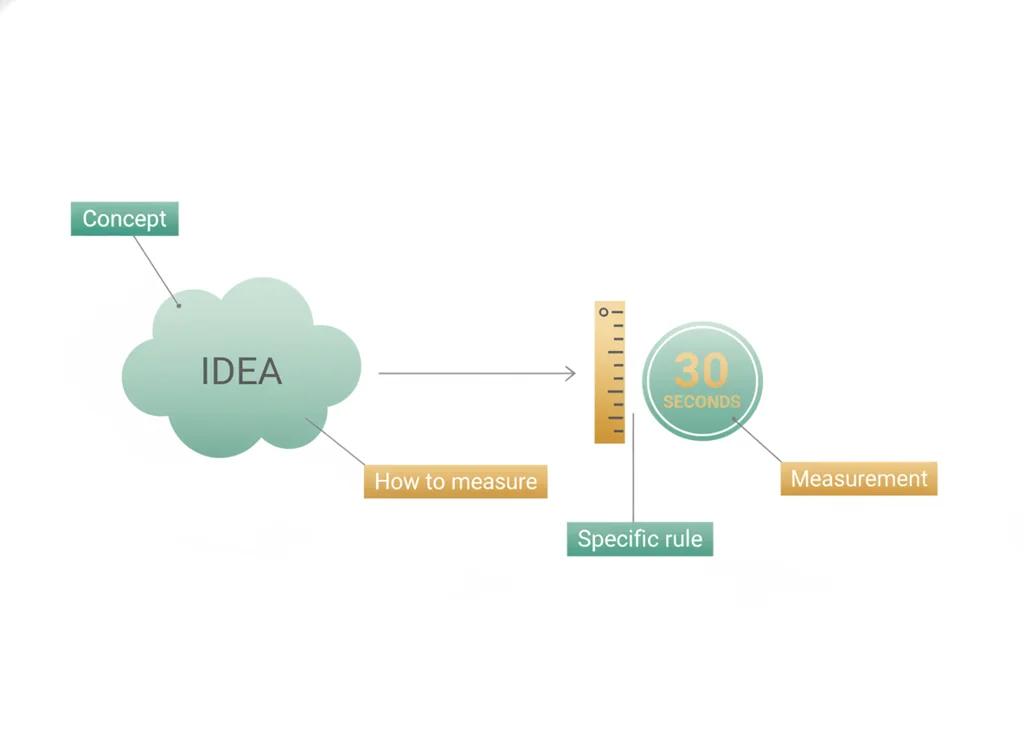
How do you turn a fuzzy idea like 'good speech' into something you can measure fairly and identically for hundreds of different children?

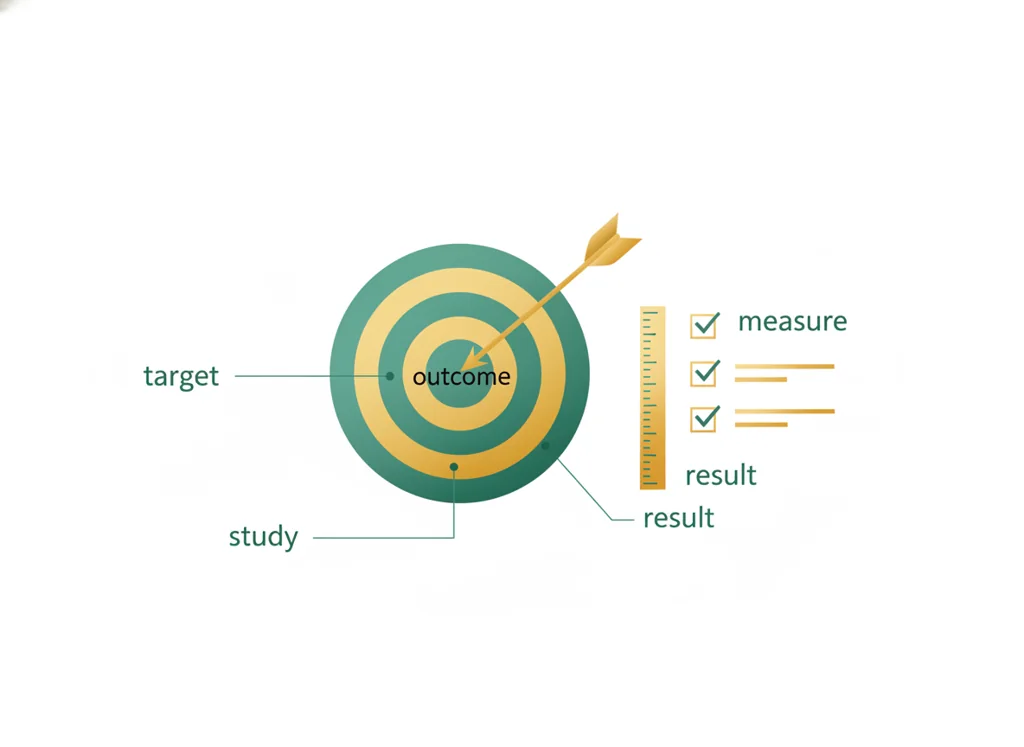
💡 An plus standardization turns a fuzzy concept into a comparable measure, and a captures success a clinician's score can miss.

The plan

Prerequisite check

Before this page, you should know
  • TOPS compared repair at 6 months versus 12 months in 558 infants across 23 centers in five countries, excluding syndromic and severely delayed children.
  • The was at 5 years; rates were 8.9% (21 of 235) at 6 months and 15.0% (34 of 226) at 12 months.
Today's new idea is only
An plus standardization turns a fuzzy concept into a comparable measure, and a captures success a clinician's score can miss.
Learn first

What you will learn

Goal: Turn a fuzzy concept like 'good speech' into a defined, standardized , and explain why patient-reported outcomes capture success a clinician's score can miss.

Know by the end
  • An is the specific, defined thing a study counts; an is the exact written rule for what you observe and how you score it.
  • TOPS did not score 'good speech'; it scored a velopharyngeal composite (VPC-Sum) from 0 to 6 on a fixed single-word test, with 4 or higher defined as insufficiency.
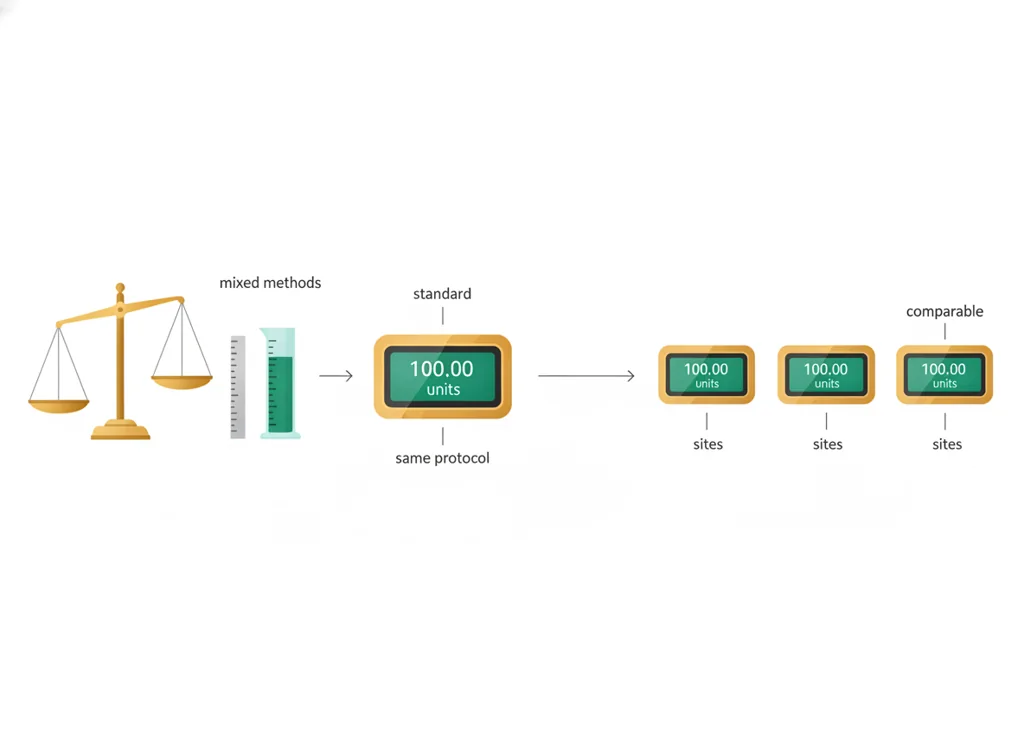
  • Standardization means everyone measures the same way (same test, sounds, scoring rules, training); TOPS used blinded central assessors and had half the tests scored by a second therapist as a consistency check.
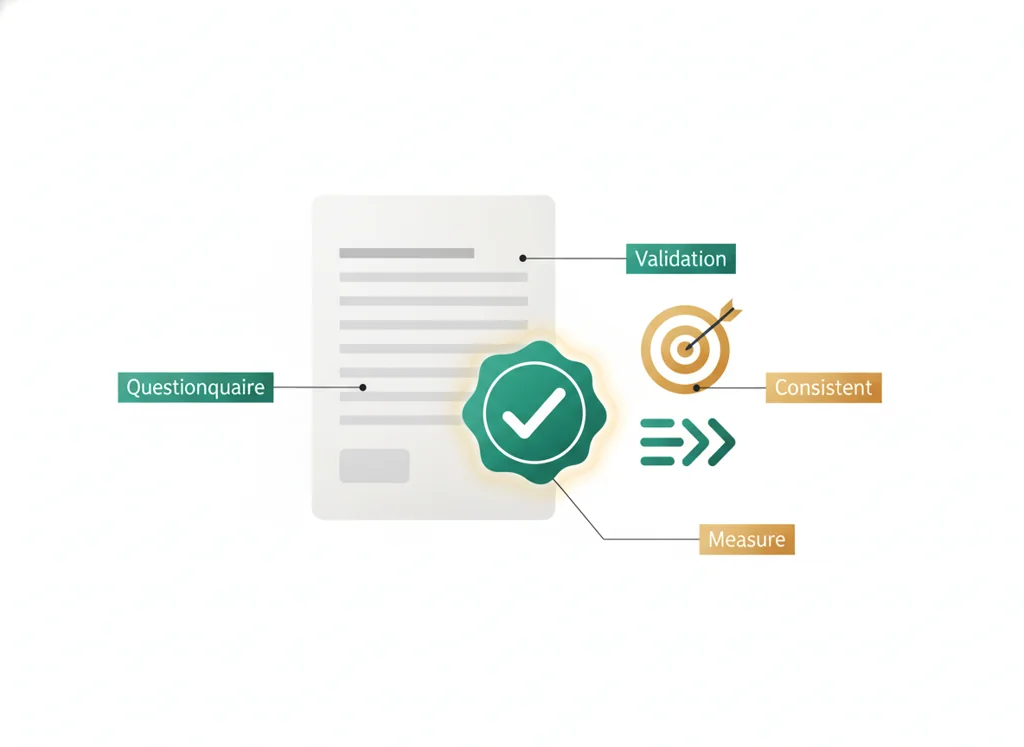
  • A is reported by the patient or family, not a clinician, and the strongest PROs use a ; a can score as a clinical success while the child is still unhappy with how they sound.
Learn first

Model: Two ways to measure speech, and two kinds of success

A team wants to record whether each 5-year-old's speech is acceptable. In Approach A, each local clinician listens to their own patients and writes 'sounds fine' or 'sounds off,' using their own judgment. In Approach B, every child takes the same single-word test using the same target sounds; three trained speech therapists, working at one central site and unaware of which surgery the child had, rate specific features (is it nasal, is air escaping through the nose, are pressure sounds weak) and combine them into a defined score from 0 to 6, where 4 or higher counts as the speech problem. Approach B is what TOPS actually did: its was a velopharyngeal composite score (VPC-Sum) from standardized single-word tests scored by blinded central assessors.

Then there are two kinds of success. A clinician measure asks whether the closes properly during speech, observed by a trained professional. A patient or family measure asks whether Mateo feels understood by friends, likes how he sounds, and avoids being teased, reported by Mateo and his family. A palate can score as anatomically successful while the child is still unhappy with how they sound, and the reverse can happen too. Both questions are real; they are not the same question.

Read this in pieces, one chunk at a time
Do the work

Explore (work the model before reading on)

  1. What exactly is the same for every child in Approach B that is not the same in Approach A?
  2. Who reports the outcome in the clinician measure, and who reports it in the patient or family measure?
  3. Why would Approach A make it impossible to fairly compare the 6-month and 12-month groups, even if every clinician is honest and skilled?
  4. Why might a child's score as a surgical success while that same child still reports being unhappy with their speech? What does the patient measure capture that the clinician score misses?
  5. Imagine TOPS had used Approach A instead of a standardized, blinded score. Predict one specific way the trial's headline result could have been distorted, even with no one cheating.
The plan

Guided notes

1

Operational definition and standardization

Model start: The trick is moving from a vague concept ('good speech') to an exact, written rule for what you will observe and how you will score it, so anyone could in principle apply the same rule.
  • TOPS did not score 'good speech'; it scored a velopharyngeal composite of 0 to ____ from a fixed single-word test, with 4 or higher defined as insufficiency.
  • Standardization means the same test, the same sounds, the same scoring rules, the same training; TOPS scored recordings centrally while ____ (aware / unaware) of each child's timing group.
  • Without standardization, a difference between groups could just be a difference in how people ____ (measured / felt), not a real difference in the children.
2

Patient-reported outcomes

  • A is reported by the patient or ____, not a clinician: how the child feels about their speech, appearance, or quality of life.
  • The strongest PROs use a ____ instrument, a questionnaire tested in advance to confirm it measures what it claims, consistently.
  • A complete picture of 'did it work' needs both a standardized clinician measure and a ____ measure; a trial that measures only one tells half the story.
Explore

Reading the Research

What to read
Why this source matters
This is the published evidence behind today's idea: An plus standardization turns a fuzzy concept into a comparable measure, and a captures success a clinician's score can miss.
Words to unlock first
outcome measureoperational definitionstandardizationpatient-reported outcomevalidated instrument
Reading moves
  1. Skim the title and abstract first to get the gist.
  2. Circle the one sentence that states the main claim.
  3. Box the evidence the authors give for that claim.
  4. Mark one sentence that confuses you, and move on.
Stop point
You do not need the methods or statistics yet. If a sentence is about lab technique or math you have not learned, mark it and skip it.
Your output
Write one claim-evidence sentence: what this source claims, and the one piece of evidence that backs it up.
Where this fits
Tested on (Ohio WebXam)
Genetics of Disease · 072130
PLTW lesson
MI · Experimental Design domain · Defining and standardizing outcome measures; patient-reported outcomes and validated instruments
WebXam domain
Bio-Molecular Technology
Evidence to produce
Your team will study whether a new feeding-support program helps cleft infants. A colleague writes the outcome as 'babies will feed better.' As study coordinator, sharpen it. (1) Rewrite 'feed better' as an operational definition: one specific, countable thing you will measure. (2) Name one standardization step so every site measures it the same way. (3) Add one family-reported outcome the clinician measure would miss. (4) In one sentence, say why you want both.
Lab / skill
Biomedical Innovations (BI) · AP Biology
Words

Vocabulary (the same words your classes use)

The plan

Track your progress today

Check these off as you work through the lesson, then submit. This tells Mr. Mendoza how you're doing so he can help the class. It does not replace turning in your producible.

Use the code Mr. Mendoza gave you, not your name. Saved on this device.

Check off as you finish
  • Read the Model and answered the Explore questions.
  • Filled in the guided notes in my own words.
  • Defined the new vocabulary with an example.
  • Built the producible: Your team will study whether a new feeding-support program helps cleft infants. A colleague writes the outcome as 'babies will feed better.' As study coordinator, sharpen it. (1) Rewrite 'feed better' as an operational definition: one specific, countable thing you will measure. (2) Name one standardization step so every site measures it the same way. (3) Add one family-reported outcome the clinician measure would miss. (4) In one sentence, say why you want both.
  • Wrote my Claim, Evidence, and Reasoning exit ticket.
Pick your period and code first.
Check yourself

Exit ticket (Claim, Evidence, Reasoning)

  • Claim: A trial's conclusion is only as trustworthy as its ( / / funding).
  • Evidence: Use the contrast between Approach A and Approach B, and one real standardization step from TOPS (blinded central assessors, fixed single-word test, or second-rater check).
  • Reasoning: Explain how an plus standardization makes a fuzzy outcome like speech comparable across hundreds of children, and why a adds something the clinician score alone cannot.
How this is graded (rubric)
For: Your team will study whether a new feeding-support program helps cleft infants. A colleague writes the outcome as 'babies will feed better.' As study coordinator, sharpen it. (1) Rewrite 'feed better' as an operational definition: one specific, countable thing you will measure. (2) Name one standardization step so every site measures it the same way. (3) Add one family-reported outcome the clinician measure would miss. (4) In one sentence, say why you want both.
CriterionProficientDevelopingBeginning
CompleteEvery required part of the artifact is present and filled in.Most parts are present, but one is missing or left blank.Several parts are missing.
AccurateThe science and data are correct and match the evidence.Mostly correct, with a small factual slip.Key science or data is wrong.
Scientific reasoning (CER)States a claim, backs it with specific evidence, and explains the reasoning.Has a claim and evidence, but the reasoning is thin or missing.Gives an answer with no evidence or reasoning.
Professional communicationClear, organized, and labeled the way a clinician or scientist would write it.Readable but disorganized or missing labels.Hard to follow.
SubmittedTurned in the right way (Schoology for routine work) and confirmed.Turned in, but in the wrong place or unconfirmed.Not turned in.
How the model answer scores against this rubric
  • CompleteProficient: Nothing is left blank: the model fills every part of "Your team will study whether a new feeding-support program helps cleft infants. A colleague writes the outcome as 'babies will feed better.' As study coordinator, sharpen it. (1) Rewrite 'feed better' as an operational definition: one specific, countable thing you will measure. (2) Name one standardization step so every site measures it the same way. (3) Add one family-reported outcome the clinician measure would miss. (4) In one sentence, say why you want both.".
  • AccurateProficient: Every number and claim matches the case evidence.
  • Scientific reasoning (CER)Proficient: It names a claim, cites the specific evidence, and explains the reasoning, not just the answer.
  • Professional communicationProficient: It is organized and labeled like a real chart note.
  • SubmittedProficient: It would be turned in on Schoology and confirmed.
Explore

Where this leads: careers

Clinical Research Coordinator Speech-Language Pathologist Outcomes Researcher

What's next: We now know how to measure a fuzzy outcome like speech carefully and the same way for every child. But even a perfectly measured outcome can still point us to the wrong cause. A real trial once found its result was driven not by the treatment but by something hiding in the background. What could fool us, even when our measurements are flawless? We chase that next time.