Rough draft.This research track is under review with Dr. Atit's lab. Content and sequence may still change.
The Baby Mateo Case
Experimental Design domainBiomedical Innovations (BI)Lesson 13 of 20Your seat: Principal Investigator (clinical-trial design seat)

The Fairest Test: How to Compare Two Treatments in Real Children

Discovery question

When you cannot control a child's biology, what makes a comparison of two treatments actually fair?

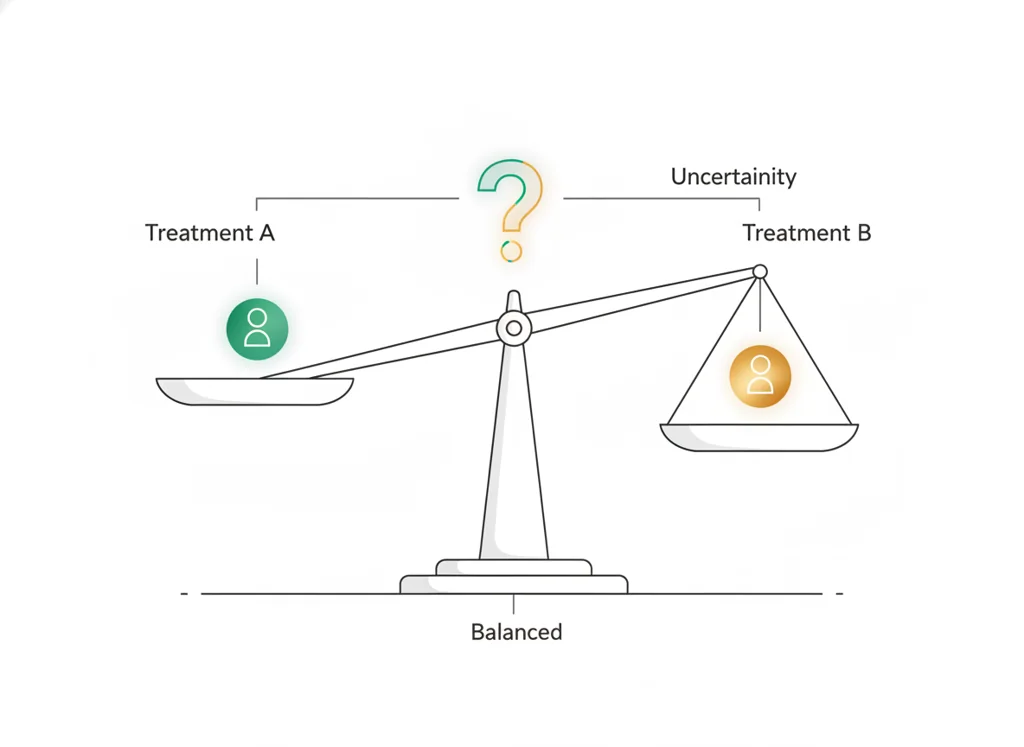
💡 Randomization, , and intention-to-treat analysis make a two-treatment comparison fair, and equipoise is what makes randomizing ethical in the first place.

The plan

Prerequisite check

Before this page, you should know
  • A removes a gene to see what fails; by itself it shows the gene is needed but does not prove the gene, and nothing else, caused the defect.
  • A deletes a possible backup gene (here Ezh1) to rule out that the backup, not your gene, explains the result; losing Ezh1 alone did nothing to the .
Today's new idea is only
Randomization, , and intention-to-treat analysis make a two-treatment comparison fair, and equipoise is what makes randomizing ethical in the first place.
Learn first

What you will learn

Goal: Explain how randomization, , and intention-to-treat make a two-treatment comparison fair, and identify each, plus equipoise, in a study description.

Know by the end
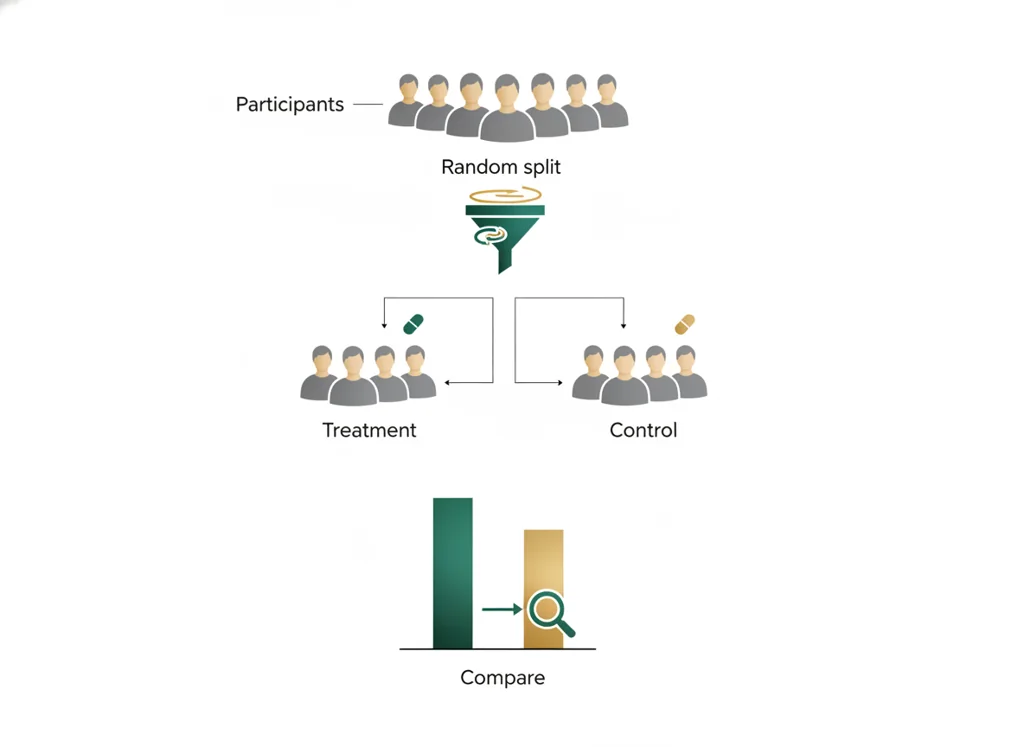
  • A assigns patients to treatments by a chance process, and it is the strongest design for a question about which treatment causes a better outcome.
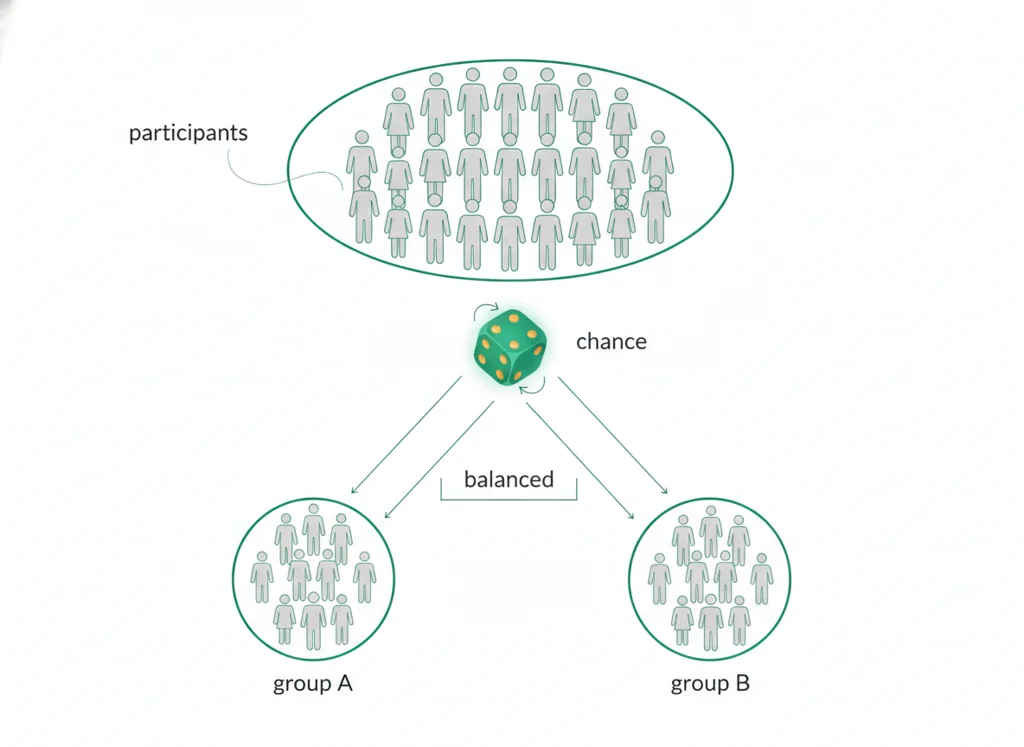
  • Randomization spreads every trait, even traits never measured, roughly evenly across groups, so any difference in outcome is believably due to the treatment.
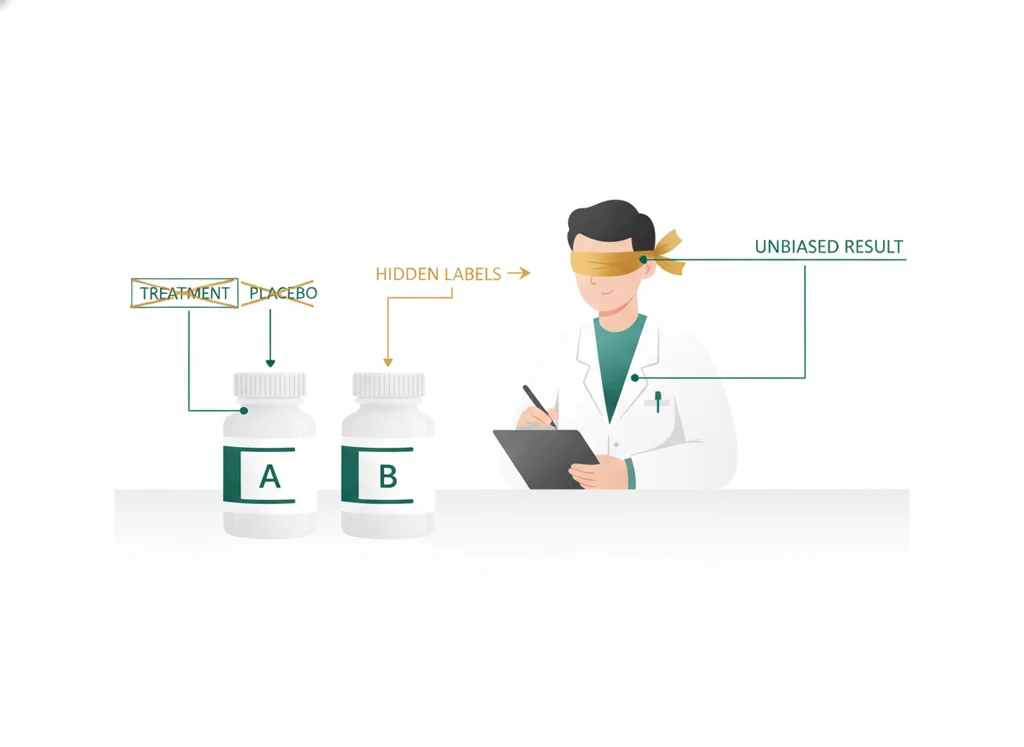
  • keeps the outcome assessor unaware of group assignment; a surgeon cannot be blinded, so TOPS blinded the central speech assessors who scored children at age 5.
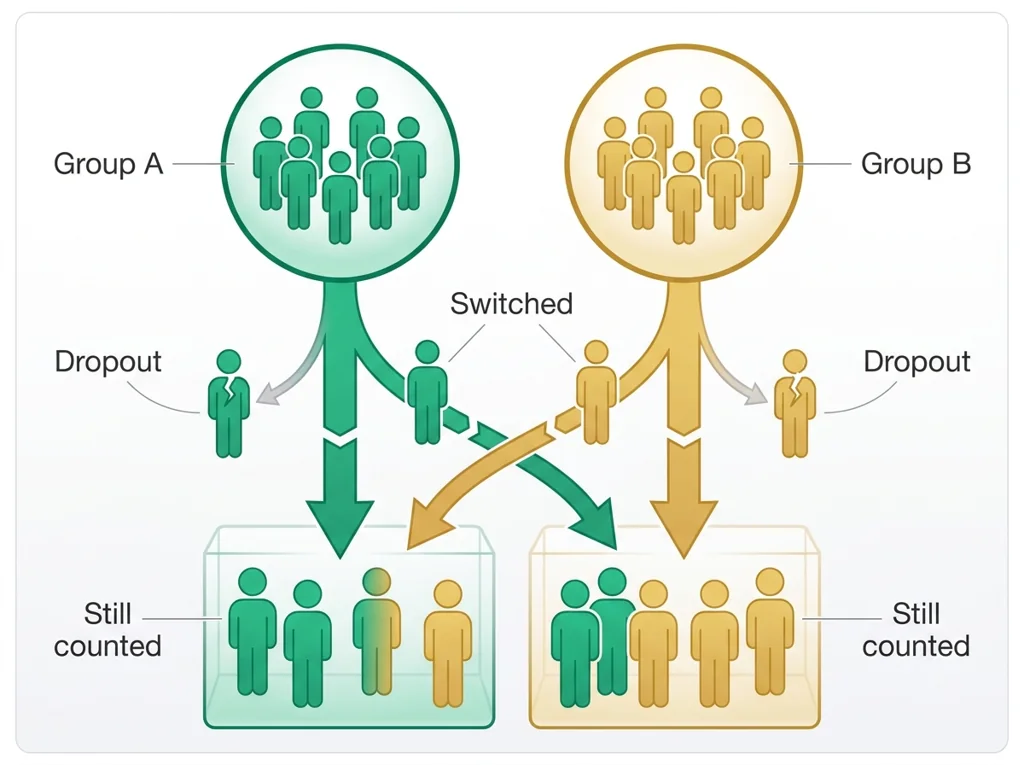
  • Intention-to-treat analyzes each patient in the group they were assigned to, even if their treatment changed, which protects the balance randomization built; equipoise (genuine uncertainty) is required before it is ethical to randomize.
Learn first

Model: Two ways to assign treatment, and a real trial's fairness machinery

Imagine a clinic comparing Surgery A and Surgery B for . In Clinic 1 the surgeon gives the healthier, simpler babies Surgery A and the more fragile babies Surgery B, because that feels safest. In Clinic 2 a computer randomly assigns A or B for every eligible baby, ignoring everything about the baby. After a year, Clinic 1 reports Surgery A had far better outcomes. But the healthier babies were funneled into A, so A's group was advantaged before any surgery.

The real TOPS trial compared repair at 6 months versus 12 months in 558 infants and shows the fix. A web-based randomization algorithm assigned each eligible infant to a group 1:1, not by surgeon preference. The speech assessors who scored the children at age 5 were unaware of which group each child was in. And the main analysis kept each child in the group they were first assigned to, even if their care later changed. A surgeon always knows what operation they performed, so TOPS blinded the people who mattered most for a fuzzy outcome: the central speech assessors.

Read this in pieces, one chunk at a time
Do the work

Explore (work the model before reading on)

  1. Who decided which baby got which surgery in Clinic 1? In Clinic 2?
  2. In Clinic 1, the healthier babies were funneled into Surgery A. Why does that make 'Surgery A had better outcomes' impossible to trust, even if the number is real?
  3. A coin flip cannot know whether a baby is fragile or healthy. So what does random assignment do to the fragile and healthy babies across the two groups, on average?
  4. Suppose the speech assessor knew which children had the newer, exciting surgery. Predict one way their scoring might drift, and how blocks that.
  5. Why can TOPS blind the speech assessors but not the surgeon?
The plan

Guided notes

1

Randomization and blinding

Model start: A compares treatments by assigning patients to groups at random; it is the strongest design for a which-treatment-is-better question.
  • Randomization means a chance process, not a person's judgment, decides who gets which treatment, so over many patients every trait spreads roughly ____ (evenly / unevenly) across groups.
  • means keeping someone unaware of the assignment; when the person measuring the outcome does not know the group, their expectations cannot ____ (color / sharpen) the score.
  • TOPS could not blind the ____, who always knows what they did, so it blinded the central speech assessors instead.
2

Intention-to-treat and equipoise

  • Intention-to-treat means analyzing each patient in the group they were ____ to, even if their treatment later changed, which protects the balance randomization built.
  • Equipoise means it is only fair to randomize when the expert community genuinely does not ____ which option is better.
  • A sham (fake) surgery is generally unacceptable in children, so a surgical RCT compares two ____ treatments, never treatment versus a pretend operation.
Explore

Reading the Research

What to read
Read the title and the abstract only, not the whole paper. Gamble et al. 2023, Timing of Primary Surgery for Cleft Palate (TOPS trial, NEJM)
Why this source matters
This is the published evidence behind today's idea: Randomization, , and intention-to-treat analysis make a two-treatment comparison fair, and equipoise is what makes randomizing ethical in the first place.
Words to unlock first
randomized controlled trialrandomizationblindingintention-to-treatequipoise
Reading moves
  1. Skim the title and abstract first to get the gist.
  2. Circle the one sentence that states the main claim.
  3. Box the evidence the authors give for that claim.
  4. Mark one sentence that confuses you, and move on.
Stop point
You do not need the methods or statistics yet. If a sentence is about lab technique or math you have not learned, mark it and skip it.
Your output
Write one claim-evidence sentence: what this source claims, and the one piece of evidence that backs it up.
Where this fits
Tested on (Ohio WebXam)
Genetics of Disease · 072130
PLTW lesson
MI · Experimental Design domain · Randomized controlled trial design; randomization, blinding, intention-to-treat, equipoise
WebXam domain
Bio-Molecular Technology
Evidence to produce
A colleague proposes: to find the better cleft palate surgery, let each family pick Surgery A or B, then compare the groups after five years. As PI, redesign this into a fair trial. (1) Replace the family-picks step with one sentence describing randomization. (2) Add one sentence describing who you would blind and why the surgeon cannot be blinded. (3) State the intention-to-treat rule for a child assigned A whose family later switched to B. (4) Name the one condition (equipoise) that must be true before it is even ethical to randomize.
Lab / skill
Biomedical Innovations (BI) · AP Biology
Words

Vocabulary (the same words your classes use)

The plan

Track your progress today

Check these off as you work through the lesson, then submit. This tells Mr. Mendoza how you're doing so he can help the class. It does not replace turning in your producible.

Use the code Mr. Mendoza gave you, not your name. Saved on this device.

Check off as you finish
  • Read the Model and answered the Explore questions.
  • Filled in the guided notes in my own words.
  • Defined the new vocabulary with an example.
  • Built the producible: A colleague proposes: to find the better cleft palate surgery, let each family pick Surgery A or B, then compare the groups after five years. As PI, redesign this into a fair trial. (1) Replace the family-picks step with one sentence describing randomization. (2) Add one sentence describing who you would blind and why the surgeon cannot be blinded. (3) State the intention-to-treat rule for a child assigned A whose family later switched to B. (4) Name the one condition (equipoise) that must be true before it is even ethical to randomize.
  • Wrote my Claim, Evidence, and Reasoning exit ticket.
Pick your period and code first.
Check yourself

Exit ticket (Claim, Evidence, Reasoning)

  • Claim: A gives a (more / less) trustworthy answer about which treatment is better than letting surgeons or families choose.
  • Evidence: Use the Clinic 1 versus Clinic 2 contrast and at least one feature of TOPS (randomization, , or intention-to-treat).
  • Reasoning: Explain how random assignment makes the groups comparable, so the treatment becomes the believable cause of any difference.
How this is graded (rubric)
For: A colleague proposes: to find the better cleft palate surgery, let each family pick Surgery A or B, then compare the groups after five years. As PI, redesign this into a fair trial. (1) Replace the family-picks step with one sentence describing randomization. (2) Add one sentence describing who you would blind and why the surgeon cannot be blinded. (3) State the intention-to-treat rule for a child assigned A whose family later switched to B. (4) Name the one condition (equipoise) that must be true before it is even ethical to randomize.
CriterionProficientDevelopingBeginning
CompleteEvery required part of the artifact is present and filled in.Most parts are present, but one is missing or left blank.Several parts are missing.
AccurateThe science and data are correct and match the evidence.Mostly correct, with a small factual slip.Key science or data is wrong.
Scientific reasoning (CER)States a claim, backs it with specific evidence, and explains the reasoning.Has a claim and evidence, but the reasoning is thin or missing.Gives an answer with no evidence or reasoning.
Professional communicationClear, organized, and labeled the way a clinician or scientist would write it.Readable but disorganized or missing labels.Hard to follow.
SubmittedTurned in the right way (Schoology for routine work) and confirmed.Turned in, but in the wrong place or unconfirmed.Not turned in.
How the model answer scores against this rubric
  • CompleteProficient: Nothing is left blank: the model fills every part of "A colleague proposes: to find the better cleft palate surgery, let each family pick Surgery A or B, then compare the groups after five years. As PI, redesign this into a fair trial. (1) Replace the family-picks step with one sentence describing randomization. (2) Add one sentence describing who you would blind and why the surgeon cannot be blinded. (3) State the intention-to-treat rule for a child assigned A whose family later switched to B. (4) Name the one condition (equipoise) that must be true before it is even ethical to randomize.".
  • AccurateProficient: Every number and claim matches the case evidence.
  • Scientific reasoning (CER)Proficient: It names a claim, cites the specific evidence, and explains the reasoning, not just the answer.
  • Professional communicationProficient: It is organized and labeled like a real chart note.
  • SubmittedProficient: It would be turned in on Schoology and confirmed.
Explore

Where this leads: careers

Clinical Trialist Biostatistician Pediatric Surgeon

What's next: We can design a fair trial on paper. But for Mateo's care, families face a real fight that lasted decades: at what age should a be repaired? Earlier might help speech, but might harm facial growth. How did scientists run a real trial to settle that exact question, and what did they decide? We chase that next time.