Rough draft.This research track is under review with Dr. Atit's lab. Content and sequence may still change.
The Baby Mateo Case
Experimental Design domainBiomedical Innovations (BI)Lesson 12 of 20Your seat: Lab scientist (causal-inference bench seat)

Knock It Out, Then Put It Back: Proving a Gene Causes a Defect

Discovery question

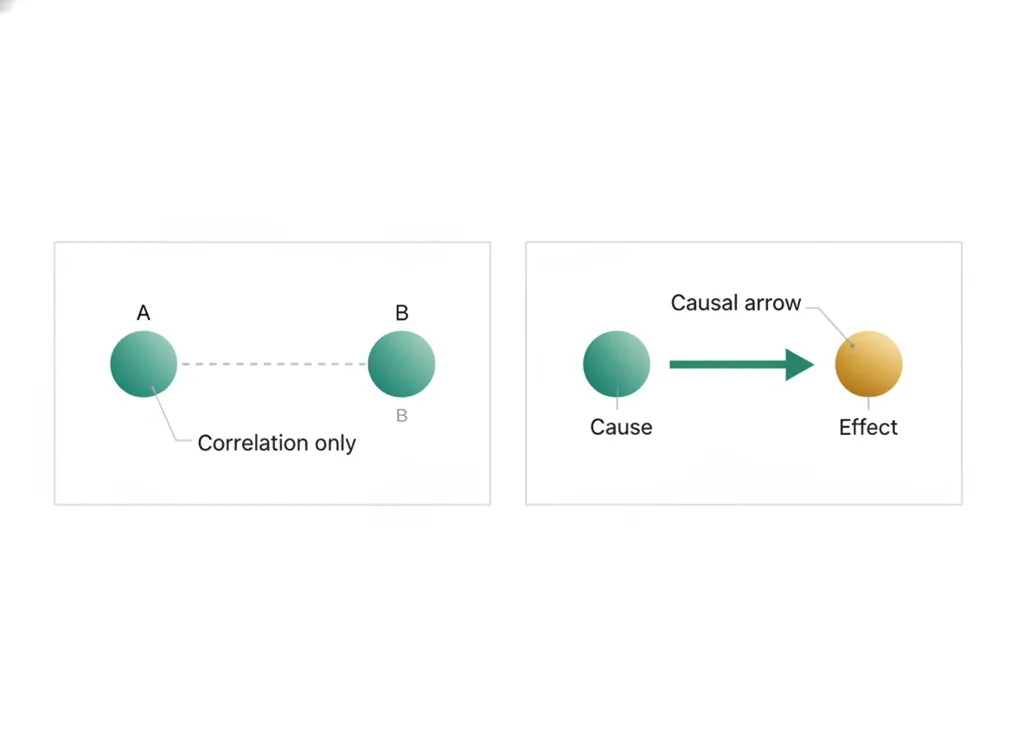
What extra experiment turns 'knock out the gene and a appears' into proof the gene itself caused the cleft?

💡 A shows a gene is needed (necessity), but only adding it back and recovering the structure (the rescue, sufficiency) closes the loop from correlation to causation.

The plan

Prerequisite check

Before this page, you should know
  • An is a non-human organism studied to learn about a human condition; it is a stand-in, never the disease itself.
  • asks whether the model disrupts the same cause (gene or pathway) believed to act in humans; asks whether the model looks like the human disease.
Today's new idea is only
A shows a gene is needed (necessity), but only adding it back and recovering the structure (the rescue, sufficiency) closes the loop from correlation to causation.
Learn first

What you will learn

Goal: Explain why a alone cannot prove causation, and how adding a rescue (and a ) completes the causal argument.

Know by the end
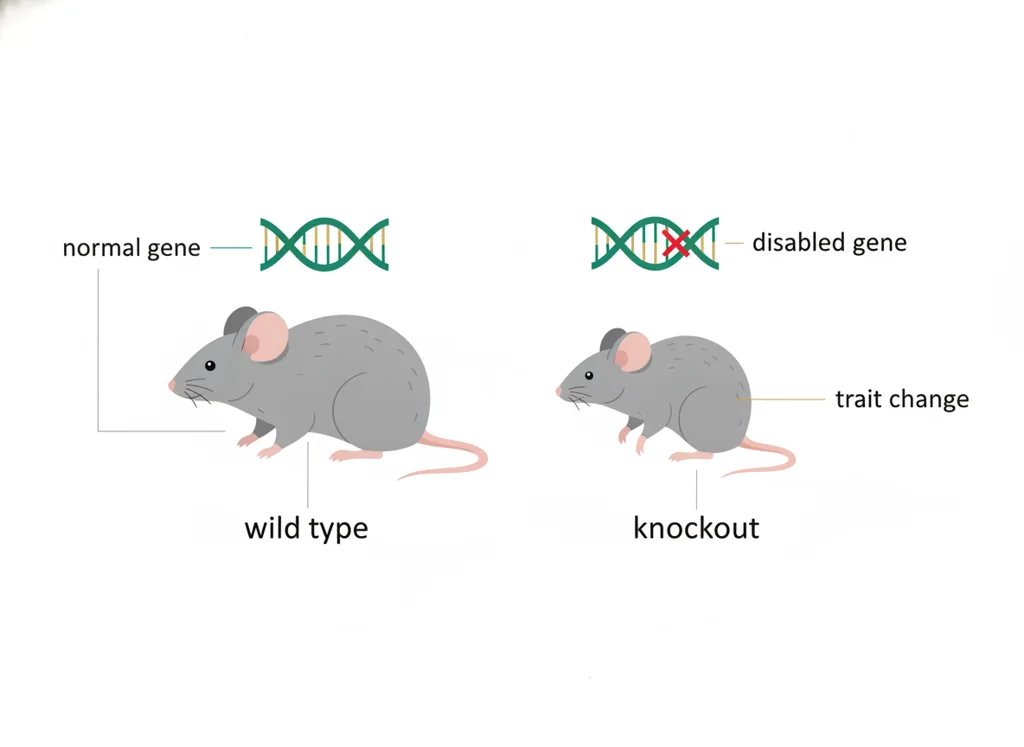
  • A removes a gene to see what fails; by itself it shows the gene is needed but does not prove the gene, and nothing else, caused the defect.
  • A deletes a possible backup gene (here Ezh1) to rule out that the backup, not your gene, explains the result; losing Ezh1 alone did nothing to the .
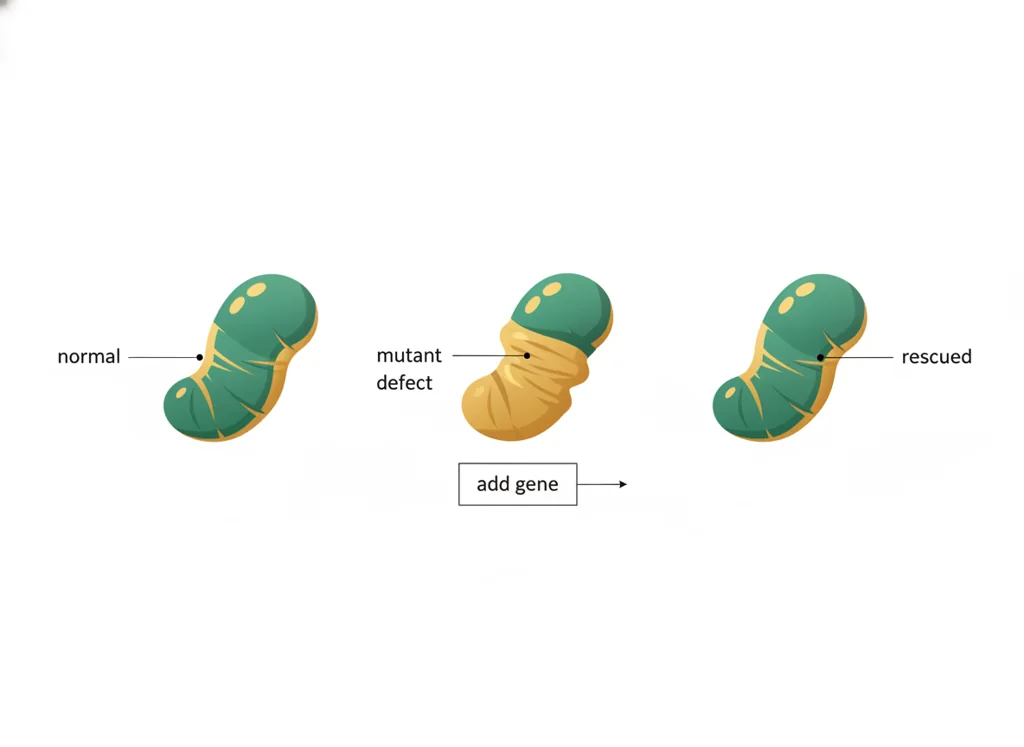
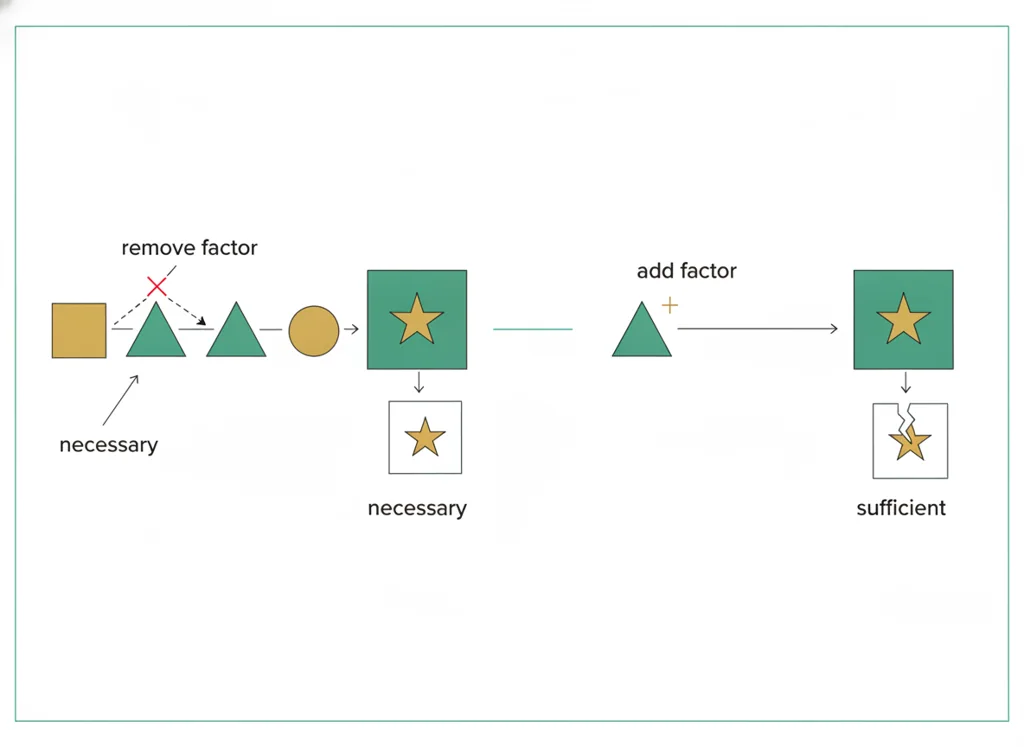
  • A re-supplies the missing gene or signal and asks whether the defect disappears; in the example, removing it blocks and adding it back restores fusion.
  • plus rescue tests necessity (remove it and it breaks) plus sufficiency or restoration (add it back and it recovers), the gold-standard causal proof in developmental biology.
Learn first

Model: A knockout with a redundancy check, plus the logic of putting it back

In the Ezh2 study, deleting Ezh2 in the palate lining produced clefts in about 20% of mice. A skeptic could say a backup gene normally covers for Ezh2, so the result is really about that backup. Ezh2 has a sister gene, Ezh1. The team also deleted Ezh1. On its own, losing Ezh1 did nothing to the palate; it was dispensable. That extra ruled out the backup-gene story.

Now think about two separate questions you could ask about any part. If I remove the part, does the machine break (is the part needed)? If I put the part back, does the machine work again (was that part the fix)? A famous developmental example uses (): delete it and mouse shelves touch but cannot fuse, leaving a ; re-supply that same TGF-beta3 signal and the shelves fuse again. Removing it breaks ; adding it back restores fusion.

Read this in pieces, one chunk at a time
Do the work

Explore (work the model before reading on)

  1. What did deleting the sister gene Ezh1 do to the by itself?
  2. Name the two opposite actions on the part: one removes, one restores.
  3. Why does deleting Ezh1 make the Ezh2 result more believable, not less? What alternative story does it kill?
  4. A alone shows the gene is needed. What does putting it back and the disappearing add that the knockout alone cannot show?
  5. You delete a gene and get a , but when you put the gene back the still does not fuse. What would you now conclude about that gene as the cause?
The plan

Guided notes

1

Two controls complete the argument

Model start: By itself a shows the gene is needed for normal development. That is real evidence, but it is not full proof, because the edit might disturb something else, or a hidden backup might be the true actor.
  • A deletes a possible ____ gene (here, Ezh1) to show the result is not secretly about that backup.
  • A re-supplies the missing gene or signal and asks whether the defect ____ (disappears / worsens).
  • If putting it back fixes the , you have linked that exact ____ to the outcome.
2

Necessity and sufficiency

  • Necessity: remove it and the structure ____ (the ).
  • Sufficiency or restoration: add it back and the structure ____ (the rescue).
  • plus rescue beats a mere correlation because the tracks the gene in both directions, ____ and off.
Explore

Reading the Research

What to read
Why this source matters
This is the published evidence behind today's idea: A shows a gene is needed (necessity), but only adding it back and recovering the structure (the rescue, sufficiency) closes the loop from correlation to causation.
Words to unlock first
knockoutrescue experimentcausationredundancy controlnecessity and sufficiency
Reading moves
  1. Skim the title and abstract first to get the gist.
  2. Circle the one sentence that states the main claim.
  3. Box the evidence the authors give for that claim.
  4. Mark one sentence that confuses you, and move on.
Stop point
You do not need the methods or statistics yet. If a sentence is about lab technique or math you have not learned, mark it and skip it.
Your output
Write one claim-evidence sentence: what this source claims, and the one piece of evidence that backs it up.
Where this fits
Tested on (Ohio WebXam)
Genetics of Disease · 072130
PLTW lesson
MI · Experimental Design domain · Causal inference; necessity and sufficiency through knockout-plus-rescue and redundancy controls
WebXam domain
Bio-Molecular Technology
Evidence to produce
A colleague reports: I knocked out Gene X in the palate and 30% of pups had clefts, so Gene X causes cleft palate. As the causal-inference scientist, design the two experiments that would let them honestly make that claim. (1) Write the rescue experiment in one sentence (what you put back, and what result would support causation). (2) Write the redundancy control in one sentence (what backup you would test, and why). (3) State the one rescue result that would disprove 'Gene X causes the cleft.'
Lab / skill
Biomedical Innovations (BI) · AP Biology
Words

Vocabulary (the same words your classes use)

The plan

Track your progress today

Check these off as you work through the lesson, then submit. This tells Mr. Mendoza how you're doing so he can help the class. It does not replace turning in your producible.

Use the code Mr. Mendoza gave you, not your name. Saved on this device.

Check off as you finish
  • Read the Model and answered the Explore questions.
  • Filled in the guided notes in my own words.
  • Defined the new vocabulary with an example.
  • Built the producible: A colleague reports: I knocked out Gene X in the palate and 30% of pups had clefts, so Gene X causes cleft palate. As the causal-inference scientist, design the two experiments that would let them honestly make that claim. (1) Write the rescue experiment in one sentence (what you put back, and what result would support causation). (2) Write the redundancy control in one sentence (what backup you would test, and why). (3) State the one rescue result that would disprove 'Gene X causes the cleft.'
  • Wrote my Claim, Evidence, and Reasoning exit ticket.
Pick your period and code first.
Check yourself

Exit ticket (Claim, Evidence, Reasoning)

  • Claim: A alone (does / does not) prove a gene causes a .
  • Evidence: Use the Ezh1 result and the put-it-back logic.
  • Reasoning: Explain how necessity plus restoration together rule out 'it was just a correlation' or 'a backup gene did it.'
How this is graded (rubric)
For: A colleague reports: I knocked out Gene X in the palate and 30% of pups had clefts, so Gene X causes cleft palate. As the causal-inference scientist, design the two experiments that would let them honestly make that claim. (1) Write the rescue experiment in one sentence (what you put back, and what result would support causation). (2) Write the redundancy control in one sentence (what backup you would test, and why). (3) State the one rescue result that would disprove 'Gene X causes the cleft.'
CriterionProficientDevelopingBeginning
CompleteEvery required part of the artifact is present and filled in.Most parts are present, but one is missing or left blank.Several parts are missing.
AccurateThe science and data are correct and match the evidence.Mostly correct, with a small factual slip.Key science or data is wrong.
Scientific reasoning (CER)States a claim, backs it with specific evidence, and explains the reasoning.Has a claim and evidence, but the reasoning is thin or missing.Gives an answer with no evidence or reasoning.
Professional communicationClear, organized, and labeled the way a clinician or scientist would write it.Readable but disorganized or missing labels.Hard to follow.
SubmittedTurned in the right way (Schoology for routine work) and confirmed.Turned in, but in the wrong place or unconfirmed.Not turned in.
How the model answer scores against this rubric
  • CompleteProficient: Nothing is left blank: the model fills every part of "A colleague reports: I knocked out Gene X in the palate and 30% of pups had clefts, so Gene X causes cleft palate. As the causal-inference scientist, design the two experiments that would let them honestly make that claim. (1) Write the rescue experiment in one sentence (what you put back, and what result would support causation). (2) Write the redundancy control in one sentence (what backup you would test, and why). (3) State the one rescue result that would disprove 'Gene X causes the cleft.'".
  • AccurateProficient: Every number and claim matches the case evidence.
  • Scientific reasoning (CER)Proficient: It names a claim, cites the specific evidence, and explains the reasoning, not just the answer.
  • Professional communicationProficient: It is organized and labeled like a real chart note.
  • SubmittedProficient: It would be turned in on Schoology and confirmed.
Explore

Where this leads: careers

Molecular Biologist Developmental Geneticist

What's next: In a mouse we control everything, so we can prove cause by cutting a gene and putting it back. But we cannot assign a gene, or a surgery, to a baby like Mateo on purpose. When the subjects are children and the question is which treatment is better, how do we make a fair comparison without controlling their biology directly? We chase that next time.