Rough draft.This research track is under review with Dr. Atit's lab. Content and sequence may still change.
The Baby Mateo Case
Disease domainShared clinical backbone (the cleft team)Lesson 13 of 20Your seat: Audiologist (cleft team)

Protecting Mateo's Hearing

Discovery question

Why do children with a get so many ear infections, and how does that threaten hearing?

💡 Mateo's repeated ear infections are a mechanical drainage problem from the , not bad luck, and untreated they threaten the hearing his speech depends on.

The plan

Prerequisite check

Before this page, you should know
  • Clear speech needs : the lifts and the throat walls move in, closing the door between the mouth and the nose at the right moments.
  • The is the muscle that lifts the soft to make this seal; in a palate it is interrupted and out of position.
Today's new idea is only
Mateo's repeated ear infections are a mechanical drainage problem from the , not bad luck, and untreated they threaten the hearing his speech depends on.
Learn first

What you will learn

Goal: Students will explain why leads to recurrent middle-ear fluid and conductive hearing loss (Eustachian tube dysfunction) and why the team monitors hearing and uses ear tubes.

Know by the end
  • The drains and ventilates through one tube, the Eustachian tube, which is normally closed and opens briefly when you swallow or yawn.
  • A muscle, the tensor veli palatini, pulls the Eustachian tube open; in a palate this muscle is interrupted, so the tube does not open and drain well.
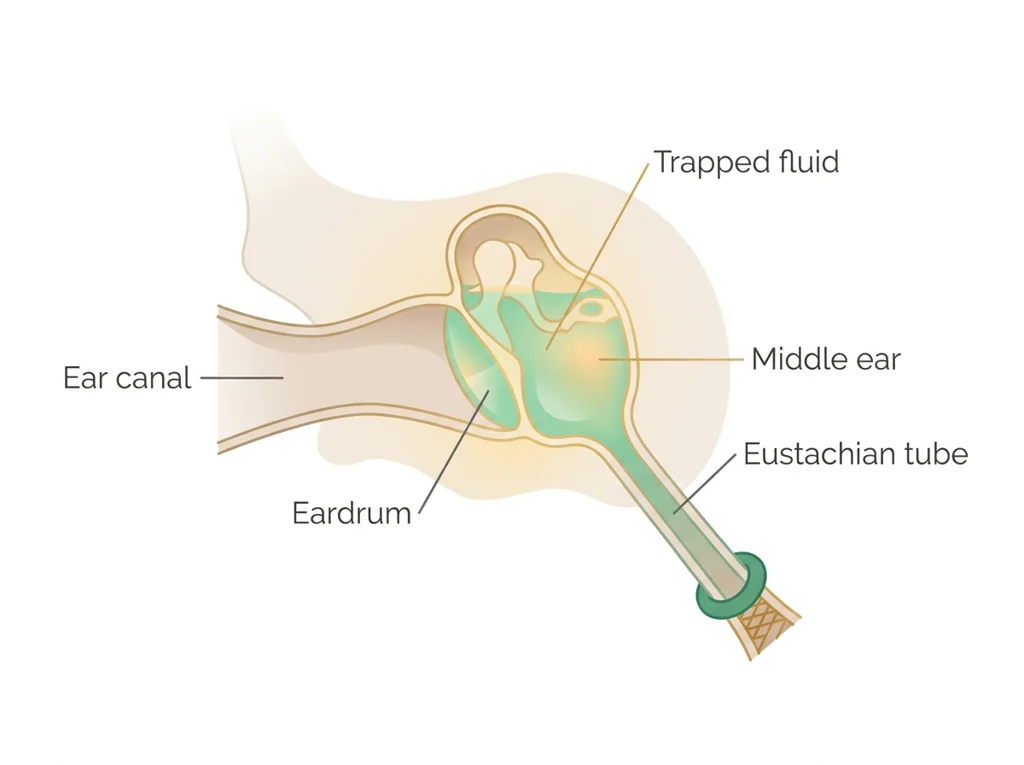
  • Fluid trapped behind the eardrum is , which is recurrent and high-risk in , and it muffles sound to cause conductive hearing loss (the inner ear is fine).
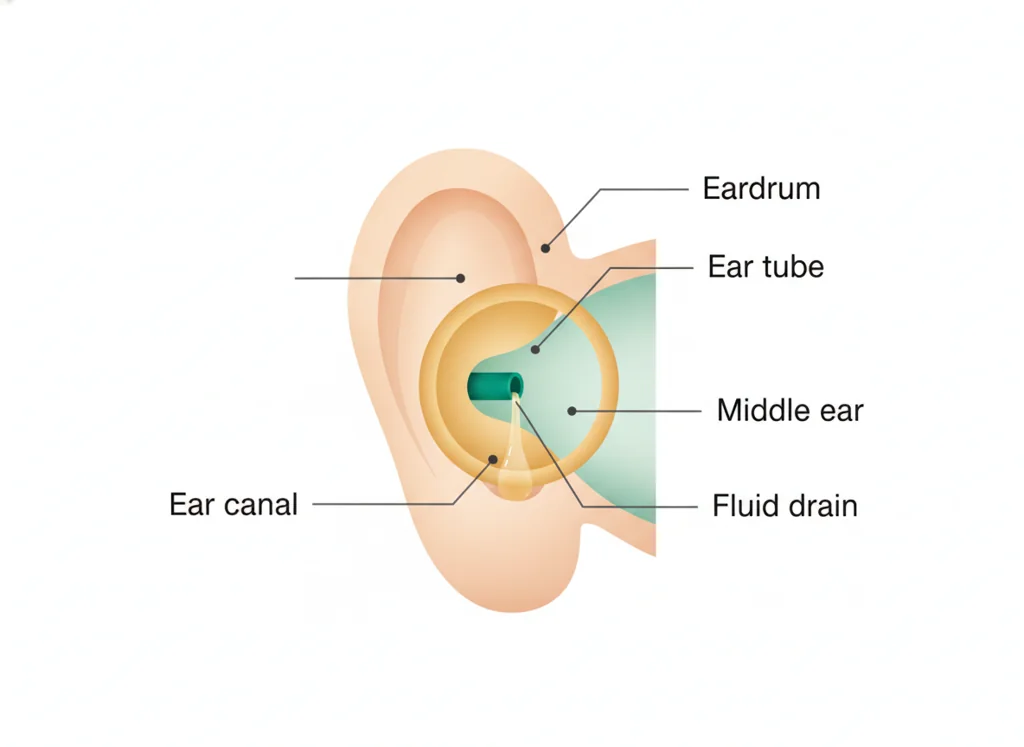
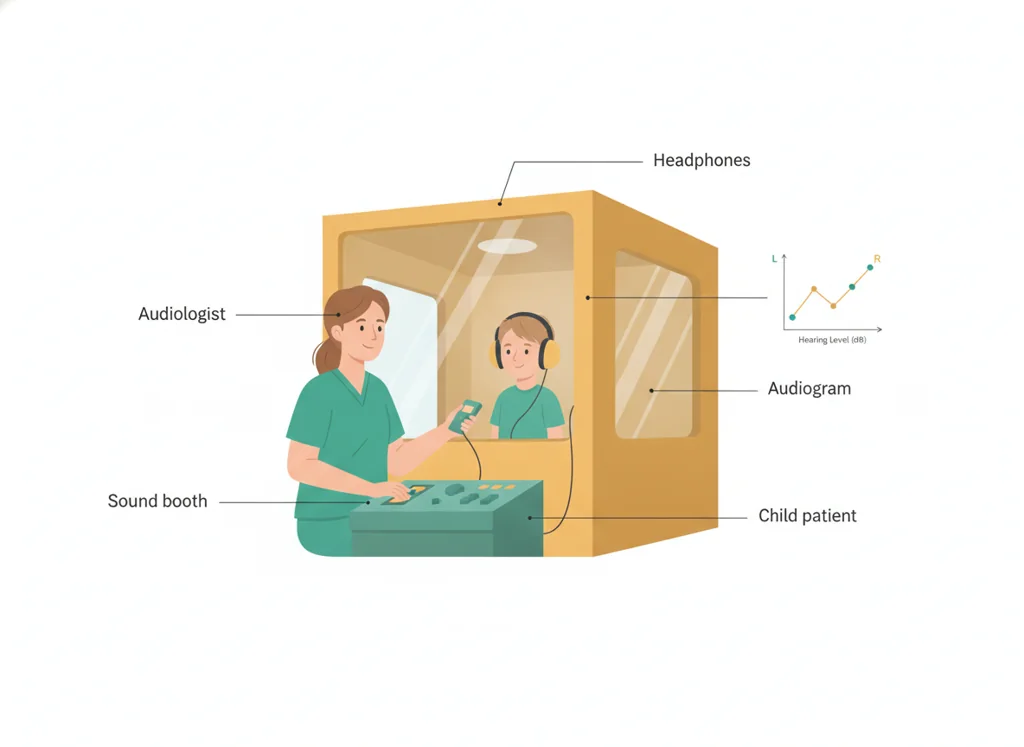
  • The team places tympanostomy (ear) tubes to drain the and protect hearing, and the audiologist monitors hearing during the years the child is learning to talk.
Learn first

Model: The middle ear needs a drainpipe, and what backed-up fluid does

The is a small air-filled space behind the eardrum, connected to the back of the nose and throat by one tube, the Eustachian tube. That tube is normally closed but opens briefly when you swallow or yawn, to let air in and fluid drain out. A muscle near the , the tensor veli palatini, pulls the tube open at those moments. In a palate this muscle is interrupted and out of position, so the tube does not open and drain the way it should. Picture a sink: if the drainpipe opens, water flows out; if it stays blocked, water backs up and sits in the basin.

From the clinical literature, the chain runs: the Eustachian tube does not open well, so the cannot drain; fluid collects behind the eardrum, called , which happens repeatedly in cleft ; the fluid muffles the eardrum and the tiny ear bones, so sound does not transmit, called conductive hearing loss; and hearing loss during the speaking-and-learning years can slow speech and language if missed. The library states this risk is high in cleft palate and that the team uses ear tubes and audiology to treat it.

Read this in pieces, one chunk at a time
Do the work

Explore (work the model before reading on)

  1. What is the one tube that drains and ventilates the ?
  2. What do we call the fluid that collects behind the eardrum?
  3. The same kind of muscle that helps seal speech also helps open the Eustachian tube. Using the sink picture, explain why a palate would let fluid back up in the .
  4. The fluid muffles the eardrum and ear bones. Why would that make soft sounds, like a parent speaking quietly, the hardest for Mateo to hear?
  5. Mateo is learning to talk in the same years his ears keep filling with fluid. Predict how unnoticed hearing loss could affect his speech progress, and why the audiologist wants to catch it early.
  6. In one sentence, what pattern did your team find linking the , the ear, and hearing?
The plan

Guided notes

1

The ear's drainpipe

Model start: A is also an ear problem, because a palate muscle helps run the ear's drainpipe.
  • The drains and ventilates through the ______ tube, which is pulled open by a muscle.
  • That muscle is the ______ veli palatini, which is disrupted when the is , so the tube does not open well.
2

Trapped fluid and hearing

  • Fluid trapped behind the eardrum is called otitis media with ______, and it is recurrent and common in .
  • The fluid muffles the eardrum and ear bones, causing ______ hearing loss; the inner ear itself is fine.
3

Protecting hearing

  • The team often places small ______ tubes through the eardrum so the can drain and breathe.
  • The audiologist checks hearing regularly, because unnoticed loss during the speech-learning years can slow language.
Explore

Reading the Research

What to read
Why this source matters
This is the published evidence behind today's idea: Mateo's repeated ear infections are a mechanical drainage problem from the , not bad luck, and untreated they threaten the hearing his speech depends on.
Words to unlock first
Reading moves
  1. Skim the title and abstract first to get the gist.
  2. Circle the one sentence that states the main claim.
  3. Box the evidence the authors give for that claim.
  4. Mark one sentence that confuses you, and move on.
Stop point
You do not need the methods or statistics yet. If a sentence is about lab technique or math you have not learned, mark it and skip it.
Your output
Write one claim-evidence sentence: what this source claims, and the one piece of evidence that backs it up.
Where this fits
Tested on (Ohio WebXam)
Genetics of Disease · 072130
PLTW lesson
MI · Disease domain · Medical Interventions (MI), Unit 1 hearing loss and intervention
WebXam domain
Bio-Molecular Technology
Evidence to produce
As Mateo's audiologist, explain to a parent in three short sentences: (1) why the cleft palate causes the ear infections (use 'Eustachian tube' and 'drain'), (2) how the trapped fluid can affect hearing, and (3) one thing the team does to protect his hearing. Add one sentence on why you want to test his hearing before he is far into learning to talk.
Lab / skill
Clinical backbone (cleft team) · Clinical backbone (cleft team)
Words

Vocabulary (the same words your classes use)

Eustachian tubeconductive hearing loss
The plan

Track your progress today

Check these off as you work through the lesson, then submit. This tells Mr. Mendoza how you're doing so he can help the class. It does not replace turning in your producible.

Use the code Mr. Mendoza gave you, not your name. Saved on this device.

Check off as you finish
  • Read the Model and answered the Explore questions.
  • Filled in the guided notes in my own words.
  • Defined the new vocabulary with an example.
  • Built the producible: As Mateo's audiologist, explain to a parent in three short sentences: (1) why the cleft palate causes the ear infections (use 'Eustachian tube' and 'drain'), (2) how the trapped fluid can affect hearing, and (3) one thing the team does to protect his hearing. Add one sentence on why you want to test his hearing before he is far into learning to talk.
  • Wrote my Claim, Evidence, and Reasoning exit ticket.
Pick your period and code first.
Check yourself

Exit ticket (Claim, Evidence, Reasoning)

  • Claim: Mateo's repeated ear infections are connected to his , not ____ (bad luck / a structural cause).
  • Evidence: The disrupts the ____ veli palatini, so the ____ tube does not open, fluid backs up, and the muffled sound causes ____ hearing loss.
  • Reasoning: Catching this early matters during the years a child is learning to speak because ____.
How this is graded (rubric)
For: As Mateo's audiologist, explain to a parent in three short sentences: (1) why the cleft palate causes the ear infections (use 'Eustachian tube' and 'drain'), (2) how the trapped fluid can affect hearing, and (3) one thing the team does to protect his hearing. Add one sentence on why you want to test his hearing before he is far into learning to talk.
CriterionProficientDevelopingBeginning
CompleteEvery required part of the artifact is present and filled in.Most parts are present, but one is missing or left blank.Several parts are missing.
AccurateThe science and data are correct and match the evidence.Mostly correct, with a small factual slip.Key science or data is wrong.
Scientific reasoning (CER)States a claim, backs it with specific evidence, and explains the reasoning.Has a claim and evidence, but the reasoning is thin or missing.Gives an answer with no evidence or reasoning.
Professional communicationClear, organized, and labeled the way a clinician or scientist would write it.Readable but disorganized or missing labels.Hard to follow.
SubmittedTurned in the right way (Schoology for routine work) and confirmed.Turned in, but in the wrong place or unconfirmed.Not turned in.
How the model answer scores against this rubric
  • CompleteProficient: Nothing is left blank: the model fills every part of "As Mateo's audiologist, explain to a parent in three short sentences: (1) why the cleft palate causes the ear infections (use 'Eustachian tube' and 'drain'), (2) how the trapped fluid can affect hearing, and (3) one thing the team does to protect his hearing. Add one sentence on why you want to test his hearing before he is far into learning to talk.".
  • AccurateProficient: Every number and claim matches the case evidence.
  • Scientific reasoning (CER)Proficient: It names a claim, cites the specific evidence, and explains the reasoning, not just the answer.
  • Professional communicationProficient: It is organized and labeled like a real chart note.
  • SubmittedProficient: It would be turned in on Schoology and confirmed.
Explore

Where this leads: careers

Audiologist Pediatric otolaryngologist (ENT) Hearing-instrument specialist

What's next: We answered why the threatens hearing and how the team protects it. But Mateo's first teeth are coming in, and his parents notice some are crooked and one looks unusually small. How do we care for his teeth and his bite over the years ahead?