Rough draft.This research track is under review with Dr. Atit's lab. Content and sequence may still change.
The Baby Mateo Case
Anatomical domainHuman Body Systems (HBS)Lesson 8 of 20Your seat: Craniofacial Surgeon (cleft lip repair)

Rebuilding the Lip

Discovery question

When you fix a lip, what are you actually rebuilding, and why is more than one technique still in use?

💡 lip repair is reconstruction of the interrupted ring, not skin closure; several techniques solve the same muscle problem with different geometry.

The plan

Prerequisite check

Before this page, you should know
  • uses a custom plus a in the first weeks of life to narrow the alveolar gap, realign the gum segments, lengthen the , and improve nasal symmetry.
  • NAM does not close the ; it shapes soft, movable newborn so the surgeon's repair begins from a better position.
Today's new idea is only
lip repair is reconstruction of the interrupted ring, not skin closure; several techniques solve the same muscle problem with different geometry.
Learn first

What you will learn

Goal: Explain that lip repair reconstructs the interrupted ring, and compare how three named techniques solve that same problem.

Know by the end
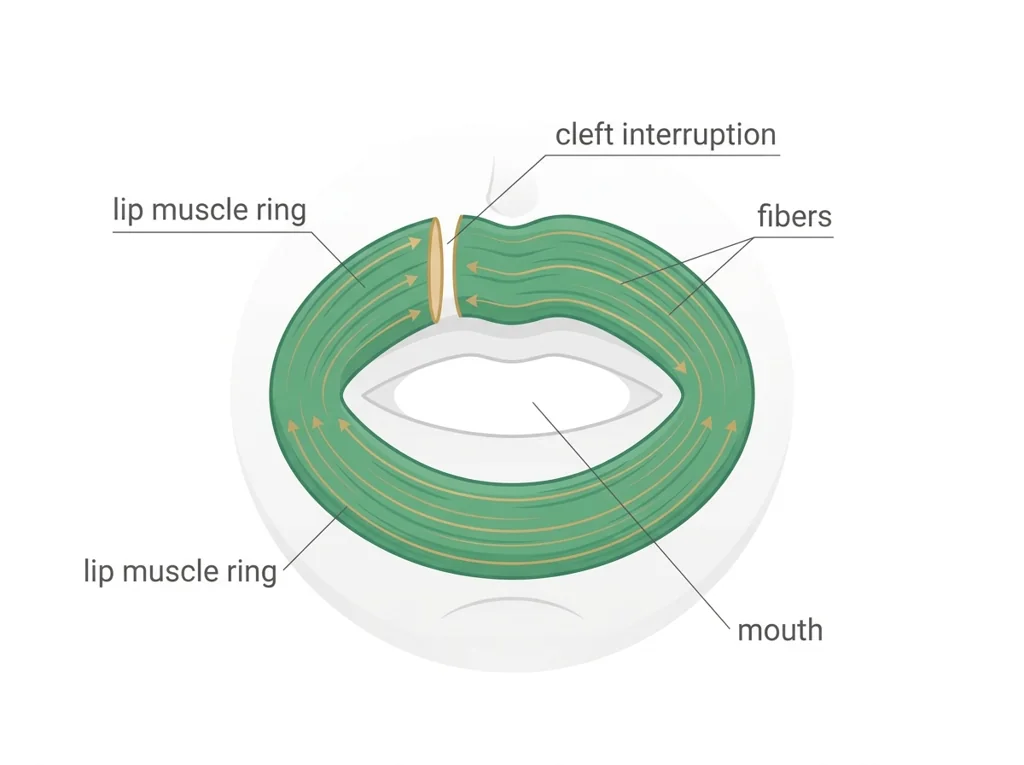
  • The defining lesion of a lip is the interrupted ring, whose fibers insert abnormally on the cleft margins instead of crossing the .
  • Every technique shares the same goals: release the misdirected muscle, rebuild a continuous ring, level the Cupid's bow, and restore and nasal symmetry.
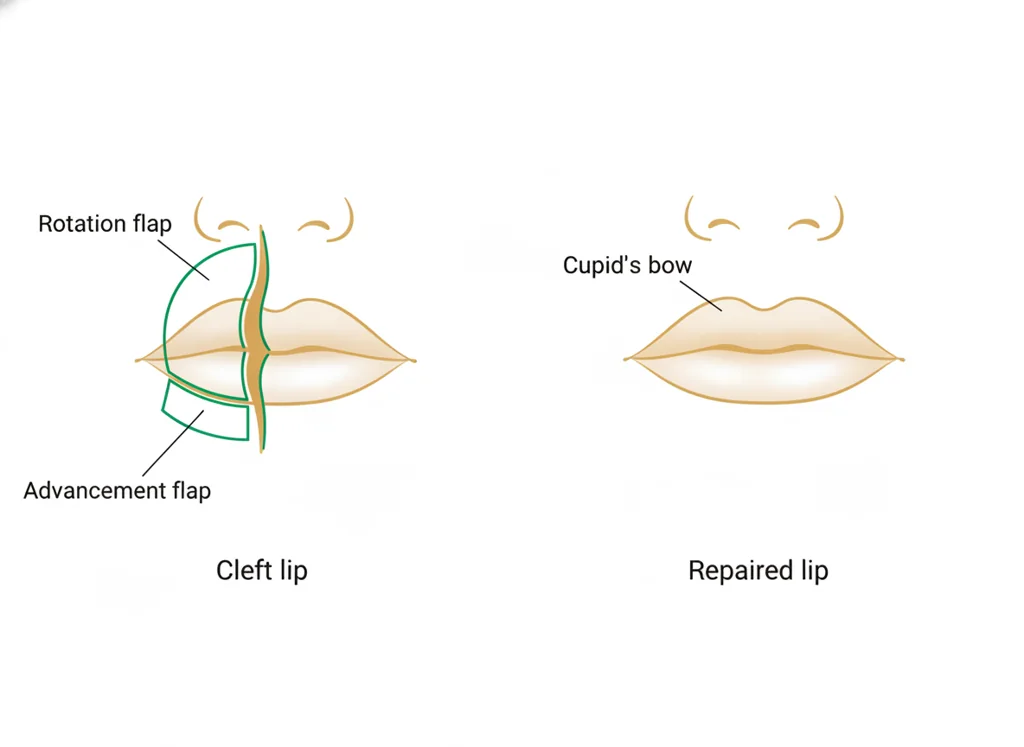
  • Millard , Tennison-Randall triangular flap, and Fisher differ in the geometry of the cuts, not in the goal.
  • Lip repair is usually done at about 3 to 6 months; in some settings minority and non-English-speaking children reach surgery measurably later, a non-anatomical cause of delay.
Learn first

Model: What is broken inside a cleft lip, and three ways to fix it

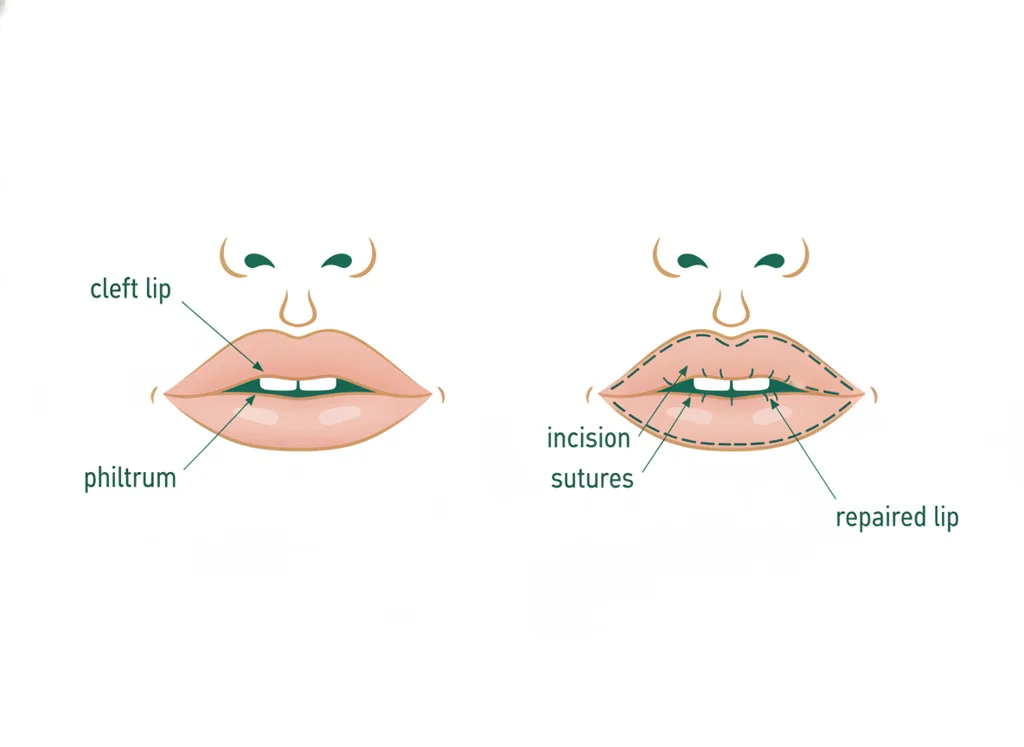
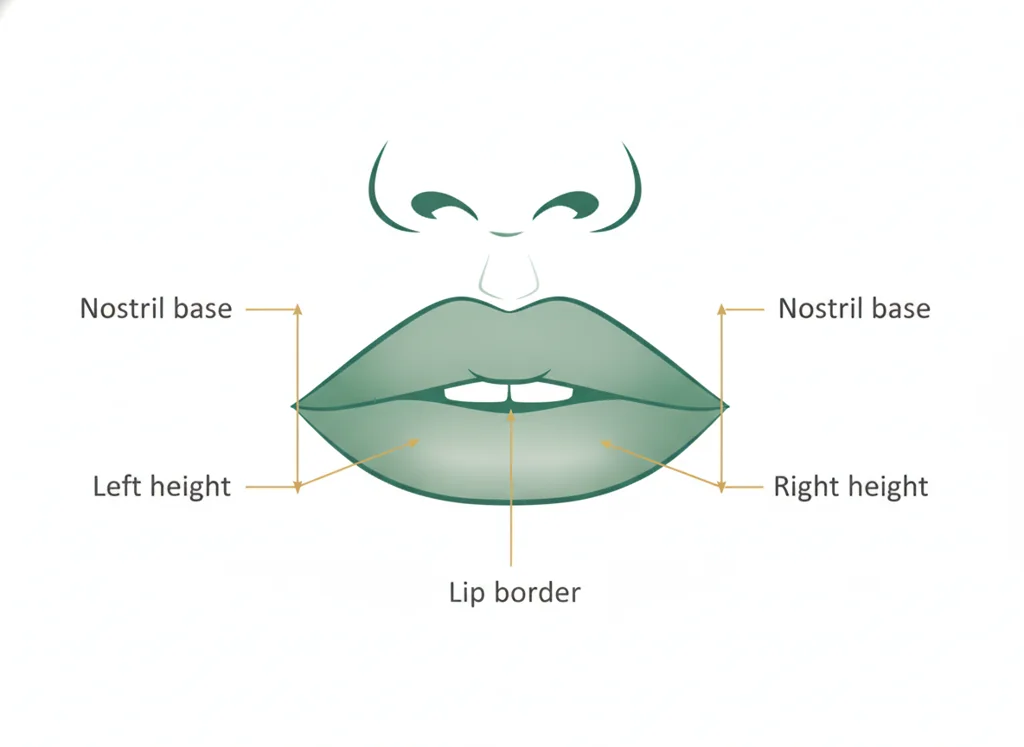
Recall the muscle lesion from Lesson 3. The is the that should encircle the mouth in a continuous ring. In Mateo's , that ring is interrupted; instead of crossing the , the fibers turn and insert abnormally upward along the cleft margins, toward the nostril base and the base. This pulls the lip apart and distorts the nose. So the surgical problem is not a slit in the skin; it is a muscle ring that runs the wrong way and inserts in the wrong place. Modern lip repair is understood as functional reconstruction in three dimensions, not merely skin closure.

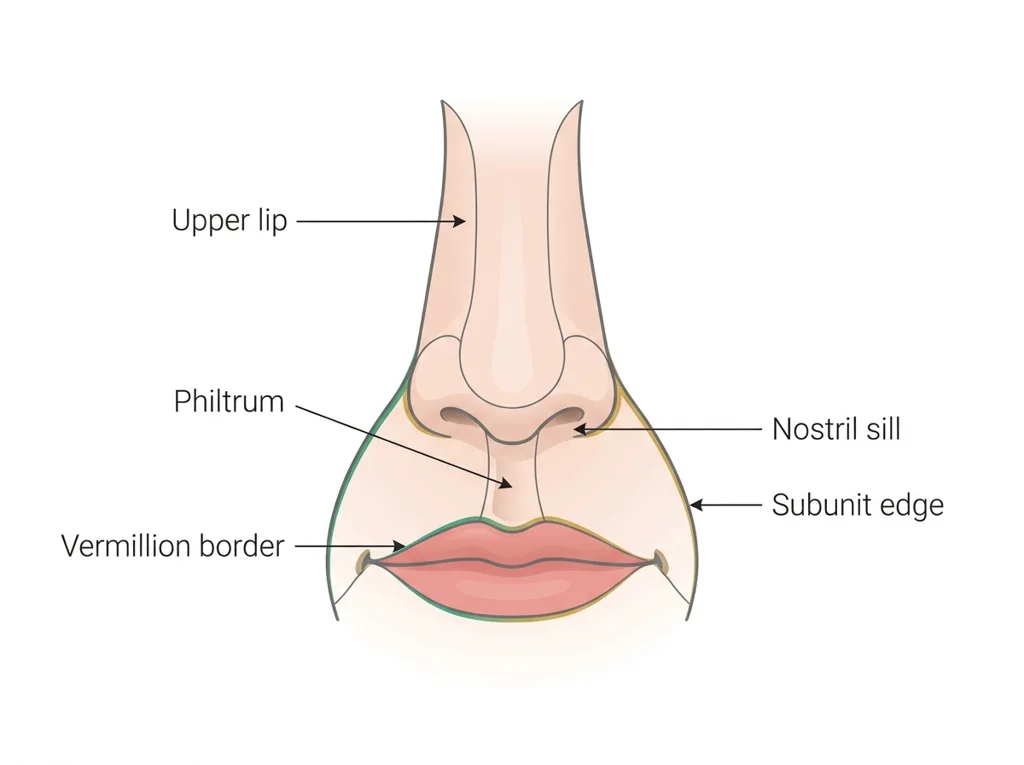
Three named techniques share the same goals (release the misdirected orbicularis, rebuild it as a continuous ring, level the Cupid's bow, restore and nasal symmetry) and differ only in geometry. Millard rotates the inner lip segment down and advances the outer segment into the gap so the scar mimics the natural philtral column; it is flexible but depends heavily on surgeon judgment. Tennison-Randall uses a precise triangular flap to regain lip height; it is reproducible but its scar crosses the philtral column. Fisher places incisions along the lip's natural subunit borders so the scar hides in a real edge, and in expert hands it matches rotation-advancement.

Read this in pieces, one chunk at a time
Do the work

Explore (work the model before reading on)

  1. In a lip, name the muscle that is interrupted and say where its fibers insert abnormally.
  2. List the goals that all three techniques share.
  3. Two repairs are praised for reproducibility or respecting natural borders, while one is praised for flexibility. Why might flexibility be both a strength and a weakness?
  4. All three techniques attack the same underlying problem. In one sentence, what is that problem, and why does fixing the skin alone not fix it?
  5. Predict one reason a surgeon might still choose an older technique even if a newer one can hide the scar better.
The plan

Guided notes

1

The true target

Model start: is not skin closure; the defining lesion is the interrupted ring, whose fibers insert on the margins instead of crossing the .
  • The interrupted muscle in a lip is the ____ ____ (the lip's ring/).
  • The shared goal is to release the misdirected muscle, rebuild a continuous ____, level the Cupid's bow, and restore and nasal symmetry.
2

Three geometries, one goal

  • Millard is flexible but ____ dependent.
  • Tennison-Randall uses a triangular flap to regain ____, but its scar crosses the philtral column.
  • Fisher places incisions along the lip's natural ____ borders to hide the scar.
3

Timing and equity

  • Lip repair is usually done at about ____ to 6 months; in some settings minority and non-English-speaking children reach surgery measurably ____.
Explore

Reading the Research

What to read
Read the title and the abstract only, not the whole paper. Vyas & Warren 2014, Unilateral cleft lip repair (Clin Plast Surg)
Why this source matters
This is the published evidence behind today's idea: lip repair is reconstruction of the interrupted ring, not skin closure; several techniques solve the same muscle problem with different geometry.
Words to unlock first
cheiloplastyorbicularis orisrotation-advancementanatomical subunitlip height
Reading moves
  1. Skim the title and abstract first to get the gist.
  2. Circle the one sentence that states the main claim.
  3. Box the evidence the authors give for that claim.
  4. Mark one sentence that confuses you, and move on.
Stop point
You do not need the methods or statistics yet. If a sentence is about lab technique or math you have not learned, mark it and skip it.
Your output
Write one claim-evidence sentence: what this source claims, and the one piece of evidence that backs it up.
Where this fits
Tested on (Ohio WebXam)
Genetics of Disease · 072130
PLTW lesson
MI · Anatomical domain · Structure and function; muscle anatomy and reconstruction
WebXam domain
Bio-Molecular Technology
Evidence to produce
Present your operative plan for Mateo's complete unilateral left cleft lip in four sentences: (1) state what structure you are actually rebuilding and why skin closure alone is not enough, citing a source, (2) name one technique you will use and one concrete reason, (3) name one trade-off you accept, and (4) end with a clear plan. Defend the logic, not the operative steps.
Lab / skill
Human Body Systems (HBS) · Biomedical Innovations (BI)
Words

Vocabulary (the same words your classes use)

The plan

Track your progress today

Check these off as you work through the lesson, then submit. This tells Mr. Mendoza how you're doing so he can help the class. It does not replace turning in your producible.

Use the code Mr. Mendoza gave you, not your name. Saved on this device.

Check off as you finish
  • Read the Model and answered the Explore questions.
  • Filled in the guided notes in my own words.
  • Defined the new vocabulary with an example.
  • Built the producible: Present your operative plan for Mateo's complete unilateral left cleft lip in four sentences: (1) state what structure you are actually rebuilding and why skin closure alone is not enough, citing a source, (2) name one technique you will use and one concrete reason, (3) name one trade-off you accept, and (4) end with a clear plan. Defend the logic, not the operative steps.
  • Wrote my Claim, Evidence, and Reasoning exit ticket.
Pick your period and code first.
Check yourself

Exit ticket (Claim, Evidence, Reasoning)

  • Claim: A lip repair succeeds or fails on muscle, not skin.
  • Evidence: Cite the muscle lesion and one technique with its source.
  • Reasoning: Explain why three different techniques can all be correct if they share the same goal.
How this is graded (rubric)
For: Present your operative plan for Mateo's complete unilateral left cleft lip in four sentences: (1) state what structure you are actually rebuilding and why skin closure alone is not enough, citing a source, (2) name one technique you will use and one concrete reason, (3) name one trade-off you accept, and (4) end with a clear plan. Defend the logic, not the operative steps.
CriterionProficientDevelopingBeginning
CompleteEvery required part of the artifact is present and filled in.Most parts are present, but one is missing or left blank.Several parts are missing.
AccurateThe science and data are correct and match the evidence.Mostly correct, with a small factual slip.Key science or data is wrong.
Scientific reasoning (CER)States a claim, backs it with specific evidence, and explains the reasoning.Has a claim and evidence, but the reasoning is thin or missing.Gives an answer with no evidence or reasoning.
Professional communicationClear, organized, and labeled the way a clinician or scientist would write it.Readable but disorganized or missing labels.Hard to follow.
SubmittedTurned in the right way (Schoology for routine work) and confirmed.Turned in, but in the wrong place or unconfirmed.Not turned in.
How the model answer scores against this rubric
  • CompleteProficient: Nothing is left blank: the model fills every part of "Present your operative plan for Mateo's complete unilateral left cleft lip in four sentences: (1) state what structure you are actually rebuilding and why skin closure alone is not enough, citing a source, (2) name one technique you will use and one concrete reason, (3) name one trade-off you accept, and (4) end with a clear plan. Defend the logic, not the operative steps.".
  • AccurateProficient: Every number and claim matches the case evidence.
  • Scientific reasoning (CER)Proficient: It names a claim, cites the specific evidence, and explains the reasoning, not just the answer.
  • Professional communicationProficient: It is organized and labeled like a real chart note.
  • SubmittedProficient: It would be turned in on Schoology and confirmed.
Explore

Where this leads: careers

Craniofacial Surgeon Plastic and Reconstructive Surgeon

What's next: We rebuilt the lip and its muscle ring, but the lip was the easier door to close. The roof of the mouth is deeper and hides a different muscle that must be rebuilt into a working sling. How does the surgeon rebuild the , where the repair happens in the dark and the muscle must be remade across the ? We chase that next time.