

Unit 2.1 Talk to Your Doc: Clinical communication, patient history, privacy, vital signs, homeostasis, EMR thinking.
Your PLTW coursework: Principles of Biomedical Science ▸ Unit 2: Clinical Care ▸ Lesson 2.1 Talk to Your Doc ▸ "Activity 2.1.2 Vital Signs", "Activity 2.1.6 Patient Privacy"
What to do if absent- CER:
- Claim, Evidence, Reasoning: make a claim, back it with evidence, explain your reasoning.
- SOP:
- Standard Operating Procedure, the exact steps to follow (especially in a lab).
- Tracker:
- Your PLTW progress log where you record completed evidence.
- myPLTW:
- The PLTW course site where you do the online activities. Find it in Clever with your Microsoft sign-in, right next to Schoology.
Take a patient history, measure and interpret vital signs, and explain how privacy rules like protect the medical record you help create.
- 1Open the Unit 2.1 task in your PLTW shell to see the graded clinical communication evidence.
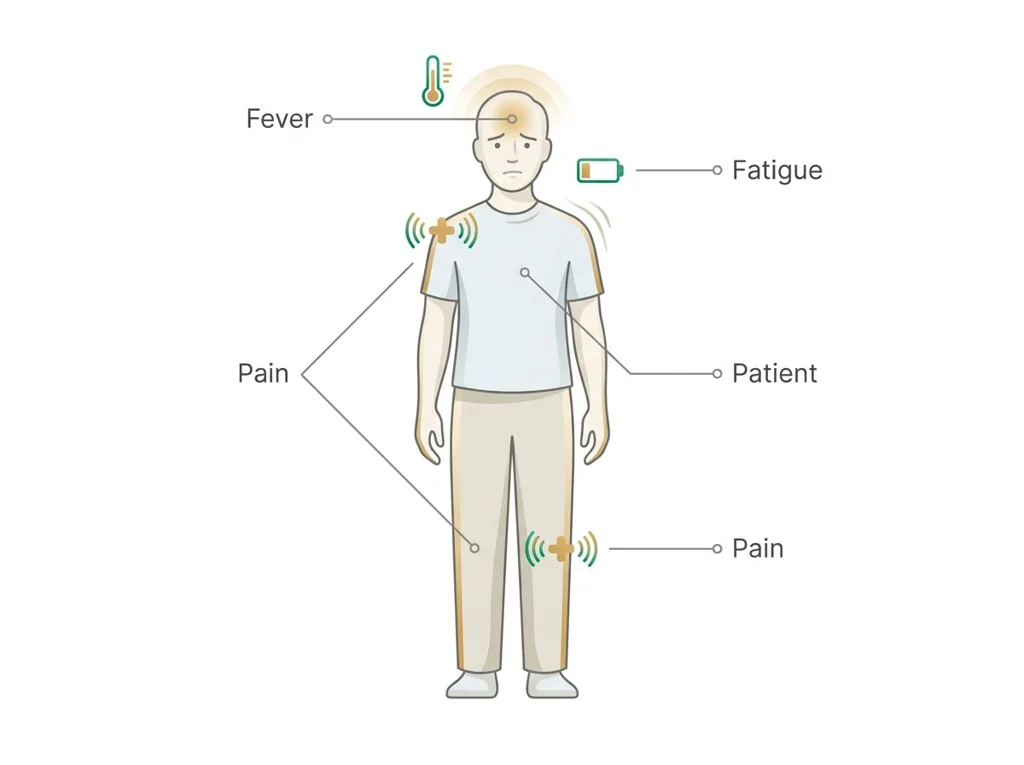
- 2Practice asking a partner about a and recording their symptoms in their own words.
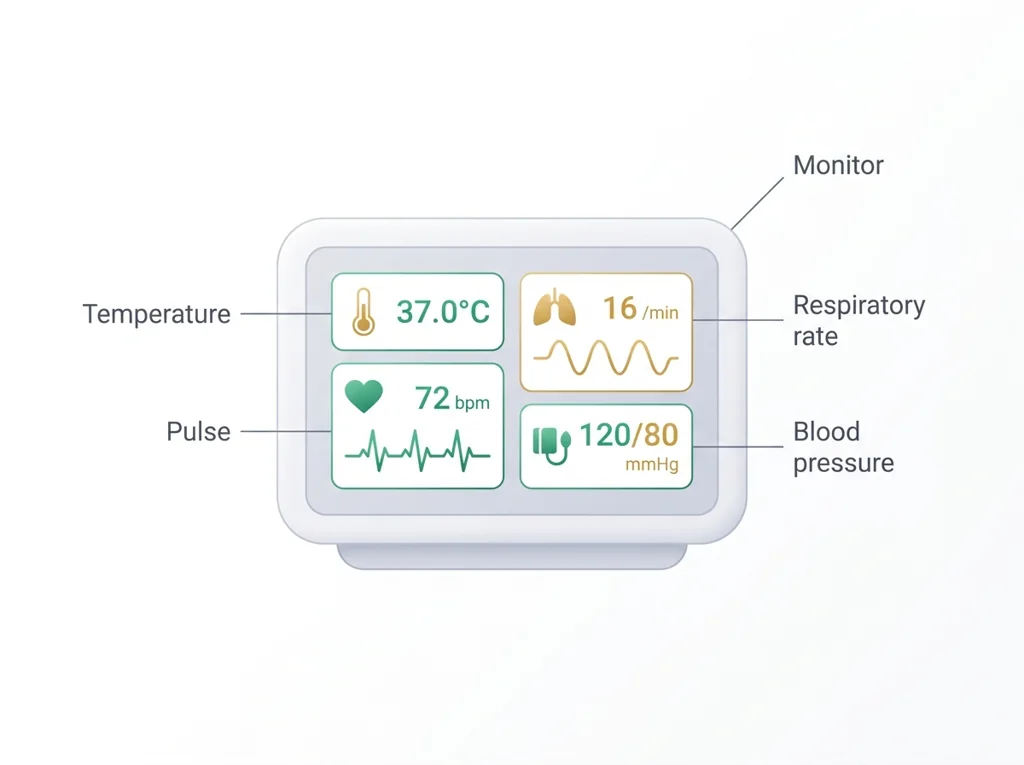
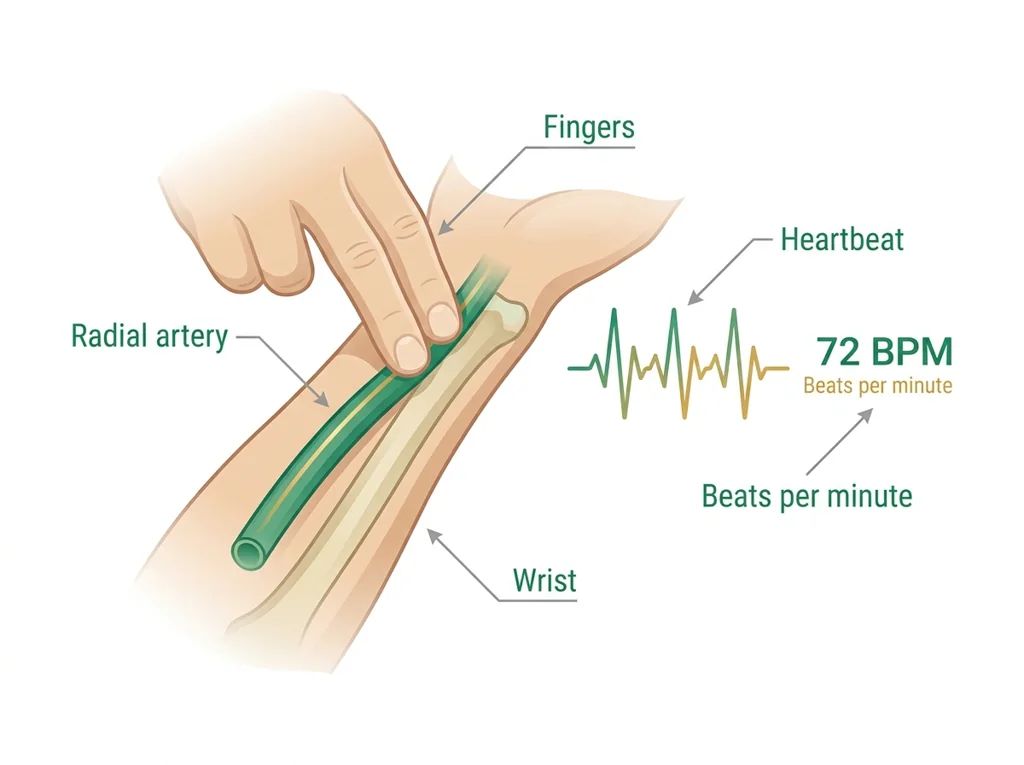
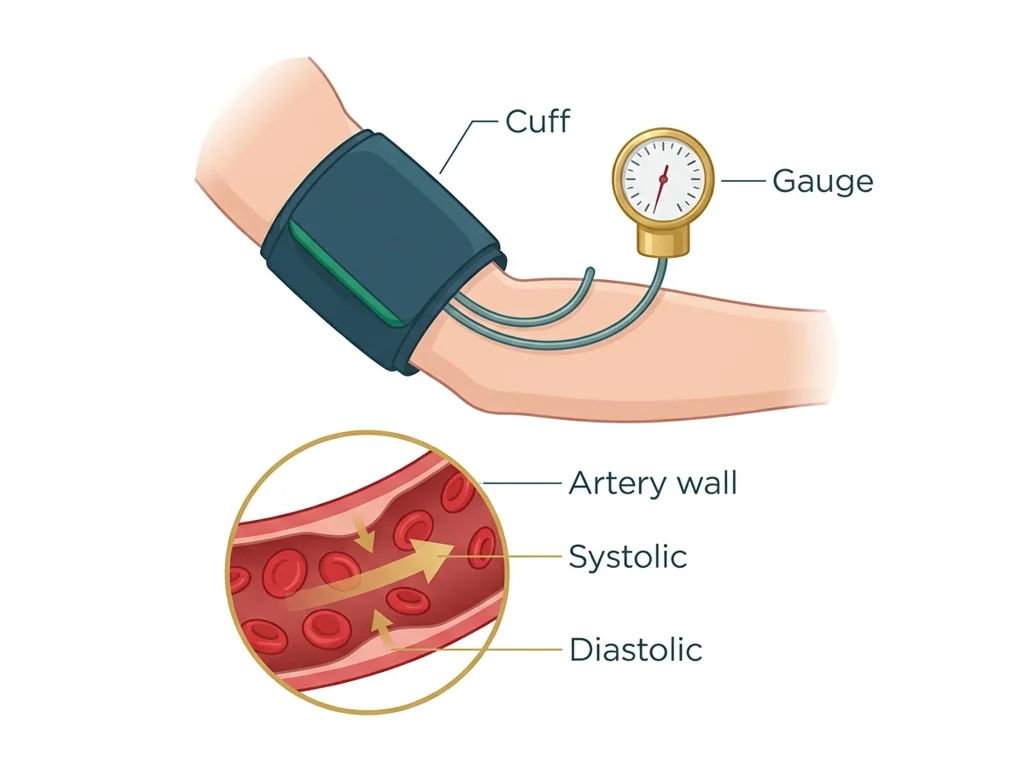
- 3Measure , , and rate and record each accurately.
- 4Compare each measured to its and note any value outside it.
- 5Explain how each reflects the body working to maintain .
- 6Describe one rule that protects the patient information you just collected.
- • You can collect a patient history including and symptoms.
- • You can measure and record , , and correctly.
- • You can explain how protects a patient's medical record.
Open any day for its full lesson, the work due that day, and guided notes.
Written CER (3-5 sentences) arguing when patient privacy should yield to public-health needs, with a reference to or mandatory reporting and a trust-based reasoning sentence.
Simulated EMR record: all four vital signs (plus if a oximeter is out) with values, units, and the noted; three heart-rate trials averaged; one sentence per on why it is measured at every visit; one limitation and one error source per technique.
CER arguing whether your partner's vital signs suggest is maintained, using today's EMR readings as evidence and connecting at least one reading to its homeostatic feedback mechanism in the reasoning.
Your worksheet: the side you argued, your three strongest arguments, the opposing point you had to answer, and where you actually stand now.
Your glucose feedback-loop diagram, annotated for type 1 diabetes, plus one CER (3-5 sentences) answering the sheet's question: should a clinic recommend continuous remote monitoring, and what has to be true for that recommendation to be responsible? Name patient autonomy in your reasoning.
- A diagnosis starts with a conversation, and how well you listen and record decides how good the data is.
- Today's goal: collect a patient history and a full set of vital signs you could hand to a physician.
- Monday's bioethics debate fits the unit: when can a doctor share a patient's information, and who decides what stays private?
- Your graded patient interview and vital signs chart are submitted on the class site.
Do this: Advance the PLTW PBS Unit 2.1 benchmark by collecting a patient history and vital signs in the online course shell.
- • A is the main reason a patient seeks care, described in their own words.
- • , , and are vital signs read against normal ranges.
- • sets rules for keeping patient health information private.
- • Measure and record , , and .
- • Document a and symptoms in a patient history.
📋 PLTW evidence due Friday: completed Unit 2.1 patient interview and vital signs chart with normal-range comparisons.
All PLTW activities are completed inside the PLTW course environment: this page only gives direction.
Use this chart to keep your place. Nothing on it is turned in through the portal.
| Day | Work | Turn in |
|---|---|---|
| Monday · Mon, Oct 12 | Ethics of privacy | Written CER (3-5 sentences) arguing when patient privacy should yield to public-health needs, with a reference to HIPAA or mandatory reporting and a trust-based reasoning sentence. |
| Tuesday · Tue, Oct 13 | Vital signs practical | Simulated EMR record: all four vital signs (plus oxygen saturation if a pulse oximeter is out) with values, units, and the normal range noted; three heart-rate trials averaged; one sentence per vital sign on why it is measured at every visit; one limitation and one error source per technique. |
| Wednesday · Wed, Oct 14 | Analyze vital signs | CER arguing whether your partner's vital signs suggest homeostasis is maintained, using today's EMR readings as evidence and connecting at least one reading to its homeostatic feedback mechanism in the reasoning. |
| Thursday · Thu, Oct 15 | JCU bioethics 4: Euthanasia to reduce antibiotic use | Your worksheet: the side you argued, your three strongest arguments, the opposing point you had to answer, and where you actually stand now. |
| Friday · Fri, Oct 16 | Ethics of monitoring | Your glucose feedback-loop diagram, annotated for type 1 diabetes, plus one CER (3-5 sentences) answering the sheet's question: should a clinic recommend continuous remote monitoring, and what has to be true for that recommendation to be responsible? Name patient autonomy in your reasoning. |
- M: Philosophy for Kids / John Carroll bioethical debate
- T: teacher background notes + PLTW launch task
- W: lab / data or model work
- Th: analysis / CER or design revision
- F: submit tracker + weekly evidence
Turn in: Unit 2.1 Talk to Your Doc: Clinical communication, patient history, privacy, vital signs, homeostasis, EMR thinking. weekly work due Patient interview and vital signs chart.
Go to Schoology to turn this in.
Submit one PDF. Schoology attaches your name to your upload; on the page itself, write your period and code. Name the file: FirstName LastName - Assignment Title - YYYY-MM-DD.pdf.
Open Schoology PDF upload helpIf you cannot get in, see Mr. Mendoza. Do not skip the work.
4 panels from the illustrated semester.

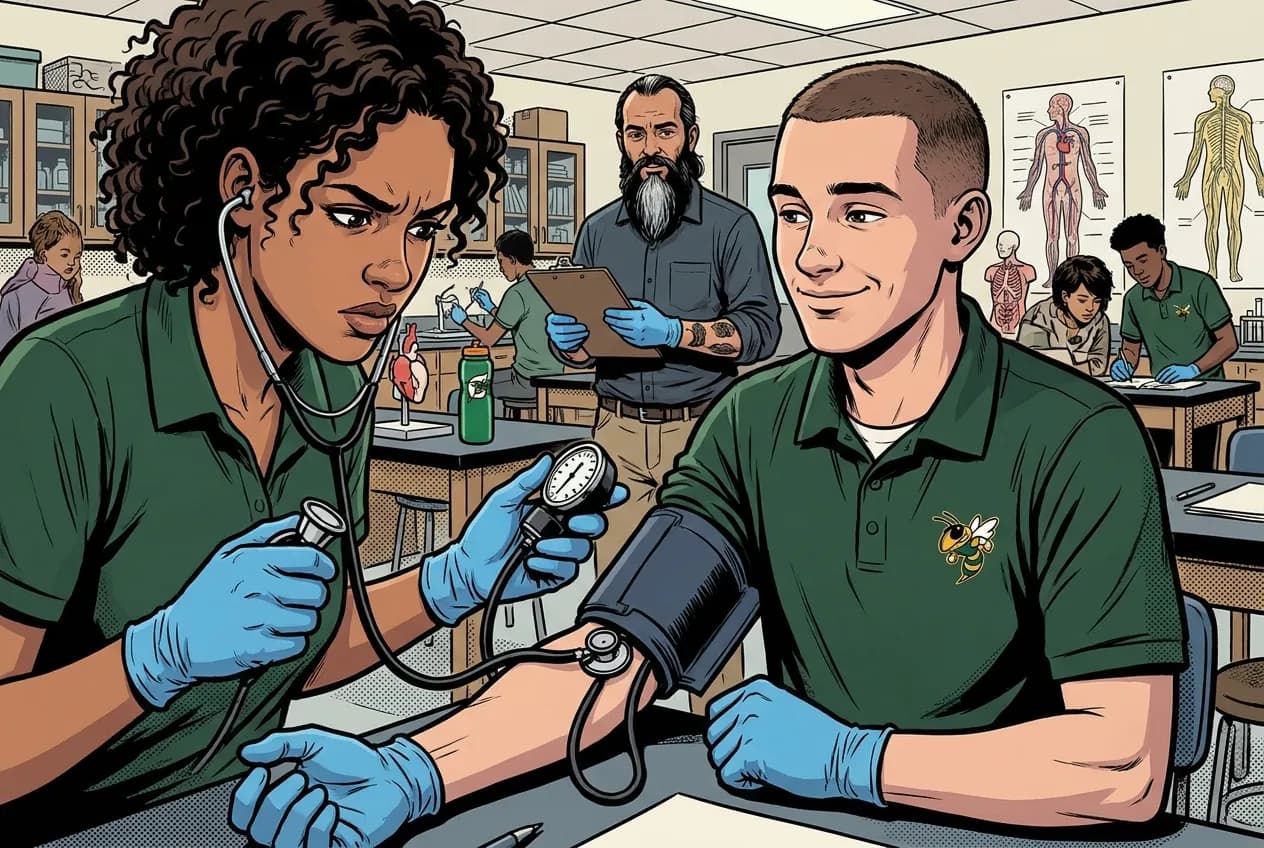
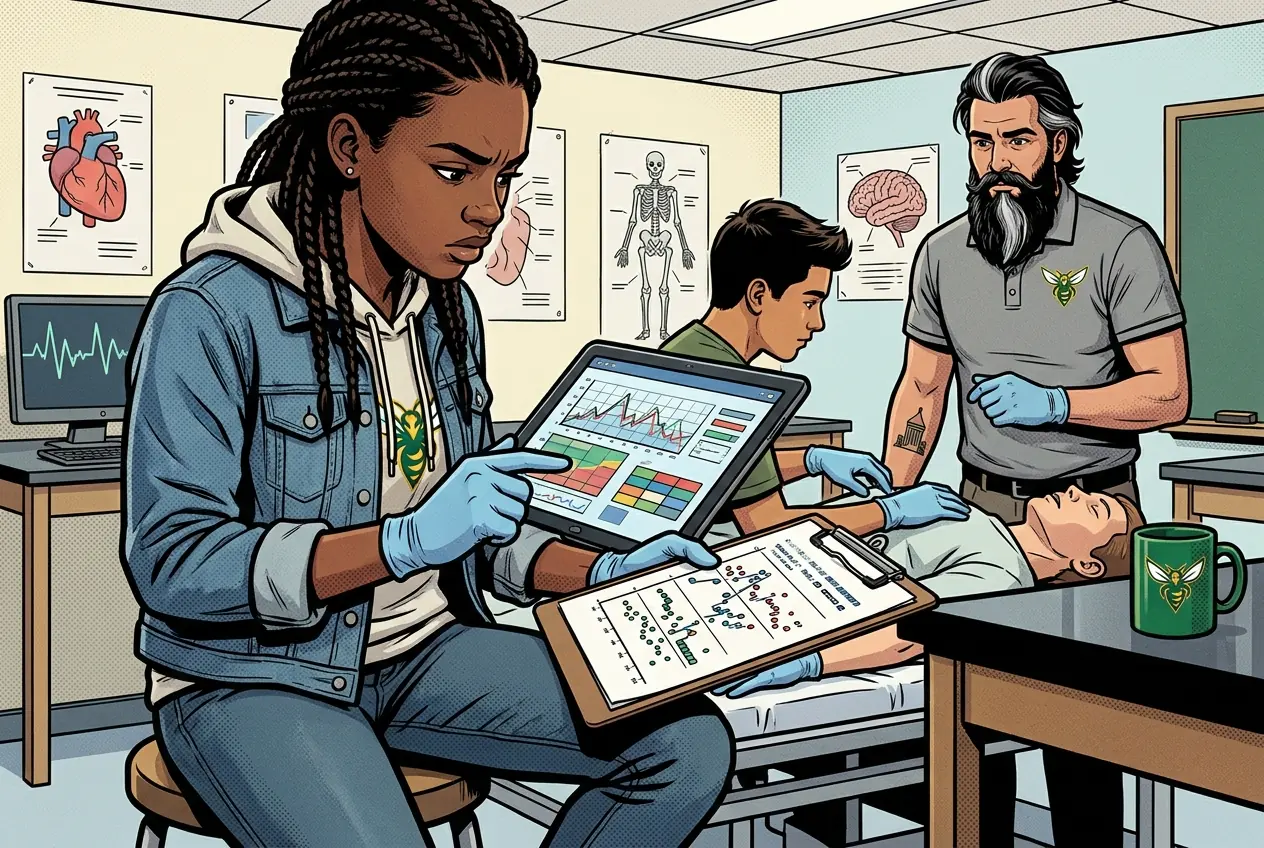
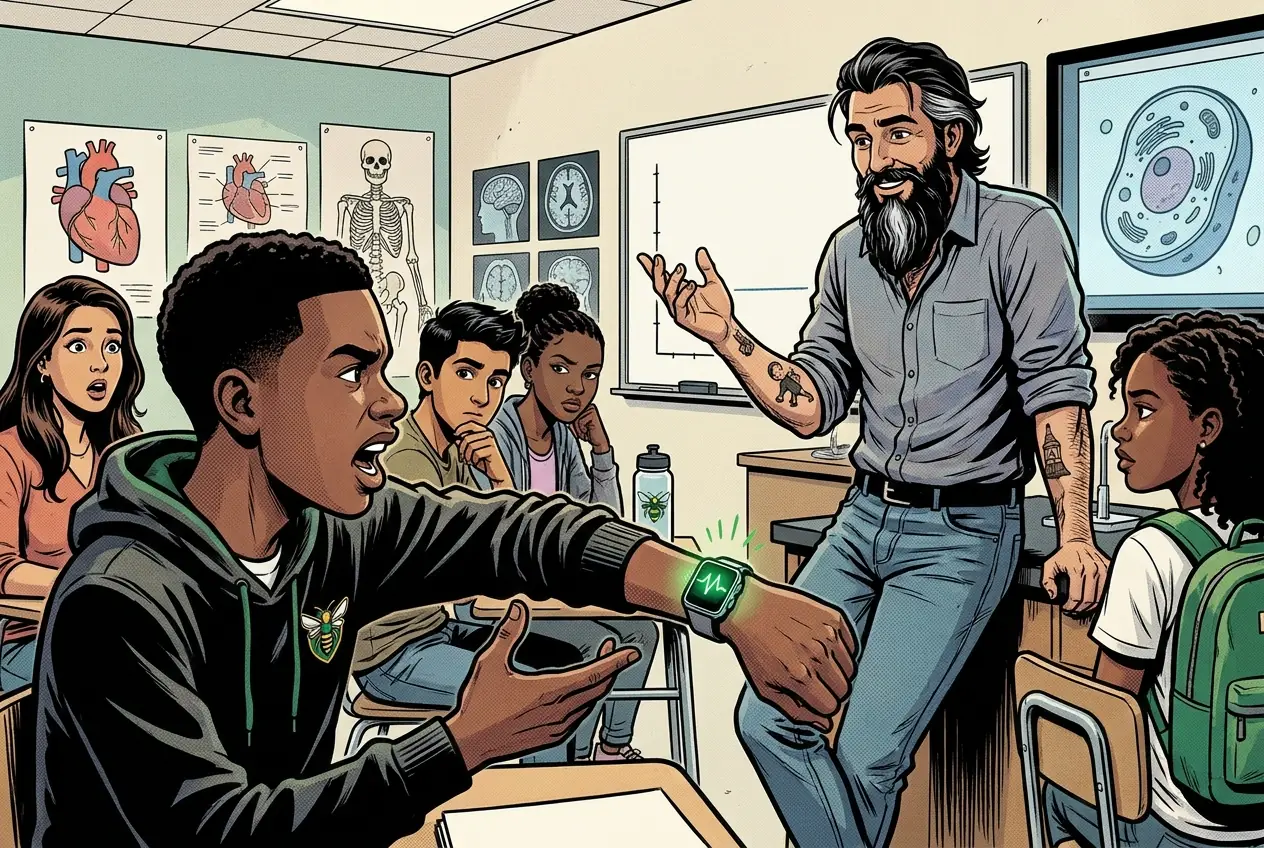
Fiction. There is no such student. The lessons, labs and dates are the real planned course; the student, the classmates and the conversations are invented.
This explainer accompanies the PLTW lab protocol: watch it before lab.
Most days, this class is your PLTW coursework: and PLTW is online and individual. So being out usually just means doing exactly what we did in class, from home.
Open Clever, then myPLTWSign in to Clever with your district Microsoft account to open Schoology or myPLTW. Follow today's posted steps. If myPLTW will not open, use the posted alternative and tell Mr. Mendoza. Turn in your completed work through the Schoology assignment.
You can't do those from home: do this instead: Teacher-posted data/model packet, same objective. Supplemental: Khan: circulatory/respiratory system basics; MedlinePlus patient privacy basics.
Class still runs. A substitute will post today's plan: complete the online activity above; it's built to be self-guided. Need the concept taught without a teacher? Use this authoritative explainer:
MedlinePlus: Vital Signs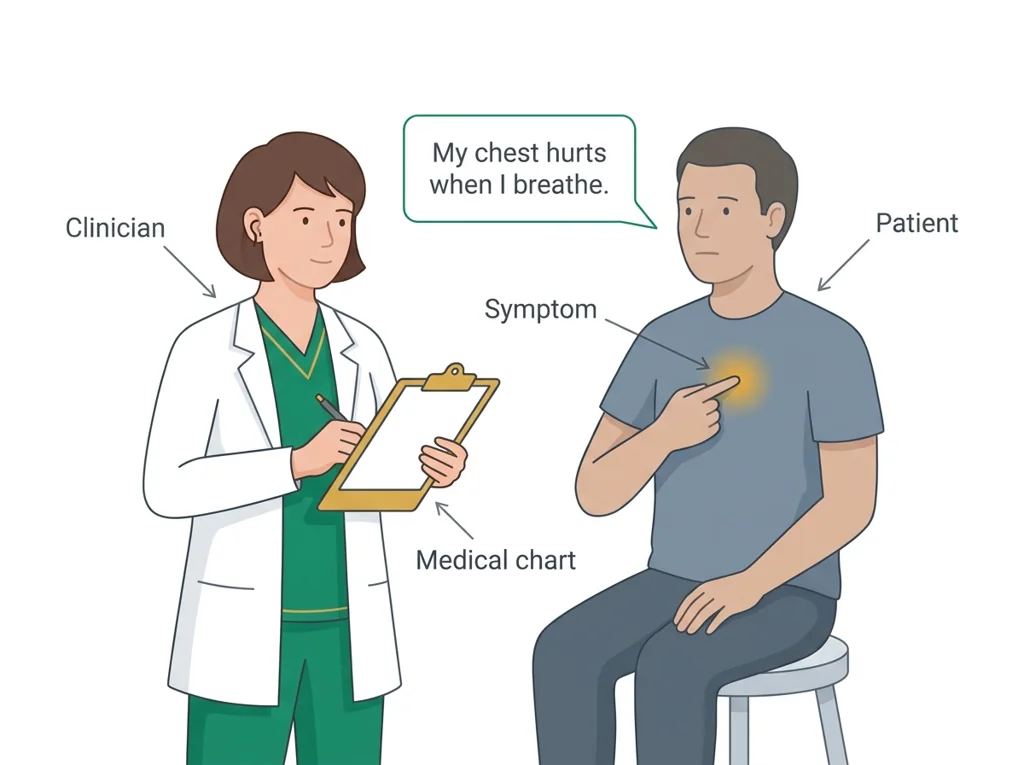
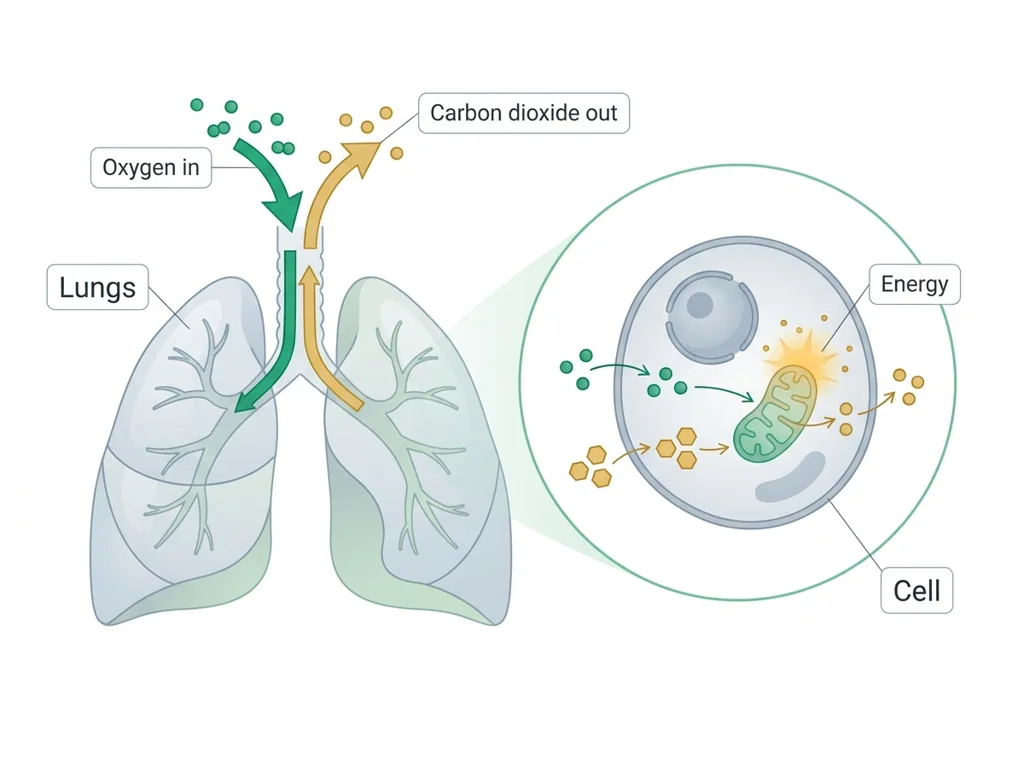
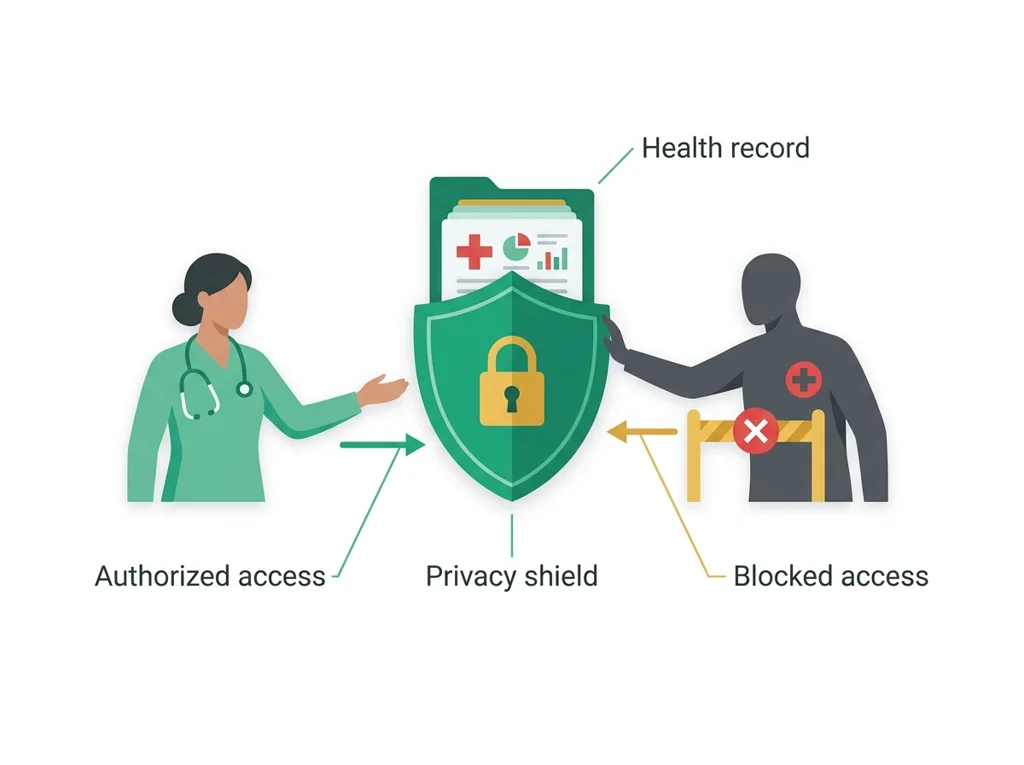
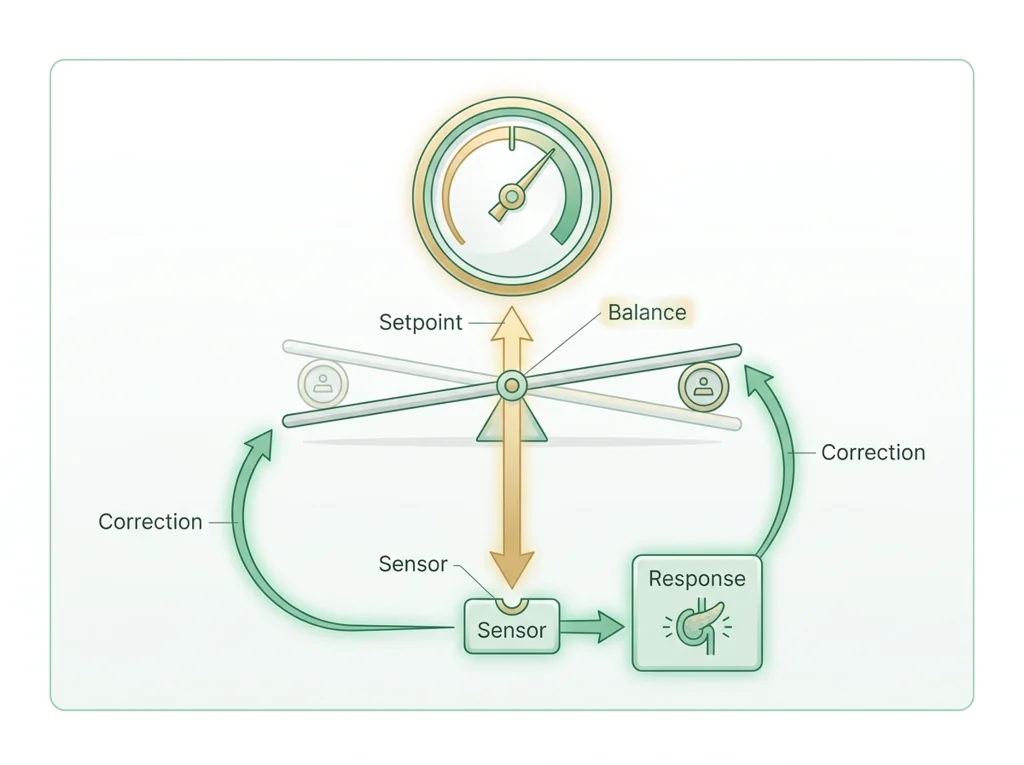
Hand-picked readings and interactives for this lesson, from authoritative open organizations and PLTW's own public course outline.