
Pedigree and risk CER
This page has four parts, in the order you use them. Part 1 is what you need to know. Part 2 says what to do, in plain English. Part 3 shows the work done once on a case that is not yours. Part 4 is your own work and where to turn it in.
Open your materials, follow the steps, then turn in your work.
Students construct a CER linking pedigree evidence to a calculated genetic risk for an offspring.
Check you have the right sheet: the top of it prints today's portal day, Pedigree and risk CER. The PLTW activity itself is in myPLTW and is not posted here.
Optional: listen or watch a unit review▸
Part 1 of 4 · Background and definitions▸
💡 Big idea: A pedigree feeds parental genotypes into a Punnett square, so a family's history becomes a quantified probability instead of a rough estimate.
- • Standard pedigree symbols encode sex, affected status, and status across generations.
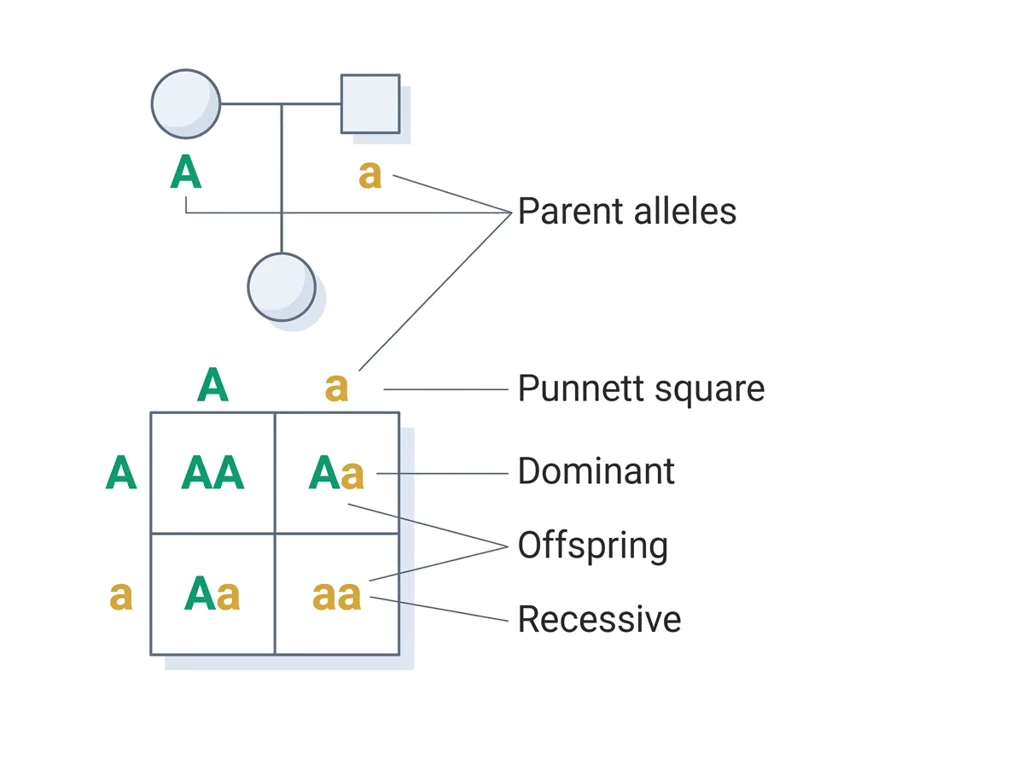
- • A Punnett square converts inheritance pattern and parental genotypes into offspring probabilities.
- • A CER requires a quantitative claim, specific pedigree evidence, and a stated assumption or limitation.
Can humans be trusted with control over genetics? And: extinction, or life without ?
A pedigree feeds parental genotypes into a Punnett square, so a family's history becomes a quantified probability instead of a rough estimate.
Driving question: Given this family's pedigree, what exact probability can you defend that the couple's next child will be affected, and what assumption is that number resting on?
New idea: A pedigree feeds parental genotypes into a Punnett square, so a family's history becomes a quantified probability instead of a rough estimate.
- Observe or measure the relevant feature in today's lesson.
- Organize the observation with a stable evidence ID.
- Apply this rule: Trace possibilities generation by generation, test the inheritance pattern against every supplied relationship, and report risk as a probability rather than a prediction of one person's outcome.
- Choose the option the evidence supports and state the limit of the conclusion.
Real biomedical example: Given this family's pedigree, what exact probability can you defend that the couple's next child will be affected, and what assumption is that number resting on?
What the evidence supports: E1 to E3 and the figure support the daily take-home when the response meets the stated success criteria.
What it cannot prove: The package does not support claims beyond this lesson's or any real patient diagnosis.
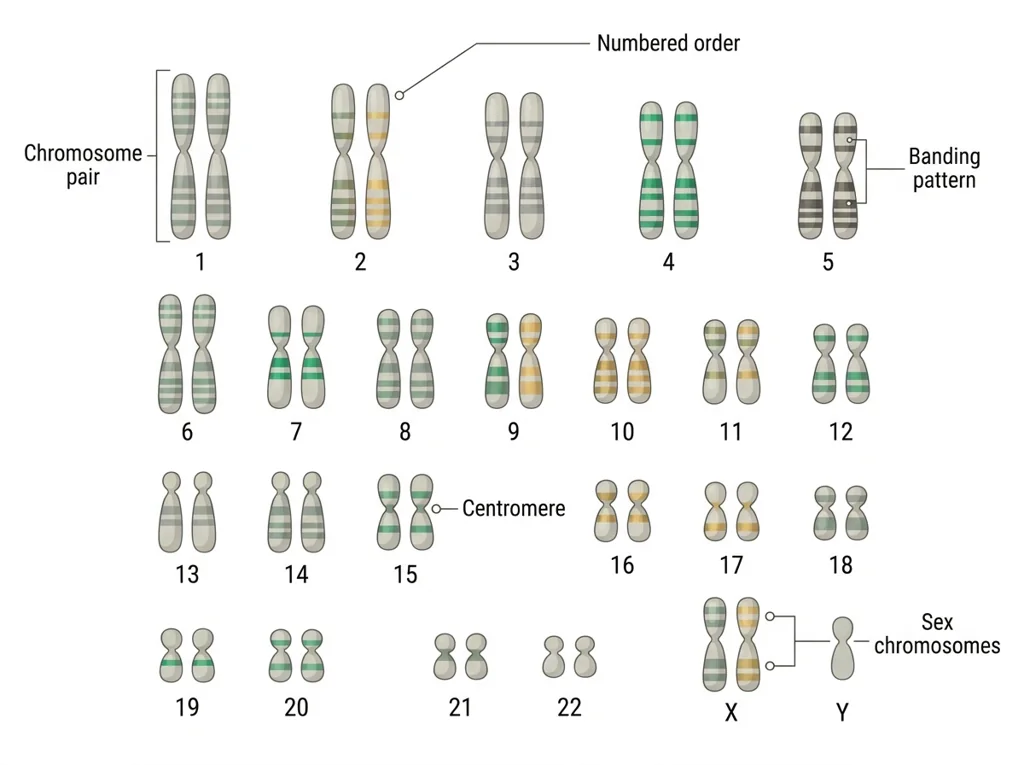
- • : A photograph of a person's chromosomes arranged in pairs by size, used to spot missing, extra, or rearranged chromosomes.
- • inheritance: The passing of genetic traits from parents to offspring through genes carried on chromosomes during reproduction.
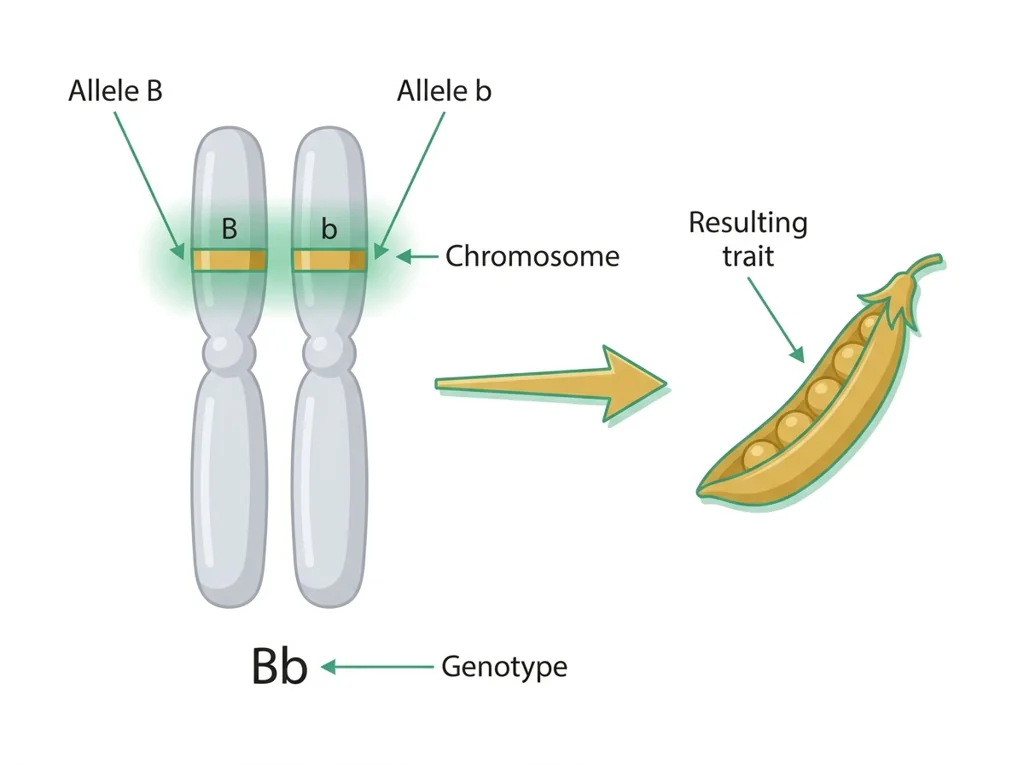
- • : The specific set of gene versions an individual carries, which works with the environment to shape observable traits.
- • phenotype: The observable traits of an organism, such as appearance or function, that result from its combined with environmental influences.
- • : A person who carries one copy of a disease without showing symptoms but can pass it to their children.
- • pedigree: A family tree drawn with standard symbols (squares for males, circles for females, filled for affected) so any geneticist can read a family at a glance.
- • : The increased chance of developing a disease that a person inherits because of specific gene variants passed down in their family.
Use it now: Choose one decision option. Cite E1 and E3, then explain how the rule connects the evidence to your choice. This is thinking practice for the one turn-in named under Turn in, not a second submission.
Go further, optional: The source links below are optional enrichment. Every fact required for today's local evidence decision appears in this lesson package.
Genetic evidence can support an inheritance, , sequence, or expression explanation, but penetrance, regulation, environment, family structure, and test uncertainty can limit the conclusion.
Limit: A classroom , , pedigree, or molecular model does not establish a real person's diagnosis, prognosis, identity, or reproductive outcome.
Trace possibilities generation by generation, test the inheritance pattern against every supplied relationship, and report risk as a probability rather than a prediction of one person's outcome.
Limit: A simplified pedigree can omit penetrance, de novo changes, uncertain relationships, environmental effects, and other information needed for real .
Calculate offspring risk consistent with the pedigree and inheritance pattern.
Limit: E3 defines the classroom product or success criterion. It is not independent scientific evidence and cannot justify a clinical or causal claim.
Today's decision · Simulated classroom evidence scenario
Your role: biomedical investigator
Decision: Your team must decide what the evidence from today's lesson supports before submitting the claim-evidence-reasoning response named on today's page.
- • State that the fourth child will be affected, because 25 percent means one of every four children is.
- • Wait until we know whether every relative in the pedigree was examined, since a missed changes the genotypes.
- • Report the risk as a probability from the Punnett square, and name the inheritance pattern the pedigree assumes.
Response: State one choice, cite at least two evidence IDs, explain the rule that connects them, and add one limitation. Use it inside the one turn-in named under Turn in; it is not a separate submission.
Claim ceiling: Today's evidence supports a classroom claim about today's lesson. It cannot prove causation, diagnose a real patient, or justify action outside this room.
Reason for review: Your team must decide what the evidence from today's lesson supports before submitting the claim-evidence-reasoning response named on today's page.
Context: A pedigree combined with a Punnett square converts family observations into a defensible probability, so risk can be quantified rather than felt.
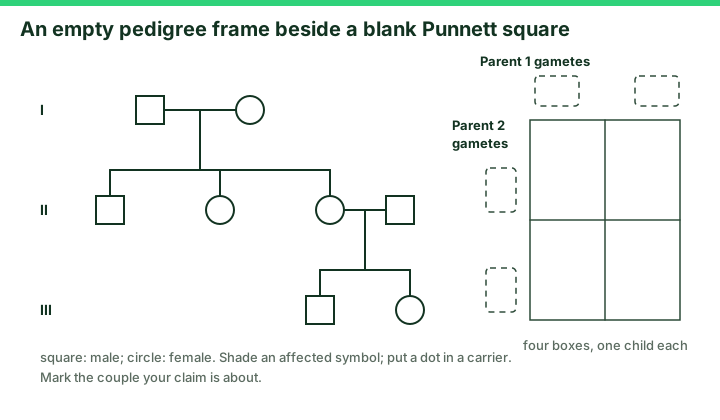
- • T1: Build a pedigree from the practice family on this page using standard symbols for sex and affected status. Practice family: Generation I, an unaffected couple with three children; Generation II, an unaffected son, an affected daughter, and an unaffected daughter who has two children with an unaffected partner; Generation III, an affected son and an unaffected daughter. The couple in your claim is the Generation II parents.
- • T2: Trace the inheritance pattern and label carriers across two generations.
- • T3: Use a Punnett square to estimate the probability that the next child is affected.
- • T4: Write a claim stating the for the couple.
- • T5: Support the claim with pedigree evidence and reasoning that names assumptions and limitations.
- • E1: Genetic evidence can support an inheritance, , sequence, or expression explanation, but penetrance, regulation, environment, family structure, and test uncertainty can limit the conclusion.
- • E2: Trace possibilities generation by generation, test the inheritance pattern against every supplied relationship, and report risk as a probability rather than a prediction of one person's outcome.
- • E3: Calculate offspring risk consistent with the pedigree and inheritance pattern.
Measurements: Use only the measurements, units, graph, or counts supplied in today's task. No additional patient measurement is implied.
Figure finding: An unfilled three-generation pedigree frame in the practice family's shape, a joined couple in generation one, three children in generation two of whom one has a partner, and two grandchildren in generation three, beside a blank two by two Punnett square with dashed gamete slots for each parent.
Uncertainty: This is a composite classroom scenario. Missing history, measurements, or confirmation tests remain unknown and limit the conclusion.
Students often think the 25 percent risk means that out of four children, exactly one will be affected, so if the first three are healthy the fourth must be affected. The trap: Each pregnancy is an independent 25 percent chance; the previous children do not change the odds for the next one. The trap is treating probability like a quota, which leads families to false certainty about the next child.
- CER:
- Claim, Evidence, Reasoning: make a claim, back it with evidence, explain your reasoning.
- SOP:
- Standard Operating Procedure, the exact steps to follow (especially in a lab).
- Tracker:
- Your PLTW progress log where you record completed evidence.
- myPLTW:
- The PLTW course site where you do the online activities. Find it in Clever with your Microsoft sign-in, right next to Schoology.
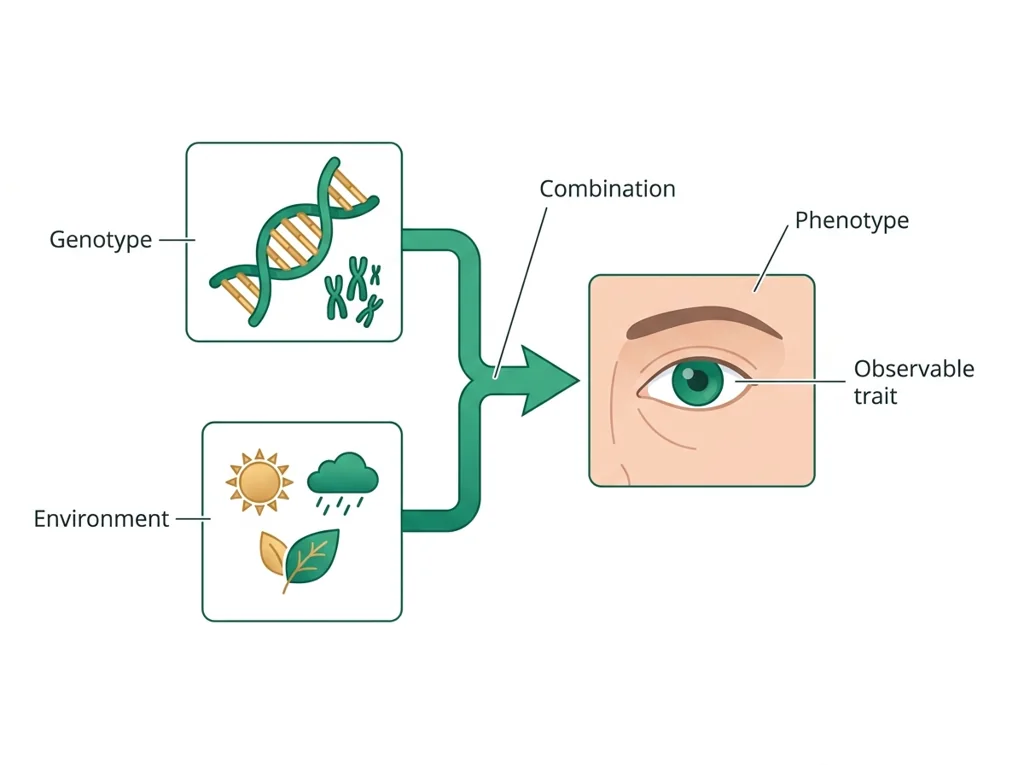
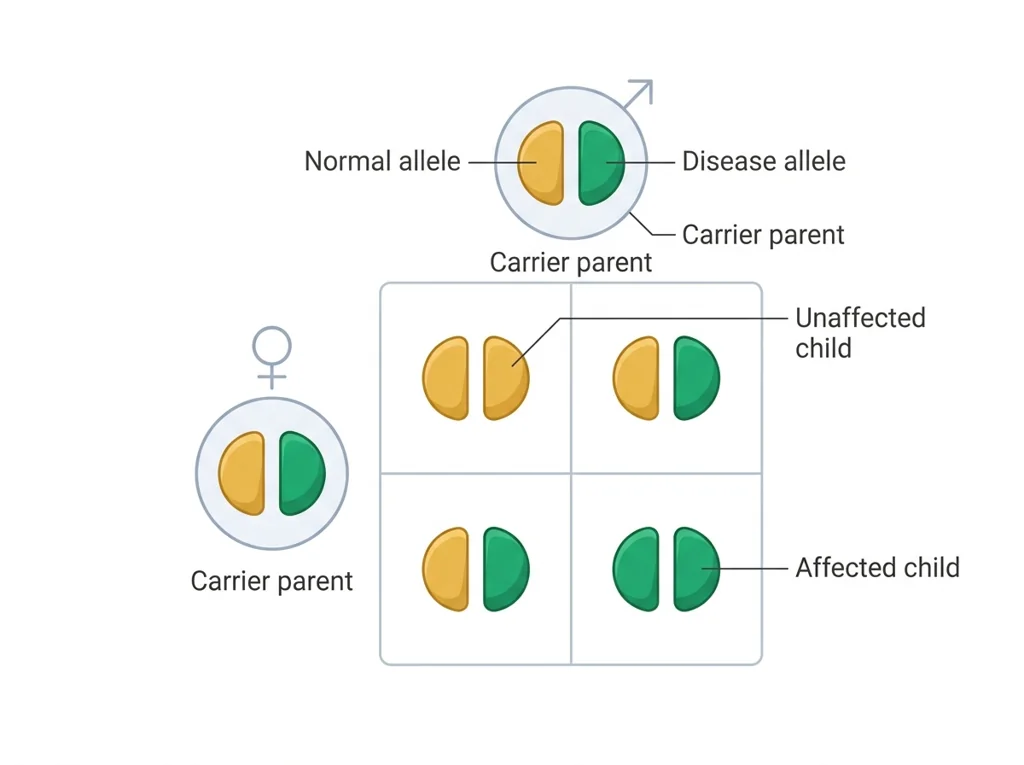
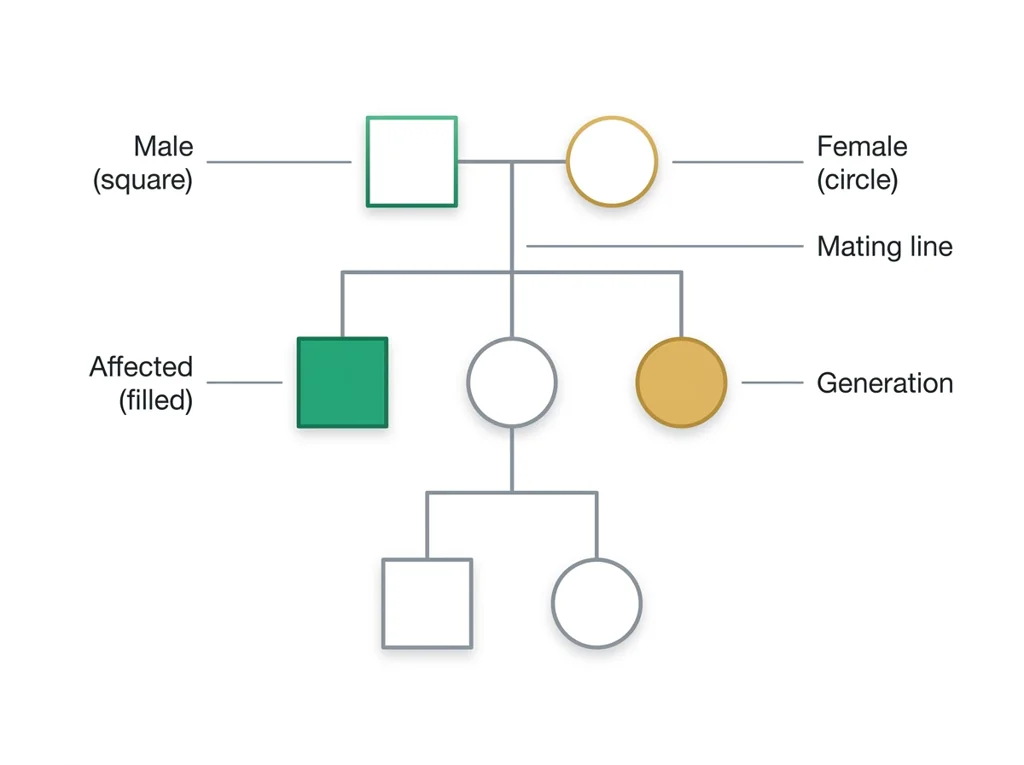
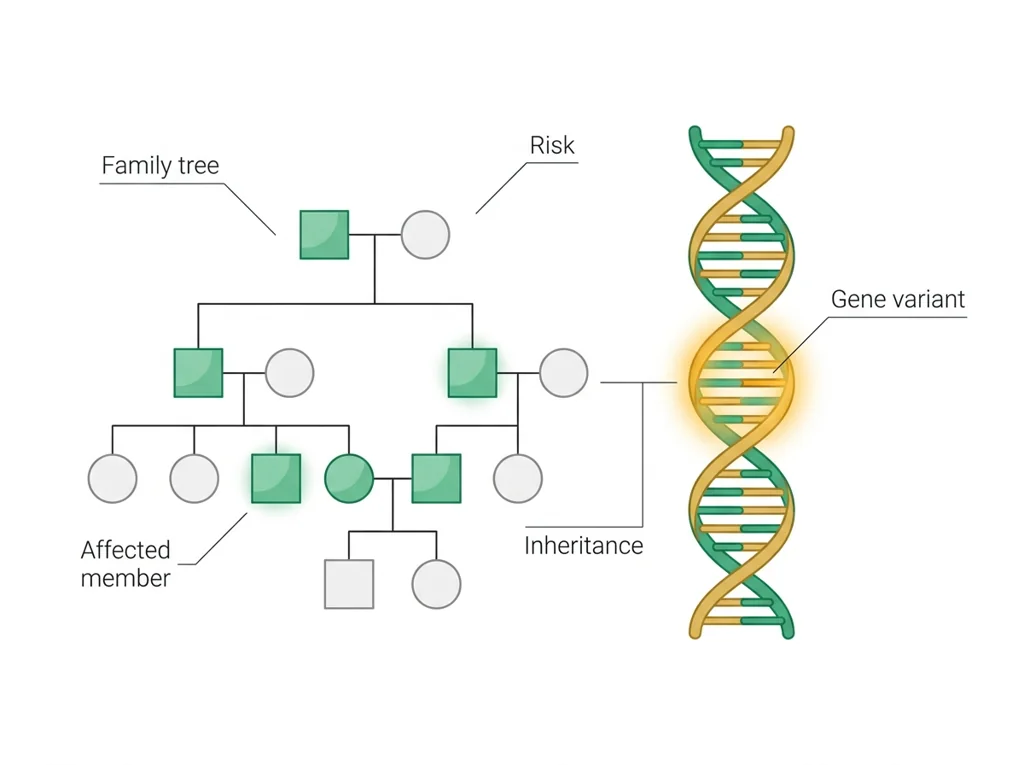
Tap the speaker to hear a term. Add two of these to your notebook glossary with a definition and an example in your own words.
Pick just 2 or 3 words from today and make them yours: write what each one means in your own words, name the context clue or evidence that helped, then give one example from what you actually did in Pedigree and risk CER. Try your own words first; the glossary is there if you get stuck. This is voluntary and counts as extra credit, so keep it short.
Saved on this device. Show Mr. Mendoza or add these to your notebook glossary to claim the extra credit.
Part 2 of 4 · Directions in plain English▸
2.1 Open your materials
2.2 Start the work
Build a pedigree from the practice family on this page using standard symbols for sex and affected status. Practice family: Generation I, an unaffected couple with three children; Generation II, an unaffected son, an affected daughter, and an unaffected daughter who has two children with an unaffected partner; Generation III, an affected son and an unaffected daughter. The couple in your claim is the Generation II parents.
Show all 5 required steps
- Build a pedigree from the practice family on this page using standard symbols for sex and affected status. Practice family: Generation I, an unaffected couple with three children; Generation II, an unaffected son, an affected daughter, and an unaffected daughter who has two children with an unaffected partner; Generation III, an affected son and an unaffected daughter. The couple in your claim is the Generation II parents.
- Trace the inheritance pattern and label carriers across two generations.
- Use a Punnett square to estimate the probability that the next child is affected.
- Write a claim stating the genetic risk for the couple.
- Support the claim with pedigree evidence and reasoning that names assumptions and limitations.
Lost your place? You should have your pedigree built and carriers labeled across two generations (steps 1-2). If so, run the Punnett square for the next child (step 3), write your risk claim (step 4), then back it with pedigree evidence and named limitations (step 5).
- 0-8 minWarm-up: draw pedigree symbols for affected male, female, unaffected female.
- 8-25 minBuild the three-generation pedigree from the practice family; label carriers.
- 25-40 minTrace inheritance pattern; set up and complete the Punnett square.
- 40-60 minWrite the CER: claim with % risk, pedigree + Punnett square evidence, reasoning.
- 60-72 minAdd one assumption and one limitation to the CER reasoning section.
- 72-80 min: swap and check that claim is quantitative and evidence is cited.
- • On Wed, Nov 4 you read a , a whole- change; today you switch to single-gene inheritance, a pedigree and a Punnett square for a trait that follows Mendel's rules.
- • Pedigrees and Punnett squares are the two core tools of classical genetics, and the biotechnology part of your end-of-course WebXam includes inheritance.
- • Your CER today must include a number, a percent risk, not just a direction.
- • Label carriers as well as affected individuals, most families have carriers who never show symptoms.
PLTW connection and today's work
In myPLTW, Lesson 2.2 Decoding a Diagnosis: the pedigree and Punnett work on this page is Project 2.2.6 A Family Affair, and your sheet carries Activity 2.2.5 My, Oh, Meiosis. Today's one turn-in is the pedigree and Punnett CER on this page.
Today's stopping point: You read the karyotype on Wed, Nov 4. Finish the Activity 2.2.5 questions if myPLTW opens, then write the CER.
PLTW activity titles identify the course connection. If your account will not open, use the posted materials for today and tell Mr. Mendoza. Do not mark an online activity complete unless you completed it.
Course connection
- Activity 2.2.5 My, Oh, Meiosis
- Project 2.2.6 A Family Affair
Use the turn-in directions in Part 4 of this page. Do not create a second submission unless your teacher asks for one.
Show another explanation or a smaller first step
Need help? Choose a starting point
Part 3 of 4 · Worked example▸
This is a parallel case, not your own. Read it for the order of the work, then do your own in Part 4.
Claim: There is a 50% chance that this couple's next son will be colorblind, and a 0% chance that a daughter will be colorblind.
Evidence: Red-green colorblindness is an X-linked recessive trait, so the allele sits on the X chromosome. The pedigree shows that the mother has a colorblind father, which means she inherited one affected X and is a carrier (X^A X^a), while the father has normal color vision (X^A Y). A Punnett square of X^A X^a mother by X^A Y father gives four equally likely children: X^A X^A, X^A X^a, X^A Y, and X^a Y. Among the two possible sons (X^A Y and X^a Y), one is affected, and neither of the two possible daughters is affected because each daughter still inherits at least one normal X^A from the father.
Reasoning: Because the trait is recessive and carried on the X chromosome, a son is affected whenever his single X carries the recessive allele, since he has no second X to mask it, giving 1 of 2 sons affected, or 50%. A daughter would need two recessive alleles to be affected, but the father can only pass a normal X^A, so no daughter in this cross can be colorblind, which is why the daughter risk is 0%. This reasoning assumes the mother is truly a carrier, which the pedigree supports because her father was colorblind and each daughter of a colorblind man must receive his X^a. A limitation is that the pedigree relies on reported vision status rather than a formal color-vision test, so mild cases could be missed or misreported, and confirming the mother's carrier status with genetic testing would make the 50% son estimate more reliable.
| Punnett (carrier mother X^A X^a by unaffected father X^A Y) | X^A from father | Y from father |
|---|---|---|
| X^A from mother | X^A X^A daughter, unaffected | X^A Y son, unaffected |
| X^a from mother | X^A X^a daughter, carrier | X^a Y son, affected |
This model shows the level of evidence and organization needed to complete: A claim-evidence-reasoning paragraph that states a quantitative genetic-risk for an offspring, supports it with pedigree and Punnett square evidence, and names at least one limitation.
- Write one defensible claim.
- Choose specific evidence that supports the claim.
- Explain the scientific rule that connects the evidence to the claim.
Keep the structure. Replace the question, facts, measurements, and evidence. Then recheck units, vocabulary, and whether the conclusion goes beyond the evidence.
Also due today: Submit your CER as one PDF to Schoology assignment for this lesson in Schoology.
A family evidence board traces possible combinations through each generation while keeping probability separate from certainty.
- Which inheritance pattern fits the supplied relationships?
- Which genotypes remain possible?
- Does the probability describe one possible outcome or guarantee it?
Trace possibilities generation by generation, test the inheritance pattern against every supplied relationship, and report risk as a probability rather than a prediction of one person's outcome.
A simplified pedigree can omit penetrance, de novo changes, uncertain relationships, environmental effects, and other information needed for real .
- • Family symbols map to the supplied phenotype record.
- • branches map to possible transmissions.
- • The final maps to a conditional probability, not a guaranteed outcome.
Part 4 of 4 · Your work▸
Check your work before submitting
- Calculate offspring risk consistent with the pedigree and inheritance pattern.
- Write a CER with claim, quantitative evidence, and reasoning that cites at least one limitation.
4.1 Turn in your work
DueCheck the Schoology assignment for this day- Hand in
- Written CER with a quantitative genetic-risk claim, pedigree and Punnett square evidence, and at least one stated limitation.
How to submit and name your file
Submit your CER as one PDF to the Schoology assignment for this lesson in Schoology.
In Schoology, open your course and the assignment for this lesson. Attach your file, select Submit, and check that it appears in the submission.
PDF upload helpYou get two school days for every day you were absent, so this deadline moves with you.
Today's lesson is in Schoology
Each school day has one lesson page in Schoology that holds everything for the day: the goal, the story so far, every table and data value, the numbered steps, and what to turn in. Open it first and work from it. The other rows for this day, if any, are the score line for a paper quiz or test and the John Carroll debate item; they do not add work. Check Schoology for each deadline.
- Checkpoint Quiz 3: cells, cancer, and proteins (paper, in class Mon 11/9)(taken on paper in class: this row holds the score, there is nothing to upload)
- Today's Lesson · Mon 11/9 · Wk12 · Checkpoint Quiz 3 on paper, then genes, alleles, and how Kai got NF1(today's lesson page: the goal, the data, the steps, and what to turn in are all on it)
Link will not open? Open Schoology, choose your course and section, and find the title shown above.
- CompleteEvery required part of the artifact is present, nothing left blank.
- AccurateThe science and the data are correct and match the evidence.
- Scientific reasoningYou explain your claim with evidence and reasoning (CER), not just an answer.
- Professional communicationClear, organized, labeled, and written the way a clinician or scientist would.
- SubmittedGo to Schoology to turn this in. Submit one PDF. Schoology attaches your name to your upload; on the page itself, write your period and code. Name the file: FirstName LastName - Assignment Title - YYYY-MM-DD.pdf. If you cannot get in, see Mr. Mendoza. Do not skip the work.
How this lesson connects
Keep using what you learned last class: Can humans be trusted with control over genetics? And: extinction, or life without culture? Today: A pedigree feeds parental genotypes into a Punnett square, so a family's history becomes a quantified probability instead of a rough estimate.
Practice: try a question, then check your answer▸
Claim ceiling for this check: Today's evidence supports a classroom claim about today's lesson. It cannot prove causation, diagnose a real patient, or justify action outside this room.
Both parents are carriers (Aa) for an autosomal recessive disease and already have two healthy children. What is the probability their third child is affected, and why?
Write an answer and pick a confidence to unlock the key.
Fast retrieval with instant answers, not the commit-then-reveal check above. Try each from memory first: write what you remember about the earlier units, then check yourself here.
Missed class or ready for more?▸
Optional practice for this unit's lab skills. Nothing in it is due today. This lesson has more than one, and they cover different skills.
What today's skills lead to. These are real health-science careers this course builds toward. Tap one to see, on the US Department of Labor's O*NET site, what the job actually involves, what it pays, and how fast it is growing.
Today is individual work you can do from home: complete the same target above, then submit your CER.
Go to Schoology to turn this in. Submit one PDF. Schoology attaches your name to your upload; on the page itself, write your period and code. Name the file: FirstName LastName - Assignment Title - YYYY-MM-DD.pdf. If you cannot get in, see Mr. Mendoza. Do not skip the work.
Class still runs. Complete today's work as this page describes (it is self-guided). Need the concept taught without a teacher? Use this authoritative explainer:
NHGRI: how to read a pedigreeSources: slides, readings, and resources▸
The deck carries the prior idea forward, lets you inspect an analogy, maps the rule to biology, and ends with the same evidence decision and exit ticket used on this page.
Hand-picked readings and interactives for this lesson, from authoritative open organizations and PLTW's own public course outline.
This week
My Progress dashboard