
Human Body Systems · 2027-02-16 · 80 minutes
Looking Inside Bone: structure, cells and repair readiness
Your goal: Compare compact and spongy bone, connect three bone-cell roles to maintenance, and explain why repair needs more evidence than a break pattern.
One product: One dated notebook entry with R1 tissue table, R2 cell-role table, R3 labeled sketch, R4 repair-limit response and R5 check.
Complete it on paper if needed. Record any missing official directions and ask the teacher; keep unfinished official requirements pending.
Start the work
Keep the CER and its source IDs. Save any posting or submission issue for teacher resolution.
- Read the word guide and E1-E3; locate every F1 label.
- Inspect M1 and complete R1-R2 in one dated notebook entry.
- Sketch F1 and finish R3, keeping the cell-role key separate.
- Use the fictional card in R4 to identify repair limits without inventing data.
- Check R1-R4, finish R5, and keep the same entry for February 17.
Show the 80-minute plan
- 0 to 8 minutes. Read the question and define schematic, matrix and fracture.
- 8 to 25 minutes. Read E1-E2 and inspect F1; complete R1.
- 25 to 40 minutes. Use M1 to complete R2.
- 40 to 58 minutes. Complete labeled sketch and R3 explanation.
- 58 to 72 minutes. Read E3 and respond to R4.
- 72 to 80 minutes. Finish R5 and retain the entry for February 17.
Open your materials
Use the reading, word guide, and worked example below. Keep your answers on paper or in one document.
Printable lesson and response record (PDF). This packet contains the same required reading and work.
F1. Bone region: supporting material and living spaces
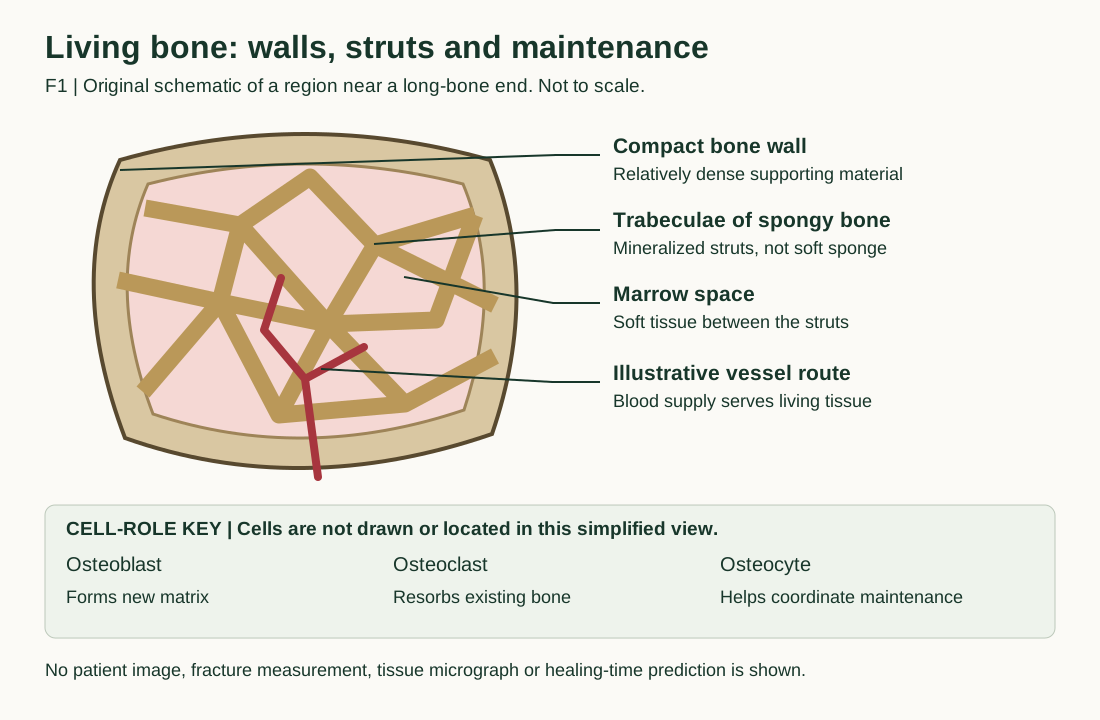
Question: How does living bone structure prepare us to reason carefully about a fracture?
Words you will use
- Matrix
- Material surrounding bone cells, including protein and mineral.
- Collagen
- A structural protein that contributes toughness to bone.
- Mineralization
- Deposition of mineral in a matrix.
- Compact bone
- Relatively dense cortical bone forming an outer wall.
- Spongy bone
- Internal trabecular bone arranged as a network of mineralized struts.
- Trabecula
- One strut or plate in that network; trabeculae is plural.
- Marrow
- Soft tissue in bone spaces; some marrow makes blood cells.
- Osteon
- A cylinder of layered compact-bone matrix around a central canal.
- Osteoblast
- A cell that forms new bone matrix.
- Osteoclast
- A cell that resorbs existing bone.
- Osteocyte
- A mature cell embedded in bone matrix that helps coordinate maintenance.
- Resorption
- Removal of existing bone tissue by osteoclasts.
- Remodeling
- Coordinated removal and replacement of existing bone.
- Fracture
- A crack or break in a bone.
- Blood supply
- Blood delivered through vessels to living tissue.
- Stability
- A mechanical condition limiting excessive movement at a repair site.
- VEGF
- Vascular endothelial growth factor, a signal involved in formation of blood vessels.
- Angiogenesis
- Formation of new blood vessels.
- Schematic
- A simplified explanatory drawing, not a patient image or a measurement.
E1. Dense walls and internal struts
Bone is living connective tissue. Its matrix contains collagen protein and mineral: collagen contributes toughness and mineral contributes hardness. Compact (cortical) bone forms a relatively dense outer wall. Spongy (trabecular) bone forms a network of mineralized struts called trabeculae inside many bones. Spongy bone is not soft sponge. Spaces between trabeculae contain marrow, not empty air. Marrow is soft tissue; some marrow produces blood cells. A long bone can contain both bone-tissue arrangements. See schematic F1. [NIAMS]
E2. Cells change the matrix
Osteoblasts form new bone matrix. Osteoclasts resorb, or remove, existing bone. Osteocytes are mature cells within the matrix that help coordinate its maintenance. Remodeling replaces existing bone through coordinated resorption and formation. It is ongoing maintenance, not a process limited to fractures. Some compact bone is arranged in osteons, cylinders of layered matrix around small vessel-containing canals. Trabeculae are internal struts; they are not miniature hollow osteons. [NIAMS; OPENSTAX]
E3. Why this matters before fracture analysis
A fracture is a crack or break in bone. Repair needs living cells, an adequate blood supply and a suitable mechanical environment, including stability. Blood carries materials needed at the repair site. A visible break pattern by itself cannot tell you whether those conditions are present or how many days healing will take. [AAOS]
Research example: Street and colleagues (2002) reduced VEGF signaling in mouse bone-injury models. Blood-vessel formation, new bone formation and mineralization were impaired. VEGF is a signal involved in vessel formation. The researchers also studied other models, including rabbit defects and cultured human bone-forming cells. This supports a role for signaling and vessels in repair; it does not make a classroom drawing a human treatment test. No animal or drug work is performed here. [STREET]
E4. How to use this preparation
This is original classroom preparation for the concepts associated with PLTW HBS Activity 1.1.4, Looking Inside Bone, before February 17 fracture analysis. Your teacher confirms the official worksheet, required screens and completion rules. If your teacher supplies an official task, keep its requirements separate and follow them. Completing this page does not certify official PLTW completion.
Use one dated notebook entry titled Looking Inside Bone preparation. Keep it for February 17. No separate February 16 Schoology assignment is assigned; do not upload it to a different assignment. A teacher may inspect the notebook in class. If an upload is later assigned, use only that confirmed destination.
M1. Two crews and a delivery route
Original analogy: a model walkway has solid outer panels and internal supporting struts. One maintenance crew removes damaged material, a second adds replacement material, and an inspector coordinates work. A delivery route brings needed supplies. With no delivery record, a drawing of a damaged panel cannot establish a repair deadline.
Map the parts yourself in R2: panels and struts illustrate arrangements of supporting material; use E2 and E3 to decide which cell or supply each crew, the inspector and the delivery route stands for. The analogy does not model cells, mineral chemistry, real forces or a specific bone injury. Inspect F1 for the biological labels.
Worked reasoning: A student sees an internal lattice in schematic F1 and calls it soft. The visible spaces show a trabecular arrangement; the supplied reading states that the struts are mineralized bone. Therefore spaces do not justify calling the struts soft. This correction uses E1 and F1, not a measurement of strength.
Try the decision
The supplied fictional card names a visible break and nothing else. Choose the best next reasoning step.
- Describe the supplied pattern and identify missing repair conditions before comparing healing.
- Assign the shortest healing time because the drawing has few fragments.
- Treat spongy bone as soft filler and ignore its role.
Explain your choice using the reading. Discuss it or say it to yourself. This practice does not add another submission.
Your response record
Use these labels on paper or in your document. The space below also works when this page is printed.
Compare tissue
Make a two-column compact/spongy table with rows for arrangement, location in F1, and what occupies nearby spaces. Add one shared property.
Use E1 and F1. Use the drawing labels rather than inventing a measurement.
Map cell roles
Make three rows: osteoblast, osteoclast, osteocyte. For each, state its role and map it to the appropriate M1 maintenance role. Add one limit of the analogy.
E2 supplies every role; M1 states the limit.
Label and explain
Sketch the simplified F1 bone region. Label compact wall, trabeculae, marrow space and vessel route. Place the three cell names in a separate role key, not at locations the schematic does not show. Add two sentences linking structure and living cells.
Use E1, E2 and F1. Artistic realism is not graded; labels and relationships matter.
Prepare tomorrow
A fictional card says only: a break is visible in a bone drawing. Nothing else is supplied. State one description the card supports, two missing facts needed to reason about repair, and why a healing-time ranking is not justified.
Use E3. Do not invent numerical data, patient age, treatment or healing time.
Check the entry
Check R1-R4, correct one error if needed, and finish with the take-home sentence in your own words. Keep the dated entry for February 17.
If already accurate, state which label and evidence you checked. No extra exit product or upload is required.
Check your product
- I distinguish mineralized trabeculae from marrow spaces.
- I correctly explain three bone-cell roles.
- I label the four required structures and explain how the model is limited.
- I identify missing repair facts without predicting a real healing time.
- I retain the same checked notebook entry and keep official completion separate.
This original preparation cannot diagnose a fracture, rank real healing times, authorize physical work, or establish completion of the official PLTW worksheet.
Turn in your work
Looking Inside Bone: structure, cells and repair readiness
Keep this dated notebook preparation for February 17; show the same entry when the teacher checks it. No new online upload is assigned here.
Complete it on paper if needed. Record any missing official directions and ask the teacher; keep unfinished official requirements pending.
Connection to PLTW
Original preparation supporting HBS Activity 1.1.4 Looking Inside Bone; official worksheet requirements remain separately teacher-confirmed.
These references locate related course material. Complete only the official work and stopping point your teacher assigns. This local preparation does not establish completion of an online activity.
- Activity 1.1.4 Looking Inside Bone
Optional practice and examples
Use these resources to practice related skills. Follow the required work and evidence limits above. A simulation does not authorize a live experiment or add another submission.
Slides and optional notes
Use R1-R5 in the same notebook entry. Optional guided notes do not replace the labeled sketch or add another product. Guided notes are optional and do not add a second submission.
Sources and optional reading
- NIAMS. What Is Bone? Reviewed May 2023. · National Institutes of Health, established anatomy and cell roles
- AAOS OrthoInfo. Nonunions. · American Academy of Orthopaedic Surgeons, repair conditions
- Street et al. (2002). Vascular endothelial growth factor stimulates bone repair by promoting angiogenesis and bone turnover. PNAS, 99(15), 9656-9661. doi:10.1073/pnas.152324099 · Primary experimental animal and cell research; PMID 12118119
- OpenStax Anatomy and Physiology 2e, 6.3 Bone Structure · Textbook publisher, bone tissue architecture
Keep going
If you were absent or lost your place, read the word guide and reading first. Try the example, then complete the first unfinished response.
No partner is required. Read your response aloud to yourself and check it against the product checklist.
Take home: Bone structure and living cells support repair; a drawing alone cannot predict healing time.
Which repair conditions must be supplied before a fracture pattern can support a healing claim?