Rough draft.This research track is under review with Dr. Atit's lab. Content and sequence may still change.
Craniofacial Research Track
Session 11Reading the Evidence, DecemberLens: Genetics of Disease

BLAST: is IRF6 conserved across species?

Discovery question

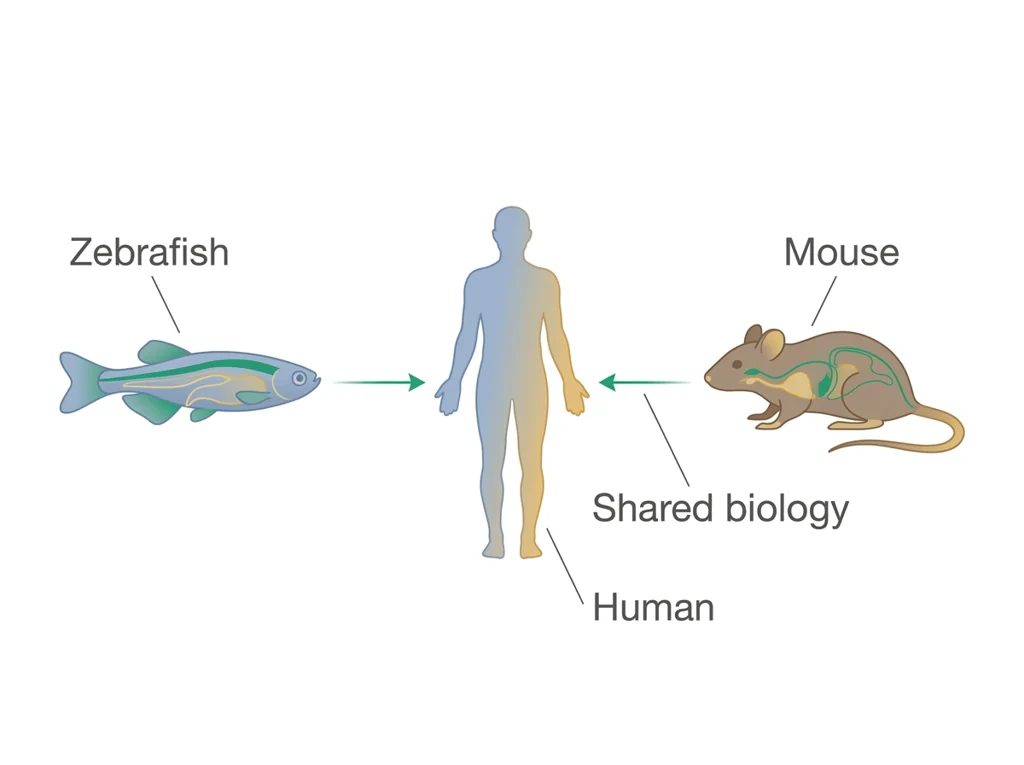
Dr. Atit's lab studies clefting in zebrafish and mice, not people. How do scientists know findings in a fish or a mouse can tell us anything about Mateo?

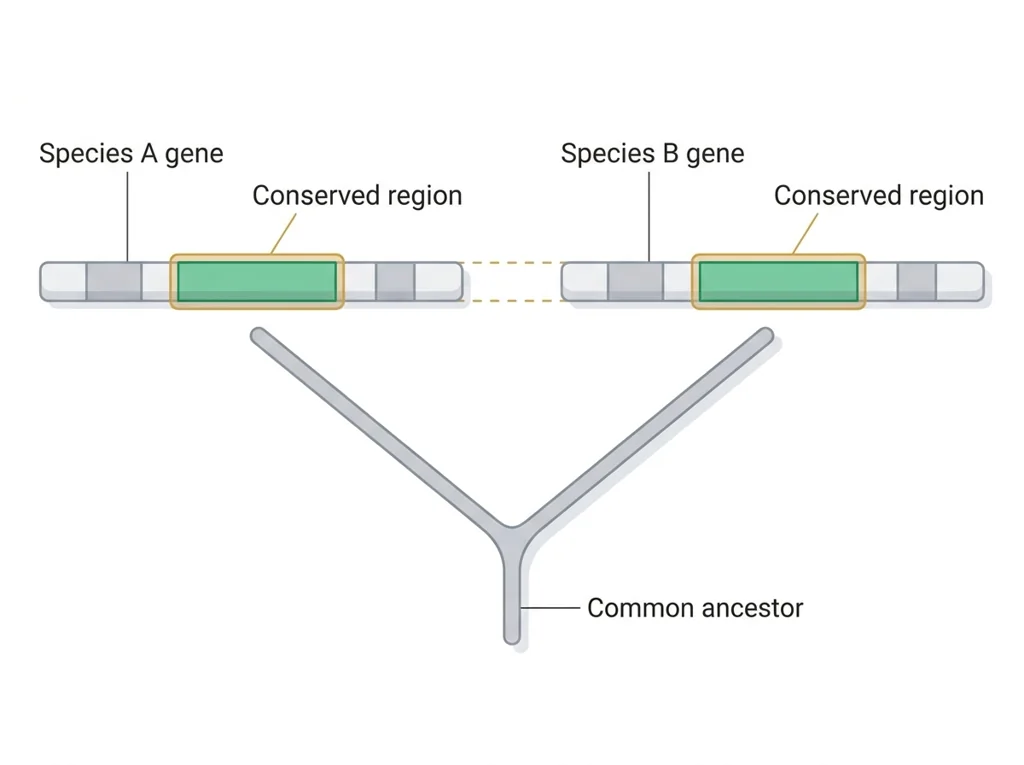
If a 's sequence stays similar from fish to mouse to human, evolution is telling us the protein does a job too important to change. That is why model organisms work.

The plan

Prerequisite check

Before this page, you should know
  • Every human gene has a public record in NCBI Gene with a stable Gene ID (IRF6 is Gene ID 3664).
  • A gene record lists the official symbol, the full name, aliases (other names), and the location.
Today's new idea is only
If a 's sequence stays similar from fish to mouse to human, evolution is telling us the protein does a job too important to change. That is why model organisms work.
Learn first

What to learn

Goal: Run a of human IRF6 against mouse and zebrafish, read the , and write a conservation claim backed by that evidence.

Know by the end
  • lines up two sequences position by position and reports , how much of the sequence matches.
  • A is the same gene or in another species, descended from a shared ancestor.
  • High conservation across distant species is evidence that a does an essential job.
  • Because IRF6 is conserved, what the Atit lab learns in zebrafish and mouse can inform human research.
The plan

Guided notes

1

Set up the comparison

Model start: I am BLASTing the human IRF6 against other species to see how much of the sequence stays the same.
  • Write the human IRF6 accession you are searching with (NP_006138).
  • Predict before you run it: will mouse or zebrafish be more similar to human, and why?
2

Read the evidence

Model start: The mouse IRF6 matches the human protein at a high , well above what random sequences would share.
  • Find the mouse (Mus musculus) IRF6 hit and write its .
  • Find the zebrafish (Danio rerio) IRF6 hit and write its .
  • Which is more conserved, and does that match your prediction?
3

Make the claim

  • Write a claim: IRF6 is (highly / weakly) conserved across species.
  • Back it with evidence: cite the mouse and zebrafish numbers you found.
  • Explain why this makes zebrafish and mouse useful model organisms for research.
Explore

Reading the Research

What to read
Read the title and the abstract only, not the whole paper. Dr. Atit's published craniofacial research (PubMed)
Why this source matters
This is the published evidence behind today's idea: If a 's sequence stays similar from fish to mouse to human, evolution is telling us the protein does a job too important to change. That is why model organisms work.
Reading moves
  1. Skim the title and abstract first to get the gist.
  2. Circle the one sentence that states the main claim.
  3. Box the evidence the authors give for that claim.
  4. Mark one sentence that confuses you, and move on.
Stop point
You do not need the methods or statistics yet. If a sentence is about lab technique or math you have not learned, mark it and skip it.
Your output
Write one claim-evidence sentence: what this source claims, and the one piece of evidence that backs it up.
Lab day

Use the real database

blast

  1. Open at https://blast.ncbi.nlm.nih.gov/Blast.cgi and click the blue BLAST (blastp) box.
  2. In the Enter Query Sequence box, type the human IRF6 accession NP_006138 (you can find this accession in the NCBI Gene 3664 record under the RefSeq protein products, or in UniProt O14896).
  3. Leave the database set to Non-redundant sequences (nr). Optional: under Organism, you can run it once limited to Mus musculus (taxid:10090) and again limited to Danio rerio (taxid:7955) to isolate each species.
  4. Click the blue button at the bottom and wait for the results page (it may take up to a minute).
  5. On the Descriptions tab, find the row whose Scientific Name is Mus musculus and read its Per. Ident () value. Write it down.
  6. Find the row whose Scientific Name is Danio rerio and read its Per. Ident value. Write it down.
  7. Note the Query Cover for each so you know how much of the aligned, then compare the two numbers.
Turn in: A short conservation claim with evidence: a one-sentence claim that IRF6 is highly conserved, the mouse and zebrafish numbers as evidence, and one sentence on why this makes them useful model organisms for the Atit lab's work.
Lab day

Using the database (what to capture)

Compares your sequence against everything known, to find matches and measure how similar they are.

When you use this: Use this when you want to know whether another species has the same gene or , so you can tell if a model animal (like the mouse) is a fair stand-in for Mateo's IRF6.
What the screen looks like
blast.ncbi.nlm.nih.gov human IRF6 protein (paste sequence) 1 blastp results, top hits 2 Percent identity / E-value (top hit) 92% identity · E = 0.0 3 1 Paste your sequence and run blastp. 2 Look at the first row (best match). 3 Read Percent identity and E-value.
A labeled map of the screen. The circled numbers match the steps.
Step by step
  1. 1Open .ncbi.nlm.nih.gov and choose BLAST (blastp).
  2. 2Paste your IRF6 sequence into the query box and click .
  3. 3When the results load, look at the very first row (the best match) and read its and E-value.
Capture these fields
  • Query (what you searched): Human IRF6 protein (O14896)
  • Subject (the best match it returned): Mouse Irf6 protein
  • Percent identity (how alike): about 92% identical
  • E-value (could this be by chance?): 0.0 (essentially impossible by chance)
  • Interpretation: Human and mouse IRF6 are nearly the same protein, so the mouse is a good model for it.
How to read it: High plus a very small E-value means a real match, not a coincidence. The smaller the E-value (closer to 0), the more confident the hit. Strong conservation across species is a clue the gene does an essential job.
Lost? BLAST quick-start guide

The reference record for a : its length, its domains, and what each part does.

When you use this: Use this when you need to know which PART of the a variant hits, so you can predict whether it breaks a working region.
What the screen looks like
uniprot.org/uniprotkb/O14896 IRF6 human 1 Protein entry: IRF6 2 Length + domains 467 aa · DNA-binding + SMIR domains 3 1 Open the IRF6 entry (O14896). 2 Go to the Family & Domains section. 3 Read the length and which domains exist.
A labeled map of the screen. The circled numbers match the steps.
Step by step
  1. 1Open uniprot.org and search IRF6 human, then open entry O14896.
  2. 2Scroll to the Family and Domains section.
  3. 3Read the length and which domains exist (for example the ).
Capture these fields
  • Accession (the protein's ID): O14896
  • Length (amino acids): 467 aa
  • Domains / regions: A DNA-binding domain and a protein-partner (SMIR) domain
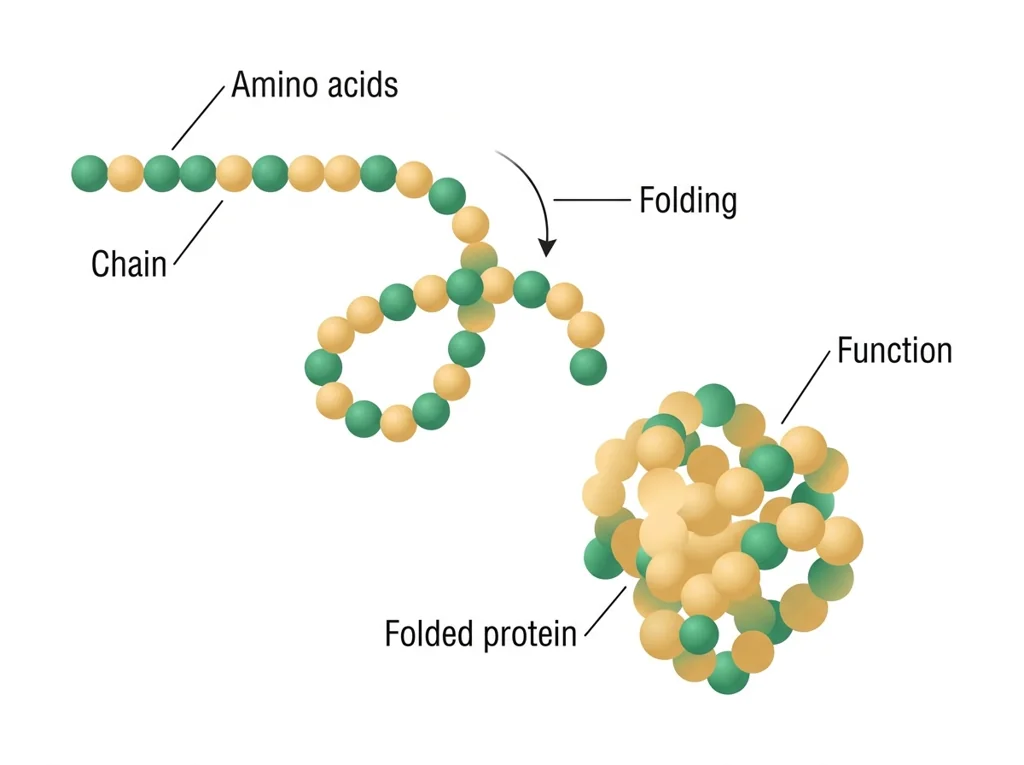
How to read it: The domains tell you which part of the does which job. A variant that lands inside the is more likely to break IRF6's -factor function than one in a spacer region.
Lost? UniProt help: reading protein domains
NCBI Gene
Open the tool

The full reference record for a gene: its official symbol, ID, location, and what it does.

When you use this: Use this first, when you have a gene name and need its official ID and address. It is the home base every other database points back to.
What the screen looks like
ncbi.nlm.nih.gov/gene IRF6 1 Gene record: IRF6 2 Official symbol / Gene ID / Location IRF6 · ID 3664 · 1q32.2 3 1 Type the gene symbol and search Gene. 2 Open the top human result. 3 Read symbol, Gene ID, and location at the top.
A labeled map of the screen. The circled numbers match the steps.
Step by step
  1. 1Go to ncbi.nlm.nih.gov/gene and type the gene symbol IRF6 in the search box, then press Search.
  2. 2Open the top result whose organism is Homo sapiens (human).
  3. 3At the top of the record, read three things and write them down: the official symbol, the Gene ID number, and the location ( band).
Capture these fields
  • Symbol (official gene name): IRF6
  • Gene ID (the stable number): 3664
  • Location (chromosome band): 1q32.2
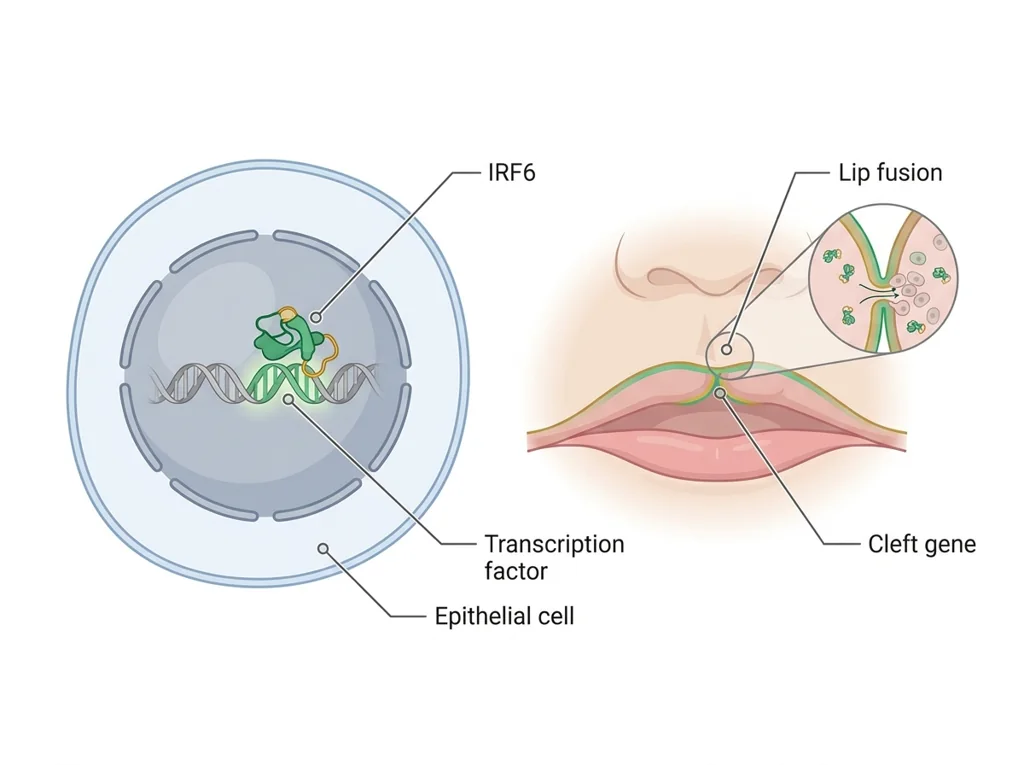
  • Summary (one line on its job): A transcription factor needed for the skin-surface cells that let the lip and palate fuse.
How to read it: The symbol and Gene ID let you find the exact same gene in every other database. The location should match the band you mapped (1q32). The summary tells you the gene's job in one sentence.
Lost? NCBI Gene help manual (how to use the Gene database)
Words

Vocabulary (the same words your classes use)

sequence alignmentsequence conservation
Learn first

Pick your level

Level 1, Guided

Use the sentence starters, a word bank from the vocabulary, a labeled diagram, and the exact source link.

Level 2, Collaborative

Complete a partly blank model or table and explain it.

Level 3, Independent

Make a claim from a new example or an unfamiliar entry in .

The plan

Work as a research team

Team roles
  • Manager: keeps the group moving
  • Recorder: writes the shared model or table
  • Evidence checker: verifies each claim against the source
  • Reporter: explains the group's reasoning
Process reflection
  • What evidence changed your thinking today?
  • What did your group disagree about, and how did you resolve it?
  • What question is still unresolved?
Check yourself

Demonstration of learning

By the end of this session, submit ONE of: a labeled diagram with a 2-sentence explanation; a claim, evidence, reasoning paragraph; a completed data table from a real database; or a one-question exit ticket using today's vocabulary.

Recommended here: A short conservation claim with evidence: a one-sentence claim that IRF6 is highly conserved, the mouse and zebrafish percent identity numbers as evidence, and one sentence on why this makes them useful model organisms for the Atit lab's cleft work.

Meets standard if your explanation correctly connects structure, timing, gene or protein function, or evidence source to Mateo's case: Run a protein BLAST of human IRF6 against mouse and zebrafish, read the percent identity, and write a conservation claim backed by that evidence.
How this is graded (rubric)
For: A short conservation claim with evidence: a one-sentence claim that IRF6 is highly conserved, the mouse and zebrafish percent identity numbers as evidence, and one sentence on why this makes them useful model organisms for the Atit lab's cleft work.
CriterionProficientDevelopingBeginning
CompleteEvery required part of the artifact is present and filled in.Most parts are present, but one is missing or left blank.Several parts are missing.
AccurateThe science and data are correct and match the evidence.Mostly correct, with a small factual slip.Key science or data is wrong.
Scientific reasoning (CER)States a claim, backs it with specific evidence, and explains the reasoning.Has a claim and evidence, but the reasoning is thin or missing.Gives an answer with no evidence or reasoning.
Professional communicationClear, organized, and labeled the way a clinician or scientist would write it.Readable but disorganized or missing labels.Hard to follow.
SubmittedTurned in the right way (Schoology for routine work) and confirmed.Turned in, but in the wrong place or unconfirmed.Not turned in.
How the model answer scores against this rubric
  • CompleteProficient: Nothing is left blank: the model fills every part of "A short conservation claim with evidence: a one-sentence claim that IRF6 is highly conserved, the mouse and zebrafish percent identity numbers as evidence, and one sentence on why this makes them useful model organisms for the Atit lab's cleft work.".
  • AccurateProficient: Every number and claim matches the case evidence.
  • Scientific reasoning (CER)Proficient: It names a claim, cites the specific evidence, and explains the reasoning, not just the answer.
  • Professional communicationProficient: It is organized and labeled like a real chart note.
  • SubmittedProficient: It would be turned in on Schoology and confirmed.