Rough draft.This research track is under review with Dr. Atit's lab. Content and sequence may still change.
The Baby Mateo Case
Genetics domainMedical Interventions (MI), with PBS overlapLesson 3 of 20Your seat: Clinical geneticist

Does It Run in Families Like a Single Gene?

Discovery question

Does Mateo's fit clean single-gene (dominant) , or something else?

💡 How a trait moves through a family tells you whether to expect one gene or many, before you ever find a gene.

The plan

Prerequisite check

Before this page, you should know
  • A phenotype is the set of observable features a person has.
  • Clefts split into nonsyndromic (no other features, about 70%) and syndromic (packaged with other features, about 30%).
Today's new idea is only
How a trait moves through a family tells you whether to expect one gene or many, before you ever find a gene.
Learn first

What you will learn

Goal: Students will compare clean autosomal dominant inheritance against the multifactorial and use Mateo's sparse, non-vertical pedigree to argue that his fits the multifactorial picture, without yet naming a cause.

Know by the end
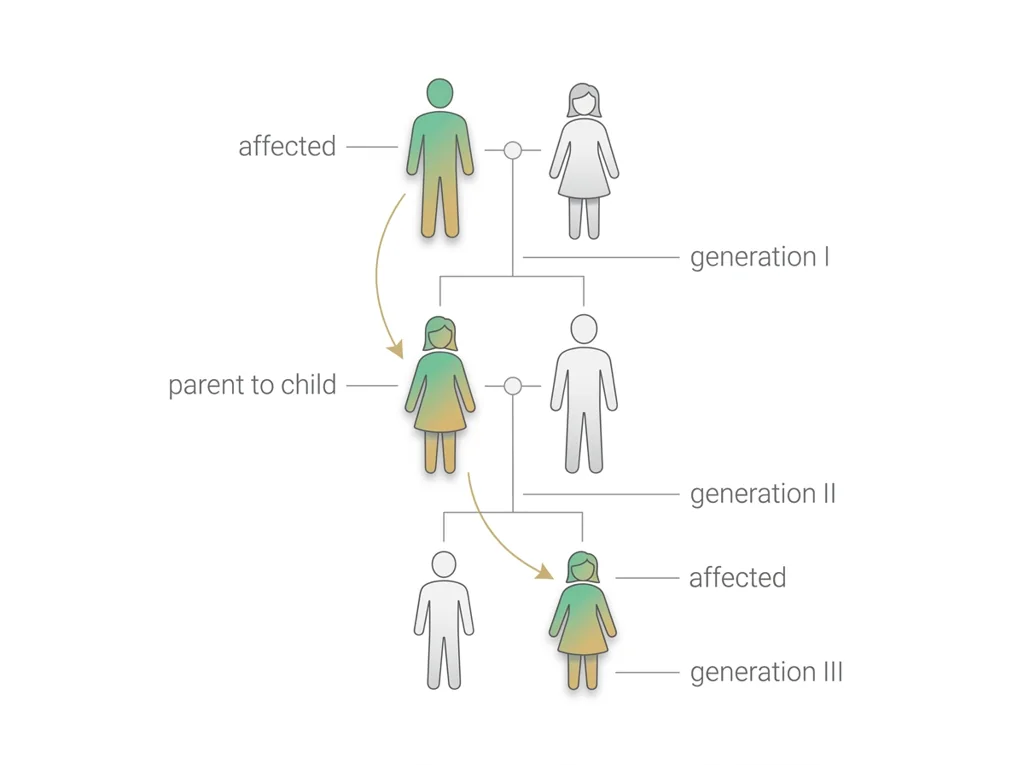
  • Clean autosomal dominant inheritance needs one altered copy of a single gene and shows : an affected person in almost every generation.
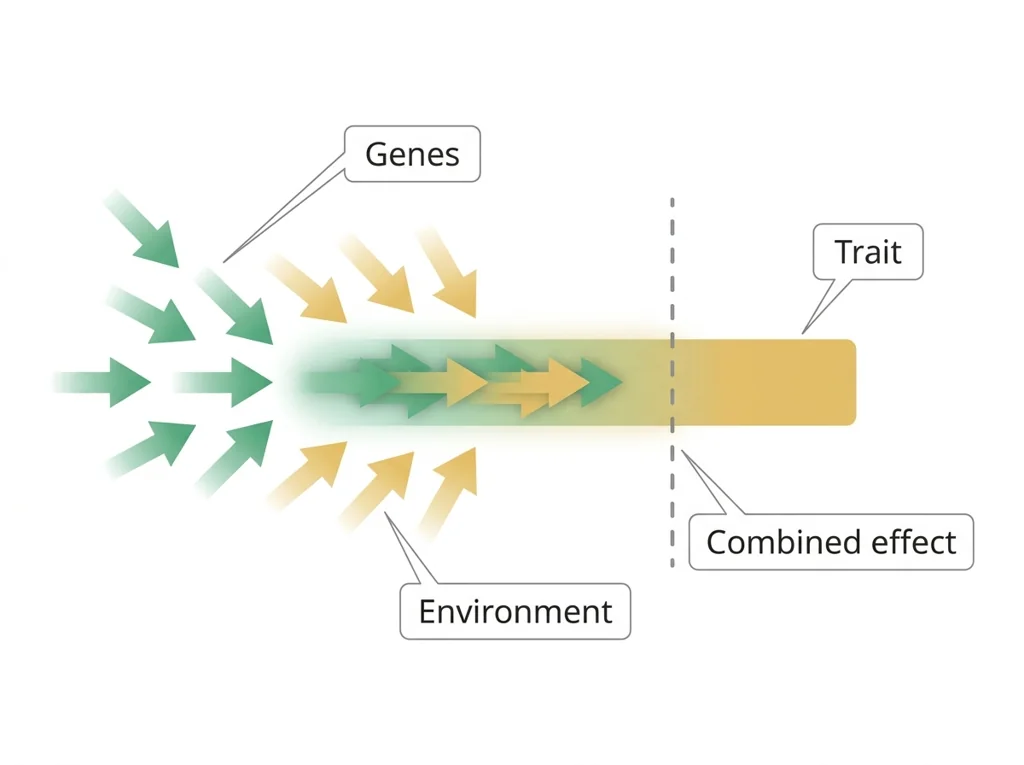
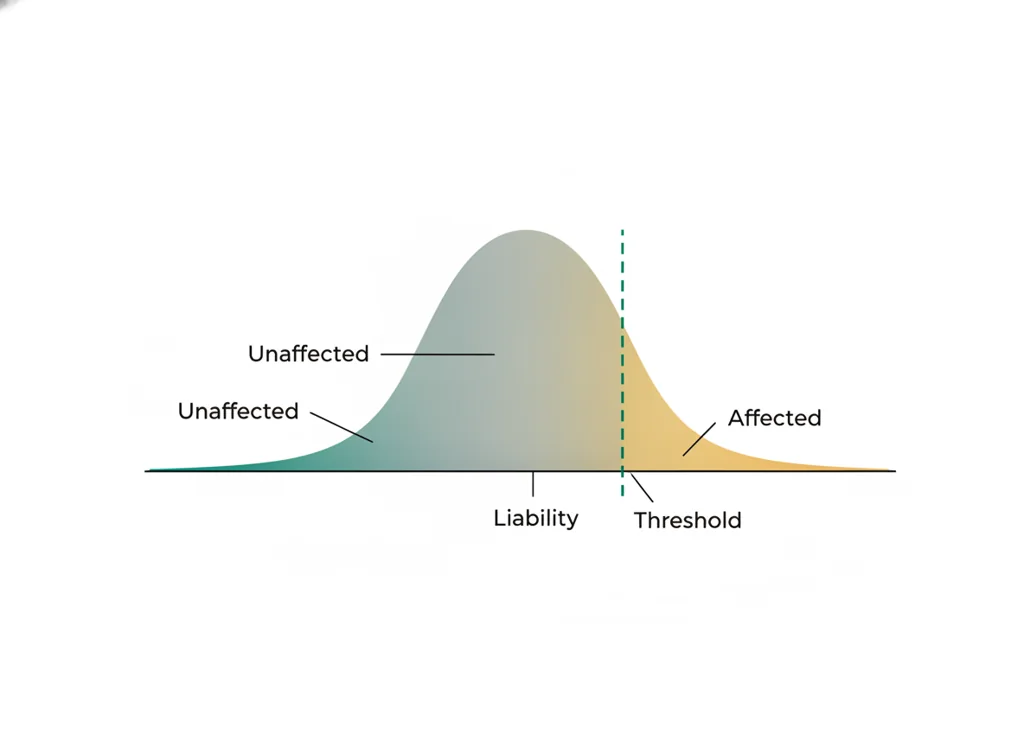
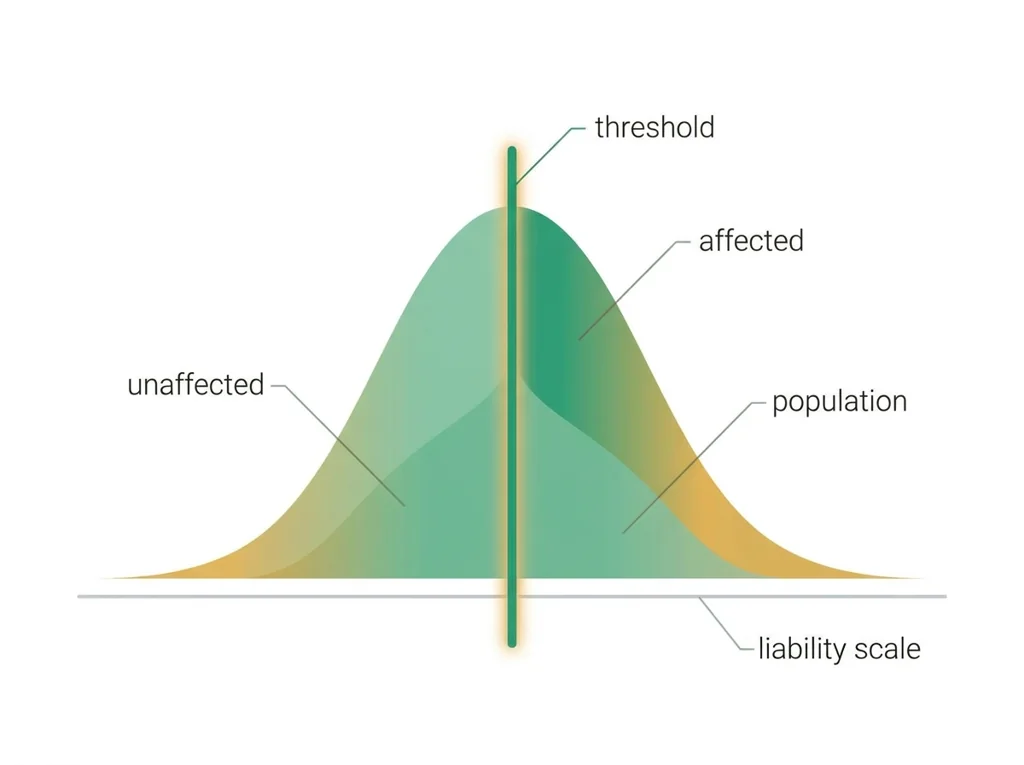
  • Multifactorial (threshold) inheritance has no single controlling gene; many small genetic and environmental factors add up to a total liability, and a appears only when liability crosses a threshold.
  • About 70% of clefts, the isolated ones, follow the multifactorial model rather than clean dominant .
  • Under the multifactorial model, sibling is raised but far below the 50% of a single dominant gene.
Learn first

Model: Clean dominant next to Mateo's family, and two models of inheritance

First, a textbook autosomal dominant family (a contrast case, like a Van der Woude family): an affected grandfather, an affected parent, and affected children, with someone affected in EVERY generation, parent to child, in both sexes. Now Mateo's actual family: unaffected grandparents, two unaffected parents, an unaffected sister, and only Mateo affected as the proband, with one distant great-uncle as an unconfirmed "?". Counting Mateo's family, there is only ONE confirmed affected person, with two unaffected parents above him and no vertical, generation-after-generation pattern.

Geneticists carry two mental models. Clean autosomal dominant: one altered copy of a single gene is enough, and the signature is , an affected person in almost every generation. Two unaffected parents rarely produce it. Multifactorial (threshold) model: there is no single controlling gene; many small genetic and environmental factors add up into a total liability, and a appears only when that total crosses a threshold. Most cases are sporadic (one affected person, unaffected parents), risk to relatives is modestly raised but not 50%, and the trait does NOT march cleanly down the generations. About 70% of clefts follow this model.

Read this in pieces, one chunk at a time
Do the work

Explore (work the model before reading on)

  1. In the clean-dominant family, is there an affected person in every generation? In Mateo's family, how many generations show a confirmed ?
  2. In Mateo's family, are Mateo's parents affected or unaffected?
  3. Clean dominant traits usually pass from an affected parent to a child. Mateo has two unaffected parents and no confirmed affected ancestor. Does that fit clean dominant, or argue against it?
  4. Which model predicts mostly sporadic cases, unaffected parents, and no neat generational pattern? Which fits Mateo's pedigree better?
  5. Under the multifactorial model, if Mateo's parents have another child, would you expect to be a clean 50% or much lower? Explain using many small factors adding up.
  6. In one sentence, which inheritance model fits Mateo's family better, and what feature of the pedigree tells you?
The plan

Guided notes

1

What clean dominant looks like

Model start: Clean autosomal dominant inheritance needs one altered copy and shows , an affected person in almost every generation.
  • A clean autosomal dominant trait sits on a non-sex and needs only ____ altered copy to show.
  • Its signature is : an affected person in almost every generation, passed parent to child.
2

Why Mateo does not fit

  • Mateo's pedigree shows only Mateo confirmed, his parents ________, and no generation-after-generation pattern.
  • That argues against clean dominant .
3

The multifactorial threshold model

  • Each person carries a total liability built from many small genetic and environmental risk factors, and a appears only when liability crosses a line.
  • This predicts mostly sporadic cases, unaffected parents, and a sibling raised but far below 50%; about 70% of clefts follow it.
Explore

Reading the Research

What to read
Read the title and the abstract only, not the whole paper. Babai A, Irving M. 2023. Orofacial Clefts. Genes. [DOI:10.3390/genes14081603]
Why this source matters
This is the published evidence behind today's idea: How a trait moves through a family tells you whether to expect one gene or many, before you ever find a gene.
Reading moves
  1. Skim the title and abstract first to get the gist.
  2. Circle the one sentence that states the main claim.
  3. Box the evidence the authors give for that claim.
  4. Mark one sentence that confuses you, and move on.
Stop point
You do not need the methods or statistics yet. If a sentence is about lab technique or math you have not learned, mark it and skip it.
Your output
Write one claim-evidence sentence: what this source claims, and the one piece of evidence that backs it up.
Where this fits
Tested on (Ohio WebXam)
Genetics of Disease · 072130
PLTW lesson
MI · Genetics domain · Unit 2 How to Screen Your Genes, 2.1 Genetic Testing and Screening
WebXam domain
Bio-Molecular Technology
Evidence to produce
Write the inheritance line for Mateo's chart stating that the pattern does NOT fit clean autosomal dominant and is best modeled as multifactorial (threshold), and explain in one sentence why a future sibling's recurrence risk would be well below 50%.
Lab / skill
Medical Interventions (MI) · Principles of Biomedical Science (PBS)
Words

Vocabulary (the same words your classes use)

autosomal dominant
The plan

Track your progress today

Check these off as you work through the lesson, then submit. This tells Mr. Mendoza how you're doing so he can help the class. It does not replace turning in your producible.

Use the code Mr. Mendoza gave you, not your name. Saved on this device.

Check off as you finish
  • Read the Model and answered the Explore questions.
  • Filled in the guided notes in my own words.
  • Defined the new vocabulary with an example.
  • Built the producible: Write the inheritance line for Mateo's chart stating that the pattern does NOT fit clean autosomal dominant and is best modeled as multifactorial (threshold), and explain in one sentence why a future sibling's recurrence risk would be well below 50%.
  • Wrote my Claim, Evidence, and Reasoning exit ticket.
Pick your period and code first.
Check yourself

Exit ticket (Claim, Evidence, Reasoning)

  • Claim: Mateo's fits the ____ model better than clean autosomal dominant.
  • Evidence: The pedigree shows ____ confirmed affected person and ____ parents, with no .
  • Reasoning: Clean dominant predicts an affected parent and a generational pattern, while the multifactorial predicts ____ cases from many small factors, which is what we see.
How this is graded (rubric)
For: Write the inheritance line for Mateo's chart stating that the pattern does NOT fit clean autosomal dominant and is best modeled as multifactorial (threshold), and explain in one sentence why a future sibling's recurrence risk would be well below 50%.
CriterionProficientDevelopingBeginning
CompleteEvery required part of the artifact is present and filled in.Most parts are present, but one is missing or left blank.Several parts are missing.
AccurateThe science and data are correct and match the evidence.Mostly correct, with a small factual slip.Key science or data is wrong.
Scientific reasoning (CER)States a claim, backs it with specific evidence, and explains the reasoning.Has a claim and evidence, but the reasoning is thin or missing.Gives an answer with no evidence or reasoning.
Professional communicationClear, organized, and labeled the way a clinician or scientist would write it.Readable but disorganized or missing labels.Hard to follow.
SubmittedTurned in the right way (Schoology for routine work) and confirmed.Turned in, but in the wrong place or unconfirmed.Not turned in.
How the model answer scores against this rubric
  • CompleteProficient: Nothing is left blank: the model fills every part of "Write the inheritance line for Mateo's chart stating that the pattern does NOT fit clean autosomal dominant and is best modeled as multifactorial (threshold), and explain in one sentence why a future sibling's recurrence risk would be well below 50%.".
  • AccurateProficient: Every number and claim matches the case evidence.
  • Scientific reasoning (CER)Proficient: It names a claim, cites the specific evidence, and explains the reasoning, not just the answer.
  • Professional communicationProficient: It is organized and labeled like a real chart note.
  • SubmittedProficient: It would be turned in on Schoology and confirmed.
Explore

Where this leads: careers

Genetic counselor Clinical geneticist Epidemiologist

What's next: Mateo's fits a multifactorial model where many small factors add up. But to understand cleft biology at all, scientists study the best-understood cleft gene in depth. Which gene is the best door into how clefts happen?