Rough draft.This research track is under review with Dr. Atit's lab. Content and sequence may still change.
The Baby Mateo Case
Genetics domainMedical Interventions (MI), with PBS overlapLesson 14 of 20Your seat: Developmental-biology liaison

What Does IRF6 Actually Do in the Embryo?

Discovery question

What job do the cells controlled by IRF6 perform, and how does losing that job cause the shelves to fail to fuse?

💡 IRF6 drives cells to differentiate so the palatal shelves can reach the and fuse; without it, surfaces stick wrongly and the stays open.

The plan

Prerequisite check

Before this page, you should know
  • A is a set of genes that switch one another on and off to run a process.
  • A is a that turns other genes on or off; IRF6, GRHL3, and p63 are all factors.
Today's new idea is only
IRF6 drives cells to differentiate so the palatal shelves can reach the and fuse; without it, surfaces stick wrongly and the stays open.
Learn first

What you will learn

Goal: Connect the IRF6 gene to a single cell behavior, , and trace how losing that behavior turns a gene change into a physical .

Know by the end
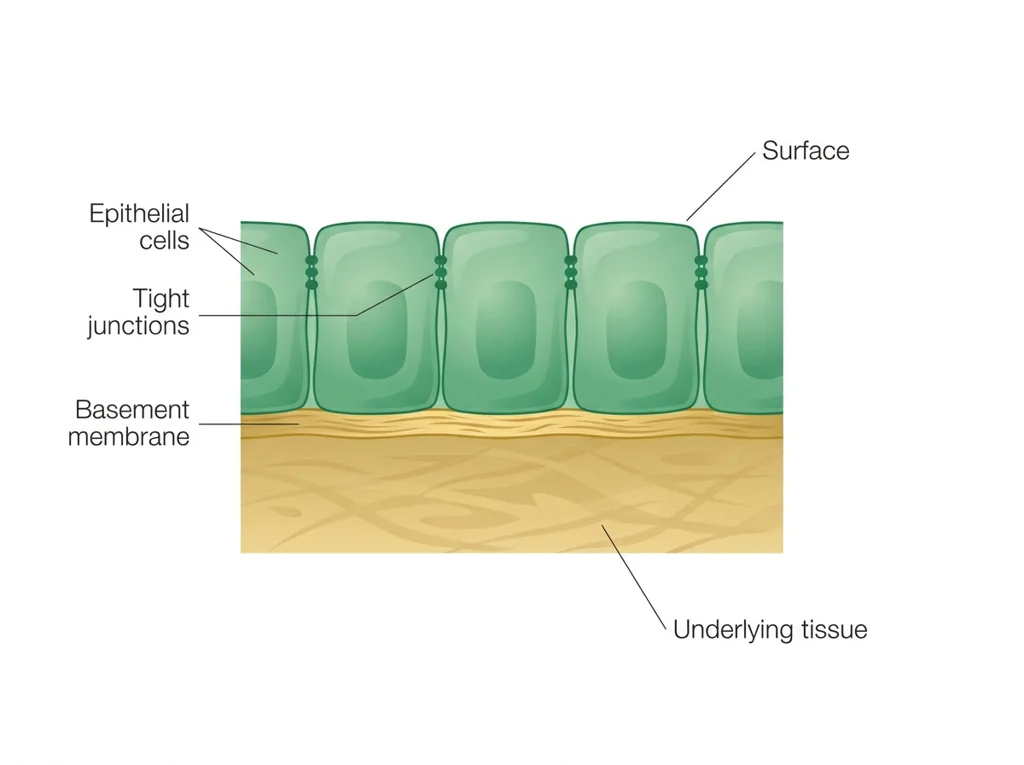
  • The is the sheet of cells covering surfaces; its outermost layer is the , a non-stick protective coating.
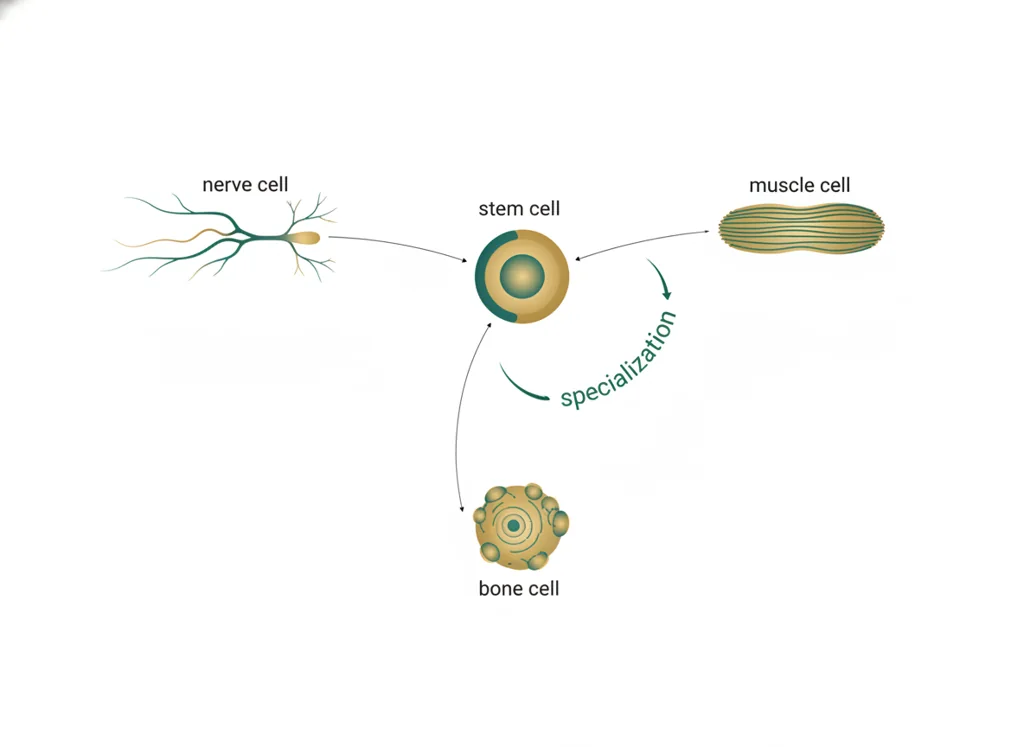
  • is a cell maturing into a specialized type that does a specific job.
  • IRF6 drives so shelves avoid sticking to the wrong partner (the tongue), reach the , and fuse cleanly.
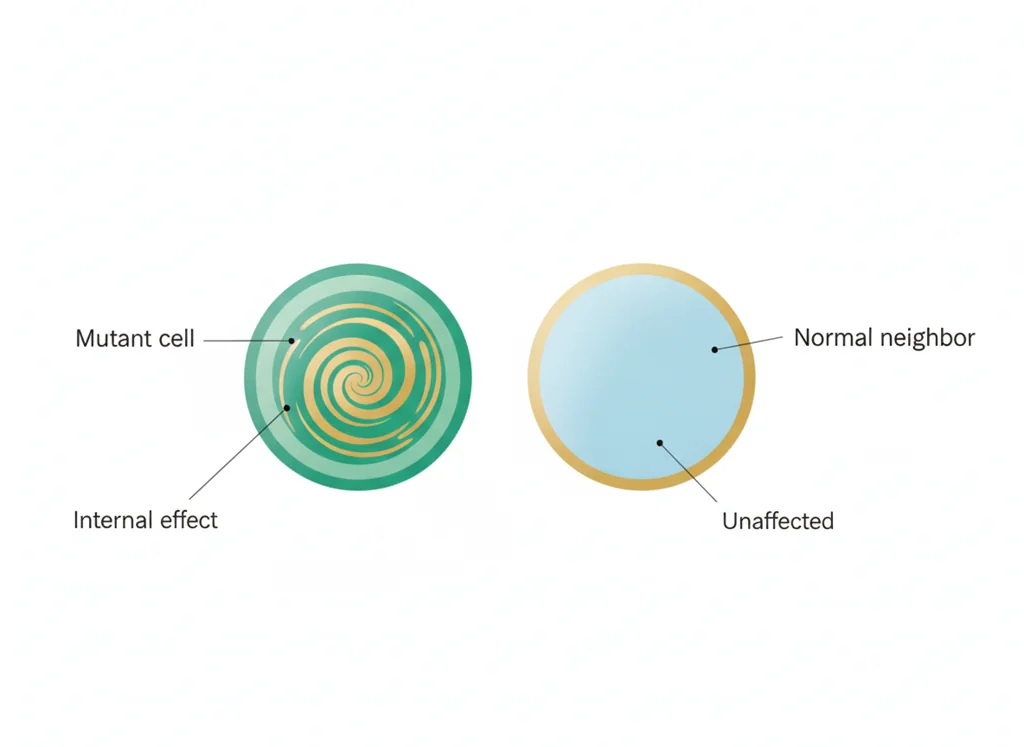
  • Rescue experiments showed IRF6 must be present in the cells themselves, so it acts cell-autonomously.
  • You can check this expression evidence yourself: GEO ( Omnibus) shows whether IRF6 is switched on in , and FaceBase shows exactly where in the developing face it is active.
Learn first

Model: Two surfaces during palate closure, and what happens when IRF6 is removed

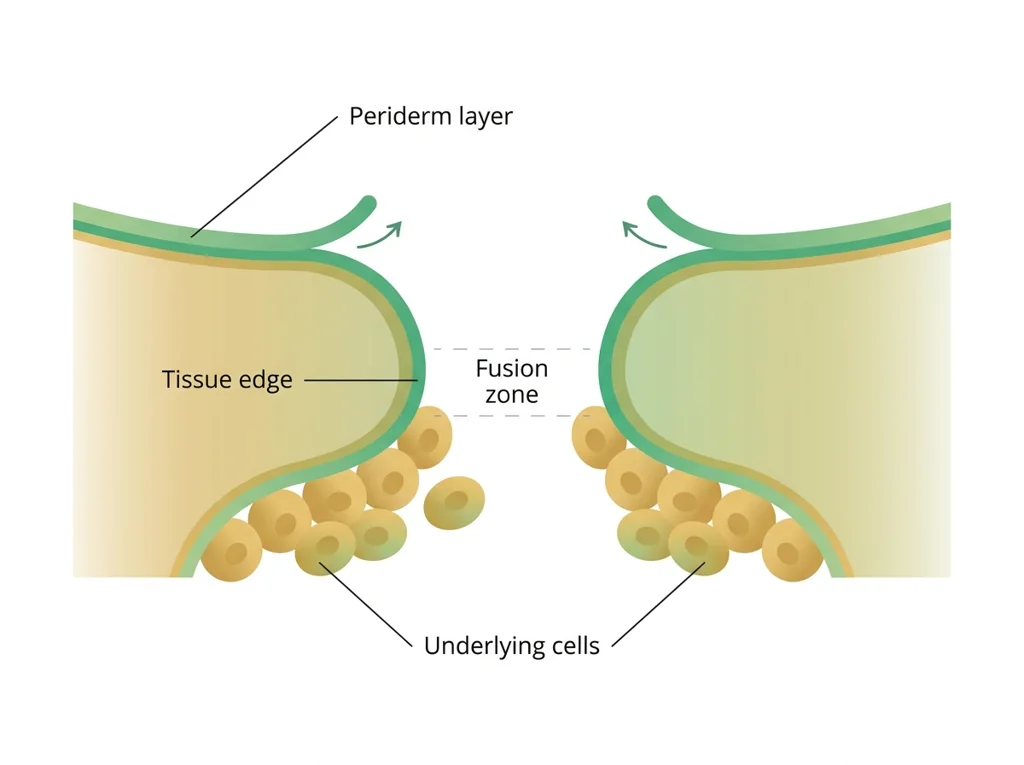
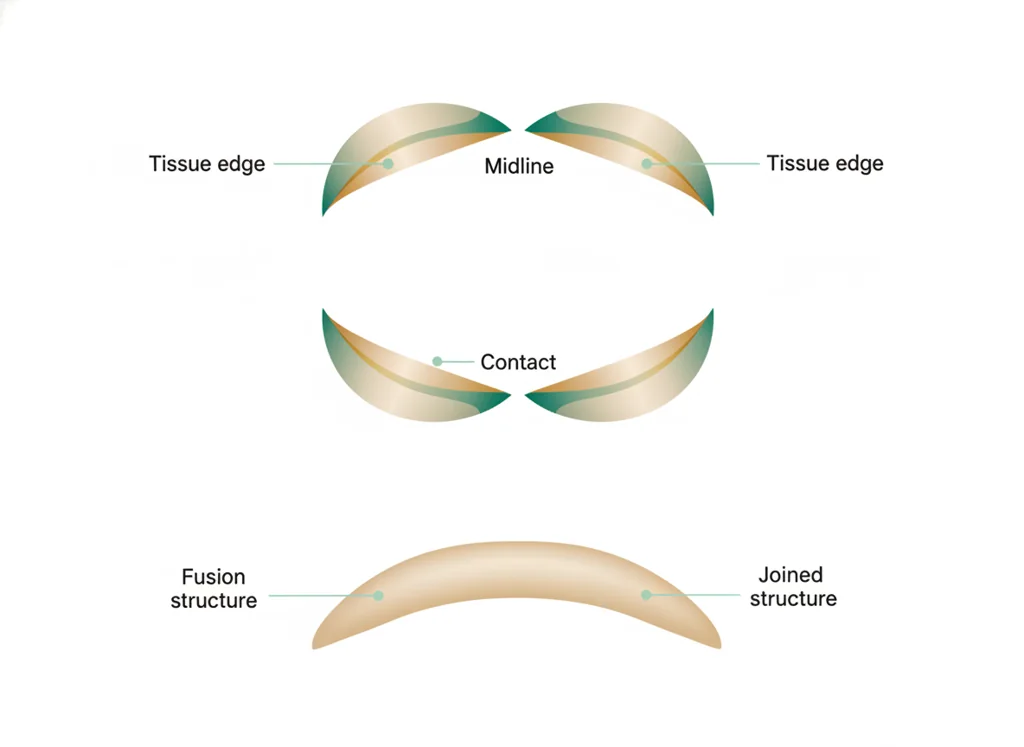
During development the two palatal shelves grow toward the and must touch and fuse. The outer has a special top layer called the . Think of the periderm as a non-stick coating: it keeps surfaces from sticking to the wrong partner (like the tongue) until the right surfaces meet, then lets the shelves fuse cleanly at the correct seam. When IRF6 works, the periderm differentiates, the shelves meet at the midline, and the closes. When IRF6 is lost, no proper periderm forms, the shelves stick to the tongue and to wrong surfaces, and they cannot reach the midline.

The real mouse and zebrafish data show this directly: the fails to differentiate, palatal shelves form abnormal adhesions to the tongue and to each other, those adhesions physically restrain the shelves so they cannot swing to the , and genes (GRHL3, KLF4 and KLF17, keratins, esrp1) drop. Crucially, putting IRF6 back only in the deeper basal layer was not enough; IRF6 had to be in the periderm cells themselves.

Read this in pieces, one chunk at a time
Do the work

Explore (work the model before reading on)

  1. In the model, what does the do in the normal panel that it fails to do in the IRF6-lost panel?
  2. Name two specific things that go wrong in the when IRF6 is removed.
  3. The shelves in the IRF6-lost mouse are physically stuck to the tongue. Explain, step by step, how failing to differentiate leads to shelves that cannot reach the .
  4. Putting IRF6 back only in the deeper basal layer did not fix the ; IRF6 had to be in the cells themselves. What does that tell you about which cells need IRF6?
  5. Predict what you would see under the microscope in a developing if IRF6 cannot grip DNA (from Lesson 12). Describe the and what the shelves do.
The plan

Guided notes

1

The cell behavior IRF6 controls

Model start: The covers surfaces of the , and its outermost layer is the , a non-stick coating. is a cell maturing into a specialized type.
  • IRF6's real job is to drive the to ____ so the palatal shelves have a proper surface.
  • With a working , the shelves avoid sticking to the wrong partner (the tongue), reach the , and ____ cleanly.
  • Without IRF6 the never matures, surfaces stick where they should not, and the trapped shelves cannot reach the ____.
2

Cell-autonomous

  • Rescue experiments showed IRF6 must be present in the ____ cells themselves.
  • A gene that has to act inside the very cell that needs it is called ____.
Explore

Reading the Research

What to read
Why this source matters
This is the published evidence behind today's idea: IRF6 drives cells to differentiate so the palatal shelves can reach the and fuse; without it, surfaces stick wrongly and the stays open.
Reading moves
  1. Skim the title and abstract first to get the gist.
  2. Circle the one sentence that states the main claim.
  3. Box the evidence the authors give for that claim.
  4. Mark one sentence that confuses you, and move on.
Stop point
You do not need the methods or statistics yet. If a sentence is about lab technique or math you have not learned, mark it and skip it.
Your output
Write one claim-evidence sentence: what this source claims, and the one piece of evidence that backs it up.
Lab day

Using the database (what to capture)

Part of today's expected outcome is to actually open the tool below and write down the value it gives you. That captured value is the evidence you will use in your Claim, Evidence, Reasoning. Follow the steps, use the labeled screenshot so you do not get lost, and record each field.

GEO (Gene Expression Omnibus)
Open the tool

A public archive of gene-expression experiments: it shows whether a gene is switched ON (high) or OFF (low) in particular tissues or conditions.

When you use this: Use this when you need evidence that IRF6 is actually active in the right place. A gene can only cause a if it is expressed in the that forms the . GEO lets you check: is IRF6 high in palate tissue, and does it drop when something goes wrong?
What the screen looks like
ncbi.nlm.nih.gov/geo IRF6 palate 1 GEO Profiles: IRF6 expression 2 Expression in palate vs control samples High in palatal shelf, low in control 3 1 Search the gene, then click GEO Profiles. 2 Open a craniofacial dataset profile. 3 Read the bar chart: which samples are high?
A labeled map of the screen. The circled numbers match the steps.
Step by step
  1. 1Open ncbi.nlm.nih.gov/geo and, in GEO Profiles, search IRF6 (the gene plus the ).
  2. 2Open one craniofacial dataset profile from the results (a study of or facial ).
  3. 3Read the expression bar chart: compare the value in or samples against the control samples, and write down which is higher.
Capture these fields
  • Gene + tissue searched: IRF6 in palatal shelf / periderm
  • Dataset (the study): A mouse palate-development expression study (a GDS/GSE record)
  • Expression in the target tissue: High in the palatal-shelf periderm samples
  • Expression in the control: Low in non-fusing control tissue (or in the IRF6 knockout)
How to read it: If IRF6 reads HIGH in exactly the that must fuse (the palatal ) and LOW where is not happening, that is direct evidence the gene is on the job at the right place and time. Expression where and when it is needed turns a name on a map into a working part of the story. Low expression in a , alongside a , links the missing gene activity to the failure.
Lost? What GEO is and how to browse it

A craniofacial-specific data hub: expression maps, 3D images, and datasets focused on how the face and form, much of it from mouse and zebrafish models.

When you use this: Use this when GEO is too general and you want craniofacial detail: exactly WHERE in the developing face or a gene like IRF6 is active, and what the looks like, from labs that study clefts specifically.
What the screen looks like
facebase.org IRF6 palate 1 FaceBase data record 2 Organism / assay / structure Mouse · expression · palatal shelf (MEE) 3 1 Search IRF6 or 'palate'. 2 Filter by assay type and organism. 3 Open a record and read where IRF6 is active.
A labeled map of the screen. The circled numbers match the steps.
Step by step
  1. 1Open facebase.org and search IRF6, or browse by the structure .
  2. 2Filter the records by organism (mouse) and type (for example or imaging).
  3. 3Open one record and read where IRF6 is active in the developing structure (for example the medial edge of the ).
Capture these fields
  • Search term: IRF6 (or palate)
  • Organism: Mouse (Mus musculus)
  • Assay / data type: Gene expression / imaging of the developing palate
  • Where the gene is active: The medial edge epithelium (MEE), the surface that must seal
How to read it: FaceBase puts the gene in its craniofacial place. Seeing IRF6 active at the medial edge , the exact surface where the two shelves meet, is strong location evidence that ties the molecular cause to the physical structure that fails in a . It complements GEO: GEO tells you how much, FaceBase tells you exactly where, in the face.
Lost? About FaceBase
Where this fits
Tested on (Ohio WebXam)
Genetics of Disease · 072130
PLTW lesson
MI · Genetics domain · From gene to cell behavior; molecular basis of development
WebXam domain
Bio-Molecular Technology
Evidence to produce
Brief the Developmental (PBS) team. In three or four sentences, explain the chain from an IRF6 variant down to a physical cleft: variant to broken protein to lost cell behavior to failed fusion. Use the words periderm, differentiate, and fusion correctly.
Lab / skill
Medical Interventions (MI) · Principles of Biomedical Science (PBS)
Words

Vocabulary (the same words your classes use)

The plan

Track your progress today

Check these off as you work through the lesson, then submit. This tells Mr. Mendoza how you're doing so he can help the class. It does not replace turning in your producible.

Use the code Mr. Mendoza gave you, not your name. Saved on this device.

Check off as you finish
  • Read the Model and answered the Explore questions.
  • Filled in the guided notes in my own words.
  • Defined the new vocabulary with an example.
  • Opened GEO (Gene Expression Omnibus) and FaceBase and recorded the value it gave me.
  • Built the producible: Brief the Developmental (PBS) team. In three or four sentences, explain the chain from an IRF6 variant down to a physical cleft: variant to broken protein to lost cell behavior to failed fusion. Use the words periderm, differentiate, and fusion correctly.
  • Wrote my Claim, Evidence, and Reasoning exit ticket.
Pick your period and code first.
Check yourself

Exit ticket (Claim, Evidence, Reasoning)

  • Claim: IRF6's job is to drive needed for (agree or disagree).
  • Evidence: When IRF6 is removed in mice, the fails to ____ and the shelves form ____ to the tongue.
  • Reasoning: Losing one cell behavior, , turns a gene change into a physical because the shelves can no longer reach the and ____.
How this is graded (rubric)
For: Brief the Developmental (PBS) team. In three or four sentences, explain the chain from an IRF6 variant down to a physical cleft: variant to broken protein to lost cell behavior to failed fusion. Use the words periderm, differentiate, and fusion correctly.
CriterionProficientDevelopingBeginning
CompleteEvery required part of the artifact is present and filled in.Most parts are present, but one is missing or left blank.Several parts are missing.
AccurateThe science and data are correct and match the evidence.Mostly correct, with a small factual slip.Key science or data is wrong.
Scientific reasoning (CER)States a claim, backs it with specific evidence, and explains the reasoning.Has a claim and evidence, but the reasoning is thin or missing.Gives an answer with no evidence or reasoning.
Professional communicationClear, organized, and labeled the way a clinician or scientist would write it.Readable but disorganized or missing labels.Hard to follow.
SubmittedTurned in the right way (Schoology for routine work) and confirmed.Turned in, but in the wrong place or unconfirmed.Not turned in.
How the model answer scores against this rubric
  • CompleteProficient: Nothing is left blank: the model fills every part of "Brief the Developmental (PBS) team. In three or four sentences, explain the chain from an IRF6 variant down to a physical cleft: variant to broken protein to lost cell behavior to failed fusion. Use the words periderm, differentiate, and fusion correctly.".
  • AccurateProficient: Every number and claim matches the case evidence.
  • Scientific reasoning (CER)Proficient: It names a claim, cites the specific evidence, and explains the reasoning, not just the answer.
  • Professional communicationProficient: It is organized and labeled like a real chart note.
  • SubmittedProficient: It would be turned in on Schoology and confirmed.
Explore

Where this leads: careers

Developmental Biologist Embryologist

What's next: We found that IRF6 makes cells differentiate so the shelves can fuse, and without it they stick wrongly and stay open. But a strong story is not proof. How do scientists actually prove that losing IRF6 causes the , rather than just appearing alongside it? We chase that next.