
Chance or Genetic? Reading Mateo's Family Tree
This reading contains every idea and every piece of evidence needed for today's decision. The research links at the end are optional.
Why this matters
A pedigree is the first genetic model students can build from a clinical interview.
The question you are trying to answer
Which connections can the map show directly?
Begin with the idea you already earned
Mateo's cleft is best explained as a developmental pathway outcome with bounded evidence, not as one proven cause.
Study the analogy before the biology
- Which connections can the map show directly?
- What important system remains hidden underground?
- Why would one affected home not prove a random event?
Turn the analogy into three rules
Limit: Families are not neighborhoods. The analogy models visible relationships versus hidden causes.
Map those rules onto the biology
A pedigree is a family diagram that records relationships and traits across generations.
Mateo is the proband, the person who brings the family to genetic attention. No other clefts are reported.
An isolated pedigree can reflect many small risks, a new variant, incomplete penetrance, or missing family information.
Read Mateo's labeled case evidence
Mateo is the only reported relative with a cleft across three generations.
The pedigree appears sporadic rather than strongly familial.
Both parents are unaffected.
A simple fully penetrant dominant pattern is not supported.
Isolated clefts can still involve inherited and new genetic risk factors.
No family history does not mean no genetic contribution.
Make the concrete decision
You are the intake genetic counselor.
Mateo's parents ask whether the empty family history means the cleft was only chance.
- Say the pedigree looks isolated but cannot exclude genetic risk.
- Say no relatives means genes played no role.
- Diagnose a dominant syndrome from one affected child.
Choose the counseling statement and cite the pedigree plus its limit.
Claim ceiling: You may describe the observed family pattern. You may not exclude genetic contribution or name an inheritance model yet.
Write the 10-year takeaway
A pedigree shows how a trait travels through a family; it does not prove that an isolated case is non-genetic.
- What does Mateo's pedigree show?
- What genetic claim can it not close?
Glossary in plain English
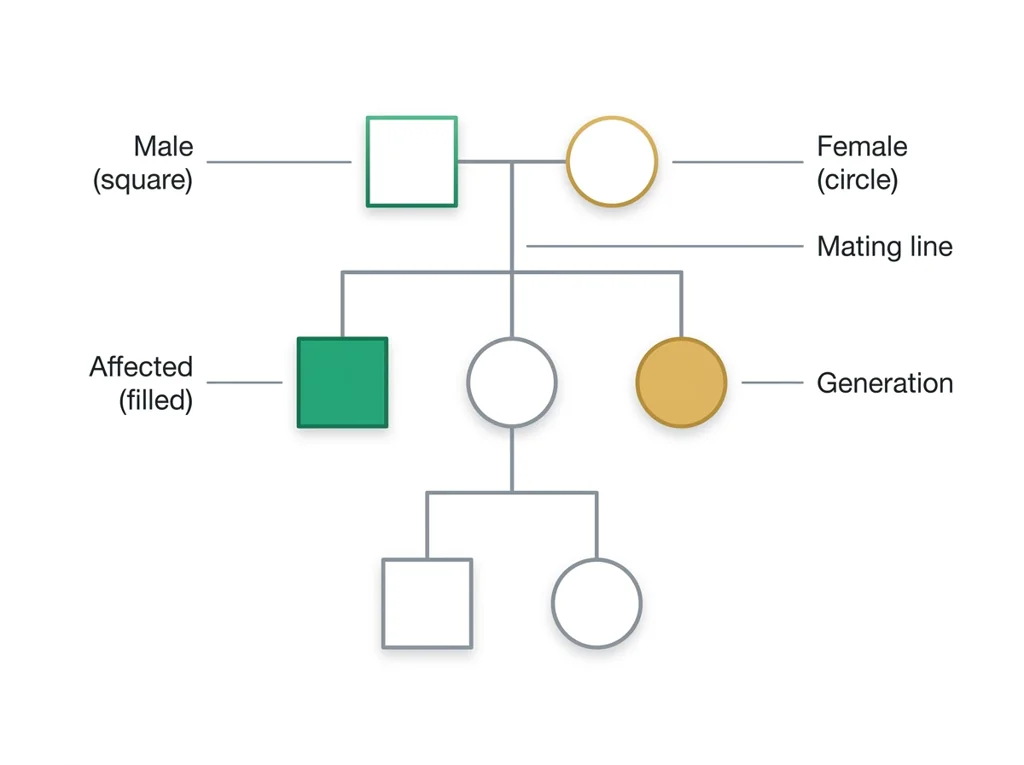
A family tree drawn with standard symbols (squares for males, circles for females, filled for affected) so any geneticist can read a family at a glance.
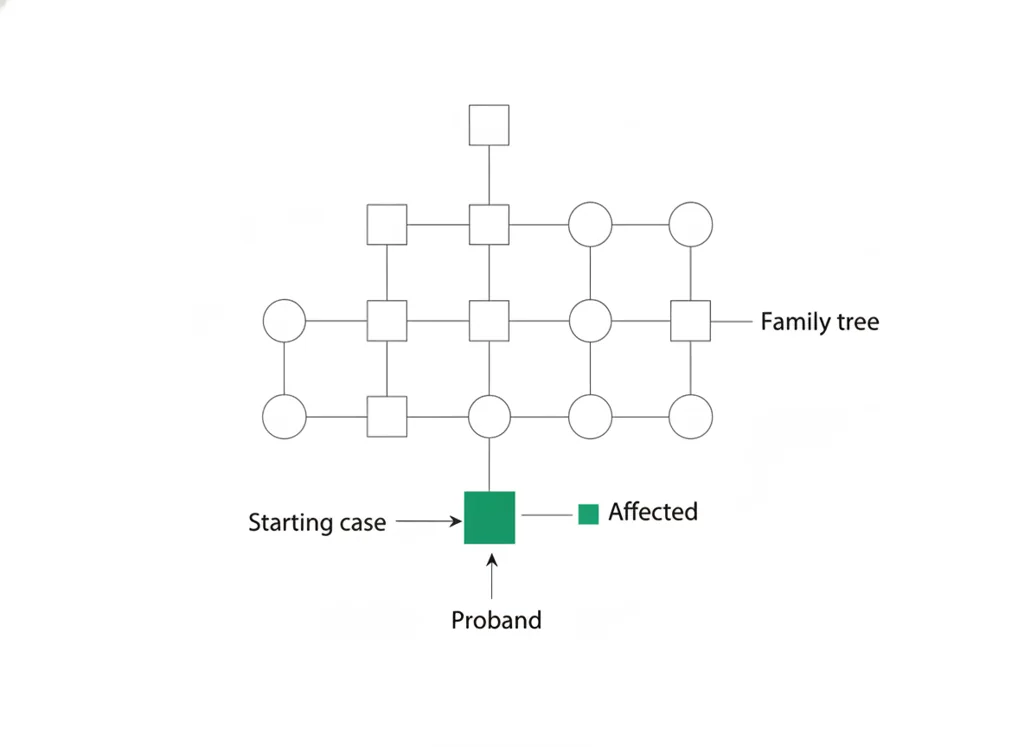
The first affected person whose case brings a family in for genetic study, marked with an arrow on the pedigree.
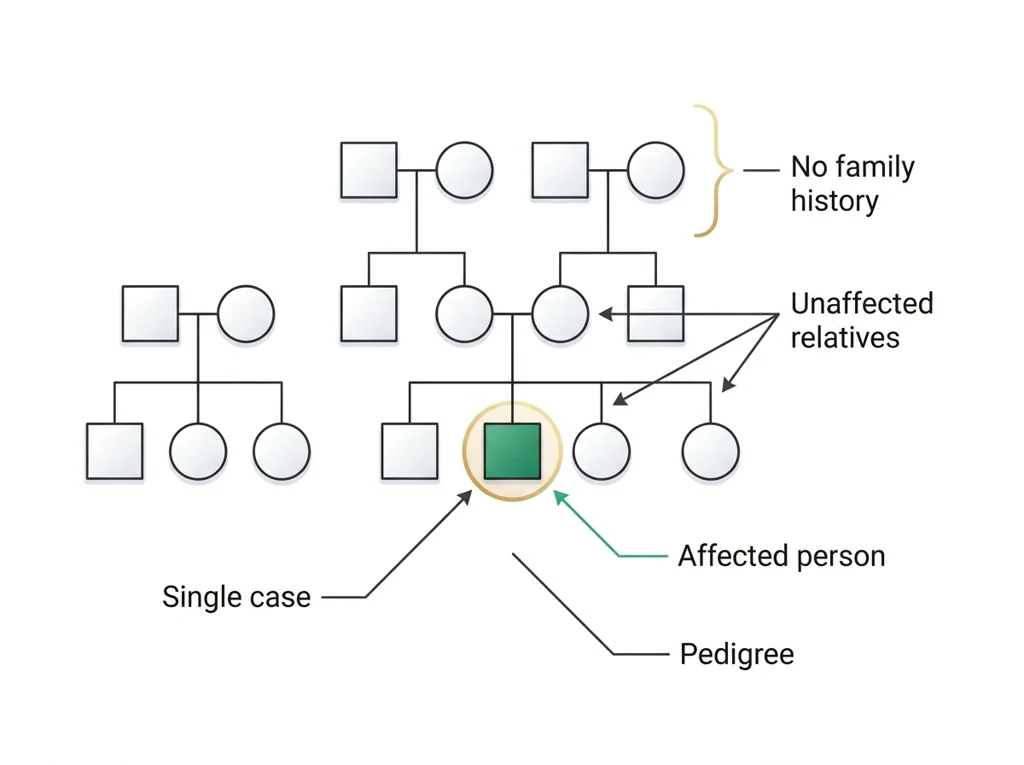
A trait that appears in just one person in a family, with no other clearly affected relatives.
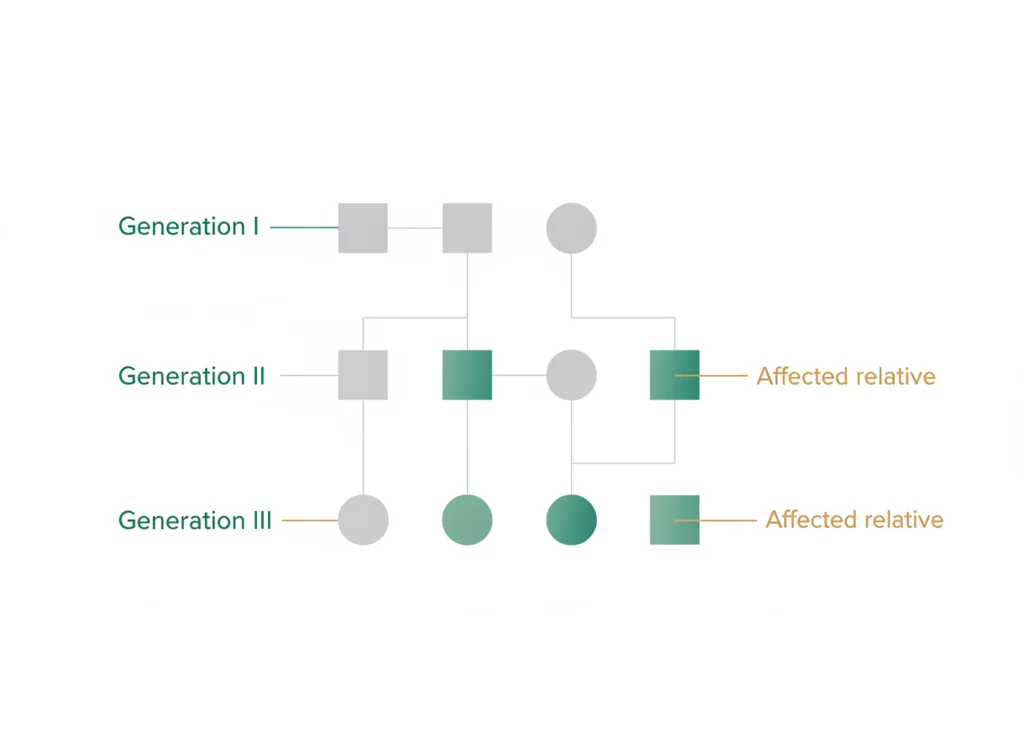
An instance of a trait or condition that appears in more than one relative, often across several generations of a family.
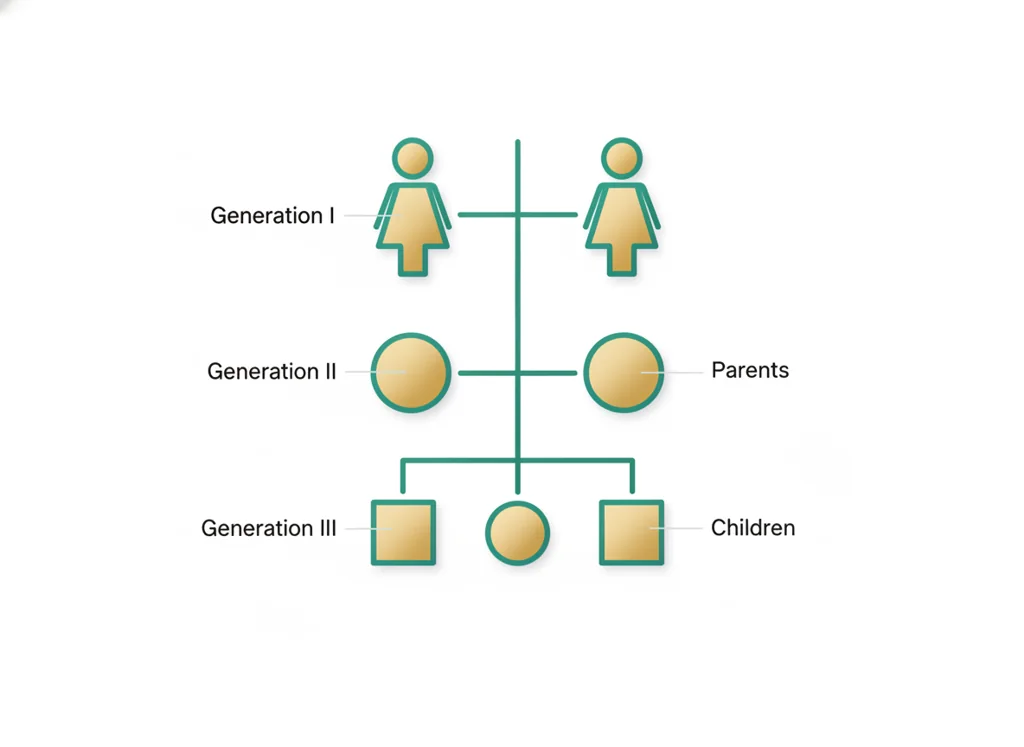
One layer of a family tree, such as grandparents, then parents, then children, shown as a row on a pedigree.
Research citation trail (advanced)
You do not need these papers or database records to finish the lesson. They document where the plain-language explainer's claims come from and are intended for teachers or advanced readers.