Rough draft.This research track is under review with Dr. Atit's lab. Content and sequence may still change.
The Baby Mateo Case
Experimental Design domainBiomedical Innovations (BI)Lesson 18 of 20Your seat: Bioethicist / IRB liaison

What Makes Research on Children Ethical?

Discovery question

What has to be true before scientists are allowed to study a baby like Mateo?

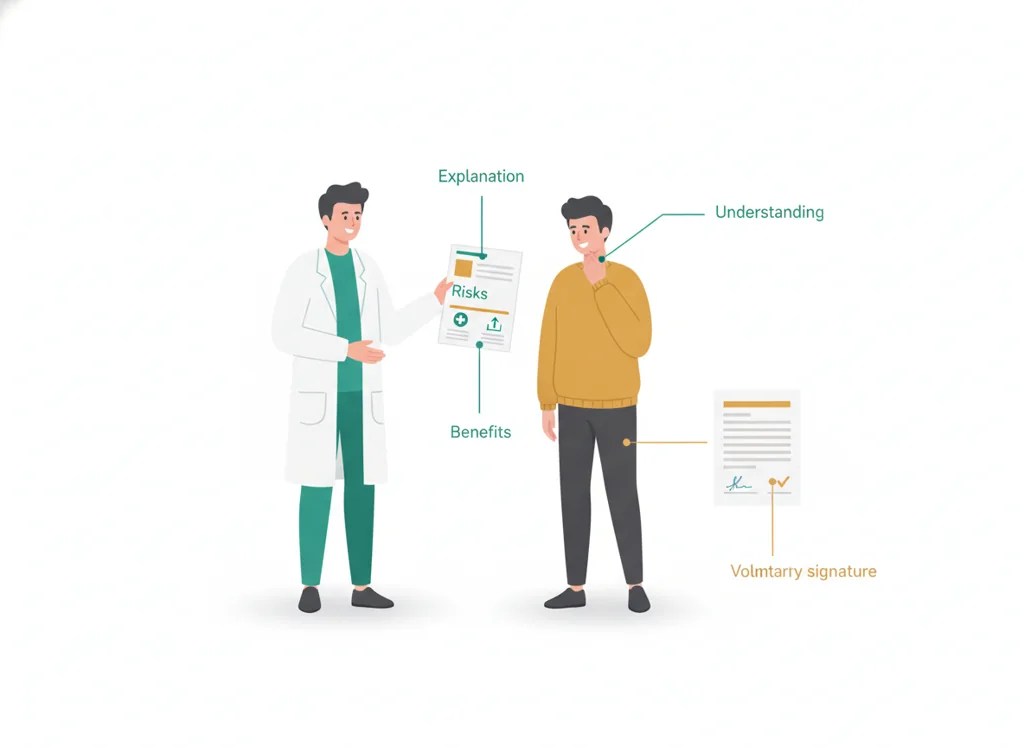
💡 A study is only ethical when it is fair (genuine equipoise), the family truly agreed ( and, for older children, assent), and an independent board (IRB or ethics committee) approved it first.

The plan

Prerequisite check

Before this page, you should know
  • A is a structured, repeatable way to find all the studies on one question, judge their quality, and summarize them, reported under the 27-item checklist plus a flow diagram.
  • Gold-standard reviews use a pre-registered protocol, a multi-database search, dual independent screening, a formal risk-of-bias check, and an assessment of .
Today's new idea is only
A study is only ethical when it is fair (genuine equipoise), the family truly agreed ( and, for older children, assent), and an independent board (IRB or ethics committee) approved it first.
Learn first

What you will learn

Goal: Explain why a pediatric study needs IRB approval, parental , child assent, and genuine equipoise, and apply these rules to decide whether a proposed study could ethically run.

Know by the end
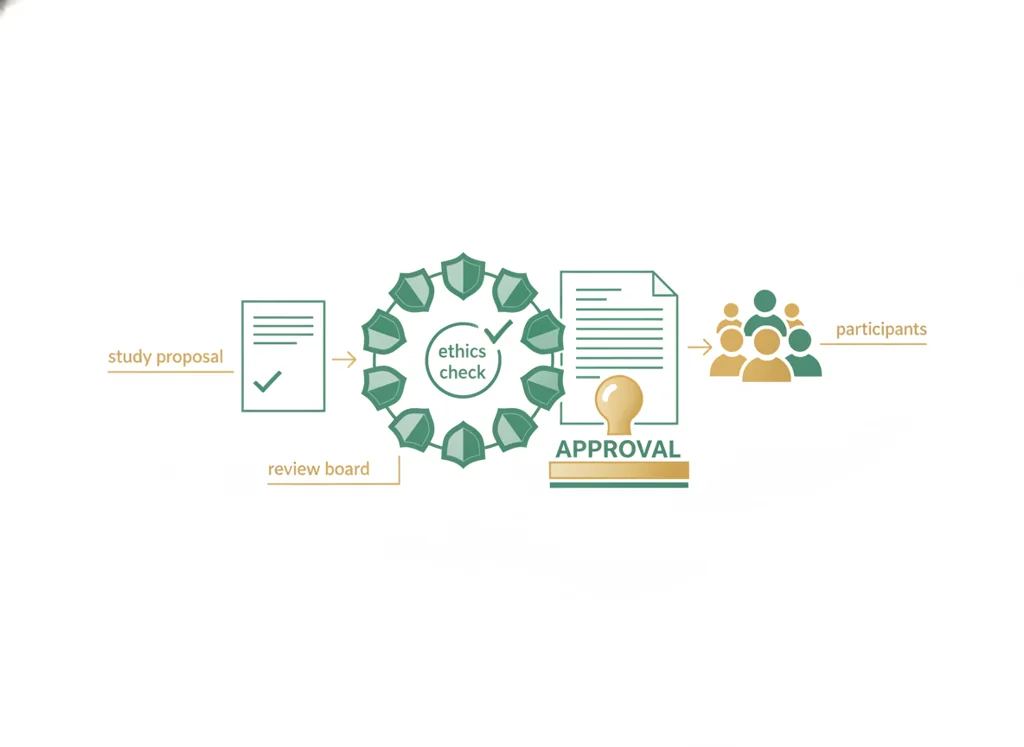
  • An IRB or ethics committee is an independent group that must approve a study's protocol before it begins and approve any later changes; TOPS needed approval in every one of its five countries.
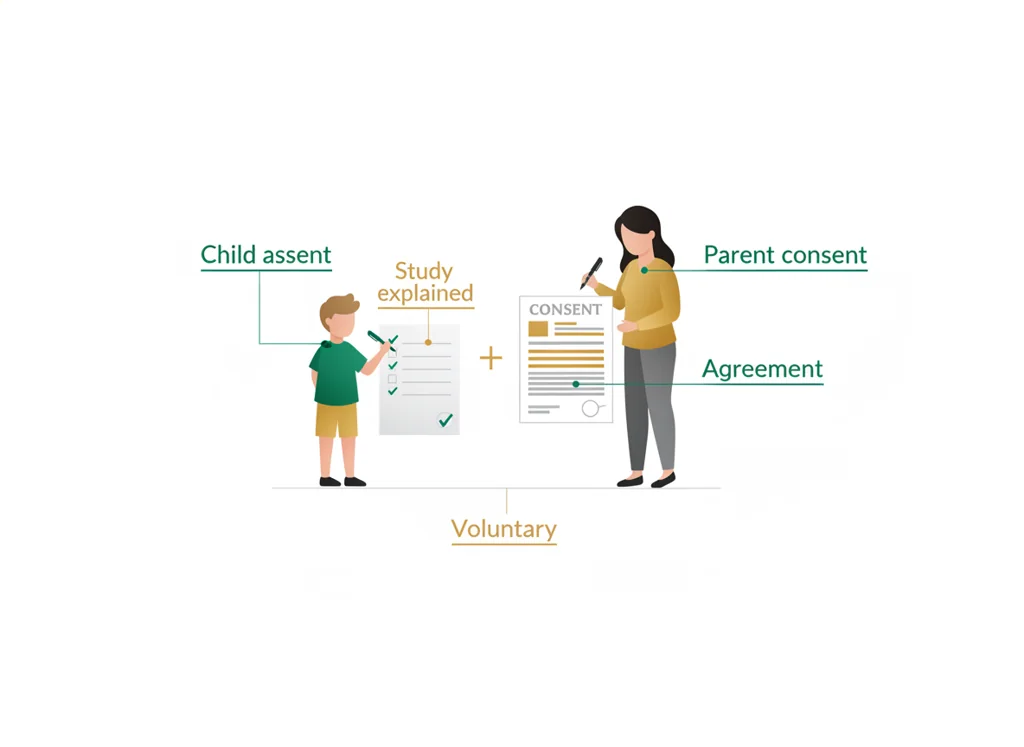
  • means the participant, or for a child a parent or guardian, is told the real risks, benefits, and alternatives and freely agrees in writing, with the right to withdraw; an infant cannot consent, so parents give permission.
  • Assent is an older child's age-appropriate agreement to take part, in addition to a parent's consent, which respects the child as a person.
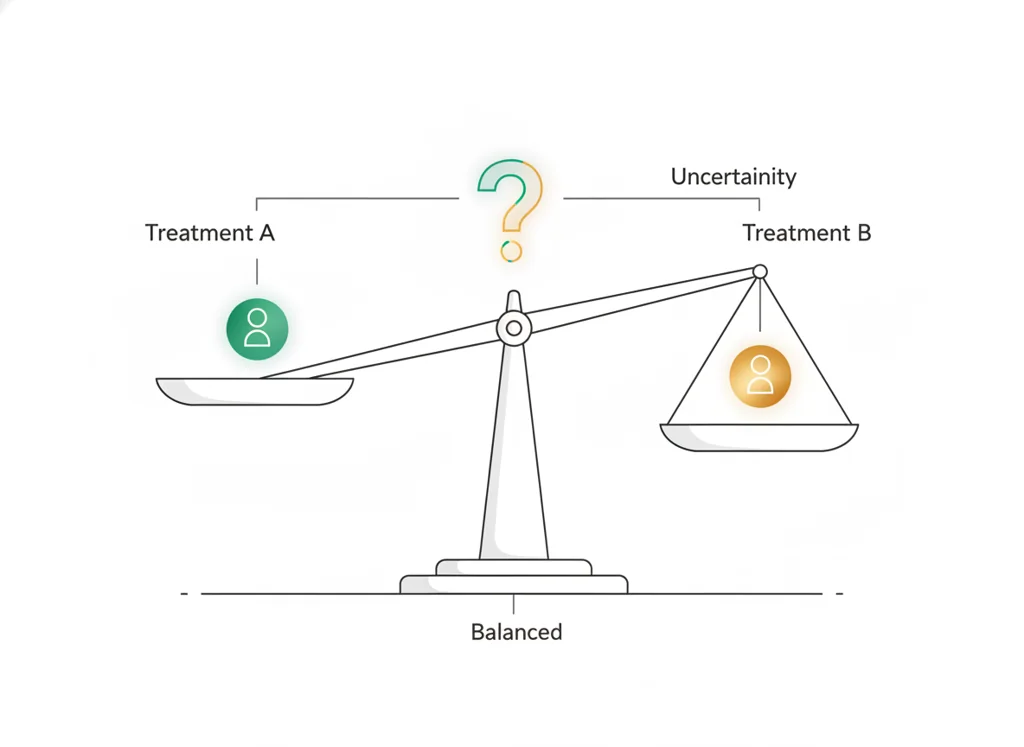
  • Equipoise means you may only randomize when the expert community genuinely does not know which option is better; the moment real proof exists, equipoise is gone and you can no longer randomize.
Learn first

Model: How a real trial got permission, and a genetics study where the subject is a family

The TOPS trial randomized infants with to surgery at 6 months or 12 months to learn which timing gave better speech. Before a single baby was enrolled, the team had to clear three gates described in the trial's own methods. Gate 1: an independent ethics committee in every country (Brazil, Denmark, Norway, Sweden, United Kingdom) reviewed and approved the protocol and every amendment. Gate 2: written from a parent or guardian for each infant. Gate 3: the study was only allowed because the field genuinely did not know which timing was better, the open question that made it fair to let chance, not the surgeon, decide each baby's timing.

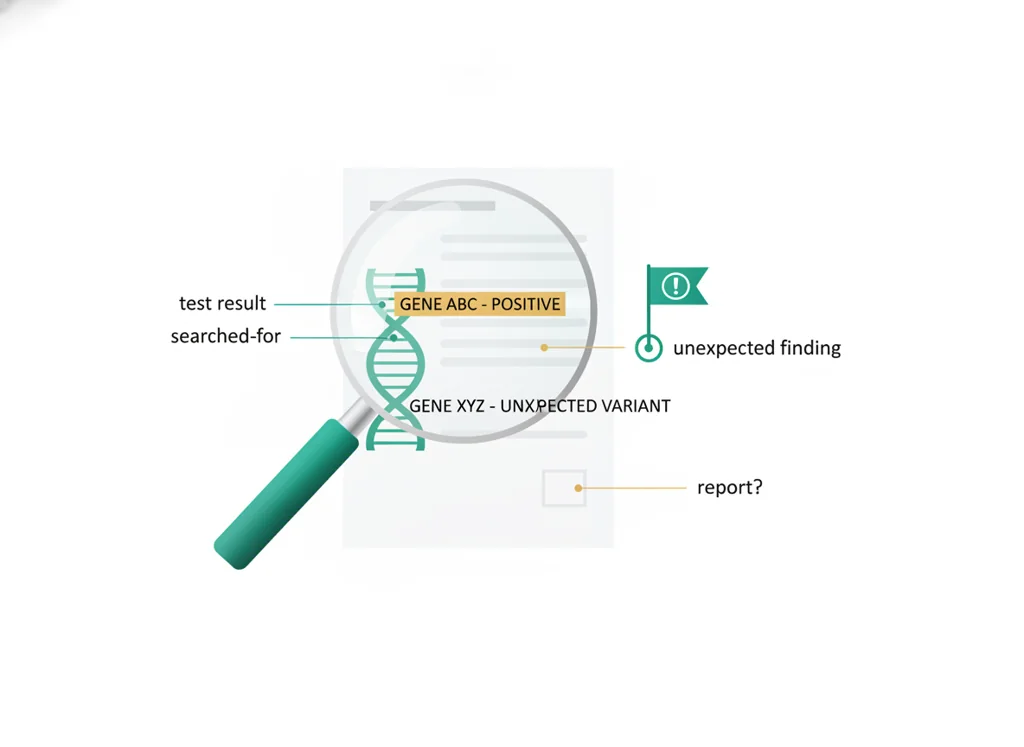
A genetics study can be trickier. The IRF6 study collected DNA from an affected child and both parents to find a risk gene. Consent here is harder than in surgery: testing one person's DNA reveals information about relatives who never agreed to be tested, and a child is too young to decide whether their DNA should be stored or reused. The team needed consent from the parents and a plan for the child's future say.

Read this in pieces, one chunk at a time
Do the work

Explore (work the model before reading on)

  1. Name the three gates the TOPS team had to pass before enrolling a baby.
  2. Who gave permission for each infant, since the infant could not?
  3. Why is consent for a DNA study more complicated than consent for a surgery study?
  4. The team randomized babies to a surgery timing. Why is that only fair if nobody already knows which timing is better?
  5. Imagine a surgeon was already certain that 6-month surgery is better. Predict why it would now be unethical for that surgeon to run the trial, even though the science would be the same.
The plan

Guided notes

1

IRB, consent, and assent

Model start: Research on humans, especially children, runs under a set of protections. Naming them is your job today.
  • An , called an ethics committee in many countries, must ____ a study's protocol before it begins and approve any later changes.
  • means the participant, or for a child a ____ or guardian, is told the real risks, benefits, and alternatives and freely agrees in writing, with the right to withdraw.
  • For an older child who can understand some of the study, we also ask for assent: the child's own age-appropriate ____ to take part.
2

Equipoise and the duty not to waste participants

  • Equipoise means you may only randomly assign people to treatments when the expert community honestly does ____ know which option is better.
  • Good ethics also requires a power ____ so you enroll enough children to get an answer but not one child more than needed.
  • In genetics, storing a child's DNA raises the ____-findings problem: a scan can reveal risks the family never asked about.
Explore

Reading the Research

What to read
Read the title and the abstract only, not the whole paper. Gamble et al. 2023, TOPS trial ethics approvals and consent (NEJM)
Why this source matters
This is the published evidence behind today's idea: A study is only ethical when it is fair (genuine equipoise), the family truly agreed ( and, for older children, assent), and an independent board (IRB or ethics committee) approved it first.
Words to unlock first
informed consentassentequipoiseInstitutional Review Board (IRB)incidental findings
Reading moves
  1. Skim the title and abstract first to get the gist.
  2. Circle the one sentence that states the main claim.
  3. Box the evidence the authors give for that claim.
  4. Mark one sentence that confuses you, and move on.
Stop point
You do not need the methods or statistics yet. If a sentence is about lab technique or math you have not learned, mark it and skip it.
Your output
Write one claim-evidence sentence: what this source claims, and the one piece of evidence that backs it up.
Where this fits
Tested on (Ohio WebXam)
Genetics of Disease · 072130
PLTW lesson
MI · Experimental Design domain · Research ethics; IRB, informed consent, assent, and equipoise in pediatric studies
WebXam domain
Bio-Molecular Technology
Evidence to produce
A junior researcher proposes: randomly assign 200 babies with cleft palate to get repair surgery, or to get NO repair surgery ever, and compare their speech at age 5. As bioethicist: (1) state whether equipoise exists here (do we already know whether repairing a cleft palate helps?); (2) name which protection this study violates and why an IRB would reject it; (3) rewrite the comparison so the study could ethically run (think about what TOPS actually compared).
Lab / skill
Biomedical Innovations (BI) · AP Biology
Words

Vocabulary (the same words your classes use)

The plan

Track your progress today

Check these off as you work through the lesson, then submit. This tells Mr. Mendoza how you're doing so he can help the class. It does not replace turning in your producible.

Use the code Mr. Mendoza gave you, not your name. Saved on this device.

Check off as you finish
  • Read the Model and answered the Explore questions.
  • Filled in the guided notes in my own words.
  • Defined the new vocabulary with an example.
  • Built the producible: A junior researcher proposes: randomly assign 200 babies with cleft palate to get repair surgery, or to get NO repair surgery ever, and compare their speech at age 5. As bioethicist: (1) state whether equipoise exists here (do we already know whether repairing a cleft palate helps?); (2) name which protection this study violates and why an IRB would reject it; (3) rewrite the comparison so the study could ethically run (think about what TOPS actually compared).
  • Wrote my Claim, Evidence, and Reasoning exit ticket.
Pick your period and code first.
Check yourself

Exit ticket (Claim, Evidence, Reasoning)

  • Claim: Scientists were allowed to study babies like Mateo in the TOPS trial only because strict protections were met.
  • Evidence: Name two protections the TOPS team had to satisfy before enrolling any infant.
  • Reasoning: Explain why equipoise is what made it fair to let chance decide each baby's surgery timing.
How this is graded (rubric)
For: A junior researcher proposes: randomly assign 200 babies with cleft palate to get repair surgery, or to get NO repair surgery ever, and compare their speech at age 5. As bioethicist: (1) state whether equipoise exists here (do we already know whether repairing a cleft palate helps?); (2) name which protection this study violates and why an IRB would reject it; (3) rewrite the comparison so the study could ethically run (think about what TOPS actually compared).
CriterionProficientDevelopingBeginning
CompleteEvery required part of the artifact is present and filled in.Most parts are present, but one is missing or left blank.Several parts are missing.
AccurateThe science and data are correct and match the evidence.Mostly correct, with a small factual slip.Key science or data is wrong.
Scientific reasoning (CER)States a claim, backs it with specific evidence, and explains the reasoning.Has a claim and evidence, but the reasoning is thin or missing.Gives an answer with no evidence or reasoning.
Professional communicationClear, organized, and labeled the way a clinician or scientist would write it.Readable but disorganized or missing labels.Hard to follow.
SubmittedTurned in the right way (Schoology for routine work) and confirmed.Turned in, but in the wrong place or unconfirmed.Not turned in.
How the model answer scores against this rubric
  • CompleteProficient: Nothing is left blank: the model fills every part of "A junior researcher proposes: randomly assign 200 babies with cleft palate to get repair surgery, or to get NO repair surgery ever, and compare their speech at age 5. As bioethicist: (1) state whether equipoise exists here (do we already know whether repairing a cleft palate helps?); (2) name which protection this study violates and why an IRB would reject it; (3) rewrite the comparison so the study could ethically run (think about what TOPS actually compared).".
  • AccurateProficient: Every number and claim matches the case evidence.
  • Scientific reasoning (CER)Proficient: It names a claim, cites the specific evidence, and explains the reasoning, not just the answer.
  • Professional communicationProficient: It is organized and labeled like a real chart note.
  • SubmittedProficient: It would be turned in on Schoology and confirmed.
Explore

Where this leads: careers

Bioethicist IRB Administrator Genetic Counselor

What's next: We answered today's question: an ethical study needs IRB approval, real consent and assent, and genuine equipoise. But clearing ethics only means a study was allowed to run, not that its result is true. Suppose a study cleared every ethics check and was run perfectly. How does the rest of the world confirm it is trustworthy and not just one team's claim? We chase that next time.