Rough draft.This research track is under review with Dr. Atit's lab. Content and sequence may still change.
The Baby Mateo Case
Disease domainShared clinical backbone (the cleft team)Lesson 11 of 20Your seat: Plastic surgeon (cleft team)

What the Surgeries Are Actually For

Discovery question

What clinical problem does each surgery solve, and why is each one scheduled when it is?

💡 The lip repair and the repair solve different problems, which is why they are separate, separately timed operations.

The plan

Prerequisite check

Before this page, you should know
  • care is multidisciplinary (many specialists as one team) and staged (a timed sequence, not all at once), forming a from birth into adulthood.
  • Feeding comes first (birth to 3 months); lip repair is around 3 months; cleft repair is around 9 to 12 months, timed before the toddler speech window.
Today's new idea is only
The lip repair and the repair solve different problems, which is why they are separate, separately timed operations.
Learn first

What you will learn

Goal: Students will explain the clinical purpose and approximate timing of lip repair () and cleft repair () from a family's point of view, distinguishing the form goal from the speech goal.

Know by the end
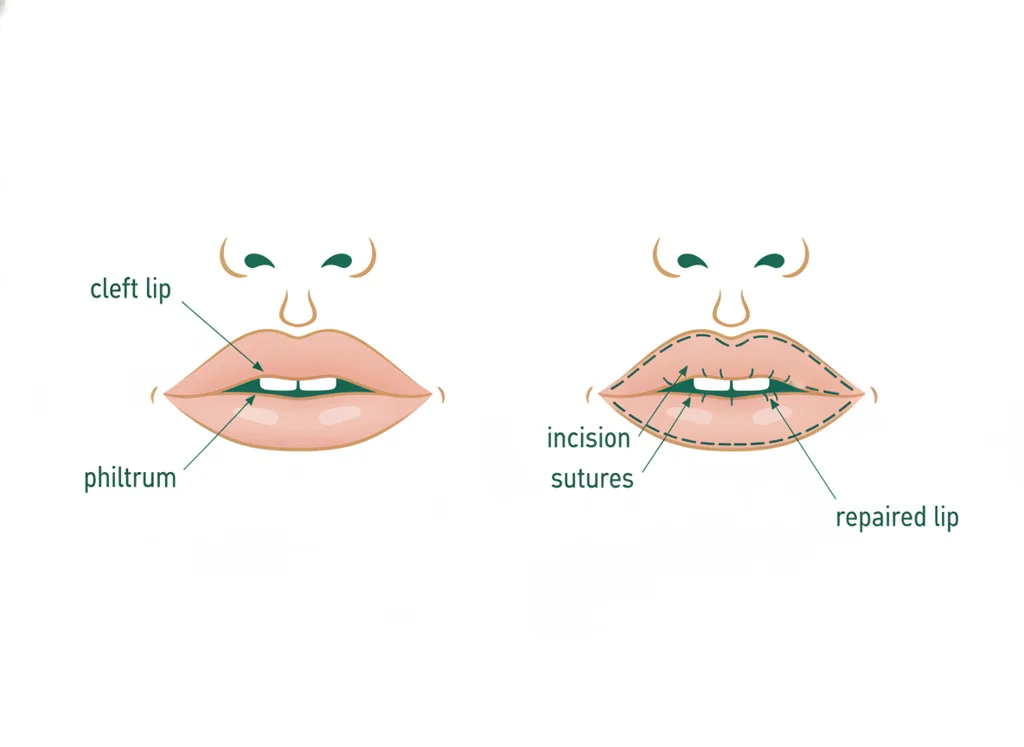
  • lip repair () is done at about 3 months (within the first 12 months) mainly to restore the form of the lip and nose.
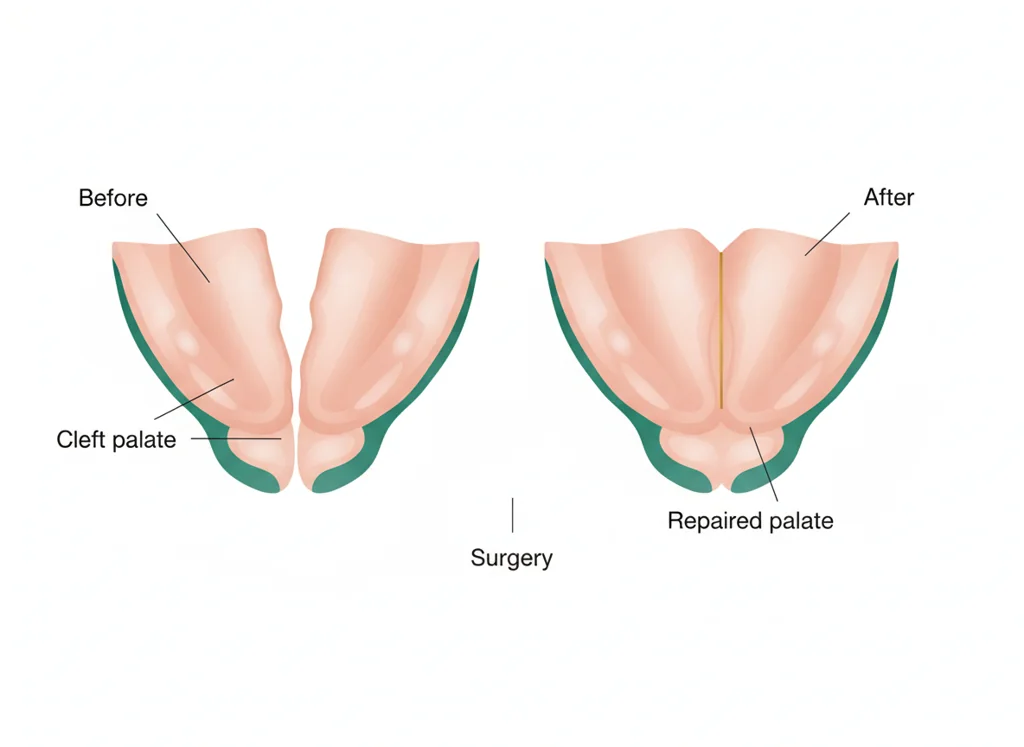
  • repair () is done at about 9 to 12 months (within the first 18 months) mainly to separate the oral and nasal cavities and enable normal speech.
  • repair is timed to the second half of the first year on purpose, because that is when speech sounds begin to develop and an open palate cannot build the pressure speech needs.
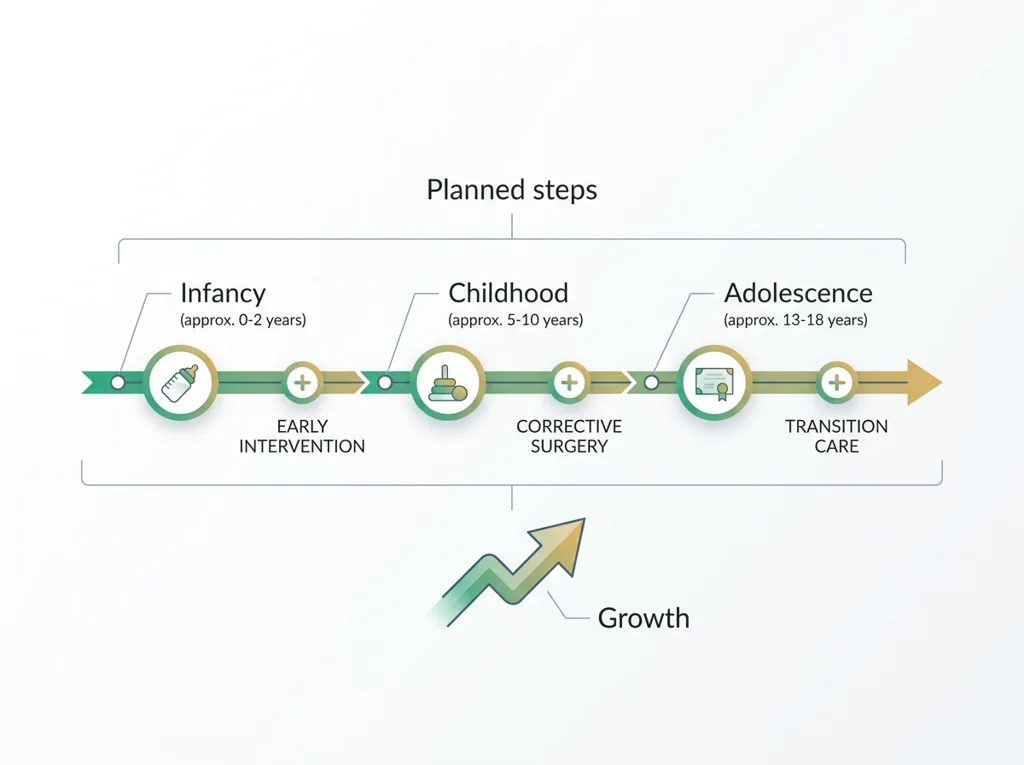
  • care is staged: the cleft is fixed in a planned sequence, each step timed to a developmental need, not all in one operation.
Learn first

Model: Two milestones from the care timeline, and a parent's two worries

From the consolidated (DATA_TABLES.md section D, drawn from the reviews and CDC), two early operations sit on Mateo's plan. Cleft lip repair () is done around 3 months, within the first 12 months, and its stated purpose is to restore lip and nasal form. Cleft repair () is done around 9 to 12 months, within the first 18 months, and its stated purpose is to enable normal speech and to separate the oral and nasal cavities. Notice the purposes are written differently: one says 'form,' the other says 'speech' and 'separate the cavities.'

At the same visit, Mateo's parents say two things. 'When he smiles, I want his lip to look whole.' And, 'I am scared he will not be able to talk, or that food will come out of his nose.' Hold both worries next to the table. The lip-form worry maps to the lip repair; the talking-and-nasal-leak worry maps to the repair. The palate is repaired in the second half of the first year, the same window when speech sounds start to develop, because an open palate cannot build the air pressure that speech needs. (How the surgeon actually rebuilds the lip and palate belongs to the Anatomical team; here we only need purpose and timing.)

Read this in pieces, one chunk at a time
Do the work

Explore (work the model before reading on)

  1. At about what age is the lip repaired, and at about what age is the repaired?
  2. Copy the stated purpose of each operation in your own words.
  3. The lip repair purpose talks about 'form'; the repair purpose talks about 'speech' and 'separating cavities.' Match each of the parents' two worries to the operation that addresses it.
  4. The repair is scheduled in the second half of the first year, not later in childhood. Speech sounds begin to develop in that same window. Why might the team not want to wait several years to repair the palate?
  5. Imagine the were left open until age 5 to 'let Mateo grow first.' Predict one problem with speech and one problem with eating that this delay could cause.
  6. In one sentence, what pattern did your team find about the two operations and their timing?
The plan

Guided notes

1

Two operations, two different jobs

Model start: The two early operations solve different clinical problems, which is why they are separate surgeries on separate dates.
  • (lip repair) is done at about ______ months, mainly to restore the form of the lip and nose.
  • ( repair) is done at about ______ to ______ months, mainly to separate the oral and nasal cavities and enable speech.
2

Why the palate cannot wait

  • repair is timed before the toddler ______ window, because an open palate cannot build the air pressure speech needs.
  • An open also lets food and air leak between the mouth and nose until the cavities are separated.
3

Staged care

  • care is ______ care: a planned sequence of steps over time, each timed to a developmental need.
  • More refinements (nose, scar, bite) come later across the 18-year plan, so a single operation does not finish the work.
Explore

Reading the Research

What to read
Why this source matters
This is the published evidence behind today's idea: The lip repair and the repair solve different problems, which is why they are separate, separately timed operations.
Words to unlock first
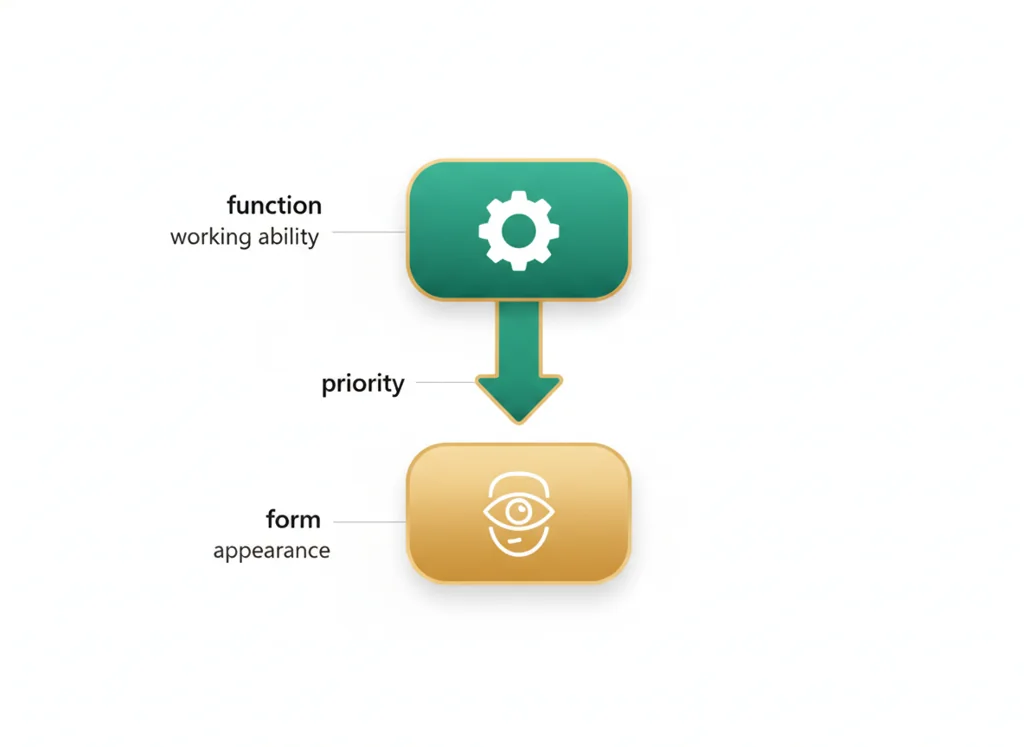
cheiloplastypalatoplastystaged carefunction before form
Reading moves
  1. Skim the title and abstract first to get the gist.
  2. Circle the one sentence that states the main claim.
  3. Box the evidence the authors give for that claim.
  4. Mark one sentence that confuses you, and move on.
Stop point
You do not need the methods or statistics yet. If a sentence is about lab technique or math you have not learned, mark it and skip it.
Your output
Write one claim-evidence sentence: what this source claims, and the one piece of evidence that backs it up.
Where this fits
Tested on (Ohio WebXam)
Genetics of Disease · 072130
PLTW lesson
MI · Disease domain · Medical Interventions (MI), staged surgical management
WebXam domain
Bio-Molecular Technology
Evidence to produce
Counsel Mateo's parents in three short sentences a non-medical parent could follow: (1) what the lip surgery is for and roughly when, (2) what the palate surgery is for and roughly when, and (3) why the palate cannot just wait until he is older. Use the words 'form,' 'speech,' and 'separate the cavities.'
Lab / skill
Clinical backbone (cleft team) · Clinical backbone (cleft team)
Words

Vocabulary (the same words your classes use)

The plan

Track your progress today

Check these off as you work through the lesson, then submit. This tells Mr. Mendoza how you're doing so he can help the class. It does not replace turning in your producible.

Use the code Mr. Mendoza gave you, not your name. Saved on this device.

Check off as you finish
  • Read the Model and answered the Explore questions.
  • Filled in the guided notes in my own words.
  • Defined the new vocabulary with an example.
  • Built the producible: Counsel Mateo's parents in three short sentences a non-medical parent could follow: (1) what the lip surgery is for and roughly when, (2) what the palate surgery is for and roughly when, and (3) why the palate cannot just wait until he is older. Use the words 'form,' 'speech,' and 'separate the cavities.'
  • Wrote my Claim, Evidence, and Reasoning exit ticket.
Pick your period and code first.
Check yourself

Exit ticket (Claim, Evidence, Reasoning)

  • Claim: The lip repair and the repair solve ____ (the same / different) problems for Mateo.
  • Evidence: The lip repair, at about ____ months, restores ____, while the repair, at about ____ months, enables ____ and separates the cavities.
  • Reasoning: The repair is timed to the first year rather than delayed because ____.
How this is graded (rubric)
For: Counsel Mateo's parents in three short sentences a non-medical parent could follow: (1) what the lip surgery is for and roughly when, (2) what the palate surgery is for and roughly when, and (3) why the palate cannot just wait until he is older. Use the words 'form,' 'speech,' and 'separate the cavities.'
CriterionProficientDevelopingBeginning
CompleteEvery required part of the artifact is present and filled in.Most parts are present, but one is missing or left blank.Several parts are missing.
AccurateThe science and data are correct and match the evidence.Mostly correct, with a small factual slip.Key science or data is wrong.
Scientific reasoning (CER)States a claim, backs it with specific evidence, and explains the reasoning.Has a claim and evidence, but the reasoning is thin or missing.Gives an answer with no evidence or reasoning.
Professional communicationClear, organized, and labeled the way a clinician or scientist would write it.Readable but disorganized or missing labels.Hard to follow.
SubmittedTurned in the right way (Schoology for routine work) and confirmed.Turned in, but in the wrong place or unconfirmed.Not turned in.
How the model answer scores against this rubric
  • CompleteProficient: Nothing is left blank: the model fills every part of "Counsel Mateo's parents in three short sentences a non-medical parent could follow: (1) what the lip surgery is for and roughly when, (2) what the palate surgery is for and roughly when, and (3) why the palate cannot just wait until he is older. Use the words 'form,' 'speech,' and 'separate the cavities.'".
  • AccurateProficient: Every number and claim matches the case evidence.
  • Scientific reasoning (CER)Proficient: It names a claim, cites the specific evidence, and explains the reasoning, not just the answer.
  • Professional communicationProficient: It is organized and labeled like a real chart note.
  • SubmittedProficient: It would be turned in on Schoology and confirmed.
Explore

Where this leads: careers

Plastic surgeon Oral and maxillofacial surgeon Surgical nurse

What's next: We answered why the is repaired early to protect speech. But that raises a new question: how exactly does a repaired palate let Mateo make clear speech sounds, and what happens if it still does not seal well?