
How Palate Repair Lets a Child Speak
This reading contains every idea and every piece of evidence needed for today's decision. The research links at the end are optional.
Why this matters
A cleft can affect speech, so a repair must restore movement as well as close the opening.
The question you are trying to answer
Why can air escape through the nose even after the roof of the mouth has been closed?
Begin with the idea you already earned
Cleft surgery timing balances present safety, early function, future growth, and family readiness rather than following one magic date.
Study the analogy before the biology
- When must one route close?
- Why should the other route remain available sometimes?
- What signal would reveal a leaky switch?
Turn the analogy into three rules
Limit: Speech depends on the brain, hearing, articulation, language, and learned motor patterns as well as anatomy.
Map those rules onto the biology
The velopharyngeal valve includes the soft palate and the walls of the throat. It changes shape during speech.
For many oral pressure sounds, the valve closes the nasal path so pressure builds in the mouth. For nasal sounds, the path opens.
Cleft-team speech assessment checks resonance, nasal air escape, articulation, and how understandable speech is. Anatomy and learned speech patterns both matter.
Read Mateo's labeled case evidence
Mateo's repaired soft palate contains a reconstructed levator sling.
The velum has the anatomy needed to elevate, but function must be measured.
A speech sample shows pressure consonants with no consistent nasal emission.
The supplied sample supports effective closure during those sounds.
Speech assessment includes resonance, nasal emission, articulation, and intelligibility.
One sound or one appearance cannot define the whole speech outcome.
Make the concrete decision
You are the cleft-team speech-language pathologist.
Mateo produces clear pressure consonants but a trainee says the nose should be sealed for every sound.
- Explain controlled closure for oral sounds and opening for nasal sounds.
- Recommend permanent complete nasal blockage.
- Judge the valve only from a still photograph.
Choose the explanation and cite airflow plus speech-sample evidence.
Claim ceiling: You may interpret the supplied educational speech sample. You may not diagnose a real child's resonance without a complete evaluation.
Write the 10-year takeaway
Clear oral speech needs a moving velopharyngeal valve that closes the nasal path for pressure sounds and opens it for nasal sounds.
- When should the nasal path close?
- Which speech observations test valve function?
Glossary in plain English
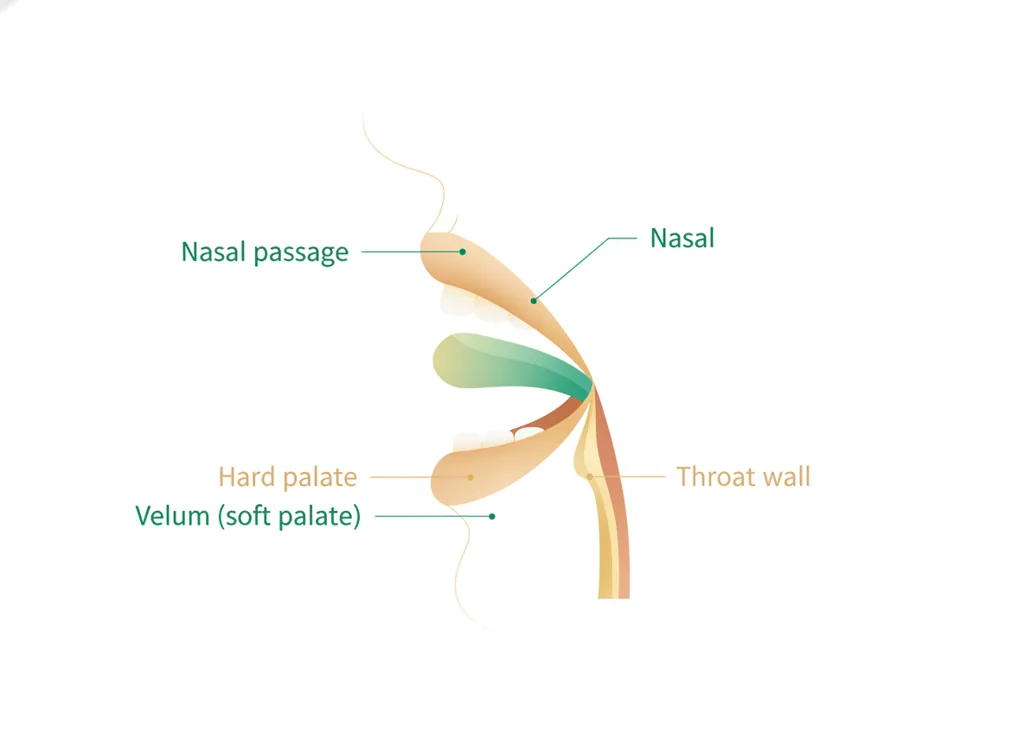
The soft palate, the muscular back part of the roof of the mouth that lifts to seal off the nose during speech and swallowing.
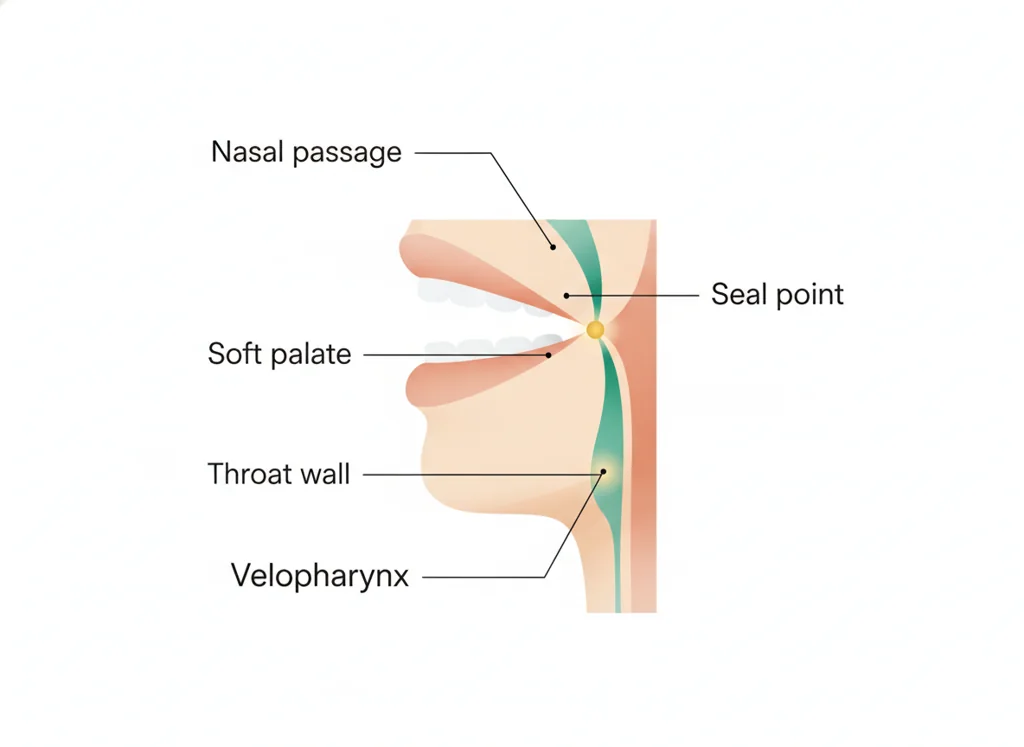
The space where the soft palate meets the back of the throat, which must seal off the nose during speech and swallowing.
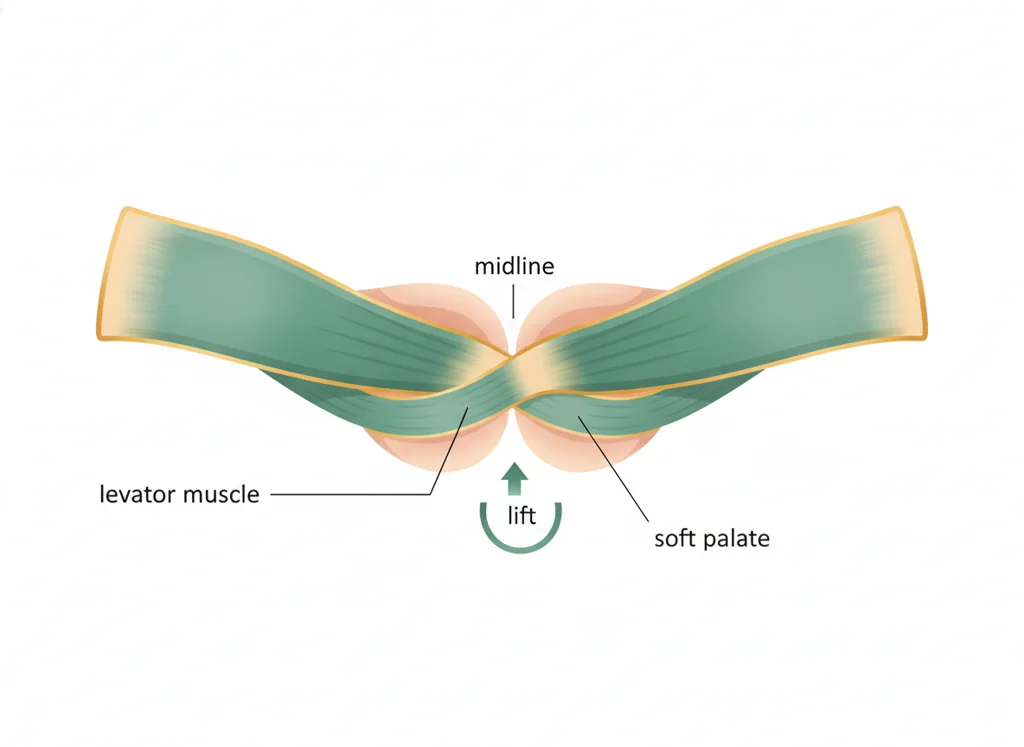
The main muscle that lifts the soft palate to close off the nose during speech and swallowing; it is often disrupted in cleft palate.
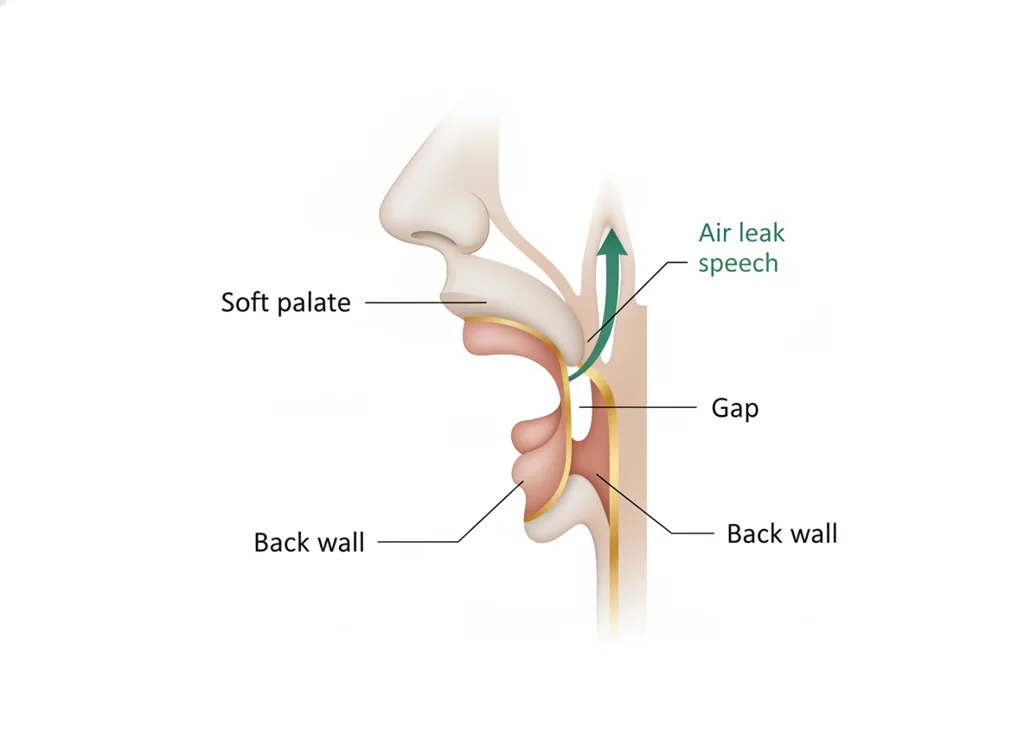
When the soft palate cannot fully close off the nose from the mouth during speech, letting air escape and making speech sound nasal.
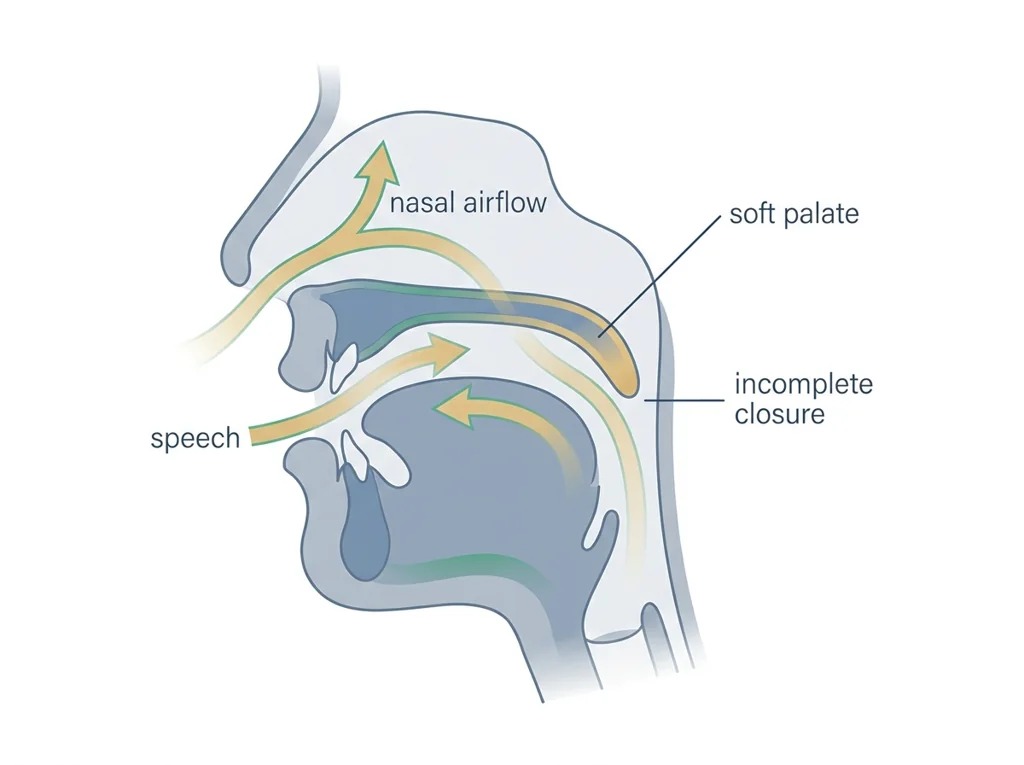
A speech quality where too much air escapes through the nose, often when the soft palate cannot fully close off the nasal passage.
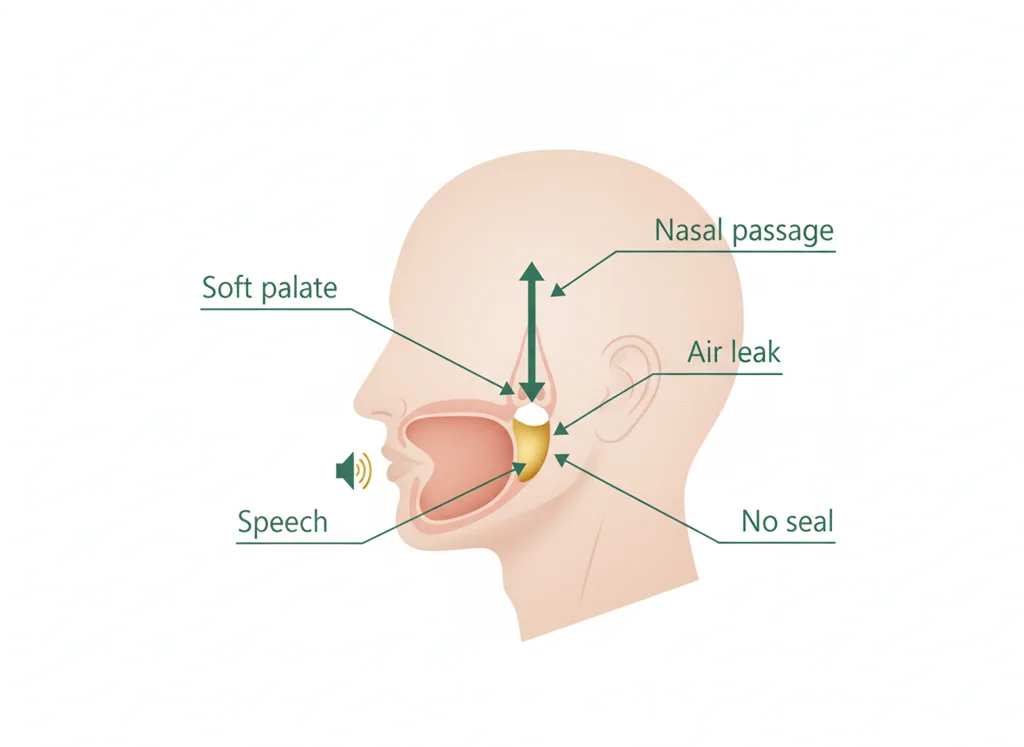
Air leaking out through the nose during speech when the soft palate cannot fully seal the mouth off from the nasal passage.
Research citation trail (advanced)
You do not need these papers or database records to finish the lesson. They document where the plain-language explainer's claims come from and are intended for teachers or advanced readers.
- American Cleft Palate Craniofacial Association. 2024 Parameters of Care.
- Kotlarek et al. 2020, Asymmetry and Positioning of the Levator Veli Palatini in Repaired Cleft Palate (J Speech Lang Hear Res)
- Hofman et al. 2024, Long-Term Speech Outcomes After Sommerlad Palatoplasty (Clin Oral Investig)
- MedlinePlus: Cleft lip and palate