Rough draft.This research track is under review with Dr. Atit's lab. Content and sequence may still change.
The Baby Mateo Case
Anatomical domainHuman Body Systems (HBS)Lesson 11 of 20Your seat: Speech-Language Pathologist

How Palate Repair Lets a Child Speak

Discovery question

Why does repairing the roof of the mouth decide whether a child speaks clearly or sounds like air is leaking out the nose?

💡 A good repair rebuilds the muscle sling, not just the hole, because the has to move to seal off the nose during speech.

The plan

Prerequisite check

Before this page, you should know
  • Lip repair is usually done at about 3 to 6 months; repair is generally favored as a one-stage repair at about 9 to 14 months, before first words.
  • Three forces pull on the dates: (wait for the infant to grow for safer anesthesia), speech (the valve must work before first words), and growth ( surgery disturbs upper-jaw growth, pulling toward waiting).
Today's new idea is only
A good repair rebuilds the muscle sling, not just the hole, because the has to move to seal off the nose during speech.
Learn first

What you will learn

Goal: Explain how the works as a valve and why a repaired levator sling decides between clear speech and .

Know by the end
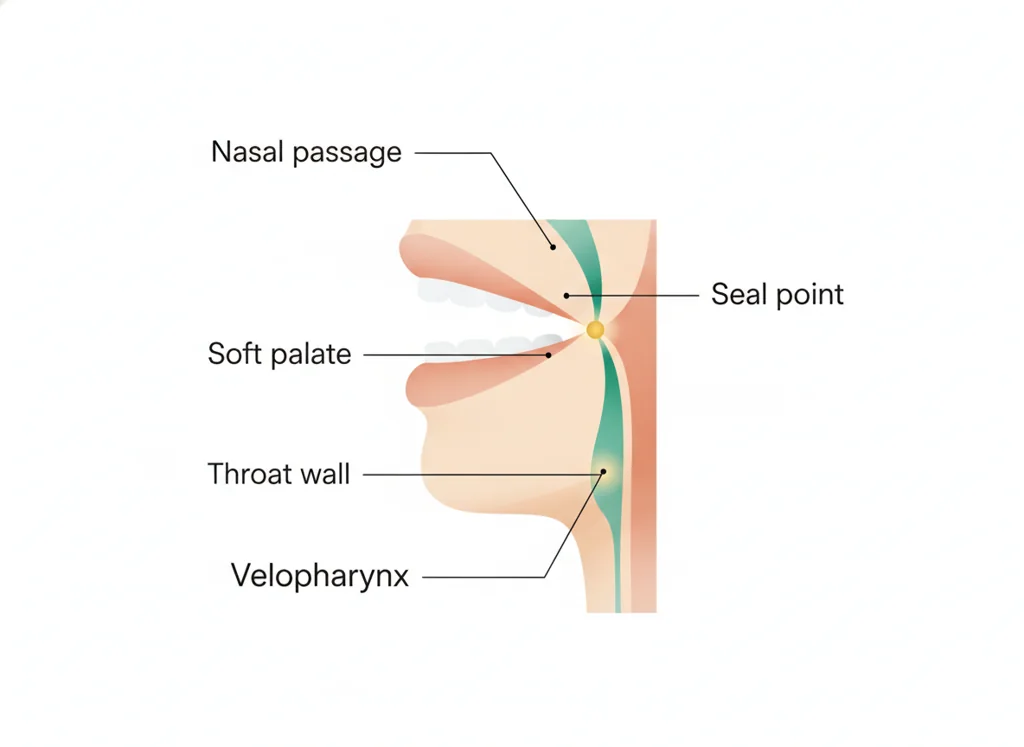
  • The and the throat walls form a muscular valve, the , that closes the nose off from the mouth during speech.
  • The normally forms a sling that lifts the up and back to seal that valve.
  • Repairing a means taking down the muscle's and rebuilding the sling, not just closing the gap.
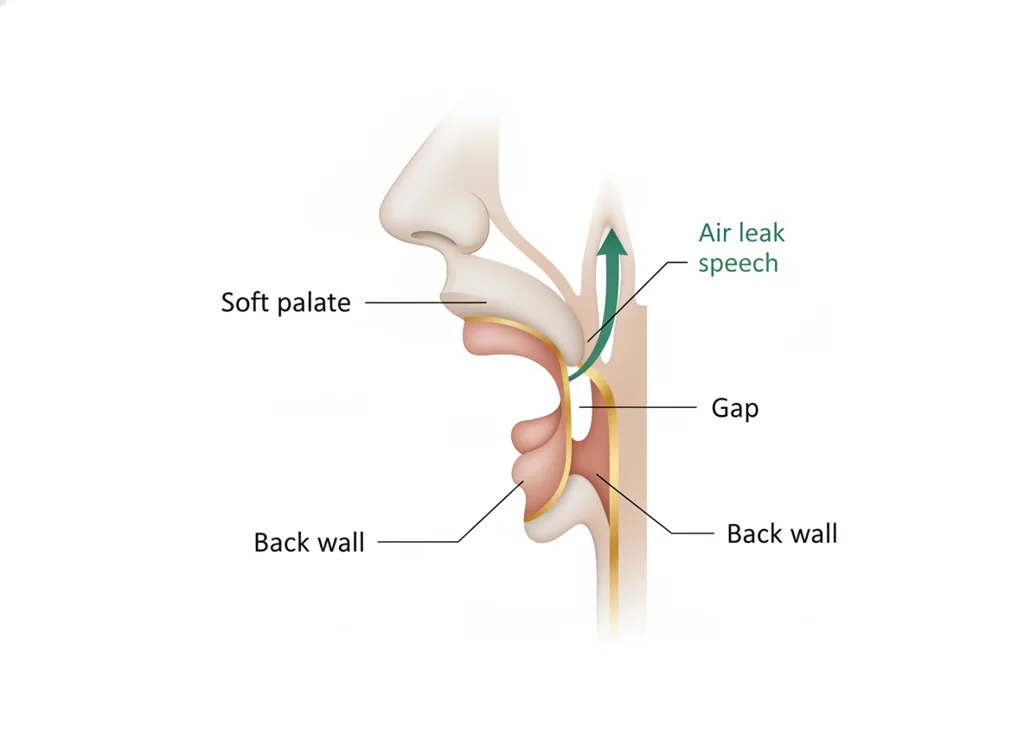
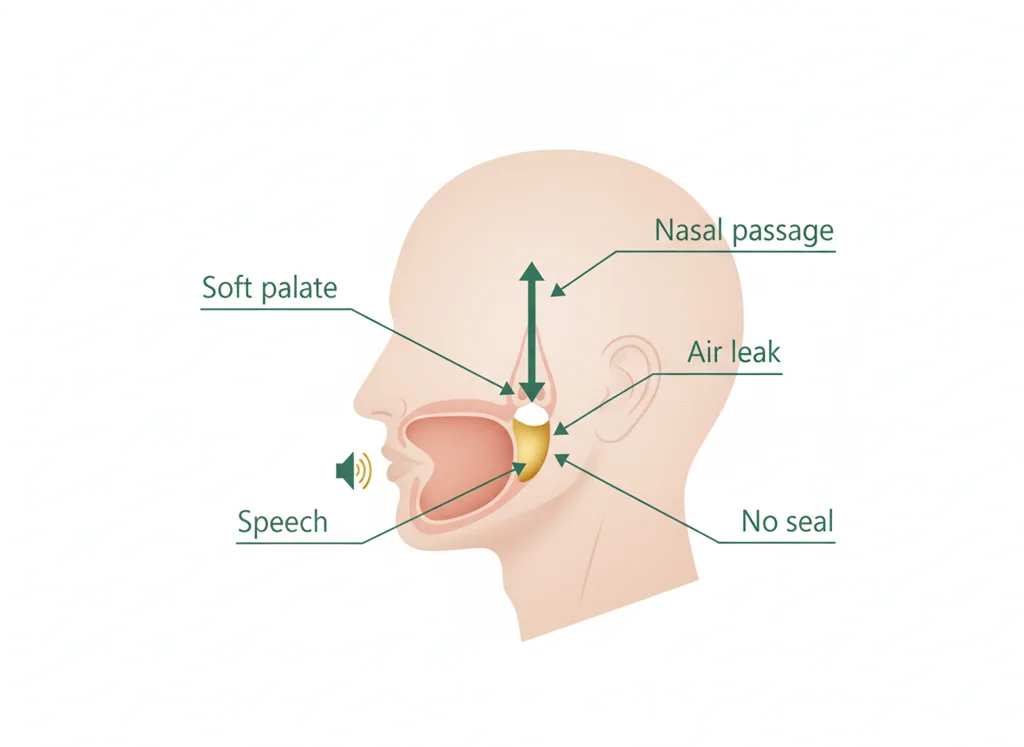
  • When the repaired cannot seal, the child has , with and audible .
Learn first

Model: The valve at the back of the mouth

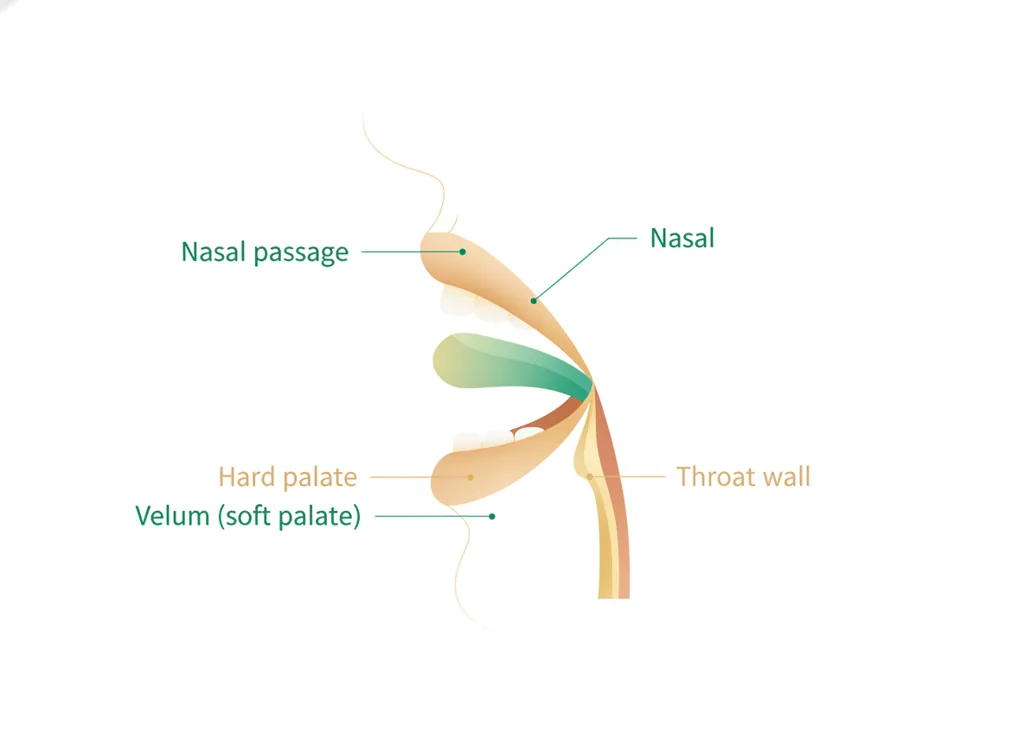
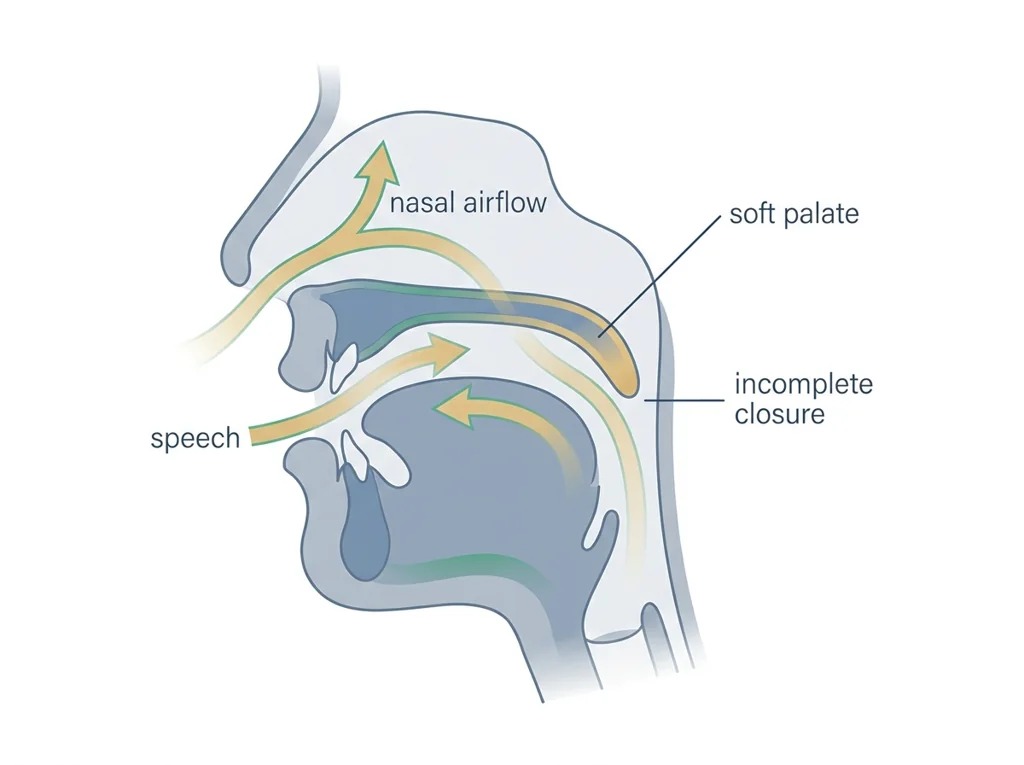
Say the word "puppy" out loud, then say "mommy." For "puppy" you trap air in your mouth and pop it out. For "mommy" you let air flow up into your nose. What lets you switch is a muscular valve called the : the soft (the ) lifts up and back and presses against the back and side walls of the throat. When it closes, air goes out the mouth; when it relaxes open, air goes up the nose.

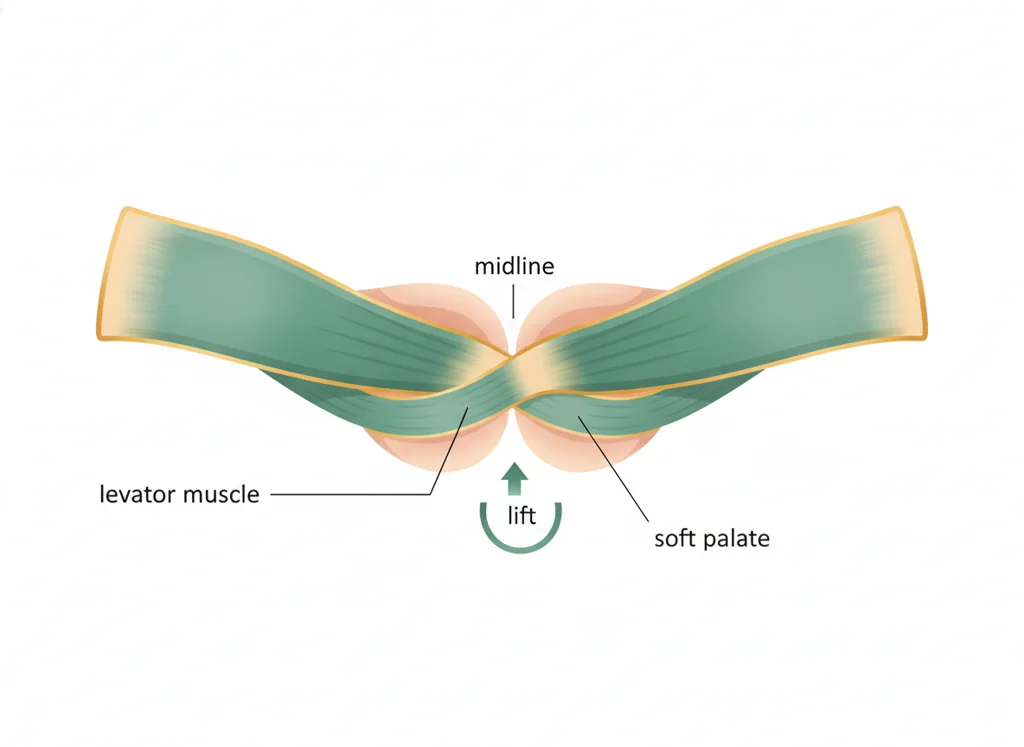
The muscle that lifts the is the . In a person without a , the two levator muscles meet in the and interlace, forming a sling across the middle of the soft . When the sling contracts, it lifts the velum like a trampoline being pulled tight.

In an unrepaired the levator never formed that sling. The fibers run front to back and insert abnormally onto the back edge of the bony . There is no trampoline, only two loose ends pointing the wrong way. Imaging of children with repaired cleft palate shows the levator still differs from normal in thickness, length, and symmetry, and the children with the most asymmetric muscle were the ones who still had a leaky after surgery.

Read this in pieces, one chunk at a time
Do the work

Explore (work the model before reading on)

  1. For "puppy" which direction does the air travel? For "mommy"?
  2. In an unrepaired , where do the levator fibers attach instead of meeting in the ?
  3. A surgeon can sew the gap shut but leave the muscle pointing the wrong way. Why would that child still struggle to make a "p" sound?
  4. The study found the most asymmetric muscle in the leakiest patients. What does that say matters more, closing the hole or rebuilding the sling?
  5. Predict: if Mateo's cannot fully close, where does the air go when he tries to say "baby," and how might his voice sound?
The plan

Guided notes

1

The valve

Model start: The soft is the , and the valve it forms with the throat walls is the ; the lifts the velum to close it.
  • In normal the two levator muscles meet in the to form a ____ across the soft .
  • When the closes, air goes out the ____; when it opens, air goes up the nose.
2

What repair must do

  • repair is not just closing the gap; it takes down the and rebuilds the ____ so the can move.
  • When the repaired cannot seal the , the child has velopharyngeal ____ (VPI).
3

The signs of a leak

  • Air escaping into the nose produces ____ (the voice sounds nasal) and audible .
Explore

Reading the Research

Why this source matters
This is the published evidence behind today's idea: A good repair rebuilds the muscle sling, not just the hole, because the has to move to seal off the nose during speech.
Words to unlock first
velumvelopharynxlevator veli palatinivelopharyngeal insufficiency (VPI)hypernasality
Reading moves
  1. Skim the title and abstract first to get the gist.
  2. Circle the one sentence that states the main claim.
  3. Box the evidence the authors give for that claim.
  4. Mark one sentence that confuses you, and move on.
Stop point
You do not need the methods or statistics yet. If a sentence is about lab technique or math you have not learned, mark it and skip it.
Your output
Write one claim-evidence sentence: what this source claims, and the one piece of evidence that backs it up.
Lab day

Using the database (what to capture)

Part of today's expected outcome is to actually open the tool below and write down the value it gives you. That captured value is the evidence you will use in your Claim, Evidence, Reasoning. Follow the steps, use the labeled screenshot so you do not get lost, and record each field.

MedlinePlus
Open the tool

Plain-language explanations of a gene or condition, written for patients and families.

When you use this: Use this when a research paper is too dense, or when you need to explain a finding to Mateo's family in everyday words.
What the screen looks like
medlineplus.gov/genetics IRF6 gene 1 Plain-language gene page 2 What the gene does + linked conditions Helps the face join · cleft, VWS 3 1 Search the gene or condition. 2 Read the summary in everyday words. 3 Note the conditions it links to.
A labeled map of the screen. The circled numbers match the steps.
Step by step
  1. 1Open medlineplus.gov/genetics and search the gene or condition (IRF6).
  2. 2Read the summary written in everyday words.
  3. 3Note the conditions the gene is linked to at the bottom of the page.
Capture these fields
  • Topic: IRF6 gene
  • Plain-language summary: IRF6 helps the tissues of the face join correctly before birth.
  • Linked conditions: Van der Woude syndrome; nonsyndromic cleft
How to read it: Start here when a research paper is too dense. MedlinePlus gives you the gist in everyday words so you can go back to the harder source knowing what it is about.
Lost? About MedlinePlus Genetics
Where this fits
Tested on (Ohio WebXam)
Genetics of Disease · 072130
PLTW lesson
MI · Anatomical domain · Muscular system; structure-function of the velopharynx in speech
WebXam domain
Bio-Molecular Technology
Evidence to produce
You are reviewing Mateo six months after his palate repair. On a VPI risk checklist, mark which of three risk factors a wide complete cleft like his could carry: severe Veau class, cleft width over 10 mm, a residual fistula. Then write one sentence telling the family, in plain words, what you will listen for at his next visit and why early speech therapy matters.
Lab / skill
Human Body Systems (HBS) · Principles of Biomedical Science (PBS)
Words

Vocabulary (the same words your classes use)

The plan

Track your progress today

Check these off as you work through the lesson, then submit. This tells Mr. Mendoza how you're doing so he can help the class. It does not replace turning in your producible.

Use the code Mr. Mendoza gave you, not your name. Saved on this device.

Check off as you finish
  • Read the Model and answered the Explore questions.
  • Filled in the guided notes in my own words.
  • Defined the new vocabulary with an example.
  • Opened MedlinePlus and recorded the value it gave me.
  • Built the producible: You are reviewing Mateo six months after his palate repair. On a VPI risk checklist, mark which of three risk factors a wide complete cleft like his could carry: severe Veau class, cleft width over 10 mm, a residual fistula. Then write one sentence telling the family, in plain words, what you will listen for at his next visit and why early speech therapy matters.
  • Wrote my Claim, Evidence, and Reasoning exit ticket.
Pick your period and code first.
Check yourself

Exit ticket (Claim, Evidence, Reasoning)

  • Claim: Repairing the well means rebuilding the muscle, not just closing the hole, because ____.
  • Evidence: Give one finding from today's models or studies that supports your claim.
  • Reasoning: Explain why this matters for Mateo's speech as he learns to talk.
How this is graded (rubric)
For: You are reviewing Mateo six months after his palate repair. On a VPI risk checklist, mark which of three risk factors a wide complete cleft like his could carry: severe Veau class, cleft width over 10 mm, a residual fistula. Then write one sentence telling the family, in plain words, what you will listen for at his next visit and why early speech therapy matters.
CriterionProficientDevelopingBeginning
CompleteEvery required part of the artifact is present and filled in.Most parts are present, but one is missing or left blank.Several parts are missing.
AccurateThe science and data are correct and match the evidence.Mostly correct, with a small factual slip.Key science or data is wrong.
Scientific reasoning (CER)States a claim, backs it with specific evidence, and explains the reasoning.Has a claim and evidence, but the reasoning is thin or missing.Gives an answer with no evidence or reasoning.
Professional communicationClear, organized, and labeled the way a clinician or scientist would write it.Readable but disorganized or missing labels.Hard to follow.
SubmittedTurned in the right way (Schoology for routine work) and confirmed.Turned in, but in the wrong place or unconfirmed.Not turned in.
How the model answer scores against this rubric
  • CompleteProficient: Nothing is left blank: the model fills every part of "You are reviewing Mateo six months after his palate repair. On a VPI risk checklist, mark which of three risk factors a wide complete cleft like his could carry: severe Veau class, cleft width over 10 mm, a residual fistula. Then write one sentence telling the family, in plain words, what you will listen for at his next visit and why early speech therapy matters.".
  • AccurateProficient: Every number and claim matches the case evidence.
  • Scientific reasoning (CER)Proficient: It names a claim, cites the specific evidence, and explains the reasoning, not just the answer.
  • Professional communicationProficient: It is organized and labeled like a real chart note.
  • SubmittedProficient: It would be turned in on Schoology and confirmed.
Explore

Where this leads: careers

Speech-Language Pathologist Craniofacial Surgeon

What's next: We answered why repair decides clear speech. But here is a new clue: the muscles that move Mateo's soft palate are anchored near the skull base, right next to the tube that drains his . If those same muscles are abnormal, what happens to his ears? We chase that next time.