
How Does the World Check That a Study Is Trustworthy?
This reading contains every idea and every piece of evidence needed for today's decision. The research links at the end are optional.
Why this matters
Science becomes checkable when the route from question to result is visible.
The question you are trying to answer
Which detail lets the next team repeat the method?
Begin with the idea you already earned
Child research requires favorable risk and benefit, IRB review, parental permission, and affirmative assent when the child is capable.
Study the analogy before the biology
- Which detail lets the next team repeat the method?
- Where are missing participants shown?
- What if the original design was unfair but perfectly reported?
Turn the analogy into three rules
Limit: Exact reproduction may be impossible across people and settings, even when methods are transparent.
Map those rules onto the biology
Reporting guidelines list information readers need. CONSORT supports randomized trials, STROBE observational studies, PRISMA systematic reviews, and ARRIVE animal research.
Transparent reports include participants, methods, outcomes, missing data, harms, analyses, and changes from the plan. Protocols and code can add detail.
Good reporting reveals what was done. It does not fix poor randomization, biased measurement, weak models, or selective data collection.
Read Mateo's labeled case evidence
The trial report includes eligibility, allocation, participant flow, outcomes, harms, and analysis.
Readers can check what happened from enrollment to result.
The study type determines the matched guideline: CONSORT, STROBE, PRISMA, or ARRIVE.
One checklist does not fit every design.
A fully reported study still has unconcealed allocation and severe missing data.
Transparency exposes the weakness but does not remove it.
Make the concrete decision
You are the journal reproducibility editor.
An author says completing a reporting checklist proves the study is trustworthy.
- Use the matched guideline, then judge design, conduct, analysis, and replication separately.
- Accept the checklist as proof of validity.
- Reject reporting guidelines because they cannot fix a study.
Choose the editorial decision and match each supplied study to its guideline.
Claim ceiling: You may judge reporting completeness and exposed strengths or weaknesses. You may not call a study reproducible or valid from a checklist alone.
Write the 10-year takeaway
Transparent reporting lets others appraise and reproduce methods, but it cannot repair a weak design.
- Which guideline fits a systematic review?
- Why does reporting not repair weak design?
Glossary in plain English
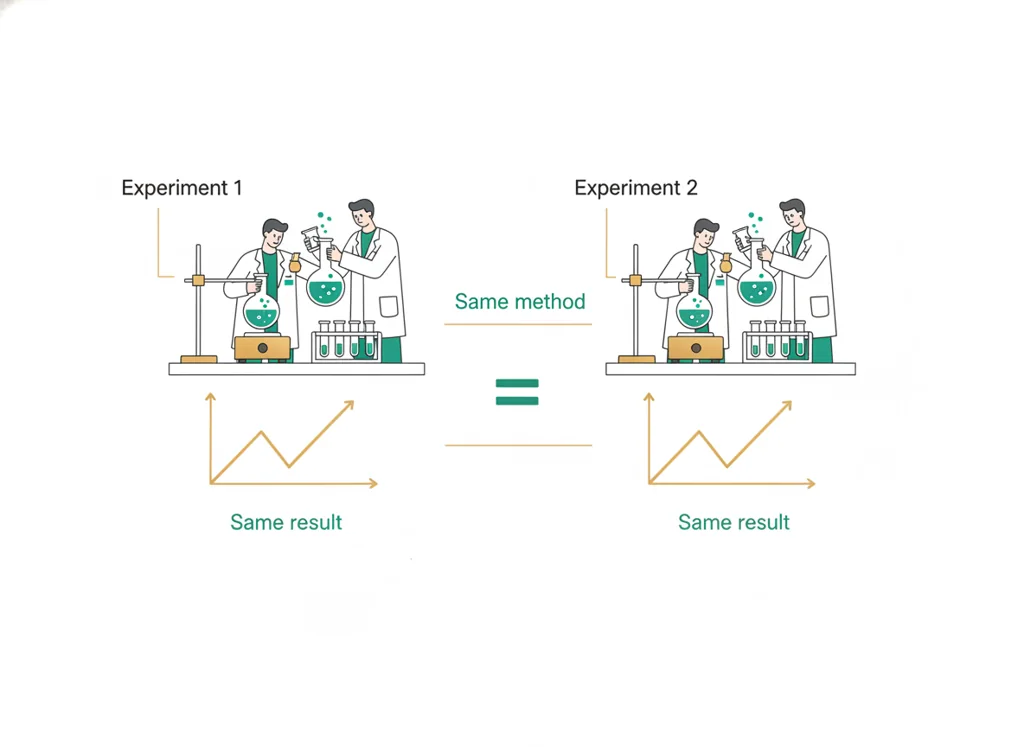
The ability to get the same results when an experiment is repeated using the same methods, which builds trust in findings.
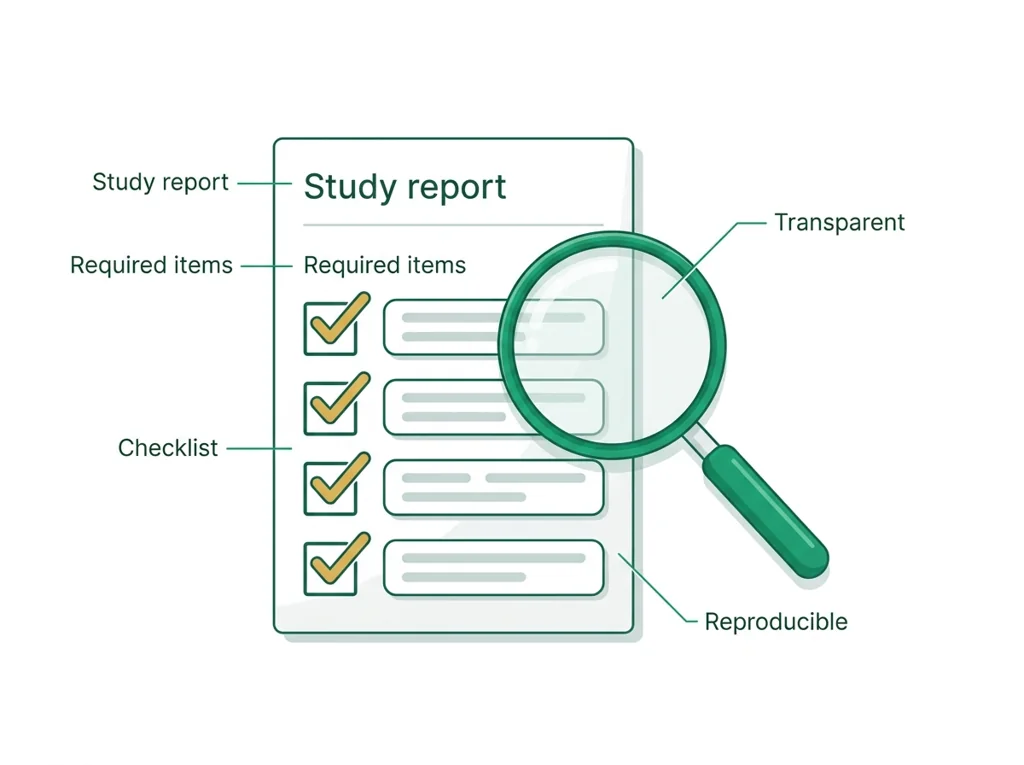
An agreed set of items a study must describe so readers can judge and reproduce the work, like the PRISMA checklist for reviews.
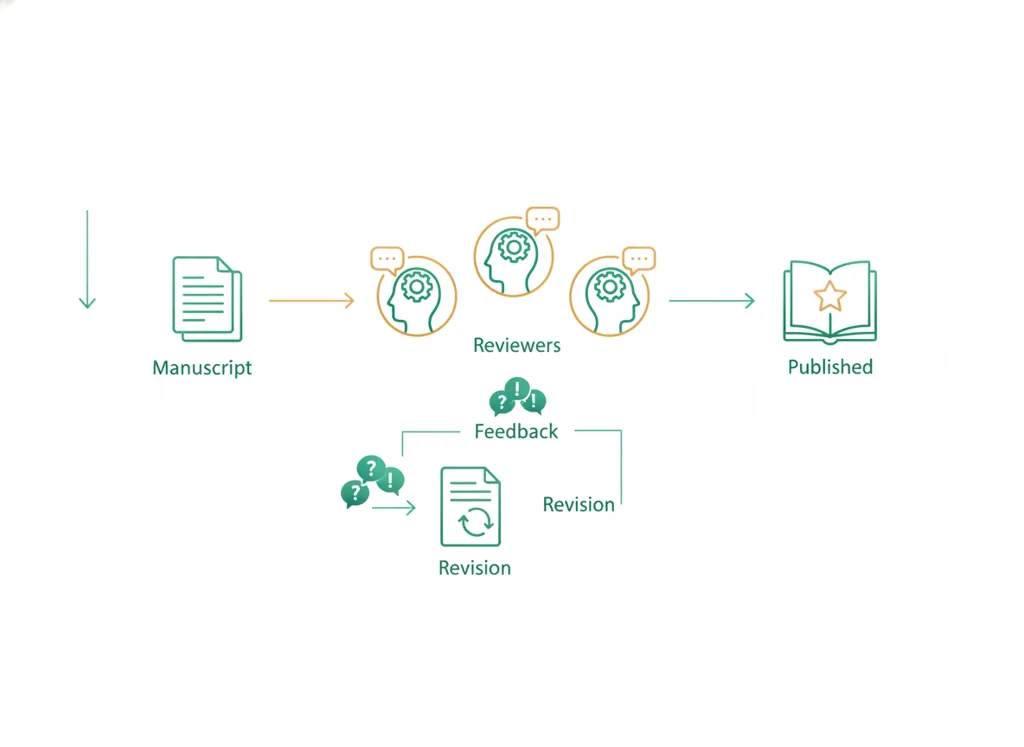
The process where independent experts evaluate a research study for quality and accuracy before it is published.
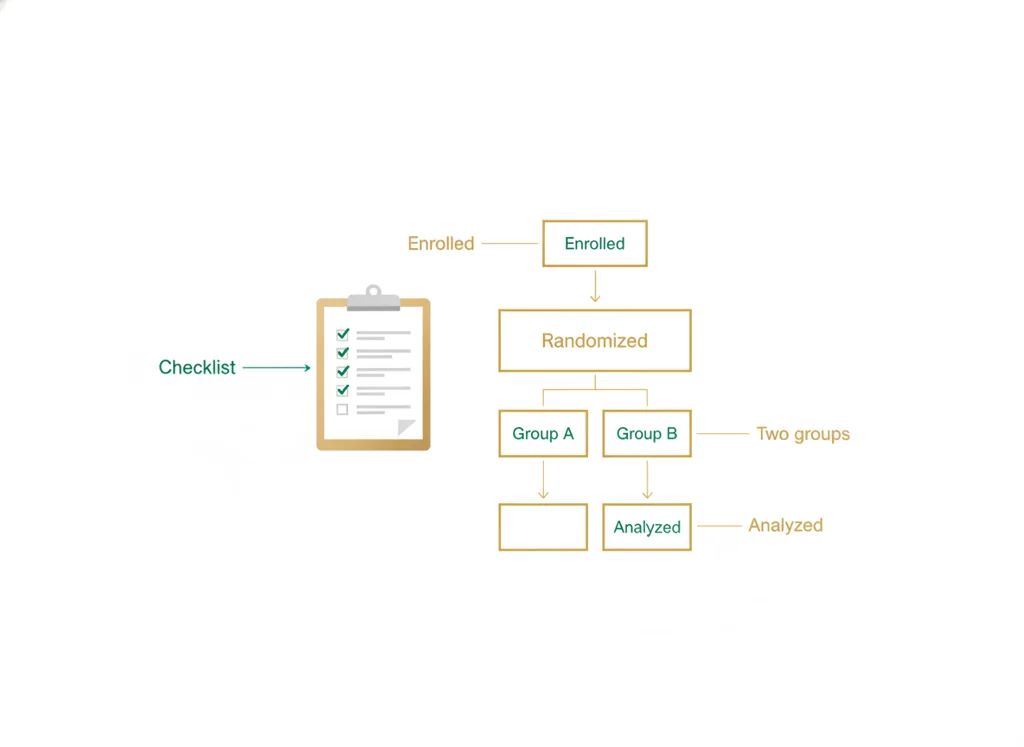
A standard checklist and flow diagram that researchers use to report every key detail of a randomized controlled trial clearly and honestly.
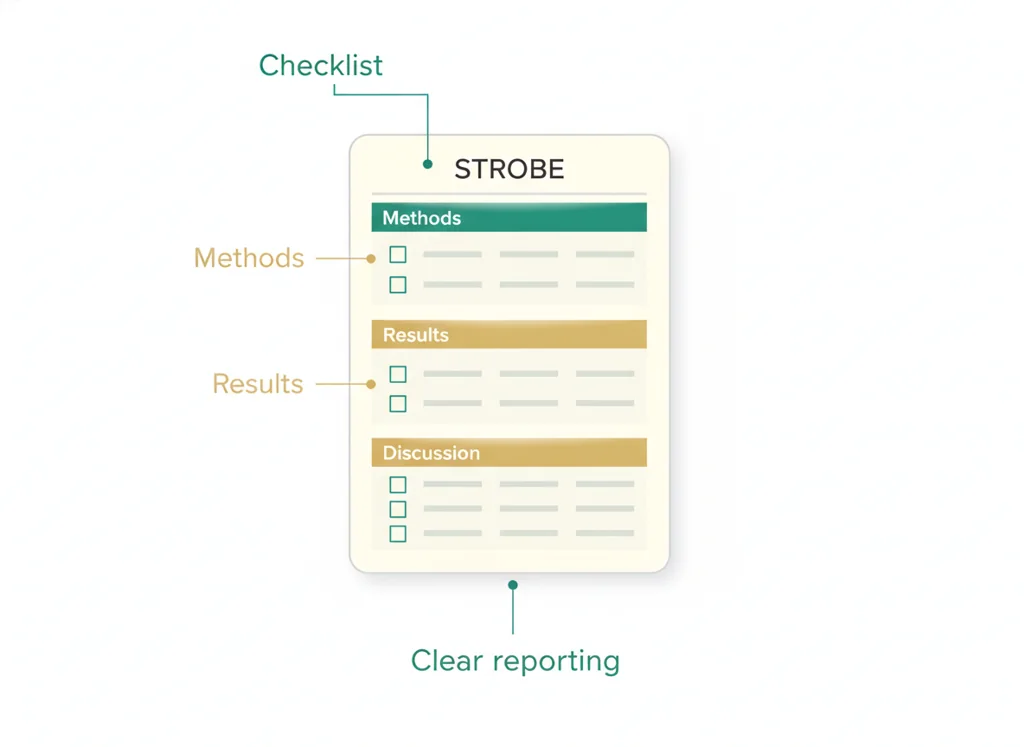
A standard checklist that guides researchers on how to clearly and fully report observational studies in medicine.
Research citation trail (advanced)
You do not need these papers or database records to finish the lesson. They document where the plain-language explainer's claims come from and are intended for teachers or advanced readers.
- CONSORT 2025. Updated reporting guidance for randomized trials.
- STROBE. Reporting guidance for observational studies.
- PRISMA 2020. Reporting guidance for systematic reviews.
- ARRIVE 2.0. Reporting guidance for animal research.
- Percie du Sert et al. 2020, ARRIVE 2.0 (audit of reporting in animal papers, PLoS Biol)
- Page et al. 2021, The PRISMA 2020 statement (BMJ)
- Gamble et al. 2023, TOPS trial (a CONSORT-style reported RCT, NEJM)