
How a Repaired Palate Lets Mateo Talk
This reading contains every idea and every piece of evidence needed for today's decision. The research links at the end are optional.
Why this matters
Speech can be affected when air leaks into the nose, even after the opening has been repaired.
The question you are trying to answer
Why can a repaired palate still let air escape through the nose during speech?
Begin with the idea you already earned
Lip repair restores form, while palate repair separates spaces and supports speech; different jobs require staged operations.
Study the analogy before the biology
- What happens if the door stays open?
- Which sounds would need pressure most?
- Is the problem the pump, the door, or both?
Turn the analogy into three rules
Limit: Speech involves airflow, sound, movement, and learned articulation. The door models only velopharyngeal closure.
Map those rules onto the biology
The soft palate lifts during many speech sounds and seals the back of the mouth from the nose.
If the seal is incomplete, too much sound enters the nose and air leaks during pressure consonants.
The speech-language pathologist identifies the pattern and helps decide whether therapy, imaging, or another procedure is needed.
Read Mateo's labeled case evidence
Mateo's voice sounds overly nasal during connected speech.
Resonance suggests air and sound are entering the nose at the wrong time.
The consonants p, b, t, d, k, and g sound weak and nasal air is visible on a mirror.
Pressure consonants are affected by a seal problem.
Vowels and low-pressure sounds are easier to produce.
The problem is patterned rather than random.
Make the concrete decision
You are Mateo's speech-language pathologist.
You must decide whether today's pattern needs ordinary articulation practice alone or a full velopharyngeal evaluation.
- Refer for velopharyngeal evaluation while continuing appropriate speech support
- Practice p sounds only and ignore nasal escape
- Assume hearing loss is the only cause
Choose the next step and use the pattern across the three evidence IDs.
Claim ceiling: You may identify a pattern consistent with VPI. You may not diagnose the exact structural cause without further evaluation.
Write the 10-year takeaway
Clear pressure sounds need the soft palate to move upward and seal the mouth from the nose.
- Why are p and b affected more than a relaxed vowel?
- What evidence makes this more than an ordinary articulation error?
Glossary in plain English
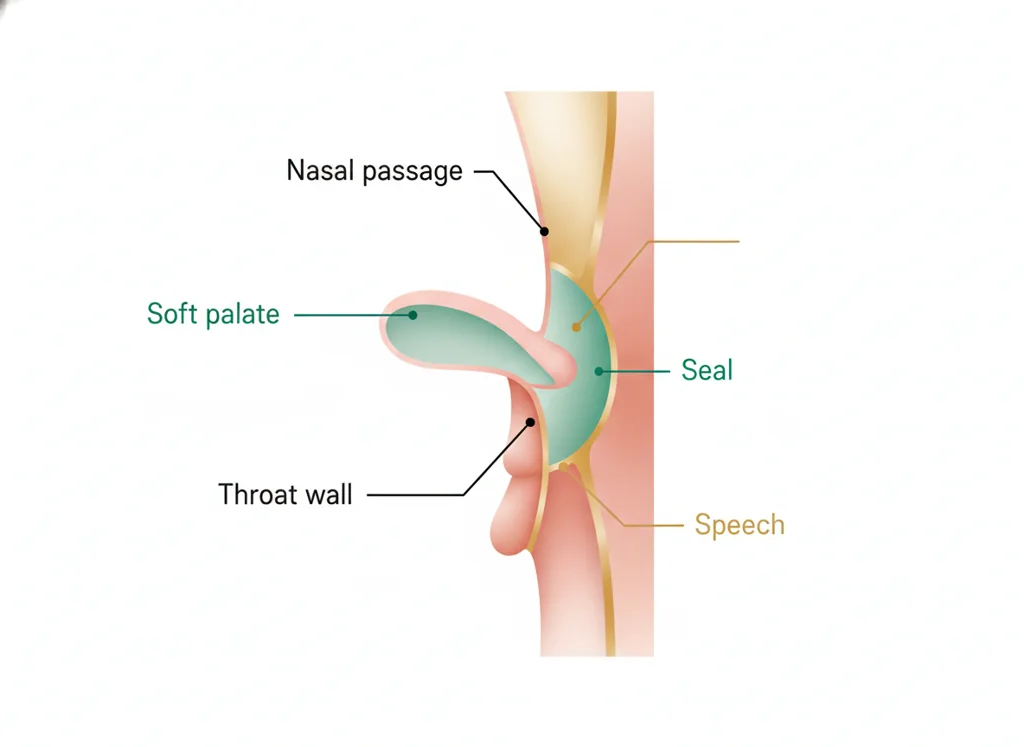
The sealing of the soft palate against the back of the throat that closes off the nose during speech and swallowing.
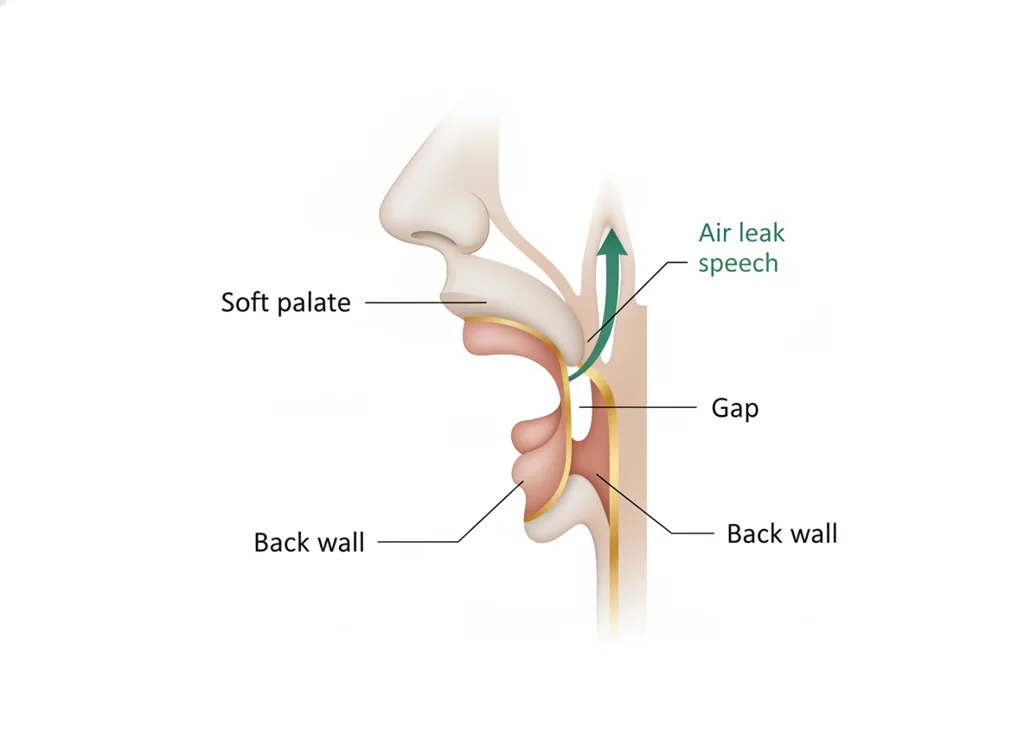
When the soft palate cannot fully close off the nose from the mouth during speech, letting air escape and making speech sound nasal.
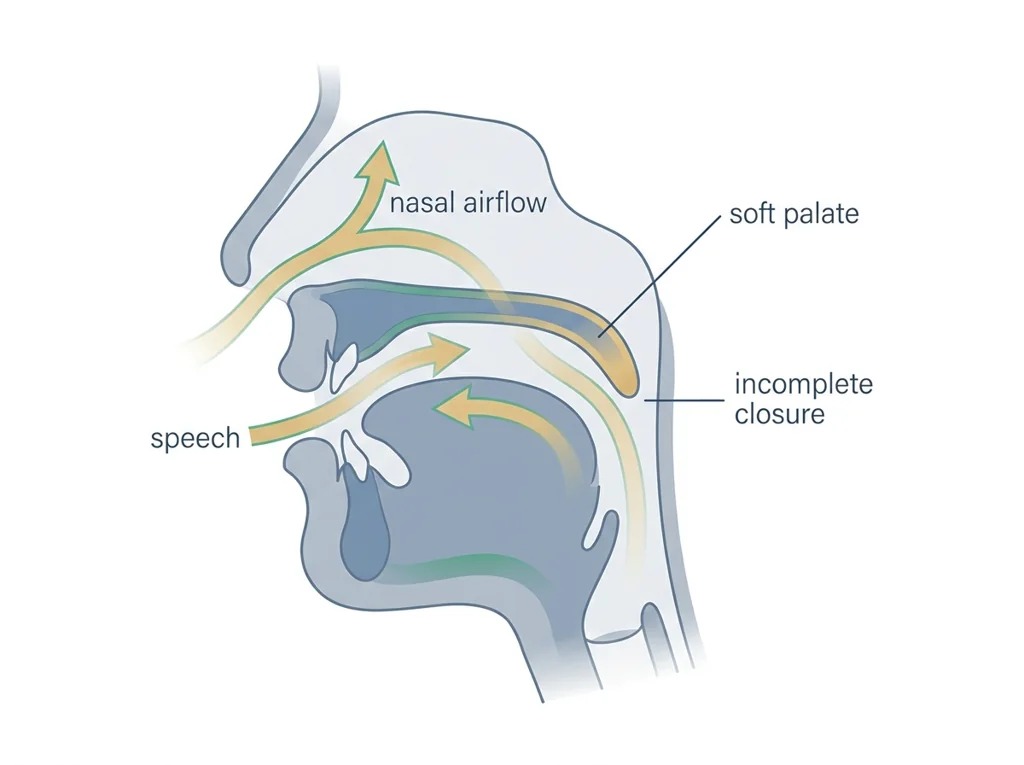
A speech quality where too much air escapes through the nose, often when the soft palate cannot fully close off the nasal passage.
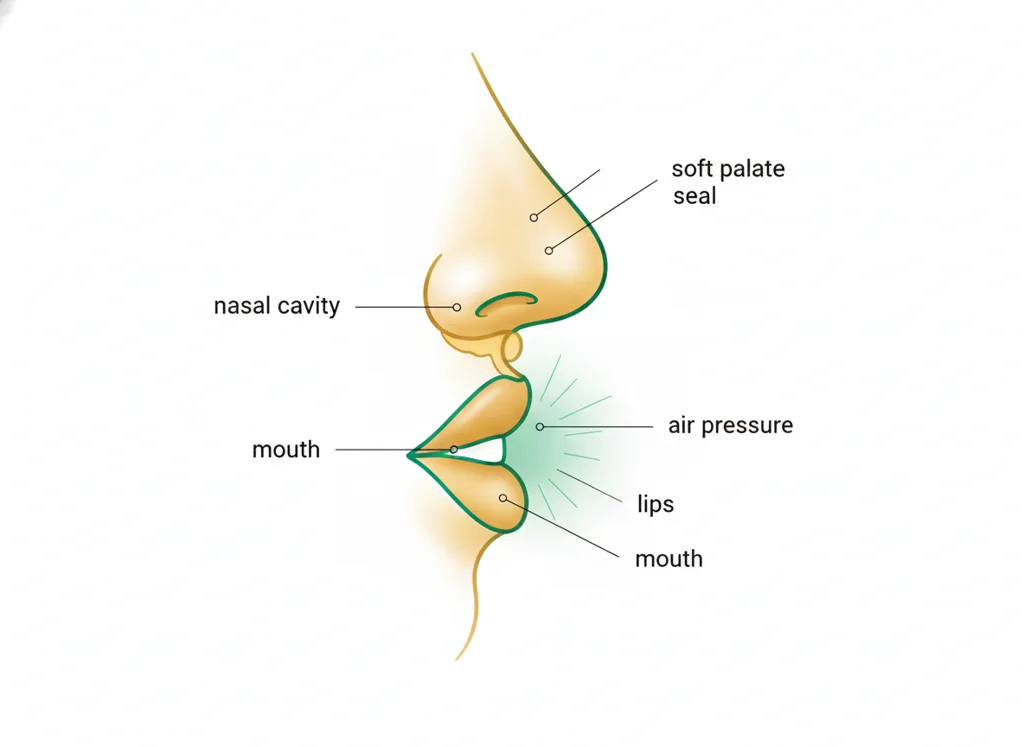
Speech sounds like p, b, t, and s that need built-up air pressure in the mouth, which a cleft or leaky palate makes hard to produce.
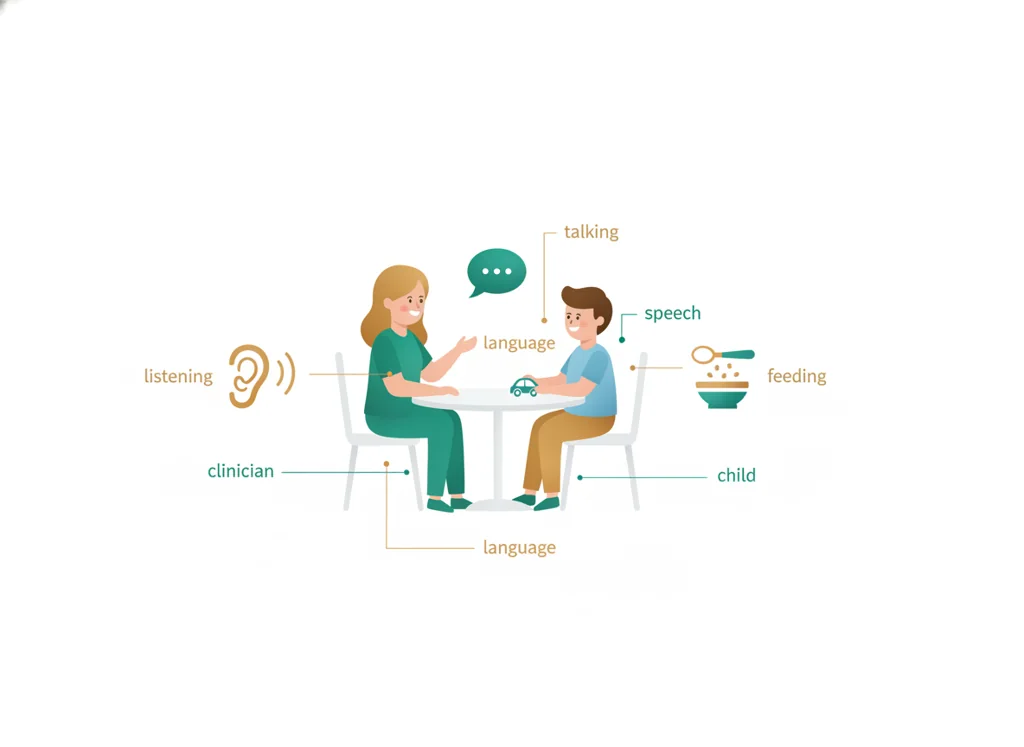
A specialist who evaluates and treats problems with speech, language, and feeding, key for children after cleft repair.
Research citation trail (advanced)
You do not need these papers or database records to finish the lesson. They document where the plain-language explainer's claims come from and are intended for teachers or advanced readers.
- American Cleft Palate Craniofacial Association. 2024 Parameters of Care.
- Vyas T, et al. 2020. Cleft of lip and palate: A review. J Family Med Prim Care. [PMID:32984097]
- Dean KM, Leeper LK. 2020. Management of submucous cleft palate. Curr Opin Otolaryngol Head Neck Surg. [PMID:33105231]
- Camargo Y, et al. 2023. Pharyngeal flap versus sphincter pharyngoplasty for VPI in 22q11.2 deletion syndrome. J Craniofac Surg. [PMID:37431935]