
How and When Does the Upper Lip Close?
This reading contains every idea and every piece of evidence needed for today's decision. The research links at the end are optional.
Why this matters
Breaking fusion into steps prevents students from treating the word fusion as a single unexplained event.
The question you are trying to answer
What must happen before the zipper can close?
Begin with the idea you already earned
Face-building cells must travel in organized streams to the right destination before they can build the right structure.
Study the analogy before the biology
- What must happen before the zipper can close?
- How could alignment fail even if both halves exist?
- What evidence would separate missing material from failed closure?
Turn the analogy into three rules
Limit: Tissues remodel and fuse through cell behavior, not metal teeth.
Map those rules onto the biology
The upper lip does not appear all at once. Tissue prominences enlarge, approach the right neighbors, contact, and remodel.
The important boundary is between a maxillary prominence and a medial nasal region.
A cleft lip can result when growth, contact, or stable joining does not complete during the window.
Read Mateo's labeled case evidence
Upper-lip tissues must grow into contact during the early facial window.
Distance is a developmental variable.
The maxillary prominence meets the medial nasal region at the lip boundary.
The contact must occur at the correct neighbor.
The joined surface must remodel into continuous tissue.
Touching alone is not the completed lip.
Make the concrete decision
You are annotating a developmental animation for the family conference.
The animation shows both tissue blocks present but never making stable contact on the left.
- Label a failed growth/contact/fusion sequence at the left lip boundary.
- Label a secondary palate elevation failure only.
- Claim the tissue blocks were never present.
Choose the label that fits the animation and cite the boundary evidence.
Claim ceiling: You may identify the failed morphologic sequence. You may not identify a gene from the animation alone.
Write the 10-year takeaway
Upper-lip closure requires growth, contact, and stable fusion at the maxillary-medial nasal boundary.
- What three steps must occur before the lip is continuous?
- Why does contact alone not prove successful fusion?
Glossary in plain English
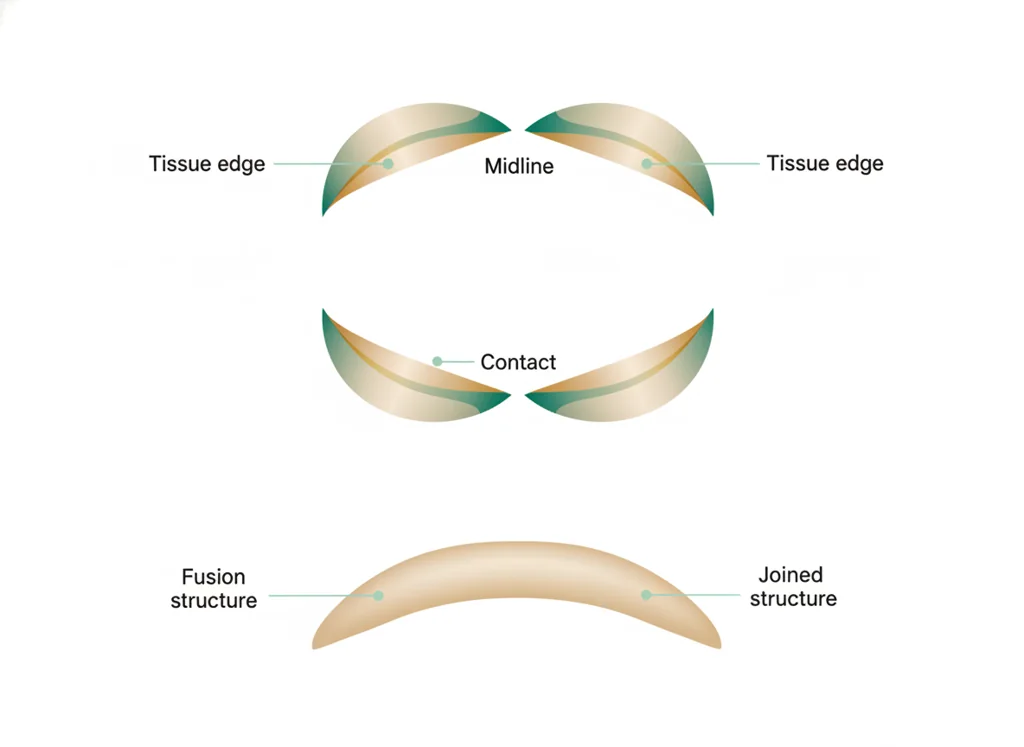
When two growing tissue edges meet at the midline and join into one continuous structure, as the lip and palate do during development.
A lesson term defined by the surrounding model and case evidence.
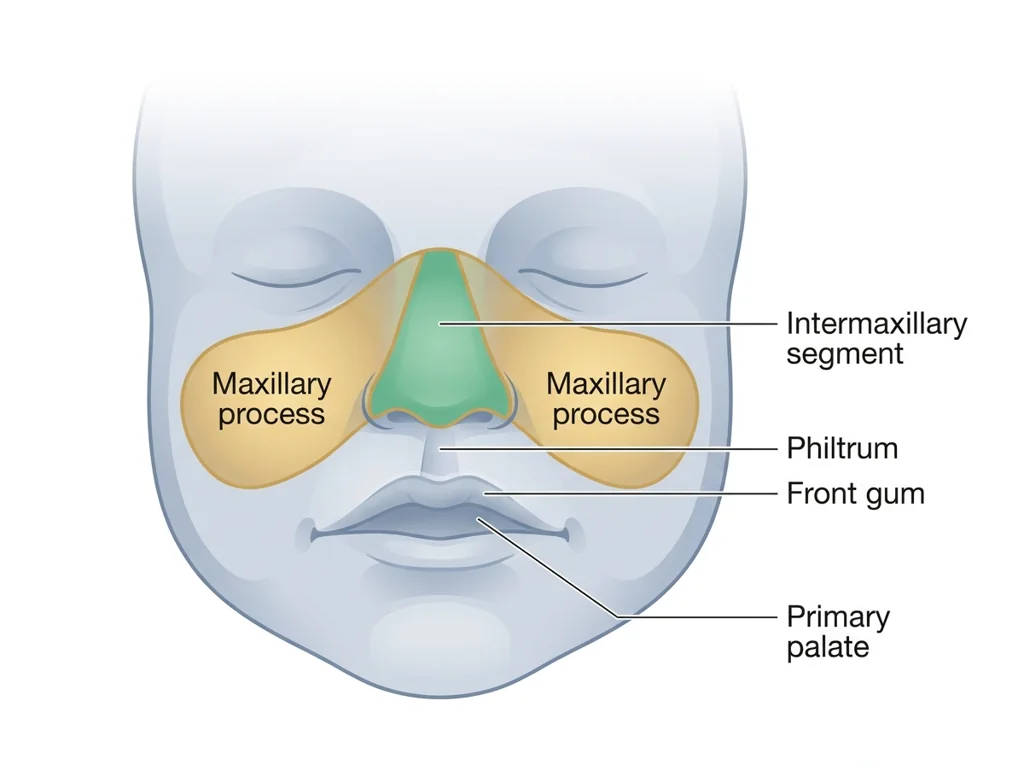
The central facial block formed in the embryo that gives rise to the philtrum of the lip, the front gum, and the primary palate.
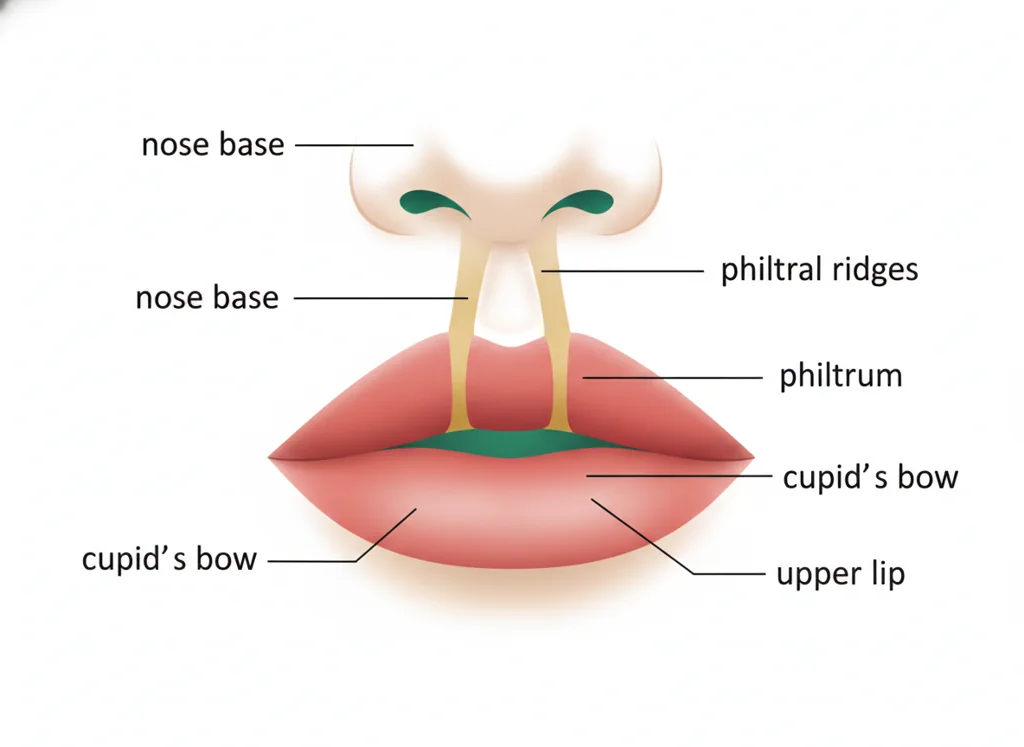
The vertical groove in the middle of the upper lip, bordered by two ridges, that forms where facial parts fuse during development.
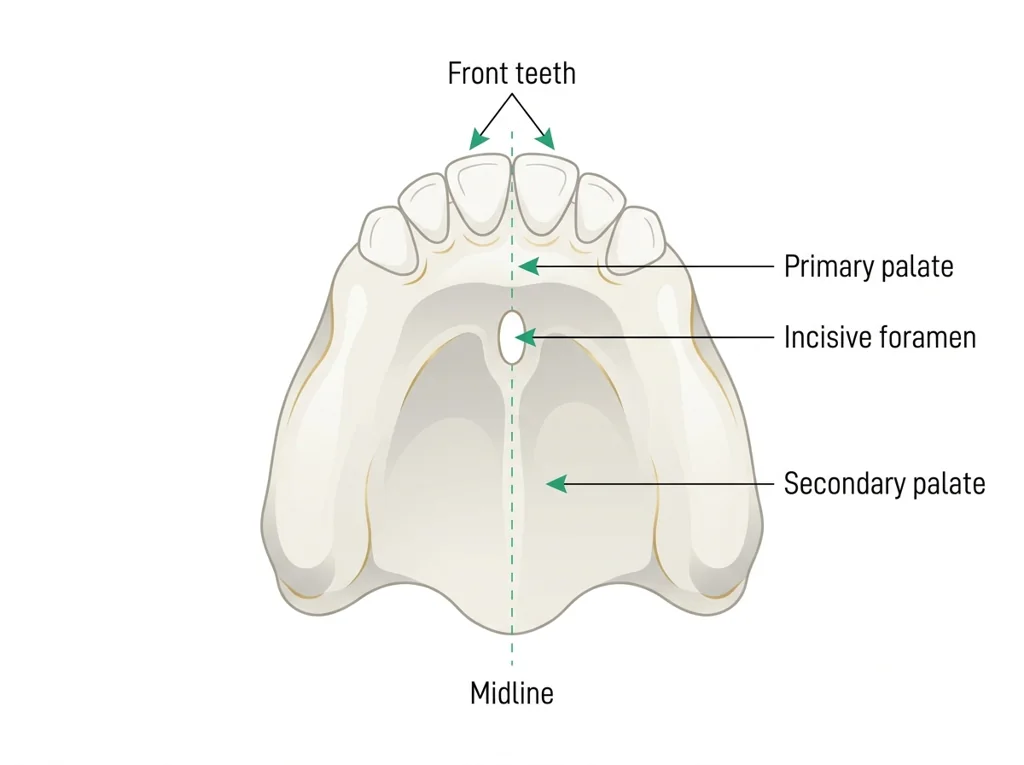
A small opening in the roof of the mouth just behind the front teeth that marks the boundary between the primary and secondary palate.
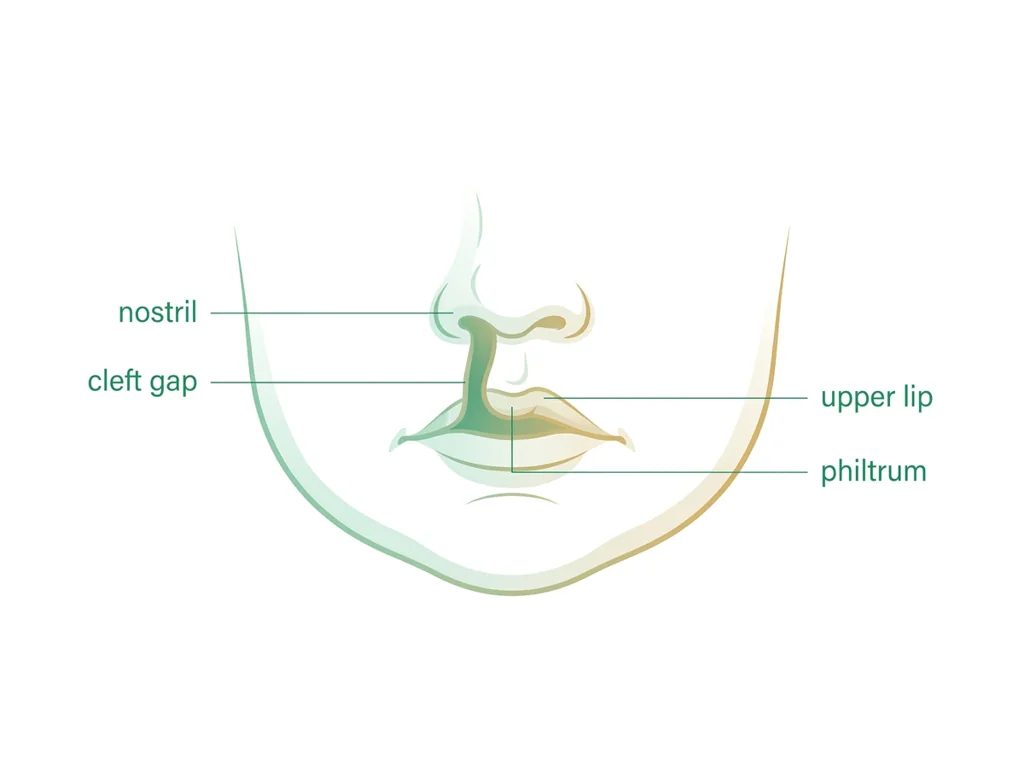
A birth difference where the upper lip does not fully fuse before birth, leaving a gap or split that can reach toward the nose.
Research citation trail (advanced)
You do not need these papers or database records to finish the lesson. They document where the plain-language explainer's claims come from and are intended for teachers or advanced readers.