
Which Building Blocks Must Fuse to Make a Lip and Palate?
This reading contains every idea and every piece of evidence needed for today's decision. The research links at the end are optional.
Why this matters
Accurate maps prevent students and clinicians from treating the face as one undivided sheet.
The question you are trying to answer
Which pieces can touch because their edges face one another?
Begin with the idea you already earned
The lip and palate form in short, ordered windows, so timing narrows where a developmental change began.
Study the analogy before the biology
- Which pieces can touch because their edges face one another?
- Which piece contributes to the center of the final picture?
- How could the final gap reveal which meeting failed?
Turn the analogy into three rules
Limit: Facial tissues grow and change shape, unlike rigid puzzle pieces.
Map those rules onto the biology
Early in development, the face is arranged as five swellings called facial prominences around the early mouth.
The center and sides do not make the same structures. The medial nasal regions help form the middle upper lip, while maxillary prominences contribute the sides.
Normal upper-lip formation requires growth, contact, and stable joining at the correct boundary.
Read Mateo's labeled case evidence
One frontonasal, two maxillary, and two mandibular prominences surround the early mouth.
The five prominences are the starting blocks of the face.
The maxillary prominence must meet the medial nasal region to build the upper lip.
A failed meeting at this boundary can produce cleft lip.
The mandibular prominences mainly form lower-face structures.
They are not the direct lip-fusion boundary in Mateo's cleft.
Make the concrete decision
You are labeling a surgical teaching model for the cleft team.
Only three labels can be placed on the model before the family teaching visit.
- Label the maxillary and medial nasal meeting as the key upper-lip boundary.
- Label the mandibular midline as Mateo's upper-lip failure.
- Label every prominence as making the same structure.
Choose the useful label set and defend it with two evidence cards.
Claim ceiling: You may name the tissue boundary involved in lip formation. You may not name the molecular cause yet.
Write the 10-year takeaway
The face forms when named tissue prominences grow into position and join specific neighbors.
- Which two named regions meet to form the upper lip?
- Why are the mandibular prominences not the best answer for Mateo's upper-lip cleft?
Glossary in plain English
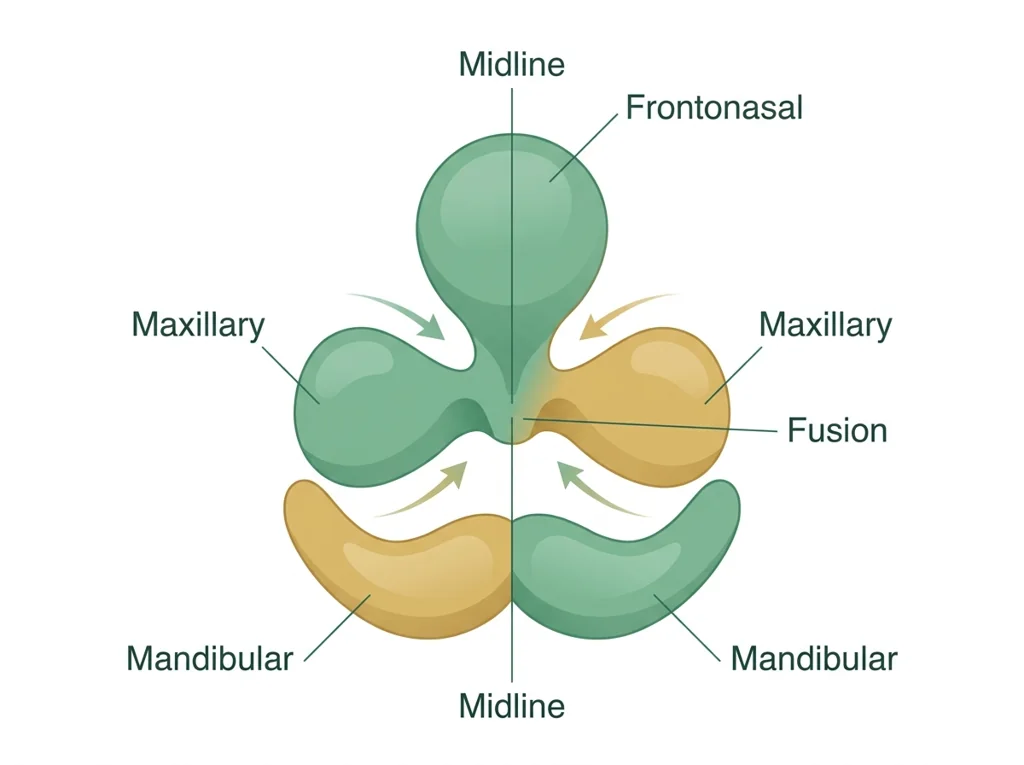
One of the five swellings of tissue (one frontonasal, two maxillary, two mandibular) that grow toward the midline and fuse to build the face.
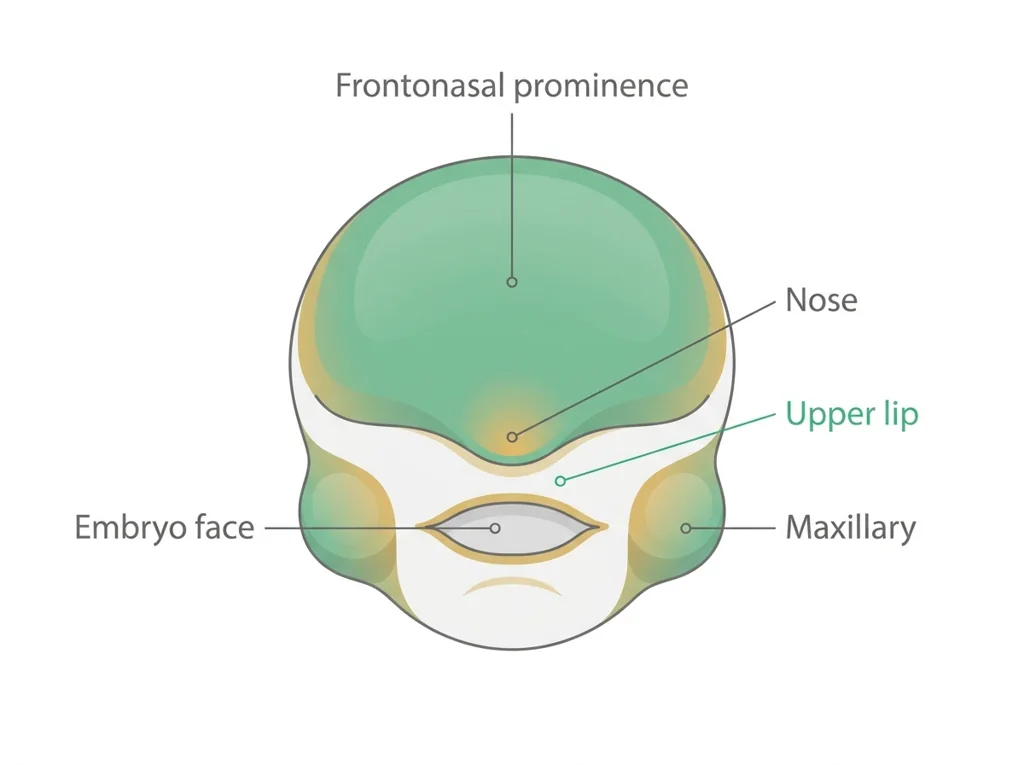
A bulge of tissue in the early embryo's face that gives rise to the forehead, bridge of the nose, and middle of the upper lip.
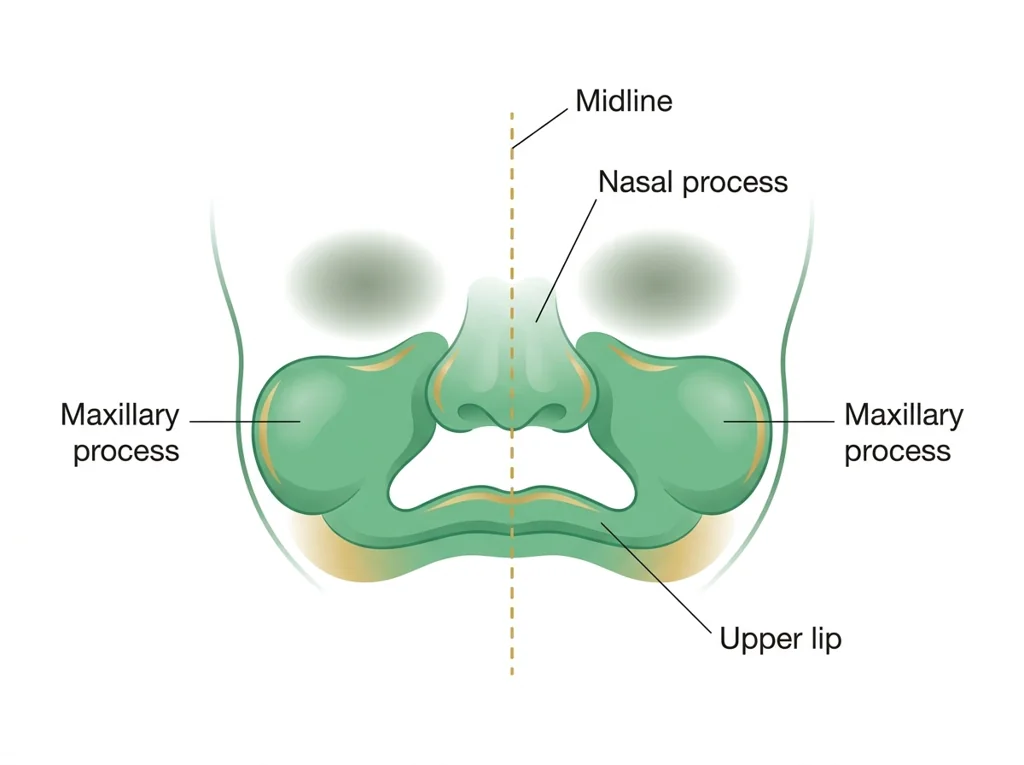
A paired bulge of embryo tissue that grows toward the midline to form the upper jaw, cheeks, and sides of the upper lip.
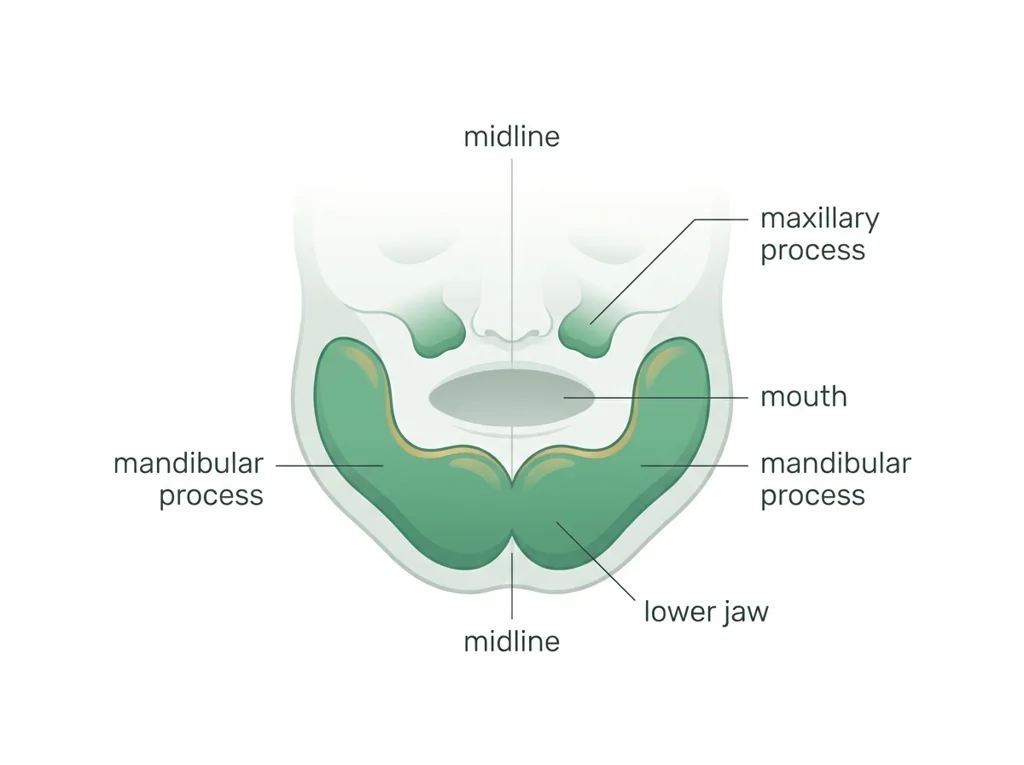
The paired early facial swellings below the mouth that grow toward each other to form the lower jaw and chin.
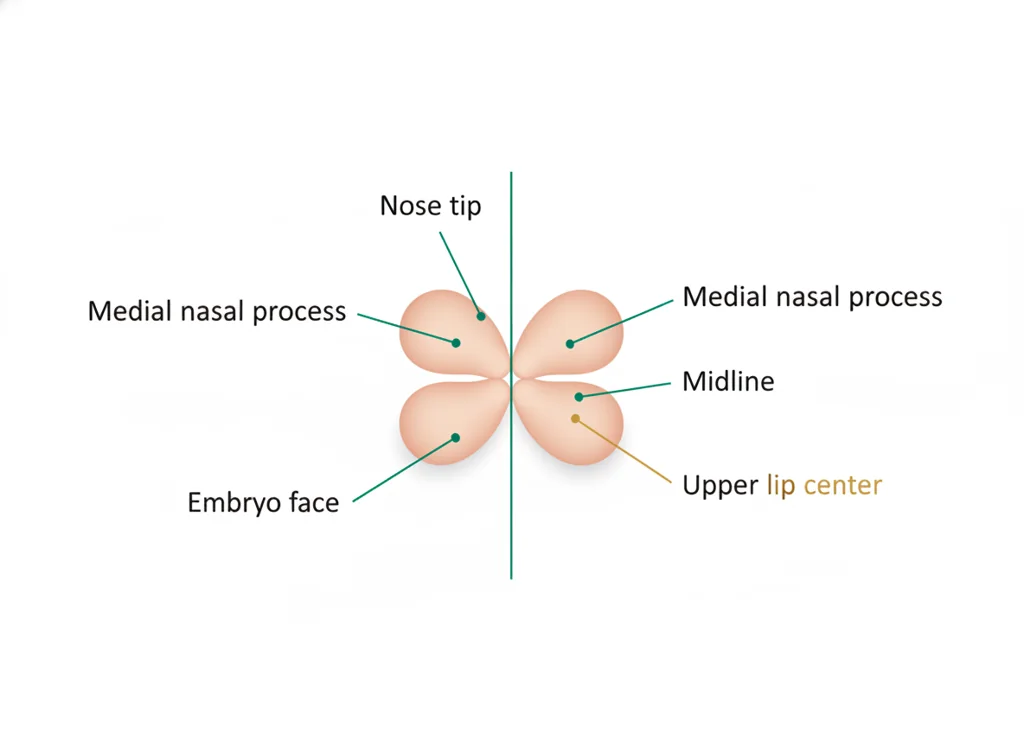
A pair of inner embryonic tissue bulges that merge to form the center of the upper lip, the philtrum, and the tip of the nose.
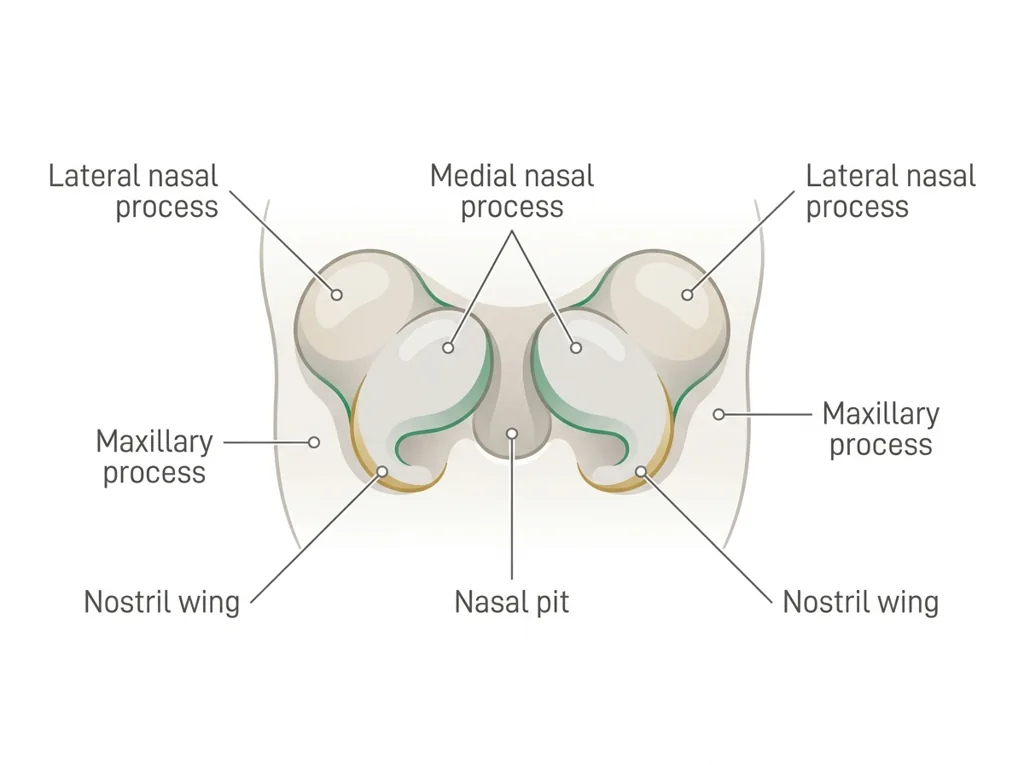
A swelling on each side of the developing face that forms the outer wing of the nostril during early facial growth.
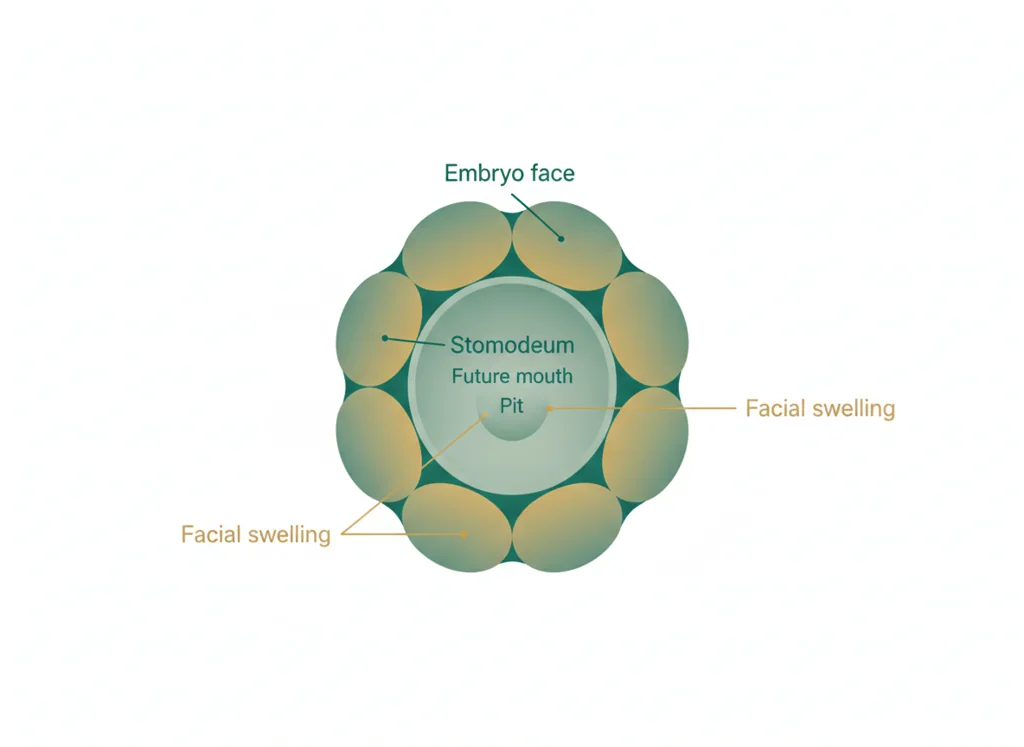
The shallow pit on the front of the early embryo that becomes the opening of the mouth as the face takes shape.
Research citation trail (advanced)
You do not need these papers or database records to finish the lesson. They document where the plain-language explainer's claims come from and are intended for teachers or advanced readers.